
 Worksheets
Weathering, Erosion and Deposition
Total questions: 40
Worksheet time: 10hrs 0mins
The breaking down of rocks and other materials on the Earth's surface.
Weathering
Erosion
Deposition
Exfoliation
The process by which rock and soil are moved from one place to another is called-
Chemical weatherin
Erosion
Mechanical weathering
Deosition
This type of weathering in which rock is physically broken into smaller pieces.
Chemical weathering
Erosion
Mechanical weathering
Deposition
What do we call the process in which rock is broken down by changes in its chemical makeup.
Chemical weathering
Mechanical weathering
Erosion
Deposition
The grinding/scratching away of rock by other rock particles carried in water, ice, or wind
Frost wedging
Exfoliation
Oxidation
Abrasion
Plants/animals digging under ground with roots or claws to break apart rocks.
Frost wedging
Abrasion
Burrowing/Biological Weathering
Exfoliation

The breaking off of the curved sheets or slabs from a rock's surface due to drastic changing temperatures.
Frost wedging
Exfoliation
Abrasion
Burrowing/Biological Weathering

A type of chemical weathering in which a substance combines with oxygen, as when iron oxidizes, forming rust.
Acid rain
Oxidation
Reaction to water
Exfoliation

The image above depicts the effects of chemical weathering breaking down limestone. Which type of chemical weathering causes this reaction?
Acid rain
Oxidation
Exfoliation
Abrasion
Over millions of years, the shape of mountains on Earth's surface can change to low hills and then rolling plains. These changes are most likely caused by-
Folding and faulting
Volcanoes and Earthquakes
Human activity
Weathering and Erosion
What is the difference between weathering and erosion?
Erosion breaks down the rocks, and weathering carries the broken pieces away.
Erosion carries broken pieces away, and weathering builds the pieces back up into another land mass.
Weathering carries broken pieces away, and erosion builds the pieces back up into another land mass.
Weathering breaks down rocks, and erosion carries the broken pieces away.

The tallest sand dunes in North America are found in Great Sand Dunes National Park and Preserve in Colorado. These dunes were formed from the sand at the bottom of a dry lake bed. Which of the following agents is most likely responsible for the formation of the sand dunes?
Wind
Water
Ice
Gravity
A student prepares a model by filling a plastic bottle with water, capping it tightly, and placing it in the freezer for 24 hours. After 24 hours, there are large cracks on the bottle's sides. The student's model most likely represents which of the following types of weathering:
Acid rain
Oxidation
Frost wedging
Abrasion
How do plants most commonly break large rocks into smaller pieces?
Seeds from plants fall onto rocks and release acidic compounds.
Plant roots grow into cracks in rocks.
Stems of plants surround and squeeze rocks.
Plant protects surrounding rocks from extreme temperatures.
Which of these processes describes how sand is deposited on beaches?
waves carry sand to the beach and the sun dries the water, leaving sand behind.
Wind and waves grind up rocks under the beach into grains of sand.
Wind carries sand onto beaches from the land and then levels it out.
waves carry sand up the sloping beach, depositing sand as the waves lose speed.

In Spring 2003, a natural rock outcropping in New Hampshire called the Old Man of the Mountain collapsed. Which of the following most likely loosed the rock and caused it to fall?
oxygen reacting with iron on the surface of the rock
heat turning sedimentary rock into metamorphic rock
volcanic activity producing pressure at the rock's base
water freezing and thawing inside cracks in the rock
The process where sediments, soil, sand, rocks, are "dropped off" and a new landform is created
weathering
erosion
deposition
compaction
Which of the following landform is NOT created by deposition?
sand dune
delta
beaches
mountains
Which one of these landforms is direct result of EROSION
Mount Rushmore
Providence Canyon
Hawiian Islands
The Statue of Liberty
Which of the following is an example of MECHANICAL WEATHERING
rocks falling off a cliff and breaking
acid rain breaking down stones
saltwater breaking rocks into sand
chemicals in water breaking down minerals in rocks
Which of these is an example of CHEMICAL WEATHERING
Freeze-Thaw process causing rocks to break down
Acid rain breaking down rock
Animals and humans walking on earth materials
Water in a river running over rocks and making them smooth

A landform that is a result of the deposition of sediments at the mouth of a river
canyon
mountain
plateau
delta
Roots growing up through a rock is an example of chemical weathering?
True
False
Chemicals reacting with the minerals in a rocks in a cave is an example of chemical weathering?
True
False
A car driving over a pile of rocks is an example of mechanical weathering
True
False
Rocks hitting against one another in a fast moving river is an example of mechanical weathering.
True
False

Fragments of weathered rocks are known as ____.
sediments
deposits
limestones
sandstones

An avalanche is an example of...
physical weathering
chemical weathering
erosion
deposition
Which is an example of biological weathering?
animals burrowing into the ground
oxygen causing iron to rust
acid rain dissolving minerals
ice freezing and thawing in cracks of rocks

Over long periods of time, deposition may change the Earth's surface by...
forming new land features.
washing away beaches.
breaking down large rocks in to smaller ones.
moving topsoil.

What is an enormous mass of ice moving over land, causing weathering of rock and soil?
A glacier
An iceberg
An ice wedge
A sand dune

What type of chemical weathering is in the picture shown?
oxidation
mosses and lichens
acid precipitation
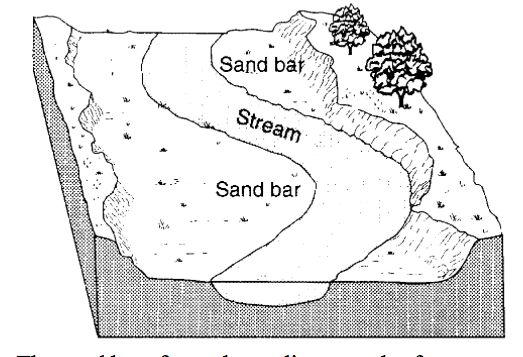
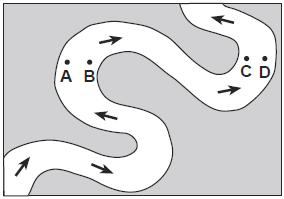
Which two locations have the greatest stream velocities?
A and B
B and C
C and D
D and A

The streambank on the outside of this meander is steeper than the streambank on the inside of this meander because the water on the outside of this meander is moving
faster, causing erosion
slower, causing erosion
faster, causing deposition
slower, causing deposition
With a steeper slope, we would expect to see...
less erosion
more erosion
the same amount of erosion
no erosion at all
What is a floodplain?
The area near a river that floods when water levels get to be too high.
The area near a river that looks boring or dull.
The process of water levels going over a river or stream bank.
Water gathering on the surface of the Earth because it doesn't seep into the ground.

Which landform is produced at location E where the Mississippi River enters the Gulf of Mexico?
delta
drumlin
tributary
floodplain

