wayground logo

Free Printable Worksheets

NEW

Font size

S
M
L
XL
Worksheets

6.2 Space & Astronomers Review

Total questions: 78

Worksheet time: 1hrs 1mins

Name
Class
Date
1.
Almost Earth’s twin in size and mass, this planet has very thick atmosphere.
a)
Venus
b)
Mars
c)
Mercury
d)
Neptune
2.
The surface of this planet appears red due to rusting iron in the rocks.
a)
Mercury
b)
Mars
c)
Pluto
d)
Venus
3.
Some scientists believe that this dwarf planet is actually a very large comet caught in a permanent orbit.
a)
Eris
b)
Pluto
c)
Mars
d)
Neptune
4.

This cold, blue planet was discovered by a mathematical prediction.

a)

Neptune

b)

Jupiter

c)

Mars

d)

Venus

5.
This is the largest planet in the solar system.
a)
Saturn
b)
Jupiter
c)
Uranus
d)
Venus
6.
This is the smallest planet in the solar system
a)
Mercury
b)
Venus
c)
Earth
d)
Mars
7.
Its largest moon is Titan.
a)
Saturn
b)
Jupiter
c)
Neptune
d)
Uranus
8.
This has an extremely elliptical orbit - 
a)
Pluto
b)
Neptune
c)
Uranus
d)
Saturn
9.
Only planet known to have life
a)
Earth
b)
Mars
c)
Venus
d)
Mercury
10.
The largest known volcano in the solar system, Olympus Mons, is located on this planet.
a)
Venus
b)
Mars
c)
Mercury
d)
Earth
11.
This is the only planet in the solar system with oceans of liquid water.
a)
Mercury
b)
Mars
c)
Venus
d)
Earth
12.
Scientists have been able to find no atmosphere around this planet because it has little gravity and is closest to the sun.
a)
Mars
b)
Venus
c)
Mercury
d)
Earth
13.
This gas giant has a large storm in its atmosphere known as The Red Spot
a)
Jupiter
b)
Saturn
c)
Uranus
d)
Neptune
14.
Most likely due to a massive collision, this planet rotates from top to bottom.
a)
Saturn
b)
Venus
c)
Neptune
d)
Uranus
15.

Which of the following statements is correct?

a)

Pluto was once classified as a dwarf planet, but is now classified as a main planet

b)

Pluto was never classified as a planet

c)

Pluto has always been considered a planet

d)

Pluto was once considered a planet, but no longer is

16.
True or False
The Earth is the center of the solar system.
a)
True
b)
False
17.
The order of the planets is:
a)
Mars,Venus,Earth,
Mercury,Saturn
Jupiter, Uranus, Neptune
b)
Earth,Venus,Mars
Jupiter, Neptune,
Mercury,Saturn,
Uranus
c)
Mercury,Venus,Earth
Mars,Jupiter,
Saturn,Uranus
Neptune
18.
What is a common characteristic of the inner planets?
a)
Large
b)
Gaseous
c)
Rings
d)
Rocky Surface
19.
What is NOT a common characteristic of the outer planets?
a)
Gaseous
b)
Giant
c)
Rings
d)
Smaller than Earth
20.
True or False
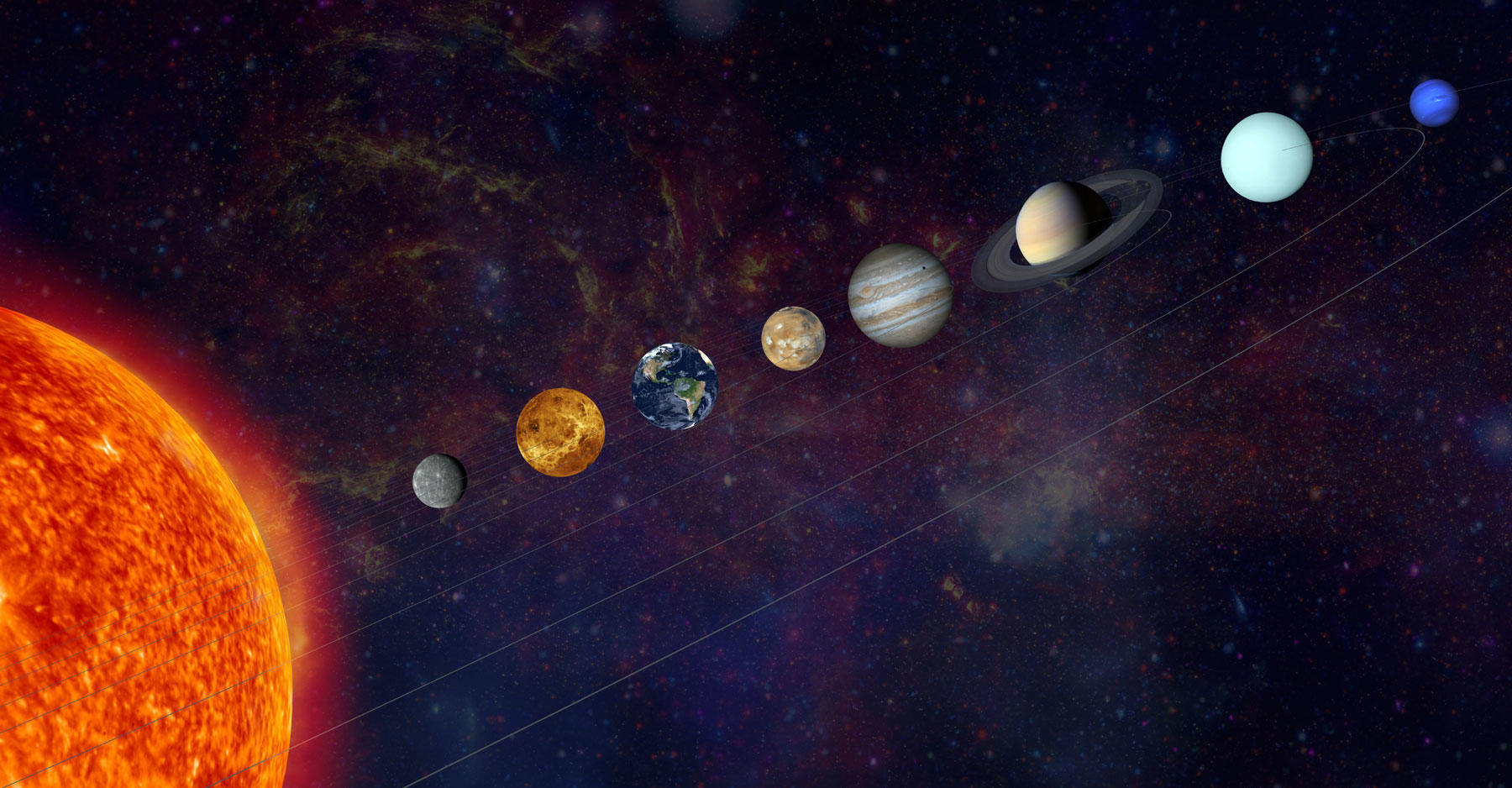
The planets are not lined up in a perfectly straight line
a)
True
b)
False
21.
True or False
The planets are all equally distanced from each other.
a)
True
b)
False
22.
Which planet has no atmosphere and looks like our moon?
a)
Mercury
b)
Venus
c)
Earth
d)
Mars
23.
Which planet has a thick atmosphere and is the hottest planet?
a)
Mercury
b)
Venus
c)
Earth
d)
Mars
24.
Which planet is covered in water?
a)
Mercury
b)
Venus
c)
Earth
d)
Mars
25.
Which planet has iron in its soil and is the red planet?
a)
Mercury
b)
Venus
c)
Earth
d)
Mars
26.
Which planet is the smallest?
a)
Mercury
b)
Venus
c)
Earth
d)
Mars
27.
Which planet is Earth's sister planet?
a)
Mercury
b)
Venus 
c)
Earth
d)
Mars
28.
Which planet rotates to give day/night every 24 hours?
a)
Mercury
b)
Venus
c)
Earth
d)
Mars
29.
Which planet has had rovers sent to it to study its soil?
a)
Mercury
b)
Venus
c)
Earth
d)
Mars
30.
What is in between the inner planets and the outer planets?
a)
Asteroid belt
b)
Kuiper belt
c)
Sun
d)
Moon
31.
Which planet is the largest?
a)
Jupiter
b)
Saturn
c)
Uranus
d)
Neptune
32.
Which planet has the biggest rings?
a)
Jupiter
b)
Saturn
c)
Uranus
d)
Neptune
33.
Which planet rotates on its side?
a)
Jupiter
b)
Saturn
c)
Uranus
d)
Neptune
34.
Which planet has a Great Dark Spot?
a)
Jupiter
b)
Saturn
c)
Uranus
d)
Neptune
35.
Which planet has hurricanes and one large one that makes up the Great Red Spot?
a)
Jupiter
b)
Saturn
c)
Uranus
d)
Neptune
36.
What force keeps the planets orbiting the sun?
a)
Gravity
b)
Magnetism
c)
Electricity
d)
Friction
37.

Which planets are considered inner planets?

a)

Venus, Earth, Mars, and Jupiter.

b)

Mercury, Venus, Earth, and Mars

c)

Saturn, Uranus, Neptune, and Pluto.

d)

Jupiter, Saturn, Uranus, and Neptune.

38.

Which planets are considered outer planets?

a)

Jupiter, Saturn, Uranus, and Neptune

b)

Mercury, Venus, Earth, Mars

c)

Saturn, Uranus, Neptune, Pluto

d)

Jupiter, Saturn, Mars, Neptune

39.

Which planets are known as terrestrial planets?

a)

Jupiter, Saturn, Uranus, and Neptune.

b)

Mercury, Jupiter, Saturn, and Uranus.

c)

Mercury, Venus, Earth, and Mars

d)

Venus, Earth, Mars, and Jupiter.

40.

Which planets are known as gas giants?

a)

Mars and Jupiter

b)

Jupiter and Saturn

c)

Mercury and Earth

d)

Uranus and Mercury

41.

What is NOT one of the main differences between inner and outer planets?

a)

Size of the planets.

b)

Number of moons.

c)

Their atmosphere.

d)

Distance from the Sun

42.

Which planet is closest to the Sun?

a)

Venus

b)

Mars

c)

Jupiter

d)

Mercury

43.

Which planet is the largest in our solar system?

a)

Mars

b)

Jupiter

c)

Venus

d)

Saturn

44.

Which planet has the most moons?

a)

Mars

b)

Jupiter

c)

Saturn

d)

Neptune

45.

Which planet has the shortest year?

a)

Venus

b)

Jupiter

c)

Mercury

d)

Saturn

46.

Which planet has the longest year?

a)

Neptune

b)

Jupiter

c)

Mars

d)

Saturn

47.

The Moon is the Earth´s natural...

a)

celestial body

b)

satellite

c)

comet

48.

What is a natural satellite?

a)

Celestial bodies that orbit an object.

b)

Small celestial bodies that orbit only planets

c)

Celestial bodies formed by ice and dust
49.
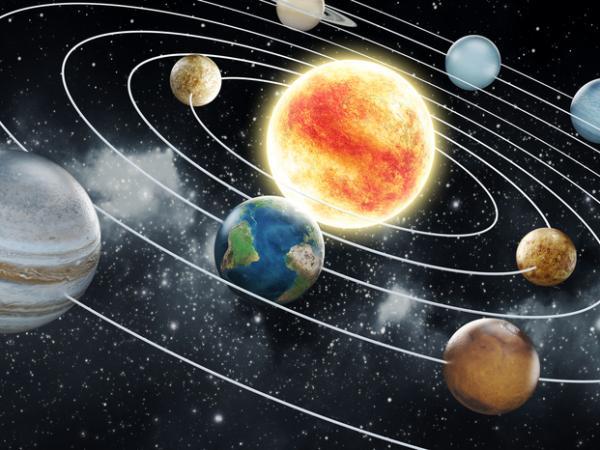
How many planets are there in the Solar System?
a)
eight
b)
three
c)
nine
d)
ten
50.

Galaxies are:

a)

gropus of Asteroids

b)

Groups of planets

c)

Groups of stars, gas and dust.

d)

Group of satellites

51.

Man-made device orbiting around the Earth, Moon or another planet that transmits information or is used for communication

a)

Planet

b)

Artificial satellite

c)

Natural satellite

d)

Star

52.

Between which 2 planets do we find the asteroid belt?

a)

Mercury and Jupiter

b)

Earth and Mars

c)

Mars and Jupiter

d)

Jupiter and Saturn

53.

Planets with the longest revolution are called ______________

a)

Gas Giants

b)

Terrestrial Planets

54.
A celestial body of ice, dust, and rock with an elongated and elliptical orbit.
a)
coma
b)
comet
c)
moon
d)
planet
55.
The gravitationally-curved path of an object around a point in space.
a)
Galilean Moons
b)
Moons of Saturn
c)
Orbital Path
56.
The force that causes objects with mass to attract one another.
a)
Galilean Moons
b)
Moons of Saturn
c)
Orbital Path
d)
gravity
57.
A celestial body that revolves around a planet.
a)
moon
b)
star
c)
comet
d)
meteor
58.
Something that orbits around another object.
a)
satellite
b)
sun
c)
galaxy
59.
Remains of meteoroids that strike the surface of Earth or the Moon.
a)
meteor
b)
meteorites
c)
meteoid
60.
A small object that enters Earth's atmosphere from space and burns due to friction, emitting light.
a)
meteor
b)
meteorites
c)
meteoid
61.
A natural chunk of rock or dust existing outside of Earth’s atmosphere.
a)
meteor
b)
meteorites
c)
meteoid
62.
The region between the inner and outer planets where most asteroids orbit around the Sun.
a)
Asteroid Belt
b)
Solar System
c)
Inner Planet
d)
Outer Planet
63.
Any of the planets Jupiter, Saturn, Uranus, and Neptune, whose orbits lie beyond the asteroid belt.
a)
Asteroid Belt
b)
Solar System
c)
Inner Planet
d)
Outer Planet
64.

...------- emit large amounts of heat and light.

a)

Stars

b)

Galaxies

c)

Planets

65.

The telescope is used to study the ………………..

a)

minerals

b)

celestial bodies.

c)

volcanoes

66.

In addition to the Sun, the solar system includes ……………

a)

eight planets only.

b)

asteroids, meteorites and comets only.

c)

stars and planets.

d)

d. eight planets with the asteroids, meteorites and comets.

67.
What is in the center of the Heliocentric Model?
a)
Sun
b)
Comet 
c)
Jupiter
d)
Earth
68.
  What does "geo-" mean?
a)
Earth
b)
sun
c)
Center
69.
This person believed that planets move on small circles that move on larger circles
a)
Ptolemy
b)
Copernicus
c)
Galileo
d)
Aristotle
70.
This person discovered moons on Jupiter, which helped to support the heliocentric theory 
a)
Aristotle
b)
Copernicus
c)
Ptolemy
d)
Galileo
71.
This person developed the heliocentric theory and was considered the founder of modern astronomy.
a)
Aristotle
b)
Copernicus
c)
Ptolemy
d)
Galileo
72.
This person was the first to use a telescope to make observations in the sky -
a)
Aristotle
b)
Ptolemy
c)
Copernicus
d)
Galileo
73.
Which astronomer created laws of gravity and motion? 
a)
Kepler
b)
Copernicus
c)
Brahe 
d)
Newton
74.
What two forces help planets stay in their orbits? 
a)
Gravity and Force
b)
Gravity and Inertia
c)
Doppler effect and Gravity
d)
Inertia and Force 
75.
This astronomer discovered that the orbit of each planet is an ellipse, or an oval shape, and not perfectly circular.
a)
Aristotole
b)
Copernicus
c)
Kepler
d)
Newton
76.
What theory of the Universe did Aristotle believe in? 
a)
Heliocentric theory
b)
Alphamanic theory
c)
Geocentric theory
d)
Vergocentric theory
77.
What shape is an ellipse?  
a)
An oval shape
b)
A round shape
c)
A circle shape 
d)
Sun, moon and Earth lined up shape
78.

Which astronomer figured out that the Earth is a sphere by observing a lunar eclipse?

a)

Newton

b)

Copernicus

c)

Ptolemy

d)

Aristotle