
 Worksheets
Layers of the Earth TEST (new)
Total questions: 73
Worksheet time: 56mins

Sophia is building a model of Earth for her science project. She wants to know which layer of Earth she should make the thickest in her model. Which layer of Earth is the thickest layer?
the inner core
the crust
the mantle
the outer core

Mia is reading about the different layers of Earth in her science book. She learns that one layer is made mostly of metal, specifically iron and nickel. Which layer is Mia reading about?
crust
mantle and core
core
mantle
Scarlett is reading a science book and comes across a statement: "Earth's crust is the thickest layer." Is this statement correct?
True
False

Grace is learning about the different layers of the Earth in her science class. She reads that Earth's crust is the least dense layer. Is this statement correct?
True
False
During a science class, Olivia is learning about the layers of the Earth. Her teacher asks, "Can anyone tell me the name of the innermost layer?"
the crust
the mantle
the outer core
the inner core
Maya is reading about Earth's layers for her science project. She learns that the outer core is mainly composed of which of the following?
solid iron and nickel
liquid iron and nickel
semi-solid magma
granite and basalt

Isla is building a model of the Earth for her science project. She wants to make sure she puts the layers in the correct order, starting from the outermost layer. Which is the correct order of the Earth's layers?
Outer most layer first.
Crust, Outer Core, Mantle, Inner Core
Crust, Mantle, Outer Core, Inner Core
Inner core, Outer core, Mantle, Crust
Charlotte is digging a tunnel deep into the Earth. As she moves deeper into the Earth's core, the temperature is:
cooler
hotter
What is your name?
First and Last
Watch this video.
I would like to visit a live volcano!
These people are nuts!
Unsure if I would go, maybe.
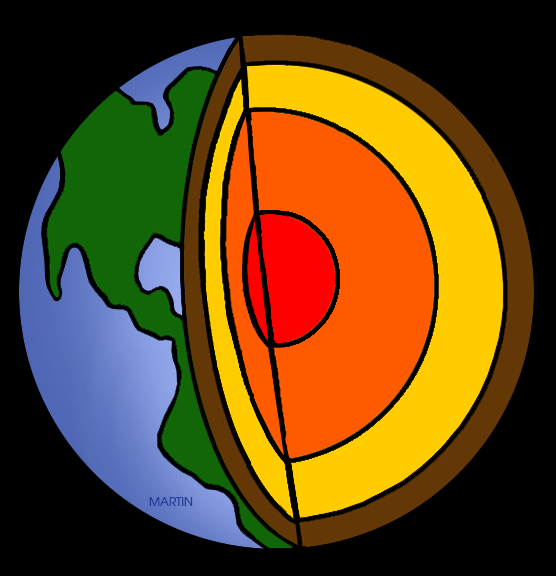
Avery is looking at a diagram of the Earth's layers in her science textbook. She notices that one layer is shown in red. Which layer is shown in red?
crust
mantle
outer core
inner core
Abigail is making a model of the Earth using different materials. She uses something soft and "flowing" like clay or pudding to represent one of the Earth's layers. Which layer is Abigail modeling with this material?
crust
mantle
outer core
inner core
Kai is curious about what lies beneath Earth's surface, but knows that no one can directly see inside the planet. How might scientists like Kai infer the internal structure of Earth without being able to directly observe inside the Earth?
Scientists analyze how earthquake waves move throught Earth's interior.
Scientists use satellite radar and sonar technologies to map Earth's internal layers.
Scientists make educated guesses about Earth's internal structure based on previous hypothesis.
Scientists study different types of rocks from many different locations on Earth's surface.

Hannah is studying a diagram of the Earth's layers in her science class. She wants to know what the "mantle" is. Which of the following best describes the mantle?
A layer molten lava
The layer of rock that forms Earth's outer surface.
The layer of hot, solid material between the Earth's crust and core.
The outermost layer of the Earth's crust.
Daniel is reading a science book and learns that the Earth is made up of multiple layers. True or false?
True
False

While studying a diagram of the Earth's layers in science class, Sophia wonders which layer has a solid inner part and a liquid outer part. What layer is she thinking about?
Crust
Mantle
Core
none
Aiden is learning about the structure of the Earth in his science class. His teacher asks him: Which layer of the earth is completely Liquid?
Crust
Mantle
Outer Core
Inner Core

While hiking, Arjun noticed that the ground beneath his feet was made of soil and rocks. Which layer of the Earth is he walking on?
Crust
Mantle
Core

Priya is reading about the layers of the Earth. She learns that one layer is made of iron and nickel. Which layer is Priya reading about?
Crust
Mantle
Core

Noah is reading about the Earth's layers in his science book. He learns that one of the layers is made of hot flowing rock (magma). Which layer is Noah reading about?
Crust
Mantle
Core

Anika is curious about where all known life on Earth exists. She looks at a diagram of Earth's layers and wonders which layer supports life.
inner core
mantle
core
crust
Mason is reading a science book and learns that this layer makes up 84% of Earth's volume.
(a)

Luna is looking at a picture of our planet on her computer. She wonders what the name of the planet that we live on is called. What is the correct answer?
Earth
Oxygen
Temperature
Space
Sophia is building a model of the Earth for her science project. She wants to stack the layers in the correct order, starting from the surface. What is the correct order she should follow?
crust, mantle, inner core, outer core
mantle, outer core, inner core, crust
inner core, outer core, mantle, crust
crust, mantle, outer core, inner core
Kai is digging a hole to learn about Earth's structure. Starting from the surface, in what order would Kai encounter Earth's layers?
crust, outer core, inner core, mantle
mantle, outer core, inner core, crust
crust, mantle, outer core, inner core
outer core, inner core, crust, mantle
Priya is on a journey to the center of the Earth, starting from the crust and moving towards the inner core. What happens to the pressure as Priya travels deeper?
Pressure Decreases
Pressure Increases
Nothing
Grace is helping her younger brother with his geography homework. She asks him, "Can you tell me what the two types of crust are?"
continental and oceanic
ocean and upper
lower and upper
pizza and subway
While watching a volcano erupt, Oliver wonders: From which layer of the earth does the lava come from?
Crust
Mantle
Outer Core
Inner Core
Aria is curious about why a compass always points north. She learns that the earth's magnetic field is responsible for this phenomenon. Which layer of the earth creates the earth's magnetic field?
Crust
Mantle
Outer Core
Inner Core
Imagine Benjamin is sorting different materials into layers based on a property. What property of matter would cause the materials to be ordered in layers, similar to how the layers of the earth are arranged?
Mass
Density
Weight
Volume

Emma is working on a science project about the structure of the Earth. She comes across a diagram showing different layers of the Earth, and she needs to identify the layer labeled # 6. Can you help Emma by selecting the correct layer?
crust
mantle
outer core
inner core

Charlotte is reading about the different layers of the Earth for her science project. She learns that one of these layers can reach temperatures as high as 5,000 degrees Celsius. Which layer is she reading about?
crust
mantle
outer core
inner core
James is baking a pizza and wants to know: There are how many different types of crust?
1
2
5
3
Imagine Anika is digging a tunnel from the Earth's crust towards the inner core. What happens to the pressure as she goes deeper?
Pressure Decreases
Pressure Increases
Nothing
When Abigail pours oil into a glass of water, the oil floats on top. Less dense materials rise to the top.
True
False
Emma is building a model landscape and notices that over time, tiny pieces of sand and dirt pile up in layers. Later, these layers become stuck together by minerals dissolved in water. What type of rock is Emma creating in her model?
Igneous rock
Metamorphic rock
Sedimentary rock
Hard rock
While hiking, Zoe finds a rock that looks very different from the others. She learns that this type of rock forms when existing rock is changed to new rock by extreme heat and pressure. What type of rock did Zoe most likely find?
Igneous rock
Metamorphic rock
Sedimentary rock
Hard rock
While hiking near a volcano, Liam notices some rocks that seem to have formed from molten (melted) rock that cooled and hardened after flowing from beneath Earth's surface. What type of rock did Liam most likely find?
Igneous rock
Metamorphic rock
Sedimentary rock
Hard rock
Abigail is learning about the structure of the Earth in her science class. Her teacher asks, "The inner most layer is ..."
hot, metallic liquid
hot, metallic solid
cold, brittle
cold, molten
Ricky is helping his younger brother build a layered cake for a school project. Each layer of the cake represents a layer of the Earth. While assembling the cake, which layer should Ricky make the thinnest to accurately represent the Earth's structure?
inner core
outer core
mantle
crust

Olivia is studying seismic waves on a distant planet. She discovers that the planet has a liquid core. Based on this, she concludes that the "S" waves _______.
slow down when they travel through the core.
are unable to pass through the core

Arjun is learning about the layers of the Earth in science class. He wonders why the inner core, even though it is extremely hot, is made of solid metal. What is the reason for this?
Because it is so hot it turns from liquid to solid
Because of the weight of the crust
Because of it's temperature
Because of the pressure of the other layers beating down on it

Rohan is curious about what lies beneath the Earth's surface. He wonders: Approximately how deep would you have to drill to reach the center of the Earth?
600 Kilometers
6,000 Kilometers
60,000 Kilometers
600,000 Kilometers
Samuel is reading about Earth's structure and wonders, "What is the thickness of the mantle?"
5 - 80 km
almost 3,000 km
almost 3,480 km

As Maya and Henry join a team of scientists drilling deeper and deeper into Earth's crust, what have they noticed about temperature and pressure?
both temperature and pressure decrease
both temperature and pressure increase
pressure increases while temperature decreases
temperature increases while pressure decreases
Jake was explaining the thickness of the different layers of the Earth to his sister. He said that it is comparable to that of the eggshell on a hard-boiled egg. Which layer is Jake talking about?
crust
mantle
inner core
outercore

Priya is building a model of the Earth using clay. She wants to make sure that two thirds of the model’s mass is in the same layer as two thirds of the Earth’s mass. Which layer should Priya focus on?
Crust
Mantle
Core
Anika is learning about the Earth's layers. She wants to know which material is similar to the mantle. Which should she choose?
Thick liquid
liquid lava
Solid rock
Putty (like a solid and liquid)
Zoe is conducting an experiment to learn about Earth's layers. She observes different materials stacked to represent the crust, mantle, outer core, and inner core. Which of the following is TRUE based on her observations?
Layers decrease in temperature as you go toward the center.
Layers increase in weight as you move outward from the center.
Layers increase in density as you move towards the center.
Layers decrease in density as you move towards the center.
Grace is at a lake and observes different objects in the water. She notices a ship floating, a rock sinking, and a leaf floating on the surface. Based on her observations, which of the following is TRUE?
A. A ship can float because it is less dense than the water.
B. A rock will sink because it is more dense than water.
C. A leaf will float because it is more dense than water.
D. Both A and B
Emily, Rob, and Gaven are having a discussion about what the Earth is mostly made of.
Emily says that the Earth is composed primarily of rock
Rob says that the Earth is composed primarily of water
Gaven says that the Earth is composed primarily of lava
Who is correct?
none
Gaven
Rob
Emily
Emily & Rob
Two students are debating in class:
Ireland says that 3/4 of the Earth is covered by a relatively thin layer of water
Caiden says that 75% of the Earth is covered by mostly deep oceans.
Who is correct?
Ireland
Caiden
neither of them
both of them

Imagine Charlotte is on a special journey, starting from the Earth's inner core and traveling outward to the crust. As she moves through each layer, how would the temperature, pressure, and density of the material around her change?
The would all increase
The would all decrease.
Nothing, the layers are made of the same material throughout
Temperature would decrease, but pressure and density would increase

Brandon and Angelina are learning about the layers of Earth. Their teacher has asked them to label the provided diagram. What letter in the diagram identifies the layer that is composed of moving continental and oceanic plates?
Layer A
Layer B
Layer C
Layer D
Priya is studying the layers of Earth for her science project. She wants to know which layer is best described as a molten state of medium density made up of mostly silicon and oxygen. Which layer should Priya focus on?
Crust
Outer core
Mantle
Inner core
Ava is curious about why the Earth's inner core is so hot. She wonders, where do the high temperatures of the Earth's inner core come from?
From the leftover heat of Earth's formation, gravity and radioactive decay.
From the gravitational forces around Earth and the Sun.
From the Sun and the moon.
From the leftover heat of Earth's formation, the moon's gravity field and the Sun.
Scarlett is learning about the Earth's core in her science class. She discovers that even though the inner core is very hot, the elements do not _________________ , and remain in a ________________ state.
freeze, solid
melt, liquid
crumble, solid
melt, solid

Imagine Harper is standing on the ground. True or False...Harper can touch only one of the Earth's layers.
True
False
Imagine Avery is in a special elevator that can travel from the center of Earth to the surface. As Avery moves upward, the pressure would...
increase
decrease
stay the same
unsure

Rohan is reading about the different layers inside the Earth. He wonders which layer has a HIGHER Temperature. Which one is it?
Outer Core
Upper Mantle
Aria is learning about the layers of the Earth in her science class. She wants to know which layer is made of softened rock. Which layer should she choose?
Crust
Lower Mantle
Inner Core
Outer Core
As Mia and Aria descend deeper into a mine, which of the following increases as they go further below the Earth's surface? (choose all that apply). Hint: There are three answers.
time
Pressure
temperature
density
Scarlett is part of a team using a special drill to dig straight down toward the center of the Earth. If the drill moves at a constant speed, through which layer would Scarlett spend the most time drilling?
Crust
Mantle
Outer Core
Inner Core
Elijah is learning about the layers of the Earth in science class. He wonders, which layer is the HOTTEST?
Crust
Mantle
Outer Core
Inner Core
Abigail is learning about the Earth's structure in her science class. She discovers that one layer is broken up into large sections called tectonic plates. Which layer is Abigail studying?
Crust
Mantle
Outer Core
Inner Core
Henry is digging a tunnel to study the layers of the Earth. He wants to know which layer is the widest so he can focus his research there. Which is the widest layer of the Earth?
Crust
Mantle
Outer Core
Inner Core
Mia is reading about the Earth's structure for her science project. She wants to know: How wide is the Mantle?
60 km
1,500 km
2,900 km
3,300 km
Elijah is reading about the Earth's structure for his science project. He wants to know: Which layers are composed of Nickel (Ni) and Iron (Fe)?
Crust
Mantle
Outer Core
Inner Core
Aria is studying the layers of the Earth for her geology class. She learns about the asthenosphere and wonders which layer sits directly above it. Which layer is directly above the asthenosphere?
Crust
Lithosphere
Mantle
Outer Core
James is reading about Earth's structure and wonders what the temperature of the inner core is. What is the temperature of the inner core?
2,500 degree
3,500 degrees
4,500 degrees
5,500 degrees

Hannah is looking at a globe and wonders about what amount of the Earth's surface is covered by water. Can you help her find the answer?
1/2, 50%
4/7, 57%
3/4, 75%
6/7, 86%
Reorder the layers of Earth, from the coolest (left) to the hottest (right).


Match the Layer # with the correct properties.
200-400 C°, solid rock, mostly igneous
Layer 1
500-4,000 C°, molten rock, magma
Layer 2
4,400-6,100 C°, liquid nickel & iron
Layer 3
5,000-7,000 C°, solid nickel & iron
Layer 4

