
 Worksheets
ES Energy/Heat Transfer Exam Review 20-21
Total questions: 68
Worksheet time: 39mins

How will the energy flow?
Hand to ice
Ice to hand
Does all of the heat energy from this persons hand go into the ice?
yes - all of our heat goes directly to the ice
no - some gets lost to the surrounding air
What is the definition of CONVECTION
When heat transfers through waves.
When heat transfers from objects that are touching.
When heat transfers due to density differences.
Heat traveling from the sun
Near the ceiling of a room the air is warmer. The warm air rises because
it is more dense
it is less dense
warm molecules huddle for warmth


Put the visible light colors in order from longest wavelength to shortest wavelength
Violet, Blue, Green, Orange, Yellow, Red
Red, Yellow, Green, Orange, Violet, Blue
Red, Orange, Yellow, Green, Blue, Violet

Which of the following electromagnetic waves is given off as heat from earth?
Radio Waves
Infrared Rays
Visible Light
Gamma Rays


Electromagnetic waves________________travel through space.
Never
Cannot
Can
Wish they could

How do the wavelengths of x-rays compare to infrared waves?
X-rays have longer wavelengths than infrared waves .
X-rays have shorter wavelengths than infrared waves .


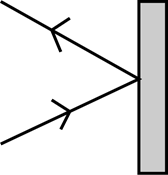
In the illustration, the light ray striking the object is-

Which has a longer wavelength?
A
B
When a wave transfers all of its energy into the material it strikes, it is called
Absorption
Diffraction
Reflection
Refraction
What happens when light hits a shiny or smooth surface?
it's transmitted
it is absorbed
it is reflected
What happens when light hits a dark, rough, or dull surface?
it's transmitted
it is absorbed
it is reflected
Which of the following would absorb the most energy?
blacktop driveway
ice sheet
lake
ocean
Which of the following would reflect the most energy?
blacktop driveway
ice sheet
forest
grassland
Good absorber =
dark, rough, dull
light, shiny, smooth
Good reflector =
dark, rough, dull
light, shiny, smooth
If an object absorbs more energy it will
reflect more
reflect less
If an object reflects more energy it will
absorb more
absorb less
Which of the following would ABSORB the least energy?
blacktop driveway
ice sheet
forest
grassland
Good absorbers of energy = good ___________ of energy
heaters
radiators
reflectors
Use ESRT Page 1 - Specific Heat = energy needed to raise _____ gram of a substance by _______o Celsius
1,1
10,10
100,100
1,10
Higher specific heat = ________ energy is needed to heat up a substance. Example of an object with a high sp. heat = ________
more; metal
less; water & metal
less; metal & land
more; water
Lower specific heat = __________ energy is needed to heat up a substance. Example of objects with a low specific heat = __________
less; water
more; water & metal
less; metal & land
more; water
___________ has a higher specific heat than ___________
Water, land
Land, water
Conduction = energy transferred in ___________ by ___________ contact.
solids; direct
liquids and gases; no direct
liquids and gases; direct
solids; no direct
Conduction commonly occurs in
air/gases
metals
water/liquids
Convection = energy transferred in fluids __________________________ due to differences in ______________
solids; density
liquids & gases; density
solids and liquids; pressure
liquids and gases; pressure
Convection occurs in
air and water
metals
sunlight
If a substance is more dense it _________ and less dense it _________
sinks, rises
rises, sinks
Use ESRT page 1 - _____________ has the highest specific heat
Lead
Liquid water
Vaporization =
liquid to gas
gas to liquid
Vaporization = ____ joules/gram of water are ________________
334, absorbed
2260, absorbed
334, released
2260, released
Condensation =
liquid to gas
gas to liquid
Condensation = ____ joules/gram of water are ________________
334, absorbed
2260, absorbed
334, released
2260, released
Melting = ____ joules/gram of water are ________________
334, absorbed
2260, absorbed
334, released
2260, released
Melting =
liquid to solid
solid to liquid
Freezing =
liquid to solid
solid to liquid
Freezing = ____ joules/gram of water are ________________
334, absorbed
2260, absorbed
334, released
2260, released
Which phase changes require energy to be absorbed?
evaporation & melting
evaporation & condensation
freezing & melting
condensation & melting
Which phase changes require energy to be released?
evaporation & melting
evaporation & condensation
freezing & melting
condensation & freezing
Temperature ____________ change during a phase change.
does
does NOT
longest wavelength = (gamma rays, radio waves)
gamma rays
radio waves
shortest wavelength = (gamma rays, radio waves)
gamma rays
radio waves
The Sun gives off __________ parts of the electromagnetic spectrum; _______________ reaches us with the most intensity.
some; visible light
some; infrared
all; visible light
all; infrared
Insolation =
incoming solar radiation
inside sol conduction
involved solstice convection
Insolation =
sunlight
darkness
Earth absorbs __________-wave radiation coming in from the Sun, in the forms of __________________.
short; ultraviolet & visible light
long; ultraviolet & visible light
short; gamma & radio waves
long; ultraviolet & gamma rays
At night, Earth radiates _________-wave radiation in the form of ___________ energy
short; infrared
long; infrared
long; ultraviolet
short; visible light
Carbon Dioxide (CO2), methane (CH4), and water vapor (H2O(g)) =
greenhouse gases
pollutants
Greenhouse gases = good absorbers of ______________
infrared energy
visible light
ultraviolet
An increase in volcanic eruptions, _______________ atmospheric transparency which means __________ insolation reaches earth’s surface and atmospheric temperatures ______________.
increases, more, decrease
decreases, less, decrease
increases, more, increase
Volcanic eruptions, clouds, dust & debris will _____________ atmospheric transparency.
increase
decrease
A clear sky = ____________ atmospheric transparency and leads to ____________ temperatures.
more; warmer
more; cooler
less; cooler
less; warmer

