
 Worksheets
Revision Question
Total questions: 100
Worksheet time: 1hrs 16mins

Which of the following is not an objective of pricing strategy?
Increase Sales
Maximize Profit
Discourage Competition
Discourage Customers
What is one of the element of the marketing mix that produces revenue?
Product
Price
Promotion
People
Printers are usually charged at a lower price, however accompanying ink top-ups are charged a premium price. This is know as _________________
Premium Pricing
Bundle Pricing
Every Day Low Prices
Optional Product
In business, a company in the same industry or a similar industry which offers a similar product or service is called?
Coordinators
Business Partners
Management
Competitor
Which function of marketing includes deciding how much to charge for a product or service?
Promotion
Product/Service Management
Financing
Pricing
Target marketing is
gathering and analyzing information about the size and location of a market
potential group of customers a company can focus on, most likely to buy their product or service
a group of people with common goods and services
facts about a population
Effective ________ pricing involves understanding how much value consumers place on the benefits they receive from the product and setting a price that captures that value.
A) competition-oriented
B) cost-based
C) time-based
D) customer-oriented
A restaurant wants to use value-based pricing. It knows the costs of the ingredients in the food. It must also factor in ________ in determining customer satisfaction and value.
A) wages of employees
B) costs of utilities of the restaurant
C) atmosphere and décor of the restaurant
D) cost of raw material
Under ________, the market consists of many buyers and sellers trading in a uniform commodity.
A) pure competition
B) monopolistic competition
C) oligopolistic competition
D) a pure monopoly
In Viña del Mar, Chile, a large number of shops specialize in selling the same quality of seafood products along the beach frequented by tourists. No individual shop dares charge more than the going price without fearing loss of business to other shops. This exemplifies ________.
A) pure competition
B) monopolistic competition
C) oligopolistic competition
D) pure monopoly
The movie industry in a country is controlled by six large studios that receive 90 percent of the annual revenues from movies. This is an example of a(n) ________.
A) pure competition
B) monopolistic competition
C) oligopolistic competition
D) pure monopoly
________ refers to a measure of the sensitivity of demand to changes in price.
A) Price elasticity
B) A demand curve
C) Price-value equation
D) Marginal utility
Colgate
company plans to introduce four toothpaste models over the next year. These
models range from basic users at $2 per unit, to more sensitive users at $4 per
unit. The more features a model has, the more expensive it is. What pricing
strategy is Colgate using for its range of toothpaste products?
A) product line pricing
B) product bundle pricing
C) captive product pricing
D) by-product pricing
Which of the following is true of optional-product pricing?
A) It involves capitalizing on low value by-products.
B) It involves pricing products that can be added to the base product.
C) It is used to price a company's main product.
D) It involves setting geographically specific prices.
Multiprint, a printer manufacturing firm, sells ink cartridges for each of its specific models. Only Multiprint cartridges are compatible with Multiprint printers, and no two models share the same specifications. What type of pricing does Multiprint use?
A) product line pricing
B) captive product pricing
C) optional product pricing
D) by-product pricing
A producer decides to use agents to get his products in the market. The producer is using…
Direct distribution
Channel A Distribution
Intermediaries
No distribution
Marketing channel also known as a distribution channel.
true
false
What is definition of retailer?
Businesses or individuals that purchase goods in large quantities from manufacturers, producers, or distributors and then sell them in smaller quantities to retailers, other businesses.
Businesses or individuals that sell goods or services directly to consumers for personal or household use.
The process of moving goods or products from the point of production to the point of consumption.
Individuals or entities that act as intermediaries between buyers and sellers, facilitating transactions and negotiations on behalf of their clients.
What is the function of broker and agent?
they serve as a vital link in the distribution network, connecting manufacturers and retailers while adding value through their expertise, efficiency, and scale of operations.
businesses that sell goods or services directly to consumers.
encompasses other activities such as order processing, inventory management, and logistics planning.
Intermediaries who facilitate transactions between parties. They act as neutral middlemen and represent and advocate for the interests of their clients.
Business that sells to consumers on small scale.
Retailer
Mail order
Agent
Customer
An independent person or business that is appointed to deal with the sales and distribution of a product or range of products.
Wholesaler
Agent
Producer
Retailer
A ______ performs the function of ‘breaking bulk’, which means the ________ buys products from manufacturers in large quantities and then divides up the stock into much smaller quantities for retailers to buy.
Agent
Producer
Wholesaler
Retailer
Wholesalers cut storage costs for retailers.
True
False
Methods refer to the actual place where goods are sold, while channel refers to the system used to get them to the consumer.
True
False
Choose the concept to the following definition:
It consists of the actors and forces outside marketing that affect marketing management's ability to build and maintain successful relationships with target customers.
Microenvironment
Macroenvironment
Marketing Environment
Which of the following is a force that does NOT affect the Microenvironment?
The company
The Suppliers and Intermediaries
Customers
The economic environment
The actors close to the company that affect its ability to serve the customers are part of
the Microenvironment
the Macroenvironment
Choose the concept for the following definition:
The internal environment is conformed by departments or areas such as finance, human resources, accounting, purchasing, and the top management, which share the responsibility for understanding customer needs and creating customer value.
The Company
The Suppliers
The Customers
The Competitors
Firms that provide the resources needed by the company to produce goods or offer services are
the company
the suppliers
the competitors
Firms that share similar or the same activity as our main activity in the company are
the intermediaries
the suppliers
the competitors
Financial publics are:
banks and stockholders
householders and customers
Media publics do NOT include:
radio and television
newspapers and magazines
social media
government
The Publics does NOT include:
Financial
Government
Local
the company
Consists of the actors and forces outside marketing that affect marketing management’s ability to build and maintain successful relationships with target customers
Marketing Environment
Macroenvironment
Microenvironment
Management Environment
The changing age structure population.
Natural Environment
Economic Environment
Demographic Environment
Political Environment
Which of the following is NOT a type of factor in a company's macroenvironment?
demographic
economic
technology
competitor
Banks, credit companies, insurance companies, and other businesses that help finance transactions or insure against the risks associated with the buying and selling of goods and services are referred to as ________.
financial intermediaries
physical distribution firms
marketing services agencies
resellers
Which of the following is NOT part of the micro-environment?
Customers' preferences.
Suppliers' quality
Competitors' activity.
Government economic policy
Laws, government agencies, and pressure groups that influence and limit various organizations and individuals in a given society.
Publics
Political environment
Financial environment
Cultural environment
This marketing intermediary works with warehouse and transportation firms, a company must determine the best ways to store and ship goods, balancing factors such as cost, delivery, speed and safety.
Resellers
Financial Intermediaries
Marketing Services Agencies
Physical distribution Firms
What is market?
set of actual buyers of a product or services
set of potential buyer of a product or services
set of actual and potential buyer of a product or services
set of products without need and demand
By ______________ the market and having several shower gel such as Safi, Gevenne, Aiken and New & Trendy, Wipro Unza has attractive offering for consumers in all preference groups.
positioning
segmenting
targeting
researching

When Dutch Lady targets different group such as 1 to 3 years, 4 to 6 years and above six years for their milk products they are practicing ______________ segmentation.
income
gender
age and life cycle
product life cycle

Yamaha Motor producing motorcycles and snowmobiles by identify the needs and preferences of the local climates. They are segmenting their product based on ____________ segmentation.
Behavioral
Demographic
Psychographic
Geographic
___________ segmentation divides buyer into different group based on social class, lifestyle and personality characteristics.
Geographic
Behavioral
Psychographic
Demography
This type of segmentation centers on the use of the word when, such as when consumers get idea to buy, when they actually make their purchase, when they use the purchase item. What do marketers call this?
Demographic
Occasions
User rate
Consumer loyalty

Nestle producing Nescafe 3 in 1 Mild, Rich and Original which each offer different caffeine contents. Nestle segmenting their product based on __________.
User status
User rate
occasions
consumer loyalty
Market can be segmented into group of non users, ex-user, first time users and regular users of a product. This method of segmentation is call _________.
user rate
user benefit
user status
user process
Which of the following is not considered as one of the requirement for effective segmentation?
Accessible
Actionable
Differentiable
Considerable
When the market segments can be effectively reached and served, they are said to process the requirement of being __________ .
Accessible
Measurable
Actionable
Substantial
When the size, purchasing power, and profiles of business market segments can be determined, they are said to process the requirement of being ____________.
Measurable
Actionable
Accessible
Subtantial
________ is referring to evaluating each market segment's and selecting one or more of the market segments to enter.
Target marketing
Positioning
Market segmenting
Competiting
Below are several factors in choosing a target marketing strategy, EXCEPT ______________.
Market variability
Competitor's marketing srategies
Firm resources
Economy conditions
Less attractive segments means ________.
it contains less competitors
it contains less suppliers
it contains many strong and aggressive competitors
it contains many weak and passive competitors
Needs of _________ are being focused in Marketing.
Customer
producer
Retailer
wholesaler
Which concept of marketing emphasis on availability and affordability of the product –
selling
production
product
marketing
This marketing concept focuses on persuading and convincing customers to buy the Products-
production
product
selling
marketing
Which among the following is not an element of marketing mix –
Product
Price
Place
Advertising
Which of the following products consume maximum time and effort to purchase –
Convenience
Shopping
Specialty
All the above
The term marketing refers to
Advertising, Sales Promotion, Publicity and Public Relational activities
A new product needs ideas, Developments, concepts and improvements
Sales Planning, Strategy and Implementation
A philosophy that stresses customer value and satisfaction.
Marketing is the activity, set of ___________ & processes for creating, communicating, delivering & exchanging offerings that have value for customers, clients, partners & society.
A. Institutions
Organizations
Companies
Institutions
Enterprises
What is the last stage in the hierarchy of needs?
Self-esteem
Self-actualization
Love and belonging
Safety and security
Which steps of the five-step marketing process are about understanding customers, creating customer value, and building strong customer relationships?
the first two only
the first three only
the first four only
the last three only
the last four only
According to the simple five-step model of the marketing process, a company needs to ________ before designing a customer-driven marketing strategy.
determine how to deliver superior value
build profitable relationships with customers
use customer relationship management to create full partnerships with key customers
understand the marketplace and customer needs and wants
construct key components of a marketing program
......are human needs as shaped by individual personality and culture.
Needs
Wants
Demands
Values
Exchanges
When backed by buying power, wants become ________.
social needs
demands
physical needs
self-esteem needs
exchanges
Which of the following refers to sellers being preoccupied with their own products and losing sight of underlying consumer needs?
selling myopia
marketing management
value proposition
marketing myopia
the product concept
A(n) ________ is the set of actual and potential buyers of a product or service.
market
control group
subsidiary
focus group
audience
Local publics include consumer organizations, environmental groups, minority groups, and others.
True
False
Sparex Inc. is a manufacturer of metal bolts that are used by Boilex Inc. to manufacture heavy machineries. In this instance, Sparex acts as a ________.
financial intermediary
supplier
retailer
customer
Price & Malone Corp., a company based in Houston, caters to a market of individuals and households that buy goods and services for personal consumption. Price & Malone caters to a ________ market.
business
reseller
government
consumer
The marketing team of 7 Star Inc., a company manufacturing smartphones, is currently studying the size, density, location, age, and occupation of its target market. Which of the following environments is being studied in this scenario?
demographic environment
political environment
economic environment
technological environment
The ________ environment consists of laws, government agencies, and pressure groups that influence or limit various organizations and individuals in a given society.
socio-legal
cultural
political
technological
The ________ environment consists of institutions and other forces that affect a society's basic values, perceptions, preferences, and behaviors.
social
cultural
political
physical
When a company hires lobbyists to influence legislation affecting its industry, it is taking a defensive stance toward the marketing environment.
True
False

What is service?
An item you can buy and bring along
An item that has physical attributes
It can be touched, tasted, heard, smelled or seen.
Something you pay someone to do, but you might end up without an item you can keep.
During this stage, a business will research and devlop the product. Product testing and trials takes place.
Development
Introduction
Growth
Maturity
Decline
During this stage, the product is launched. Usually a loss is made during this phase as Sales are low (but increasing)
Development
Introduction
Growth
Maturity
Decline
During this stage, sales rate starts to slow, perhaps a competitor has launched something similar or customers just want something new.
Development
Introduction
Growth
Maturity
Decline
During this stage, sales start to fall. Extension strategies needed to pick up sales again.
Development
Introduction
Growth
Maturity
Decline
Which stage has rapid sales?
introduction
maturity
decline
growth
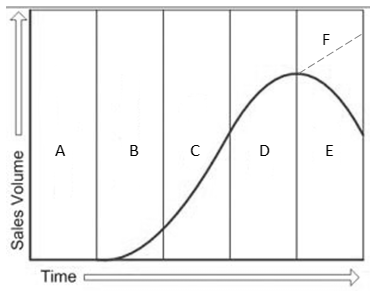
What is happening at point D on the Product Life Cycle?
Introduction
Decline
Maturity
Growth

