wayground logo

Free Printable Worksheets

Font size

S
M
L
XL
Worksheets

Carbon, Water, Organic Macromolecules

Total questions: 101

Worksheet time: 2hrs 27mins

Name
Class
Date
1.

The building blocks for organic compounds are called...

a)

Polygons

b)

Polymers

c)

Monograms

d)

Monomers

2.

___ are used by cells to get quick energy.

a)

Carbohydrates

b)

Lipids

c)

Proteins

d)

Nucleic Acids

3.

What is the monomer of carbohydrates?

a)

Monosaccharide

b)

Nucleotide

c)

Fatty Acid

d)

Amino Acid

4.

What elements would be found in carbohydrates?

a)

Carbon, Hydrogen

b)

Carbon, Hydrogen, Oxygen

c)

Carbon, Hydrogen, Oxygen, Nitrogen

d)

Carbon, Hydrogen, Oxygen, Nitrogen, Phosphorous

5.

Monosaccharides are the building blocks of which group of biomolecules?

a)

protein

b)

lipid

c)

carbohydrate

d)

nucleic acid

6.
What type of carbohydrate is this?
a)
polysaccharide
b)
disaccharide
c)
monosaccharide
d)
it isn't a carbohydrate
7.
Humans store energy in their body in the form of
a)
Starch
b)
Glycogen
c)
Cellulose
d)
Chitin
8.
Important to the structural integrity of plant cells, this is the single most popular polysaccharide in the world.
a)
Starch
b)
Glycogen
c)
Cellulose
d)
Chitin
9.
The 3 categories of carbohydrates are:
a)
Monosaccharide, disaccharide, polysaccharide
b)
glucose, fructose, galatose
c)
starch, cellulose, chitin
d)
There are no categories of carbohydrates
10.
Which of the following items is a polymer of glucose?
a)
starch
b)
cellulose
c)
glycogen
d)
All of These
11.

Carbon can form __ bonds with other atoms.

a)

2

b)

3

c)

4

d)

6

12.

Carbon forms this kind of bond with other atoms:

a)

covalent

b)

ionic

c)

polar

d)

hydrogen

13.

True or False Carbon can form rings, branches and linear chains

a)

True

b)

False

14.

Single subunit of a polymer or macromolecule

a)

monosaccharide

b)

monocle

c)

monomer

d)

dimer

15.

When water is added to a polymer or macromolecule to break it into smaller subunits or monomers

a)

dehydration

b)

demolition

c)

decontaminate

d)

hydrolysis

16.

The disaccharide sugar found in milk

a)

sucrose

b)

glucose

c)

galactose

d)

lactose

17.

The disaccharide sugar found in table sugar

a)

sucrose

b)

glucose

c)

galactose

d)

lactose

18.

The ratio of the element CHO in a carbohydrate are

a)

1:2:1

b)

1:2

c)

1:3:1

d)

1:3

19.

This is a picture of a

a)

monosaccharide

b)

disaccharide

c)

polysaccharide

20.

This is a picture of a

a)

monosaccharide

b)

disaccharide

c)

polysaccharide

21.

This is a picture of a

a)

monosaccharide

b)

disaccharide

c)

polysaccharide

22.
What word describes when water is attracted to other substances?
a)
cohesion
b)
adhesion
c)
capillary action
d)
surface tension
23.
Which end of the water molecule has a slightly positive charge?
a)
the oxygen end
b)
the hydrogen end
c)
both ends are slightly positive
d)
neither end is positive
24.
Large bodies of water, such as lakes and oceans, do not quickly fluctuate in temperature. What is the reason for this phenomenon?
a)
Water is an acid.
b)
Water is a versatile solvent.
c)
Water has a high heat capacity.
d)
 Water acts as a buffer.
25.
Water is a universal solvent because it...
a)
It can be found anywhere
b)
It freezes when it gets cold
c)
floats when frozen
d)
Dissolves most substances
26.
 Small insects can walk across the surface of calm water. Their feet push the surface of the water down slightly, somewhat like a person walking across a trampoline, but they do not break the surface. What is the best explanation for why this happens?
a)
The insects are light enough so that they do not break the hydrogen bonds holding the water molecules together
b)
The insects actually use their wings to hover slightly above the water's surface and they only skim it with their feet
c)
The insects' feet are non-polar, so they are repelled by the polar water molecules and are pushed away from the water's surface
d)
The insects are small enough to see the individual water molecules, so they are able to step carefully from one molecule to the next
27.
When a molecule has an opposite electrical charge on each end, it is known as what?
a)
cohesion
b)
polar molecule
c)
hydrogen bond
d)
solution
28.
When water molecules stick easily to other water molecules, this is called what?
a)
cohesion
b)
adhesion
c)
solution
d)
polar molecule
29.

What property of water allows for water to act as a temperature regulator for the world?

a)

Cohesive Behavior

b)

Expansion Upon Freezing

c)

High Specific Heat

d)

Universal Solvent

30.

Why does water move from the roots to the leaves of plants?

a)

Water is pushed by solutes

b)

Water is pulled by gravity

c)

Capillary action pulls the water molecules like a chain

d)

Water's cohesion causes it to "pull" towards the leaves

31.

Why does ice stay at the top of oceans instead of sinking to the bottom? 

a)

Ice is colder than liquid water

b)

Ice is less dense than liquid water

c)

Ice is more dense than liquid water

d)

Ice is warmer than liquid water

32.

Which of the following is LEAST likely to dissolve in water?

a)

nonpolar fats and oils

b)

polar sugar molecules

c)

salt made of a positive sodium ion and a negative chloride ion

d)

all of the substances will dissolve easily in water

33.
A(n) _______ is a substance with a pH greater than 7.
a)
Base
b)
Acid
c)
Buffer
d)
Water
34.
A(n) ______ is a substance with a pH less than 7
a)
Acid
b)
Alkaline
c)
Base
d)
Buffer
35.
The smallest basic unit of matter is the
a)
molecule.
b)
atom.
c)
compound.
d)
cell.
36.

Atoms transfer electrons when they form

a)

covalent bonds.

b)

ionic bonds.

c)

hydrogen bonds.

d)

polymers.

37.
Which particles are found in an atom's nucleus?
a)
protons, neutrons and electrons
b)
protons and neutrons
c)
protons and electrons
d)
electrons and neutrons
38.
Attractions between the negative Oxygen atom of one water molecule and the positive Hydrogen atom of another water molecule are called
a)
Covalent bonds
b)
Ionic bonds
c)
Polar bonds
d)
Hydrogen bonds
39.
All polymers are made up of...
a)
monosaccharides
b)
monomers
c)
proteins
d)

DNA

40.
Which biomolecule is responsible for insulation and energy storage?
a)
Protein
b)
Nucleic Acid
c)
Lipid
d)
Carbohydrate
41.
Which biomolecule is a main source of quick energy?
a)
Nucleic Acid
b)
Protein
c)
Lipid
d)
Carbohydrate
42.
Lipids are made up of which of the following?
a)
glycerol and fatty acids tails
b)
glycerol and monolipids
c)
fatty acids and phosolipids
d)
amino acids and nucleotides
43.

The type of polysaccharide used by plants to create cell walls

a)

starch

b)

lactose

c)

glycogen

d)

cellulose

44.

The type of polysaccharides used by animals to store their extra glucose is _______________. Humans store this in their liver.

a)

starch

b)

lactose

c)

glycogen

d)

cellulose

45.

The molecule shown is a

a)

lipid

b)

carbohydrate

c)

protein

d)

nucleic acid

46.

A hydrocarbon chain that is sometimes considered to be a monomer of lipids.

a)

Fatty Acids

b)

Nucleic Acids

c)

Proteins

d)

Lipids

47.

Double bond between Carbon and Hydrogen chains.

Tends to be liquid at room temperature like oils.

a)

Polysaccharides

b)

Lipids

c)

Saturated Fats

d)

Unsaturated Fats

48.

Single bond between Carbon and Hydrogen chains.

Tends to be solid at room temperature like butter.

a)

Saturated Fats

b)

Unsaturated Fats

c)

Carbohydrates

d)

Proteins

49.
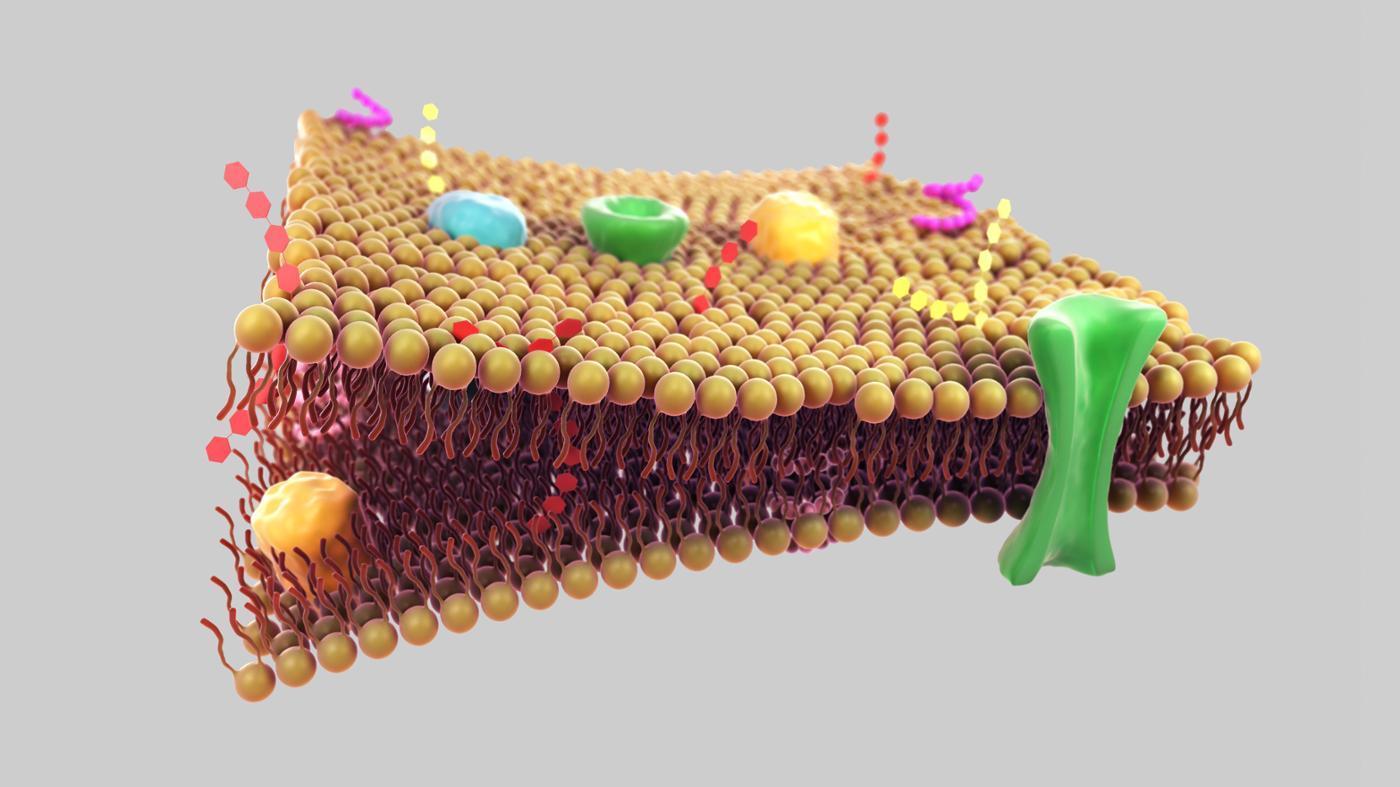
The phospholipid bilayer comprises what part of the cell?
a)
cytoplasm
b)
cell membrane
c)
cytoskeleton
d)
nuclear membrane
50.

Which diagram is a triglyceride?

a)
b)
c)
d)
51.

Unsaturated fats

a)

have a bent structure

b)

have at least one double carbon-carbon bond

c)

are liquids at room temperature

d)

all of these

52.
a)

saturated

b)

unsaturated

53.
a)

Saturated

b)

Unsaturated

54.

What is the following molecule?

a)

triglyceride

b)

phospholipid

c)

steroid

d)

protein

55.
Which of the following elements does a Nucleic Acid have that a Carbohydrate and Lipid do not?
a)
Carbon
b)
Oxygen
c)
Hydrogen
d)
Nitrogen
56.
From the nucleotide on the right, which part is labeled 2?
a)
Sugar
b)
Phosphate
c)
Nitrogenous Base
d)
Phosphorous
57.

What are the monomers of Nucleic Acids?

a)
Amino Acids
b)
Nucleotides
c)
Fatty Acids
d)
Monosaccharides
58.

What is the function of Nucleic Acids?

a)
They are responsible for energy production
b)
They are responsible for cell structure
c)
They are responsible for storing and transmitting genetic information
d)
They are responsible for protein synthesis
59.

What is this a picture of?

a)

RNA

b)

DNA

c)

Protein

d)

Carbohydrate

60.

What is a covalent bond?

a)
A bond formed by the sharing of electrons between atoms
b)
A bond formed by the transfer of electrons from one atom to another
c)
A bond formed by the attraction between oppositely charged ions
d)
A bond formed by the sharing of protons between atoms
61.

Which 4 elements make up proteins?

a)
Carbon, Hydrogen, Oxygen, Nitrogen
b)
Carbon, Hydrogen, Oxygen, Iron
c)
Carbon, Hydrogen, Oxygen, Calcium
d)
Carbon, Hydrogen, Oxygen, Potassium
62.

What are the functions of proteins?

a)
Proteins provide energy for the body
b)
Proteins help in digestion
c)
Proteins are responsible for muscle contraction
d)

Control rate of reactions, transport, formation of bone and muscle cells

63.

What are the monomers of proteins?

a)
Nucleotides
b)
Fatty acids
c)
Amino acids
d)
Glucose
64.

How many different types of amino acids are there?

a)
20
b)
22
c)
24
d)
26
65.

What is an R-group?

a)
A functional group in organic chemistry
b)
A type of protein
c)
A type of virus
d)
A variable side chain in amino acids
66.

What is this a picture of?

a)

Amino Acid

b)

DNA

c)

RNA

d)

Polypeptide

67.

Many amino acids that bond together are called:

a)

Polypeptides

b)
Nucleotides
c)
Lipids
d)
Carbohydrates
68.

The monomers of nucleic acids.

a)

Monosaccharide

b)

Amino Acid

c)

Fatty Acid

d)

Nucleotide

69.

Enzymes are an example of which macromolecule?

a)

Carbohydrates

b)

Lipids

c)

Proteins

d)

Nucleic Acids

70.

This is the only macromolecule that contains Phosphorus (P)

a)

Proteins

b)

Carbohydrates

c)

Lipids

d)

Nucleic Acids

71.
Building blocks of the body, hair , muscles etc.
a)
protein
b)
nucleic acid
c)
lipids
d)
carbohydrates
72.
DNA and RNA are examples of...
a)
proteins
b)
nucleic acids
c)
carbohydrates
d)
lipids
73.

Which of the following are examples of protein?

a)

cutin, waxes, fats, oils

b)

Collagen, enzymes, hemoglobin, insulin, and antibodies

c)

DNA& RNA

d)

Glucose, sucrose, glycogen, and cellulose

74.
All polymers are made up of...
a)
monosaccharides
b)
monomers
c)
proteins
d)
None of these
75.

Which is shown in the picture?

a)

Monosaccharide

b)

Fatty Acid

c)

Amino Acid

d)

Nucleotide

76.

Which is shown in the picture?

a)

Monsaccharide

b)

Amino Acid

c)

Fatty Acid

d)

Nucleotide

77.

Which is shown in the picture?

a)

Monsaccharide

b)

Amino Acid

c)

Fatty Acid

d)

Nucleotide

78.

Which is shown in the picture?

a)

Amino Acid

b)

Nucleotide

c)

Fatty Acid

d)

Monosaccharide

79.
Which major macromolecule is being represented in this image? 
a)
carbohydrate
b)
lipid
c)
protein
d)
nucleic acid
80.
Glucose (sugar) is an example of a
a)
Carbohydrate
b)
Lipid
c)
Protein
d)
Nucleic Acid
81.
The picture indicates which Macromolecule? 
a)
Carbohydrates
b)
Lipids
c)
Proteins
d)
Nucleic Acids
82.

Enzymes are an example of

a)

lipids

b)

carbohydrates

c)

protein

d)

nucleic acid

83.

What is a substance called if it speeds up a chemical reaction?

a)

reusable

b)

catalyst

c)

specific

d)

fragile

84.

Letter D...

a)

enzyme

b)

active site

c)

substrate

d)

products

85.

Letter B...

a)

substrate

b)

active site

c)

enzyme

d)

products

86.

An enzyme speeds up a reaction by

a)

raising the activation energy

b)

lowering the activation energy

c)

releasing energy

d)

absorbing energy.

87.

What happens to an enzyme when it is denatured?

a)

Activation energy is lowered

b)

It becomes stronger

c)

It loses its shape

d)

Activation energy is raised

88.

Absorbs energy

a)

endothermic reaction

b)

exothermic reaction

89.

Substances that are changed during a chemical reaction

a)

reactants

b)

products

90.

Releases energy

a)

endothermic reaction

b)

exothermic reaction

91.

What is the optimum temperature for this enzyme?

a)

20 degrees Celsius

b)

45 degrees Celsius

c)

52 degrees Celsius

d)

64 degrees Celsius

92.

What is the optimum pH for the enzyme salivary amylase?

a)

2

b)

5

c)

6.2

d)

9.1

93.

What is activation energy?

a)

the energy from the sun

b)

the energy produced by an enzyme

c)

the energy needed to get a reaction going

d)

none of these

94.

In the lock-and-key model of enzyme action, the __________ fits into the __________ of the enzyme.

a)

product; substrate

b)

active site; product

c)

substrate; active site

d)

active site; substrate

95.

If I take in a gram of protein, approximately how many calories have I consumed?

a)

2,000 calories

b)

9 calories

c)

3,500 calories

d)

4 calories

e)

2 calories

96.

Calorie is a measure of

a)

Energy

b)

Weight

c)

Distance

d)

Volume

97.

A calorie is officially defined as the

amount of energy it __________ to raise the temperature of 1 gram of water by 1 degree

Celsius,

a)

takes

b)

take

c)

have

d)

has

98.

Nutritionists know that a gram of protein contains ____ Calories, a gram of fat has _____ Calories, and a gram of

carbohydrate has _____ Calories.

a)

4 / 9 / 4

b)

9 / 4 / 9

c)

5 / 8 / 6

d)

5 / 8 / 6

99.
Which nutrient contributes the most calories to this product?
a)
Carbohydrates
b)
Fats
c)
Proteins  
100.
According to the label, how many calories in 1 serving come from protein?
a)
3
b)
12
c)
21
d)
27
101.

What happens to the unused calories that you take in?

a)

they are stored as fat

b)

they leave your body

c)

nothing

d)

they give you immediate bonus energy