
 Worksheets
T1/2 Final Exam Review
Total questions: 60
Worksheet time: 44mins
What is carrying capacity?
The maximum number of people that can fit in a school bus
The maximum number of a species that can sustainably live in a given area
The maximum number of resources available to a population
The maximum number of teachers in a school
Does carrying capacity apply to human population?
Yes, and it is currently at its maximum level
No, carrying capacity only applies to animal populations
Yes, but it is unknown what the carrying capacity is
No, human population can continue to grow indefinitely
Which of the following explains limiting factor?
A group of organisms that can interbreed to generate fertile offspring.
A biotic or abiotic things that restricts the growth of a population.
Living or produced by living things.
The source or supply that can be used to benefit an organism or population.

This species is unable to reproduce, in any habitat, beyond a population of around 300 individuals.
This environment has only enough resources to support 250–300 individuals of this organism.
Humans have greatly exceeded their carrying capacity.
Humans have become more efficient in producing and replenishing food resources.
Humans now consume less resources than they did previously.
The population will crash and experience a sudden decrease or extinction
Population growth will continue to increase but at a lesser rate
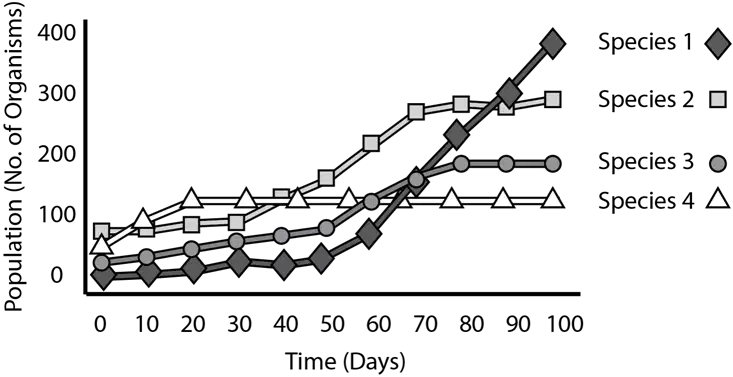
diamond
square
circle
triangle
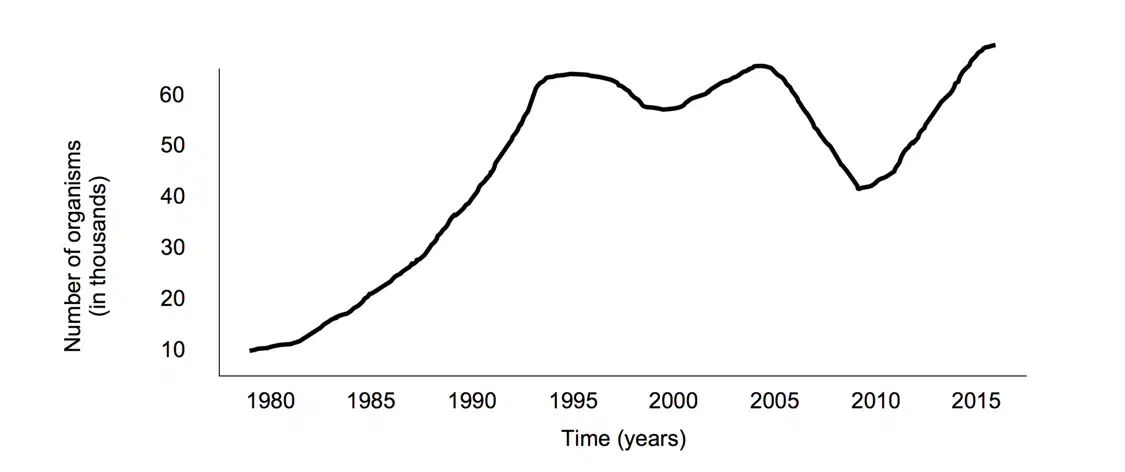
habitat destruction
increase in food abundance
Which of the following would have the lowest ecosystem resilience?
tropical rainforest/jungle
a small pond
The predators and prey populations interbreed and help increase population levels
Predators keep the prey population lower, so they don't eat all the vegetation
sunlight
disease

What will happen if all of the frogs in a population die?
The frogs' predators will decrease and the frogs' prey will increase
The frogs' predators will increase and the frogs' prey will decrease
We better all pray because there isn't anymore frogs.
The ability to do work or produce heat.
Biosynthesis
Cellular respiration
Energy
Matter
The _________________ of matter and energy states that matter/energy is neither created nor destroyed but conserved.
law of conservation
law of equilibrium
law of chemical reactions
law of gravity
law of consumption
After photosynthesis the carbon (C) from CO2 end up in which molecule?
water
glucose
oxygen
carbon dioxide
Ribosome
Which of the following provides the best evidence that living things use and recombine the elements C, H, and O to form new molecules?
The elements C, H, and O are the most common elements in the universe but are not the most common elements on earth
The cells of living thing contain molecules made of the elements C, H, and O, the same elements found in glucose consumed by living things
The elements C, H, and O can only bond with each other to form complex molecules
The amount of C, H, and O found in earth's atmosphere have changed over the history of the planet
What are the reactants (inputs) of Photosynthesis?
Glucose and Oxygen gas
Glucose and water
Oxygen gas and carbon dioxide
Water and Carbon dioxide
Carbon Dioxide and Oxygen gas
What are the reactants (inputs) of Cellular Respiration?
C6H12O6 and O2
C6H12O6 and H2O
O2 and CO2
H2O and CO2
CO2 and O2
What are the Products (outputs) of Cellular Respiration?
Glucose and Oxygen gas
Glucose and water
Oxygen gas and carbon dioxide
Water and Carbon dioxide
Carbon Dioxide and Oxygen gas
Which of the following molecule(s) correctly completes the equation:
6CO2 + 6H2O + light energy → 6O2 + _________
C6H12O6
H2O
O2
CO2
_____________ is a gas found in Earth's atmosphere produced by animals during respiration or burning/combustion.
C6H12O6
H2O
CO2
O2
True or False: As we break down food molecules energy is released by breaking bonds between the atoms in the food molecules
True
False
A form of cellular respiration that occurs when there is little or no oxygen present.
Aerobic Respiration
Anaerobic Respiration
What are the four main macromolecules found in organisms?
Carbohydrates, Proteins, Lipids, and Nucleic Acids
Salt, Minerals, Lipids, and Vitamins
Carbohydrates, Proteins, Lipids, and Vitamins
Carbohydrates, Proteins, Water, and Minerals
Amino Acids, Monosaccharides, Lipids, and Nucleic Acids
What do all the macromolecules have in common? (pick 3 answers)
All have carbon, hydrogen and oxygen
All have bonds
All contain Nitrogen
All are needed for life
All are made up of nucleotide monomers
Which statement best describes the relationship between photosynthesis and cellular respiration?
The output of photosynthesis is the inputs of cellular respiration.
The outputs of photosynthesis are the same as the outputs of cellular respiration.
The inputs of photosynthesis is the inputs of cellular respiration.
The outputs of photosynthesis change the structure of the inputs in cellular respiration.
The number of different types of organisms in an area is called _________.
Biodiversity
Homeostasis
Taxonomy
Deforestation
Which is not a characteristic of living things?
Breath oxygen
Use energy
Maintain homeostasis
Respond to the environment
True or False: Biodiversity is important because it increases food sources, can provide medicines, help maintain our natural resources, and is vital for survival of ecosystems.
True
False
Which of the following is not a human impact?
Urbanization
Building Dams
deforestation
Hunting and poaching
Volcanoes

What type of graph is this?
line graph
scatter plot
bar graph
pie chart
This type of graph is used when data is grouped by specific categories to see data that stands out.
Bar graph
line graph
scatter plot
Pie chart
(circle graph)
You want to make a graph for an experiment you did about plant growth over a two week period of time. What type of graph would you use?
bar graph
line graph
Scatter plot
pie chart
You want to make a graph for the amount of water absorbed by different brands of paper towels. What type of graph would you use?
bar graph
line graph
Scatter plot
pie chart
The process of cellular respiration takes food and rearranges it into carbon dioxide (CO2) which spheres are NOT involved in this process? (select 2)
Atmosphere
Biosphere
Geosphere
Hydrosphere
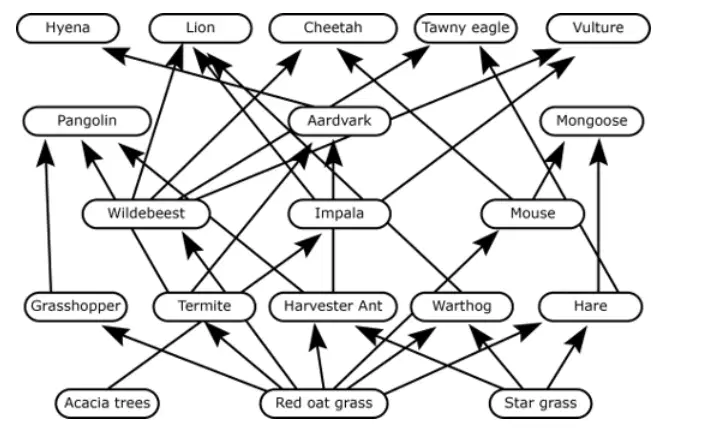
The food web diagram shows feeding relationships between organisms on the African savannah. Which of the following organisms is part of the trophic level with the greatest amount of stored energy?
Acacia trees
Impala
Vulture
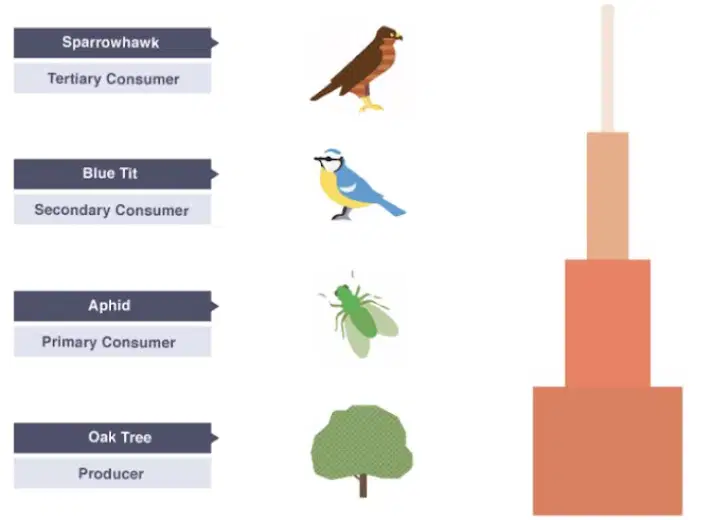
The diagram represents a model of a biomass pyramid. Which statement best describes what happens in this biomass pyramid?
Organisms decay at each level, and thus less biomass can be supported at higher levels
Energy is lost to the environment at each level, so less biomass can be supported at each higher level.
When organisms die at higher levels, their remains sink to lower levels, increasing the biomass of lower levels.
More organisms die at higher levels than at lower levels, resulting in less biomass at higher levels.
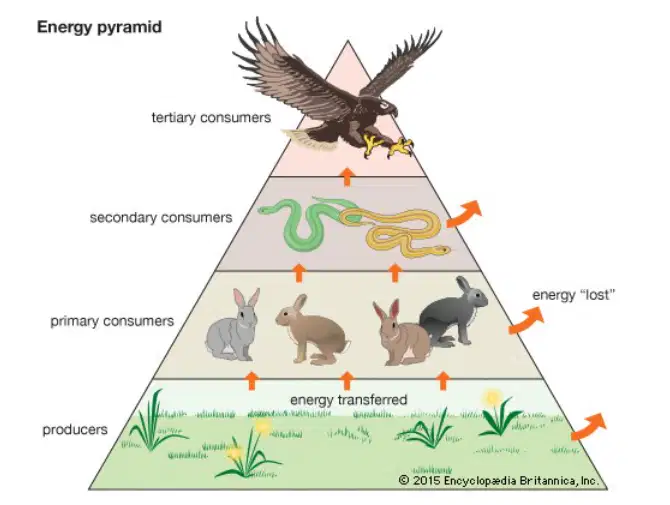
Kilocalories (kCal) is a measure of energy. If there are 50,000 kCal available for the producers, how much energy is available for the secondary consumers trophic level?
0 kCal
5 kCal
50 kCal
500 kCal
5000 kCal
How much energy is lost at each trophic level?
10%
20%
80%
90%
Steps in an ecosystem, comprising organisms that share the same function in the food chain and are the same number of steps away from the primary sources of energy are called _______________.
food chains
food levels
food webs
levels of organization
trophic levels
What is the original source of energy in an ecosystem?
Consumers
Decomposers
Producers
The Sun
Where the organisms will travel to

The food web below shows some of the feeding relationships among organisms in Arctic waters.
Which organism would be least affected by overfishing for cod in Arctic waters?
seals
shrimp
baleen whales
toothed whales

Which organisms are primary consumers in this food web?
tree, shrub, mountain lion
mountain lion and deer
squirrel, grasshopper, rabbit, deer
shrew, snake and rabbit
Where is the least amount of energy available in an energy pyramid?
The very bottom level (producers)
Secondary consumer level
The very top level (Apex predator)
Primary consumer level
How does available energy compare at different trophic levels?
Producers have less available energy than primary consumers
Producers have more available energy than primary consumers
Tertiary consumers have more available energy than secondary consumers
Primary consumers have less available energy than secondary consumers
Which would be the best way to show the total mass available at each trophic level?
A Biomass Pyramid
A Food Chain
Which would be the best way to identify the trophic level an organism belongs to in a food web?
determine who that organism eats
determine who eats that organism
determine where that organism lives
determine how many individuals lives in its population
The only organisms that can convert nitrogen in the atmosphere into a form useful to living things are nitrogen-fixing
plants
bacteria
insects
animals

Which numbered box represents a form of nitrogen that can’t be utilized by plants?
1
2
3
4
During photosynthesis, how is carbon moved?
This is released by the weathering of rocks.
Carbonate
Phosphate
Phosphorus
Nitrogen
What converts nitrogen gas into a usable form for plants and animals?
bacteria
rain
fungi
car exhaust
Which of the following explains the long term portion of the phosphorus cycle?
Phosphorus is stored in rocks, and it is slowly recycled back into the ecosystem through weathering and erosion.
Phosphorus is constantly cycled through the food chain starting at the producer level and working its way to the apex predator.
Phosphorus does not have a long term portion.
Phosphorus cannot be recycled and reused because it is a nonrenewable resource.

