
Font size
 Worksheets
science quiz
Total questions: 75
Worksheet time: 1hrs 29mins
What is combustion?
Combustion is a physical reaction that occurs when a fuel combines with oxygen to produce heat, light, and new chemical compounds.
Combustion is a biological process that occurs when a fuel combines with oxygen to produce heat, light, and new chemical compounds.
Combustion is a chemical reaction that occurs when a fuel combines with oxygen to produce heat, light, and new chemical compounds.
Combustion is a mechanical reaction that occurs when a fuel combines with oxygen to produce heat, light, and new chemical compounds.
What are the three types of combustion?
complete combustion, incomplete combustion, and spontaneous combustion
thermal combustion
chemical combustion
exothermic combustion
What are the stages of combustion?
ignition, propagation, and completion
ignition, termination, and completion
ignition, propagation, and continuation
ignition, propagation, and termination
Describe the structure of a flame.
A flame consists of one main part: the inner blue cone.
A flame consists of four main parts: the inner blue cone, the outer yellow cone, the non-luminous zone, and the luminous zone.
A flame consists of two main parts: the inner blue cone and the outer yellow cone.
A flame consists of three main parts: the inner blue cone, the outer yellow cone, and the non-luminous zone.
What are the products of combustion reactions?
carbon dioxide and water vapor
sulfur dioxide and nitrogen oxide
methane and oxygen
carbon monoxide and nitrogen dioxide
What is the importance of fire safety?
Fire safety is only important for protecting property, not lives.
Fire safety is not important because fires rarely happen.
Fire safety is important for preventing fires, protecting lives and property, and ensuring a safe environment.
Fire safety is only important in certain environments, not everywhere.
Explain the concept of complete combustion.
Complete combustion is a chemical reaction where a fuel combines with oxygen to produce carbon dioxide and water vapor.
Complete combustion is a chemical reaction where a fuel combines with oxygen to produce carbon dioxide and methane.
Complete combustion is a chemical reaction where a fuel combines with oxygen to produce carbon monoxide and water vapor.
Complete combustion is a chemical reaction where a fuel combines with nitrogen to produce carbon dioxide and water vapor.
What is the difference between a flame and a fire?
A flame is caused by a chemical reaction.
A flame is the visible, gaseous part of a fire.
A flame is a type of fire.
A flame is hotter than a fire.
What are the conditions necessary for combustion to occur?
Fuel, oxygen, and heat
Fuel, oxygen, and water.
Fuel, oxygen, and light.
Fuel, oxygen, and pressure.
How does fire spread?
Fire spreads through radiation.
Fire spreads through conduction.
Fire spreads through convection.
Fire spreads through a process called combustion.
In fractional distillation, hydrocarbons with the ____________(highest/lowest) boiling points condense first.
Highest
lowest
In destructive distillation, coal is heated strongly to about
10,000*C
5,000*C
1,000*C
100*C
Which fuel is used in jet aeroplanes?
kerosene
petrol
diesel
CNG
Coal mainly contains
carbon and hydrogen
carbon, nitrogen and oxygen
carbon, hydrogen and nitrogen
carbon
Which fuel is obtained from coal that is almost pure form of carbon is ____________.
coke
Coal tar
coal gas
Ammonium compounds
When heated in air, coal burns and produces mainly __________ .
Carbon Dioxide
Carbon Monoxide
Methane
Oxygen

Naphthalene balls are made from ______.
Coal Tar
Coke
Petroleum
Coal Gas
What is Synthesis Gas ?
CO + H2
CO2 + H2O
CH4 + SO2
CoSo4 + H2 + CO
Choose the correct statement from the following -
It is difficult to transport natural gas through pipes.
The disadvantage of natural gas is that it can not be used directly for burning in homes.
Natural gas cannot be used for power generation.
Natural gas is stored under high pressure as compressed natural gas
__________ resources is one obtained from nature
natural
artificial
____________ natural resources are those which are present in limited quality in nature
exhaustible
inexhaustible
___________ is mixture of various hydrocarbon and carbon monoxide
coal tar
coal gas
coke
coal
the liquefied form of dead organic matter is called crude oil that contains _________
coal
coke
petroleum
coal gas
coal tar contains ________________ with _____________________ smell
black thin liquid, unpleasant
black thick liquid, pleasant
black thin liquid, pleasant
black thick liquid, unpleasant
Which among the following is used in making perfumes?
Coke
Coal tar
Coal gas
Kerosene
Simarpreet is very conscious of pollution. So, to reduce the effect of pollution which fuel should she use for her vehicle?
Diesel
Petrol
CNG
LPG
Refining is
Extracting petroleum gas
Separation of various fractions of petroleum
Heating of coal
Sedimentation of fossil fuel

Fossil fuels are a _______________________.
renewable resource
unknown resource
nonrenewable resource
new resource
A gas which is found along with petroleum
Carbon dioxide
Water gas
Natural gas
Producer gas
The first oil well was drilled in
USA
UK
India
Iran
Full form of LPG
Light petroleum gas
Liquified petroleum gas
Long pipe of gas
Long petroleum gas
The main constituent of LPG is
methane
ethane
propane
butane
The chemical added to LPG to help detect its leakage is
isobutene
ethylamine
methyl mercaltan
ethyl mercaptan
excessive burning of fossil fuels release _______________ which traps __________________ in the atmosphere and causes ________________ .
oxygen , solar radiations , carbon dioxide
carbon dioxide , solar radiations , green house effect
carbon dioxide , solar energy , oxygen
oxygen , solar energy , greenhouse effect
green house effect , solar radiations , oxygen
Fractional distillation separates crude oil based on the different __________ of the molecules in the mixture
melting point
boiling point
freezing point
chemical reactivity
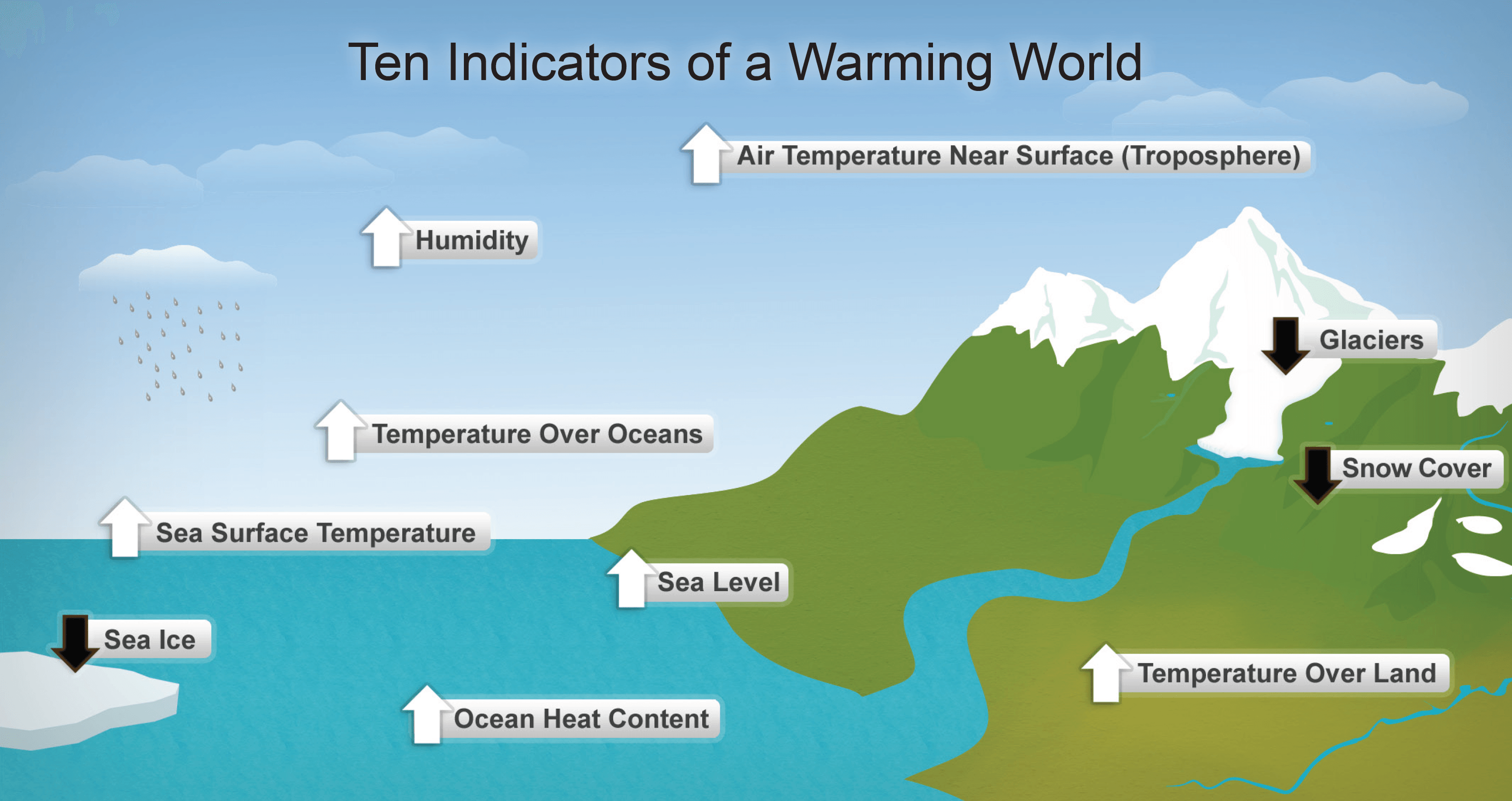
Which 2 greenhouse gases contribute the MOST to global warming of Earth?
N2O and H2O
O3 and H2O
CO2 and CH4
When an oil well is drilled through rocks, which of the following comes out first?
Coal Gas
Marsh gas
Natural gas
Carbon dioxide
Burning of charcoal in a closed room will produce
Carbon dioxide
Nitrogen dioxide
Carbon monoxide
Sulphur dioxide
Combustion is a reaction in which a substance reacts with
hydrogen
Nitrogen
Oxygen
Chlorine
Water cannot be used as a fire extinguisher to put out
Burning coal
Electrical fires
Burning wood
Forest fires
Which type of fire extinguisher should be used on a fire involving flammable liquids such as grease or oil?
Water
Carbon Dioxide
Dry Chemical
Foam
Cow dung cake is used to make (a) fuel which is eco friendly
(a) colour of the flame is caused due to the glow of unburnt carbon particles
Type of flame depends on the proportion of (a) available for combustion
Of all the fuels (a) has the highest calorific value but cannot be used because of its explosive nature
If the minimum temperature for a certain substance is very low then what is the substance called (a)
A type of combustion in which a material bursts into flame without application of heat is called (a) combustion
Fuel formed under the earth’s surface by the decomposition of organic matter is called
organic fuel
biogas
fossil fuel
underground fuel
CO2 is stored as a liquid in cylinder at
high pressure
low pressure
high temperature
low temperature
Magnesium burns with white dazzling light . Charcol burns producing heat and light.
First statement is true
second statement is true
both the statements are true
both the statements are false
Burning of white phosphorus is an example of
spontaneous combustion
rapid combustion
Explosive combustion
none of these
Name the liquid fuel which is highly inflammable.
(a)
Water is used to extinguish fire because it
raises the ignition temperature of a burning substance
lowers the ignition temperature of the burning substance
cools the burning substance to a temperature below its ignition temperature
conducts heat
Read the statements and select the correct option.
Statement 1: Kerosene oil and wood do not catch fire on their own at room temperature.
Statement 2: A combustible material cannot catch fire as long as its temperature is lower than the ignition temperature.
Both statements 1 and 2 are true and statement 2 is the correct explanation of statement 1.
Both statements 1 and 2 are true and statement 2 is not the correct explanation of statement 1.
Statement 1 is true and statement 2 is false
Both statements 1 and 2 are false
Match column 1 and column 2 and select the correct option from the given codes.
Column 1 Column2
P. Rusting i. Explosion
Q. Burning of paper ii. Spontaneous Combustion
R. Sodium iii. Rapid Combustion
S. Fire Crackers iv. Slow combustion
P-ii, Q-iii, R-i, S-iv
P-i, Q-iii, R-ii, S-iv
P-iii, Q-iv, R-i, S-ii
P-iv, Q-iii, R-ii, S-i
A fire can be controlled by
lowering the ignition temperature
cutting off the supply of supporter of combustion
both a and b
neither a nor b
The burning of LPG is an example of
rapid combustion
spontaneous combustion
slow combustion
explosion
List the conditions which are necessary for combustion to take place.
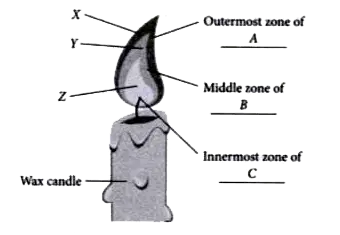
Label the given parts of candle flame in the given picture.
Define flame.
Define rapid and explosion combustion with an example
Describe how coal is formed from dead vegetation. What is this process called?
Suggest four ways to conserve coal and petroleum
What are the uses of petrochemical? Why does petroleum called black gold?
Name few pollutants produced by combustion of fuels and mention their harmful effects.
Can the process of rusting be called combustion? discuss.
Explain how CO2 is able to control fire.
Define the terms:a) calorific value
b) combustion
c) global warming
d) green house effect
e) carbonisation
Why food isa called fuel for our body?

