

wayground logo

Free Printable Worksheets

NEW

Font size

S
M
L
XL
Worksheets

Matter Review

Total questions: 48

Worksheet time: 23mins

Name
Class
Date
1.
A pure substance containing only one kind of atom.
a)
element
b)
mixture
c)
compound
2.
Can only be separated by chemical means.
a)
element
b)
mixture
c)
compound
3.
This picture represents which of the following?
a)
element
b)
compound
c)
mixture
4.
This picture represents which of the following?
a)
element
b)
compound
c)
mixture
5.
Physical or Chemical?  Water is nonflammable
a)
Physical
b)
Chemical
c)
Neither
6.
Physical or Chemical Property? If copper comes in contact with water, it will turn green.
a)
Physical
b)
Chemical
c)
Neither
7.
Physical or Chemical Property?  The temperature of boiling water is 100 degrees Celsius.
a)
Physical
b)
Chemical
c)
Neither
8.
Physical or Chemical Property?  The solid form of water is ice.
a)
Physical
b)
Chemical
c)
Neither
9.
What is matter?
a)
Any subtance that doesn't take up space or have mass.
b)
Any substance that takes up space or have mass.
c)
Any substance that exists on Earth.
d)
Any substance that exists in space.
10.
Boiling point,melting point, and density are some of an element's
a)
pure properties
b)
physical properties
c)
chemical properties
11.
A mixture that appears to be evenly mixed throughout:
a)
an atom
b)
a compound
c)
a homogeneous mixture
d)
a heterogeneous mixture
12.
 mixture that does NOT appear to be evenly mixed throughout:
a)
an atom
b)
a compound
c)
a homogeneous mixture
d)
a heterogeneous mixture
13.
Which of these is an example of a chemical property?
a)
density
b)
melting point
c)
ductility
d)
flammability
14.
Can a mixture be separated? 
a)
No
b)
Yes
c)
Only sometimes
15.
An example of a physical change would be a change in...
a)
Color
b)
Shape
c)
Size
d)
All of the above 
16.

What is the tiniest representative particle of matter within the entire universe?

a)

cells

b)

gases

c)

atoms

d)

liquids

17.

What do we call a substance composed of atoms of a singular type?

a)

cell

b)

proton

c)

element

d)

atom

18.

Which term represents the particle that is formed when 2 or more atoms come together as one?

a)

atoms

b)

elements

c)

molecules

d)

compounds

19.

What is the term used for the substances that are formed when 2 or more atoms from differing elements come together?

a)

atoms

b)

elements

c)

molecules

d)

compounds

20.

What does this picture portray?

a)

atom of an element

b)

elemental substance

c)

molecule of a compound

d)

compound

21.

What does this picture portray?

a)

atom of an element

b)

element

c)

molecule of an element

d)

compound

e)

molecule of a compound

22.

Are these molecules of elements, compounds or mixtures?

a)

elements

b)

compounds

c)

mixtures

23.

Are these molecules also compounds?

a)

YES

b)

NO

24.
What is gold?
a)
element
b)
compound
c)
mixture
25.

What is sugar? (C6H12O6)

a)

element

b)

compound

c)

mixture

26.

This picture represents a type of substance known as a ....

a)

mixture

b)

homogeneous mixture

c)

compound

d)

heterogeneous mixture

27.

Grape juice is classified as a ....

a)

Element

b)

Compound

c)

Heterogenous mixture

d)

Homogeneous mixture (solution)

28.

Type of mixture that has the SAME COMPOSITION in every part.

a)

Homogenous

b)

Heterogeneous

29.

Type of mixture that DOESN'T HAVE the same composition in every part.

a)

Homogeneous

b)

Heterogeneous

30.
Which of the following formulas contains 4 different kinds of elements?
a)
NaCl
b)
CaNO3
c)
NH4Br
d)
CO(NH2)2
31.

Which compound is best represented by this particle diagram?

a)

NH3

b)

H2O

c)

CH4

d)

HCl

32.

Which compound is best represented by this particle diagram?

a)

C2H6

b)

C6H12O6

c)

CO2

d)

NaCl

33.

How many types of atoms are in K₂SO₄

a)

7

b)

3

c)

2

d)

4

34.

How many total atoms are in K₂SO₄

a)

7

b)

2

c)

4

d)

3

35.

The energy of movement is ___.

a)

potential energy

b)

kinetic energy

c)

mechanical energy

36.

The more energy that particles have, the ___ they move.

a)

slower

b)

faster

37.

The force of attraction between molecules is ___.

a)

intermolecular forces

b)

bridge forces

c)

chemical bonds

38.

These properties describe a ___.

a)

solid

b)

liquid

c)

gas

39.

These properties describe a ___.

a)

solid

b)

liquid

c)

gas

40.

These properties describe a ___.

a)

solid

b)

liquid

c)

gas

41.

Liquid particles have more energy than ___ particles.

a)

solid

b)

gas

42.

The particles of ___ generally have the least amount of energy.

a)

solids

b)

liquids

c)

gases

43.
Gas molecules can easily be compressed  because ___________. 
a)
gas molecules are soft
b)
gas molecules are far apart
c)
gas molecules follow the shape of the container
44.

The kinetic theory states

a)

Particles won't move if you don't apply energy to it.

b)

Particles only move in liquids and gases.

c)

Particles are always in motion.

d)

At the same temperature the object that has the most mass heats quicker.
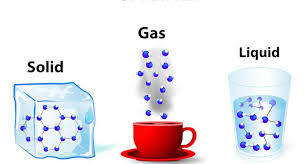
45.
In which state of matter are the particles moving the least random
a)
Gas
b)
Liquid
c)
Solid
d)
Plasma
46.
In which state of matter are the particles only vibrating?
a)
Gas
b)
Liquid
c)
Solid
d)
Plasma
47.
The slower the particles in a substance move,
a)
the colder it is.
b)
the warmer it is.
c)
the more energy it has.
d)
the less energy it has.
48.
Of these three states of matter, which one has the most kinetic energy? 
a)
Solid 
b)
Liquid 
c)
Gas
