
 Worksheets
BIO 189 - Practice final
Total questions: 90
Worksheet time: 1hrs 22mins
What are the DNA base pairing rules discovered by Erwin Chargaff?
Guanine pairs with Thymine
Adenine pairs with Cytosine
Guanine pairs with Cytosine
Adenine pairs with Thymine
Guanine pairs with Guanine
Adenine pairs with Adenine
Guanine pairs with Adenine
Thymine pairs with Cytosine
Select ALL of the rules that are part of Chargaff's rules for base pairing
% Adenine =
% Thymine
% Guanine -
% Thymine = 50%
% Guanine =
% Cytosine
% Cytosine +
% Thymine = 50%
A section of DNA contains 22% guanine.
What percent of the DNA will be cytosine?
A section of DNA contains 15% thymine.
What percent of the DNA will be cytosine?
If Cytosine makes up 20% of the bases in a DNA helix, what percent of the bases are Thymine?
Match the scientist with their important discovery about DNA
Rosalind Franklin
Took X-Ray pictures of DNA
Erwin Chargaff
Determined DNA base paring rules
Watson and Crick
Built the first accurate model of DNA
Hershey and Chase
Showed DNA was the hereditary material
Which scientist(s) were the first to build an accurate model of DNA?
Hershey and Chase
Watson and Crick
Rosalind Franklin
Erwin Chargaff
Which scientist(s) discovered that DNA is the genetic material that is passed from generation to generation?
Hershey and Chase
Rosalind Franklin
Watson and Crick
Erwin Chargaff
Last name of scientist who took X-ray images of DNA, which helped prove that DNA is a double helix shape.
(a)
Type of bond that holds together the 2 nucleotides in a base pair
Covalent bond
Ionic bond
Hydrogen bond
Friendship bond
Pair the DNA nucleotides according to base pairing rules
Guanine
Cytosine
Thymine
Adenine
Adenine
Thymine
Cytosine
Guanine
Which nitrogenous base is a component of DNA nucleotides, but NOT RNA nucleotides?
The base pairing rules for DNA to RNA are:
DNA Adenine base pairs with RNA (a)
DNA Cytosine base pairs with RNA (b)
DNA Guanine base pairs with RNA (c)
DNA Thymine base pairs with RNA (d)
The nucleotide sequence of a section of DNA is: 3' ATTGGGCTA 5'
What is the RNA sequence?
(a)
Label the chemical components of the nucleotide
nitrogenous base
phosphates
5-carbon sugar
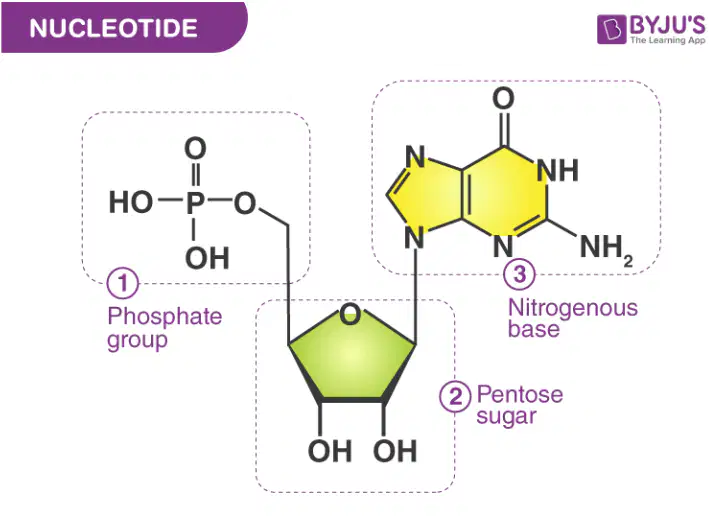
The are 4 DNA nucleotides. What chemical component makes each nucleotide different?
Phosphate groups
5-carbon sugar
Nitrogenous base
Select the chemical component that determines the difference between nucleotides.
Double helix
Single-stranded
Located in nucleus
Can move between nucleus and cytoplasm
Made of nucleotides C, G, A, and T
Made of nucleotides C, G, A, and U
A temporary copy of a gene
Genetic material passed from parents to offspring
Sort the steps of DNA replication in order
Two strands of DNA unwind
Primase creates primers
DNA polymerase assembles a new DNA strand
Ligase seals gaps in DNA
Two DNA double helices are formed
Enzyme involved in DNA replication that joins together nucleotides to form a new strand of DNA.
DNA polymerase
RNA polymerase
Primase
Ligase
Enzyme involved in DNA replication that creates primers.
DNA polymerase
RNA polymerase
Primase
Ligase
Why are primers needed for DNA replication?
Primers unwind the two strands of DNA
Primers prevent mutations
Primers act as a starting point for DNA polymerase
Primers cut out introns
Enzyme involved in DNA replication that creates seals together gaps in the new DNA strands.
DNA polymerase
RNA polymerase
Primase
Ligase
At the end of DNA replication the DNA helicies produced are made of one old DNA strand and one new DNA strand.
What is the term that represents this characteristic of DNA replicaiton?
Semiconservative
Demisynthetic
Dual strand synthesis
Noncomplementary
Match the type of RNA with its function
Carries amino acids to the ribosome during translation
tRNA
A temporary copy of a gene
mRNA
Component of ribosomes
rRNA
Type of RNA that carries amino acids to the ribosome during translation
(a)
Process of creating an mRNA copy of a gene.
Splicing
Translation
Transcription
Decoding the instructions in mRNA to produce a protein.
Splicing
Translation
Transcription
During mRNA splicing, (a) are removed, while (b) remain and code for a protein.
Unit of information encoded in the sequence of nucleotide bases in DNA
(a)
Process of turning "on" a gene, so that information from a gene is converted into a protein.
(a)
Enzyme that catalyzes transcription.
DNA polymerase
Primase
Ligase
RNA polymerase
Enzyme that catalyzes translation.
Ribosome
RNA polymerase
DNA polymerase
Ligase

RNA polymerase is required for which step of gene expression?
(a)
Three nucleotide sequence that is part of mRNA.
Intron
Anticodon
Codon
Exon
Three nucleotide sequence that is part of tRNA, and is complementary to an mRNA codon
Anticodon
Codon
Intron
Exon
Codons are three nucleotide sequences in (a) that are read by ribosomes.
Anticodons are three nucleotide sequences in (b) that are complementary to codons.
Order the following in terms of levels of organization (highest level of organization at the top)
Sister chromatid
Chromosome
DNA
Nucleotide
In humans, what are the typical sex chromosomes for most males?
(a)
In humans, what are the typical sex chromosomes for most females?
(a)
How many chromosomes are in a human diploid cell?
How many chromosomes are in a human haploid cell?

Most humans have (a) pairs of chromosomes, which includes (b) pair(s) of sex chromosomes and (c) pair(s) of autosomes.

What is the term for this type of image, which shows an individual's chromosomes in an organized image?
Chromosomes that are the same in males and females and are not involved in sex determination.
Sex chromosomes
Autosomes
Somatic cells
Nucleus
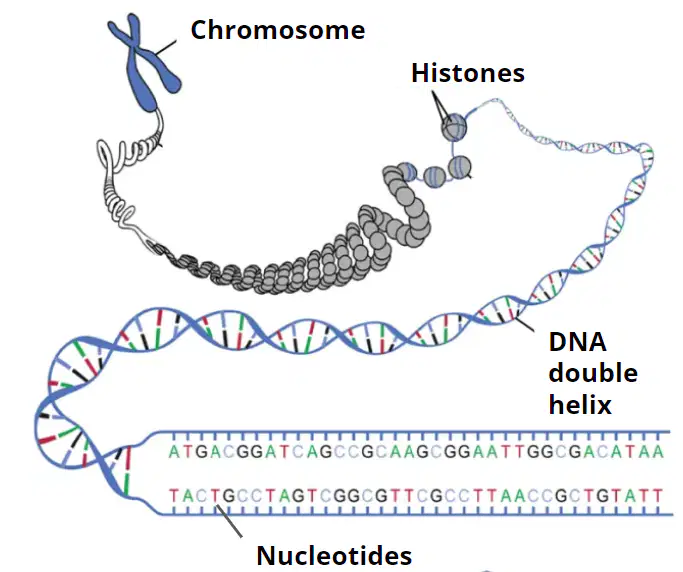
The structure that consists of DNA wrapped and organized around proteins
(a)
Proteins that organize DNA in chromosomes.
Enzymes
Histones
Microtubules
Ribosomes
Exposure to UV light can cause what kind of DNA damage?
Deletions
Nucleotide dimers
Insertions
Translocations
What is a mutation?
Any harmful event that damages a cell's DNA
Changes in the amino acid sequence of a protein that cause disease
Temporary changes in the nucleotide sequence of a gene
Permanant changes in the DNA sequence of a chromosome
Mutations where a single DNA nucleotide is exchanged for a different nucleotide.
Insertion
Deletion
Base-pair substitution
Frameshift
What kind of mutation is this?
Original DNA: AAA TTT CCC
Mutated DNA: AAA TAT CCC
Insertion
Deletion
Base-pair substitution
What kind of mutation is this?
Original DNA: CCGGAA
Mutated DNA: CCTGGAA
Insertion
Deletion
Base-pair substitution
Chromosomes that are the same length and carry the same set of genes
Mitosis creates (a) daughter cells, which are genetically (b) .
Meiosis creates (c) daughter cells, which are genetically (d) .
Type of cell division where a diploid parent cell creates haploid daughter cells.
(a)
First human immortal cell line, which was important for development of vaccines against polio and COVID-19.
(a)
Most of a cell's life is spent in (a) .
When chromosomes fail to separate during meiosis.
deletion
frameshift mutation
homologous chromosome
nondisjunction
Match the phase of the cell cycle to the description.
G1 phase
Cell growth
S phase
DNA replication
G2 phase
Cell prepares to divide
M phase
Mitosis and cytokinesis
Two copies of the same chromosome, held together by a centromere.
Sister chromatids
Sistermeres
Centrioles
Homologous chromosomes
Select ALL of the processes that occur during interphase
Cell grows in size
DNA replication
Separation of sister chromatids
Duplication of organelles
Sort the phases of mitosis in order
Prophase
Metaphase
Anaphase
Telophase
Match the description to the phase of mitosis
Chromosomes condense, spindle fibers form
Prophase
Chromosomes line up in the middle of the cell
Metaphase
Sister chromatids are pulled apart to opposite ends of the cell
Anaphase
Formation of two new nuclear envelopes
Telophase
The first round of meiosis is Meiosis I, where (a) separate.
The second round of meiosis is Meiosis II, where (b) separate.
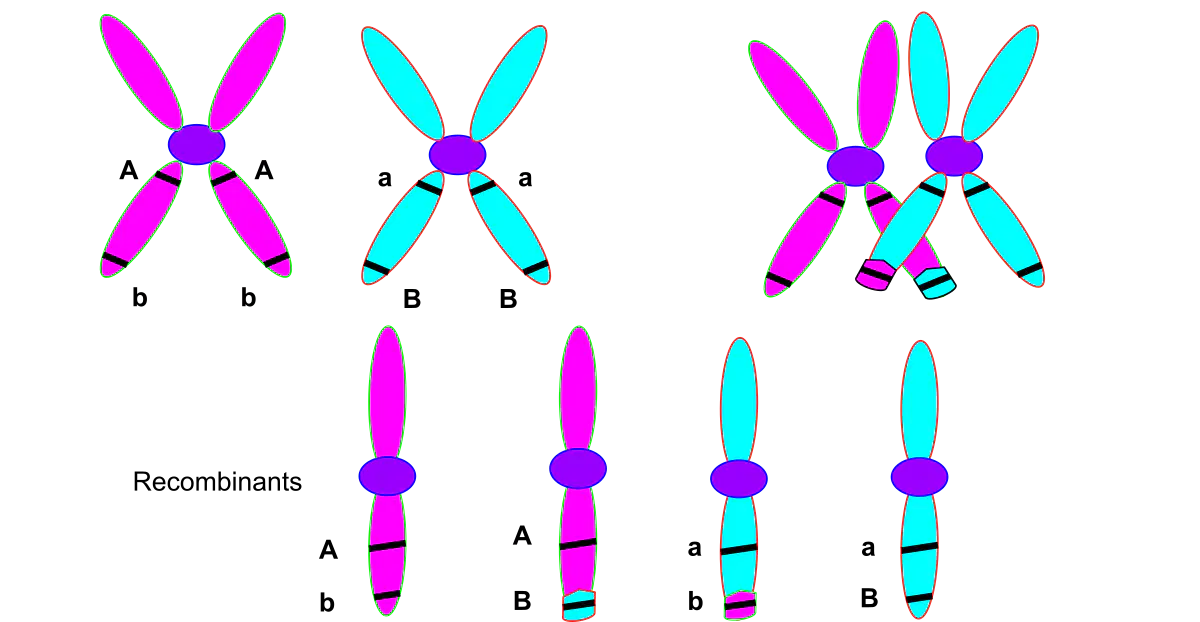
Process that occurs during meiosis that produces genetic variation by creating new combinations of alleles
Mutation
Anaphase
Fertilization
Crossing over
Genes that increase cell cycle progression. These genes are commonly over-active in cancer cells.
Tumor suppressor
Oncogene
Nondisjunction
Missense mutation
Which of the following is an example of homozygous recessive genotype?
AA
Aa
aa
An individual with two copies of the same allele for a trait is (a) .
An individual's combination of alleles is its (a) .
The observable traits of an individual is its (b) .
Label the pedigree
Female without trait
Male with trait
Male without trait
Male carrier
Female with trait
A trait that is determined by more than one gene.
Complicated
Codominant
Polygenic
Polyploid
Which step of cellular respiration produces the most ATP?
electron transport chain
fermentation
Krebs cycle
glycolysis
What is the process of creating an mRNA copy of a gene called?
translation
transcription
replication
mutation


Hemophilia is an X-linked recessive trait. The Punnett square depicts mating a female who carries hemophilia with a male showing no symptoms.
What is the correct way to complete the missing square in the Punnett square?
XH XH
Xh XH
XH Y
Xh Y
Colorblindness is a recessive trait carried on the X chromosome.
Label the phenotypes of the potential offspring of a mating between a colorblind male and a carrier female.
normal female
normal male
colorblind male
colorblind female
carrier female
carrier male
What is the enzyme that carries out transcription?
Ribosome
RNA polymerase
Ligase
DNA polymerase
What does it mean for cells to be "malignant"?
Normal cells
Evil cells
Benign cells
Cancerous cells
What error during meiosis can lead to genetic disorders caused by chromosomal abnormalities, such as Down Syndrome?
Base-pair substitution mutations
Crossing over
Nondisjunction
Frameshift mutations
Meiosis is two rounds of cell division.
The first round of cell division is called (a) , and this is when (b) separate.
The second round of cell division is called (c) , and this is when (d) separate.
Genes that push the cell cycle forward.
Oncogenes
Tumor suppressor genes
Select ALL of the activites that take occur while a cell is in interphase.
Duplicated chromosomes separate
DNA is copied
New organelles are produced
Cell grows larger
Diploid means (a) of chromosomes. In most humans, diploid cells contain (b) chromosomes.
Haploid means (c) of chromosomes. In most humans, haploid cells contain (d) chromosomes.
Which option has the highest level of organization?
DNA
Chromosomes
Sister chromatids
What phase of the cell cycle is when DNA is replicated?
What happens during S phase of the cell cycle?
How many daughter cells are produced in mitosis?
Height in humans if controlled by many genes. This is an example of a(n) ______.
If someone is a carrier of an autosomal recessive genetic disease, what is their genotype?
heterozygous (Aa)
it depends on the disease
homozygous recessive (aa)
homozygous dominant (AA)

