
Font size
 Worksheets
Cell Structure and Function Quiz
Total questions: 49
Worksheet time: 37mins
What is the function of a cell nucleus?
Produce proteins
Store and protect DNA
Control cell division
Generate energy for the cell
What is the main function of the endoplasmic reticulum?
The main function of the endoplasmic reticulum is to produce energy for the cell.
The main function of the endoplasmic reticulum is to store genetic information.
The main function of the endoplasmic reticulum is to regulate cell division.
The main function of the endoplasmic reticulum is to synthesize proteins and lipids, and to transport these molecules to other parts of the cell.
What is the primary function of the cell membrane?
Produce energy for the cell
Store genetic information
Regulate the movement of substances
Maintain cell shape
Which organelle contains DNA and controls the activities of the cell?
nucleus
endoplasmic reticulum
mitochondria
ribosome
What is the function of mitochondria in a cell?
Generating energy
Producing proteins
Regulating cell division
Storing genetic information
Which organelle is responsible for synthesizing lipids and detoxifying harmful substances?
nucleus
mitochondria
ribosomes
smooth endoplasmic reticulum
What is the role of the Golgi apparatus in the cell?
The Golgi apparatus is responsible for energy production in the cell.
The Golgi apparatus stores genetic information in the cell.
The Golgi apparatus helps in cell division and replication.
The Golgi apparatus modifies, sorts, and packages proteins and lipids.

Identify the cholesterol molecule.
Structure A
Structure B
Structure H
Structure I

Identify a glycolipid:
Structure A
Structure D
Structure E
Structure G

Identify a peripheral protein
structure a
structure b
structure g
structure h
Which describes the polarity of phospholipids?
Hydrophilic head facing exterior, hydrophobic fatty acid tails face interior
Hydrophilic head facing interior, hydrophobic fatty acid tails face exterior
Both polar head and fatty acid tails are hydrophobic
Both polar head and fatty acid tails are hydrophilic
Plasma membranes are selectively permeable. This means:
Anything can pass in and out
The membrane regulates the passage of the material in and out of the cell
Glucose cannot enter the cell
Cholesterol cannot enter

Which one is the hydrophilic (water-loving) portion of the plasma membrane that can mix with water?
A
B
Phospholipid heads contain...
Amino group and fatty acids
Phosphate group and glycerol
Amino group and glycerol
Phosphate group and fatty acids
The function of cholesterol in the plasma membrane is...
Material transport
Maintaining fluidity at different temperatures
Cell-to-cell recognition
The plant cell wall is made up of ______, which makes it thicker than the plasma membrane.
Cellulose
Chitin
Glycogen
Phospholipids are amphipathic. What does this mean?
Neither attract water nor repel water
Both attract water and repel water
Attract water
Repel water
Why does the fluid mosaic model represent a plasma membrane well?
Fluid = unable to maintain fluidity at different temperatures
Fluid = ability to move and shift
Mosaic = contains multiple macromolecules
Mosaic = contains many different proteins
Which type of organisms are Prokaryotes?
Animals
Plants
Fungi
Bacteria
This is found in plant cells but not in animal cells and provides protection
Cell Membrane
Nucleus
Mitochondria
Cell Wall
What is the main difference between prokaryotic and eukaryotic cells?
Prokaryotic cells have a nucleus and Eukaryotic cells do not
Prokaryotic cells are unicellular and Eukaryotic cells are multicellular.
Prokaryotic cells do not have a nucleus, Eukaryotic cells do have a nucleus.
Prokaryotic cells are plant cells and Eukaryotic cells are animal cells.

Which organelle, found in both plant and animal cells, converts sugars into energy?
Mitochondria
Cell Wall
Cell Membrane
Vacuole

What is this structure?
Chloroplast
Nucleus
Mitochondria
Vacuole
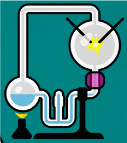
This experiment was conducted by which scientists?
Stanley Miller and Harold Urey
Harold Urey and Albert Einstein
Harrison Ford and Denzel Washington
James Watson and Francis Crick

Which question were the scientists trying to answer with this experiment?
Where do cells come from?
Which came first, the chicken or the egg?
How are biomolecules formed?
What gave rise to the Eukaryotic cell?
What was the apparatus in the experiment used to mimic?
Proteins
Earth's present conditions
Early Earth's conditions
They didn't mean to mimic anything in particular
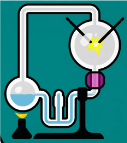
What does the gas in the apparatus mimic?
space
time
stars
atmosphere
What did the electrical sparks mimic?
Heat waves
Lightning
Volcano
Hurricane
The water used in the apparatus was used to mimic which part of early Earth?
sea
swimming pool
ocean
rain
What does the rough ER do?
Transports and modifies proteins
Transports and modifies lipids
Transports and modifies carbohydrates
Secretes proteins out of the cell
What does the Golgi body do?
Receives proteins from vesicles, tags them, then secretes them out of the cell.
Makes proteins and moves them around the cell.
Makes lipids and moves them around the cell.
Receives vesicles from outside of the cell and destroys their contents with enzymes.
What is the correct order for the endomembrane system journey?
Ribosome --> smooth ER --> vesicle --> lysosome
Ribosome --> rough ER --> vesicle --> golgi body --> vesicle --> outside of the cell
Ribosome --> golgi body --> smooth ER --> vesicle --> rough ER
Ribosome --> rough ER --> golgi body --> outside of the cell
What is a vast internal network of channels separated from the rest of the cytoplasm by membranes?
Ribosomes
Golgi Apparatus
Endoplasmic Reticulum
Nucleus
The Endosymbiotic Theory explains:
the origin of prokaryotes
how bacteria live
the origin of eukaryotes
how species develop
_____ and _____ are organelles that arose from endosymbiosis
nucleus and cell membrane
mitochondria and chloroplasts
cell wall and chloroplasts
mitochondria and nucleus
Which of the following is evidence to support the endosymbiotic theory?
Mitochondria and chloroplasts have their own DNA, which is similar to prokaryotic DNA.
Fossil evidence shows that the first forms of life were prokaryotic cells.
All eukaryotic cells have a double-layered membrane composed of phospholipids and proteins.
Prokaryotes have the same number and types of enzymes as eukaryotes.
Which type of cell does NOT contain membrane-bound organelles?
plant cells
animal cells
prokaryotic cells
eukaryotic cells

Plant Cell

Bacteria Cell

Animal Cell
* All cells have
* DNA, Cytoplasm, Ribosomes
* Smaller simple cells no nucleus
* Prokaryote
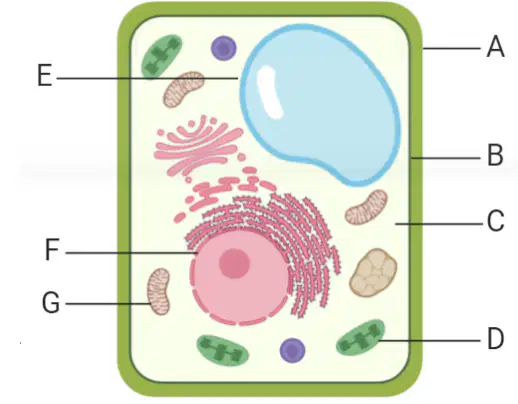
Which labeled cell structure is also found in animal cells?
D
G
E
A
What cell structure, used for movement, can be found in both prokaryotes and eukaryotes?
pili
flagellum
cell membrane
pseudopod
Which statement best describes the function of the mitochondria?
Directs all cell activities
Conducts cellular respiration to create ATP
Collects sunlight for photosynthesis
Storage center for unused materials
Another form of DNA found in prokaryotic cells is...
nucleoid
plasmid
ribosomal
cytoplasmic

Which parts are found in all prokaryotic and eukaryotic cells?
cytoplasm
ribosome
cell membrane
DNA
nucleus

In eukaryotic cells, which organelle is a specialized vesicle containing hydrolytic enzymes that can break down old cell parts and food?
vacuole
mitochondria
golgi apparatus
nucleolus
lysosome
In eukaryotic cells, which organelle produces the building blocks of ribosomes?
Smooth endoplasmic reticulum
Nucleus
Nucleolus
Cytoskeleton
Rough endoplasmic reticulum
What do prokaryotic cells have in place of a nucleus?
nucleus
nucleoid region
membrane-bound organelles
plasmids
What do animal cells have that plant cells don't?
centrioles
chloroplasts
endoplasmic reticulum
golgi bodies
How does the size of prokaryotic cells compare to eukaryotic cells?
Prokaryotic cells are much smaller than eukaryotic cells.
Eukaryotic cells are typically smaller than prokaryotic cells.
Prokaryotic cells can be the same size as eukaryotic cells if they grow under the right conditions.
Prokaryotic and eukaryotic cells are the same size.

