
 Worksheets
CH 19 Aldehydes and Ketones
Total questions: 93
Worksheet time: 47mins

What is the correct structure for 5-methyl-4-octanone?
I
II
III
IV
V
Name the aldehyde or ketone that is found in nail polish remover.
ethanol
2-butanone
acetone
formaldehyde
diethyl ether
Name the aldehyde or ketone that is used as a preservative.
ethanol
2-butanone
acetone
formaldehyde
diethyl ether

What is the IUPAC name for the following compound?
2-methyl-5-heptanone
7-methyl-4-octanone
6-isopropyl-4-octanone
isobutyl propyl ketone
1,1-dimethyl-4-heptanone

What is the IUPAC name for the following compound?
2,5-dimethyl-6-hexanal
2,5-dimethylhexanal
1,4-dimethylpentanal
1,4-dimethylhexanal
none of these
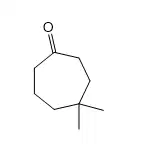
What is the IUPAC name for the following compound?
5,5-dimethyl-2-heptanone
5,5-dimethylcycloheptanone
5,5-dimethylcycloheptanone
3,3-dimethylcycloheptanone
1,1-dimethyl-4-cycloheptanone
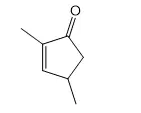
What is the IUPAC name for the following compound?
2,4-dimethyl-2-pentenone
2,5-dimethylcyclopenten-3-one
2,4-dimethylcyclopent-2-enone
3,5-dimethylcyclopent-2-enone
2-methyl-5-methylcyclopent-2-enone

What is the IUPAC name for the following compound?
4-benzylbutanal
3-phenylpropanal
3-benzylpropanal
4-phenylbutanal
2-benzylethanal

What is the structure for 5-hydroxy-2-phenyl-3-hexanone?
I
II
III
IV
V

What is the IUPAC name for the following compound?
(S)-2-methyl-2-bromobutanone
(S)-2-bromo-2-methylcyclobutanone
(R)-2-bromo-2-methylcyclobutanone
(S)-1-bromo-1-methyl-2-cyclobutanone
(R)-1-bromo-1-methyl-2-cyclobutanone

What is the correct structure for 3-methyl-5-(4-chlorophenyl)hexanal?
I
II
III
IV
V

Provide the structure for 7-bromo-1-octyn-4-one.
I
II
III
IV
none of these

What is the IUPAC name for the following compound?
4-oxo-5-phenyl-2-hexanol
5-hydroxy-2-phenyl-3-hexanone
2-hydroxy-5-phenyl-4-hexanone
2-hydroxypropyl-1-phenylethyl ketone
5-hydroxy-3-keto-2-phenylhexane

What is the IUPAC name for the following compound?
(R)-6-bromo-2-heptanal
(S)-6-bromo-2-heptanal
(R)-6-bromo-2-heptanone
(S)-6-bromo-2-heptanone
(R)-2-bromo-6-heptanone

What is the IUPAC name for the following compound?
5-cyclohexyl-2-hexanal
5-cyclohexyl-2-hexanone
5-cyclohexyl-5-methyl-2-pentanone
5-(1-methylcyclohexyl)-2-pentanone
4-(1-methylcyclohexyl)-2-butanone

Predict the product for the following reaction.
hexanal
hexanoic acid
2-hexanone
2-chlorohexane
1-hexanol

Predict the product for the following reaction.
hexanal
hexanoic acid
2-hexanone
2-chlorohexane
1-hexanol

Predict the product for the following reaction.
hexanal
hexanoic acid
2-hexanone
2-chlorohexane
1-hexanol

Predict the product for the following reaction.
hexanal
hexanoic acid
2-hexanone
2-chlorohexane
1-hexanol

Predict the product for the following reaction.
hexanal
hexanoic acid
2-hexanone
2-chlorohexane
1-hexanol

Predict the product for the following reaction.
I
II
III
IV
V

Predict the product for the following reaction.
I
II
III
IV
V

Predict the product for the following reaction.
3-methyloctanone
3-methyloctanal
2-methyloctanone
2-methyloctanal
2-methyloctanoic acid

Predict the product for the following reaction.
3-methyloctanone
3-methyloctanal
2-methyloctanone
2-methyloctanal
2-methyloctanoic acid

Predict the product for the following reaction.
I
II
III
IV
V

Compound A on ozonolysis yields acetophenone and propanal. What is the structure of compound A?
2-phenyl-2-pentene
1-phenyl-1-hexene
1-phenyl-2-pentene
2-phenyl-2-hexene

Compound A on ozonolysis yields the following two products What is the structure of compound A?
I
II
III
IV
None of these

Compound A on ozonolysis yields 2,6-heptanedione. What is the structure of compound A?
1,2-dimethylcyclohexene
2,6-dimethylcyclohexene
1,5-dimethylcyclopentene
1,2-dimethylcyclopentene
2-methyl-1-cyclopentene

Predict the product for the following reaction.
I
II
III
IV
V

Predict the product for the following reaction.
cyclopentene
cyclopentanol
cyclopentanal
cyclopentanone
none of these

Predict the product for the following reaction.
I
II
III
IV
V

Predict the major product for the following reaction.
I
II
III
IV
None of these
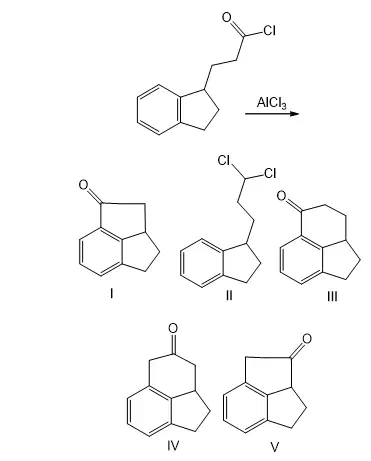
Predict the product for the following reaction.
I
II
III
IV
V

Which of the following reactions will produce acetophenone as a major product?
I
II
III
IV
All of these

Which of the following compounds is most reactive towards a nucleophilic addition reaction?
I
II
III
IV
V

Which of the following compounds is least reactive towards a nucleophilic addition reaction?
I
II
III
IV
V

Which of the following compounds is least reactive towards a nucleophilic addition reaction?
I
II
III
IV
Both I & IV

Rank the following compounds in decreasing order (most to least) of reactivity towards a nucleophilic addition reaction.
I > II > III > IV > V
II > IV > V > III > I
III > I > V > IV > II
I > III > II > IV > V
V > IV > II > III > I
Which of the following statements is consistent with the mechanism for the nucleophilic addition of aldehydes/ketones under basic conditions?
a proton transfer followed by a nucleophilic attack
a nucleophilic attack followed by a proton transfer
nucleophilic attack is the only step
proton transfer is not required
Which of the following statements is consistent with the mechanism for the nucleophilic addition of aldehydes/ketones under acidic conditions?
a proton transfer followed by a nucleophilic attack
a nucleophilic attack followed by a proton transfer
nucleophilic attack is the only step
proton transfer is not required
A compound with two OH groups attached to the same carbon is known as ______.
an acetal
a hemiacetal
a hydrate
a vicinal hydrate
none of these
A compound with an OH and an OR group attached to the same carbon is known as ______.
an acetal
a hemiacetal
a hydrate
a vicinal hydrate
none of these
A compound with two OR groups attached to the same carbon is known as ______.
an acetal
a hemiacetal
a hydrate
a vicinal hydrate
none of these

Which of the following compounds can be classified as an acetal?
I
II
III
IV
none of these

Which of the following compounds can be classified as a hemiacetal?
I
II
III
IV
none of these

Predict the product for the following reaction.
I
II
III
IV
none of these

Predict the product for the following reaction.
I
II
III
IV
none of these

Predict the product for the following reaction.
I
II
III
IV
V

Provide the structure of the product, when cyclohexanecarbaldehyde reacts with excess 2-propanol in the presence of sulfuric acid.
I
II
III
IV
V

Predict the product for the following reaction.
I
II
III
IV
V

Predict the product for the following reaction.
I
II
III
IV
V

Predict the product for the following reaction.
I
II
III
IV
V

Which one of the following pairs of compounds will yield the following product in the presence of sulfuric acid?
I
II
III
IV
V

Predict the product when pentanal reacts with CH3NH2 in the presence of an acid catalyst.
I
II
III
IV
V

Predict the product, when 4-methyl-2-hexanone reacts with hydrazine in the presence of an acid catalyst.
I
II
III
IV
V

Predict the product, when 4-methyl-2-hexanone reacts with methylamine in the presence of an acid catalyst.
I
II
III
IV
V

Predict the product for the following reaction.
I
II
III
IV
V

Predict the product for the following reaction.
I
II
III
IV
V

Predict the product, when cyclopentanecarbaldehyde reacts with phenylhydrazine (PhNHNH2) in the presence of an acid catalyst.
I
II
III
IV
V

Predict the product for the following reaction.
I
II
III
IV
V

Predict the product for the following reaction sequence.
I
II
III
IV
V

Predict the product for the following reaction sequence.
I
II
III
IV
V

Provide the product for the following reaction.
I
II
III
IV
V

Predict the product for the following reaction.
I
II
III
IV
V

Predict the product for the following reaction.
I
II
III
IV
V

Provide the major product for the following reaction sequence.
I
II
III
IV
V

Predict the product(s) for the following reaction.
I
II
III
IV
V

Predict the product(s) for the following reaction.
I
II
III
IV
none of these
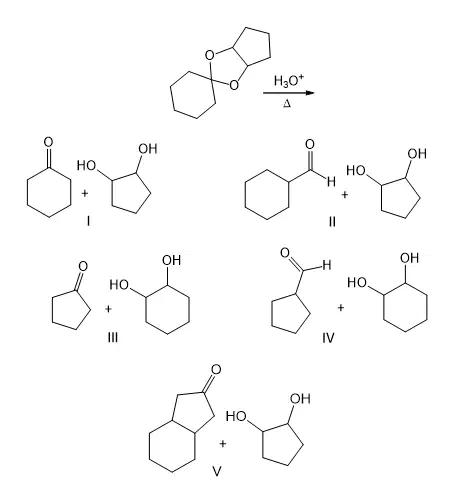
Predict the product(s) for the following reaction.
I
II
III
IV
V

Predict the product(s) for the following reaction.
I
II
III
IV
V

Provide the product of the following reaction.
I
II
III
IV
V

Provide the product of the following reaction.
I
II
III
IV
V

Provide the product for the following reaction sequence.
I
II
III
IV
V

Which one of the following compounds gives 5-methyl-3-heptanol with LiAlH4 followed by water?
I
II
III
IV
V

What would be the product of the following reaction?
I
II
III
IV
V

What would be the product of the following reaction?
I
II
III
IV
V

Predict the product for the following reaction sequence.
I
II
III
IV
V

Provide the product of the following reaction.
I
II
III
IV

Provide the reagents necessary to carry out the following conversion.
NaBH4/CH3OH
1. HOCH2CH2OH/H2SO4
2. NaBH4/CH3OH
3. H3O+, D
1. HOCH2CH2OH/H2SO4,
2. LiAlH4/ether
3. NaOH, H2O
H3O+
none of the above

Predict the product for the following reaction sequence.
6,7-dimethyl-3-nonanol
6,7-dimethyl-3-nonanone
6,7-dimethyl-3-nonanal
3,4-dimethyl-7-nonanol
3,4-dimethyl-7-nonanone

Predict the product for the following reaction sequence.
6,7-dimethyl-3-nonanol
6,7-dimethyl-3-nonanol
6,7-dimethyl-3-nonanol
3,4-dimethyl-7-nonanol
3,4-dimethyl-7-nonanone
Which one of the following compounds will yield 1-hexanol when treated with butylmagnesium bromide followed by acid workup?
1-hexanol
formaldehyde
propanal
oxirane
hexanal

Predict the product for the following reaction sequence.
I
II
III
IV
V

Predict the product of the following reaction sequence,
I
II
III
IV
V

Predict the product of the following reaction sequence,
I
II
III
IV
V
Which of the following is the best choice to prepare the following alkene using the Wittig reaction?
ethanal and 2-bromopentane/PPh3
propanal and 2-bromopentane/PPh3
2-pentanone and 1-bromopropane/PPh3
2-pentanone and 2-bromopropane/PPh3
butanal and 2-bromopentane/PPh3
Provide the structure of the ylide needed to prepare 3-ethyl-3-heptene from 3-pentanone using a Wittig reaction.
Ph3P=CH(CH2CH3)2
Ph3P=CHCH2CH3
Ph3P=CHCH2CH2CH3
Ph3P=CH2
Ph3P=CHCH2(CH3)2

Provide the reactant for the following reaction.
cyclohexanone
cyclohexanecarbaldehyde
cyclohexylpropanone
3-cyclohexylpropanal

Predict the product for the following reaction sequence.
I
II
III
IV
V

Predict the product of the following reaction.
I
II
III
IV

Predict the product of the following reaction.
I
II
III
IV
V
What is the correct order of the migration rate for the following groups in the Baeyer–Villiger oxidation reaction?
phenyl > methyl > t-butyl > H
phenyl > t-butyl > methyl > H
H > phenyl > methyl > t-butyl
H > t-butyl > phenyl > methyl
methyl > t-butyl > phenyl > H

A compound with formula C5H10O shows only two singlets, in its 1H NMR spectrum. Which one of the following is a possible structure for this compound?
I
II
III
IV
V

