
 Worksheets
driver license part 1
Total questions: 50
Worksheet time: 25mins
What will happen if you offer a testing officer a bribe to pass your driving test?
- Action will be taken against you. The penalties are severe and include fines and imprisonment.
- Only the testing officer will be investigated.
- Nothing, there is no penalty.
What will happen if you are caught cheating on the knowledge test?
- You will not be allowed to take another test for 6 weeks.
- You will never be allowed to take another test.
- Nothing, there is no penalty.
What will happen if a testing officer asks you for a bribe to pass your driving test and you give it to him or her?
- Action will be taken against all involved. The penalties are severe and include fines and imprisonment.
- Nothing, there is no penalty.
- Only the testing officer will be investigated.
Can a P1 or P2 provisional driver legally instruct a learner driver?
- No.
- Yes, provided the provisional driver has held a P2 licence for more than 6 months.
- Yes, provided L and P1 or P2 plates are displayed.
To progress to a P2 provisional licence, a P1 provisional driver must hold a P1 licence for a minimum period of -
- 12 months.
18 months.
- 24 months.
If one or two of your wheels run off the edge of the roadway, you should -
- Slow down gradually and ease back onto the road.
- Slow down quickly by braking hard.
- Increase your speed and drive back on the road.
If there are no lanes marked on the road, you should drive -
- Near to the left-hand side of the road.
- Anywhere on your side of the road.
Along the middle of the road.

If you intend to turn left, are you required to give a signal?
- Yes, if turn signals are fitted to your vehicle.
No, if turning left from a lane marked left turn only.
- No, if arrows are marked on the roadway
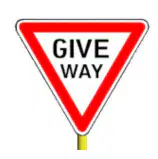
What is meant by this sign on or near a bridge?
- Slow down and be prepared to give way to vehicles travelling in the opposite direction.
Stop at all times before crossing the bridge and only give way to pedestrians who may be crossing.
- Do not overtake a vehicle travelling in the same direction.
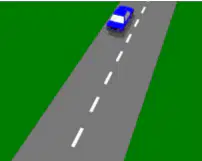
When reversing, you should -
- Take care and never reverse for a greater distance and time than is necessary.
Unbuckle your seat belt so you can reverse as quickly as possible.
Sound your horn to warn other drivers.
How close can you park to another vehicle when parked parallel to the kerb?
You must leave at least 1 metre front and back
You must leave at least 2 metres from the front only.
You must leave at least 3 metres front and back.
Where there is parallel kerbside parking, are you allowed to double-park alongside a parked vehicle?
No, not at any time.
Yes, if delivering goods.
Yes, if not obstructing traffic.
Do you have any responsibilities when opening a vehicle door on a roadway?
Yes, you must not open a door if you are likely to cause danger to road users or impede traffic
No, any following traffic must stop if the door interferes with its progress.
- No, there is no regulation to cover this situation.
Are you permitted to park on a median strip or traffic island?
- No, not at any time.
- Yes, in daylight hours
- Yes, but for no more than 30 minutes
Are you permitted to park in the direction of the arrow?
- No, not at any time
Yes, provided no taxis are using the area
Yes, if you are carrying two or more passengers.
When driving at sunset or dawn on a dark day, what should you do?
- Turn on your lights on low beam.
- Keep your sunglasses on to cut down headlight glare.
- Turn on your hazard warning lights
You are driving at night with your headlights on high beam. When should you dip your headlights?
- When within 200 metres of the vehicle ahead or an oncoming one.
- When within 200 metres of an oncoming vehicle only.
- Never, you are allowed to drive with your lights on high beam at all times.
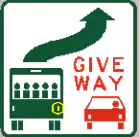
You are driving in a 60 km/h zone, with only one lane for traffic in your direction. You see a bus ahead (with this sign displayed on the rear) signalling its intention to pull out from a bus stop, you should -
- Slow down, and give way to the bus as it has priority.
Sound your horn to stop the bus from pulling out.
- Continue at your normal speed as the bus does not have priority.
Is it an offence to obstruct clear vision of your number plates?
- Yes, at any time.
Yes, but it is legal for a towbar or bicycle rack to cover the rear number plate.
- No, you are allowed to cover your number plates if you want to.
Before driving on a freeway, which of the following should you do?
Make sure your vehicle has enough fuel, oil, water and the correct tyre pressure.
Take your street directory in case you get lost.
Take something to calm your nerves before driving.
What must you do if you miss your exit on a freeway?
Continue until you reach the next appropriate exit.
Stop, and reverse back along the freeway to the exit you missed.
Stop immediately and turn around.
As you leave a freeway, which of the following should you check?
Your speed.
Fuel gauge.
Windscreen wipers.
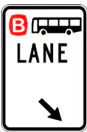
When can a private car travel in a lane marked by this sign?
Only within 100 metres of making a turn.
When carrying at least two passengers.
Only to overtake another vehicle.
Are you permitted to drive a car towing more than one trailer?
- No, not at all.
- Yes, if the combined length of vehicle and trailers does not exceed 15 metres.
- Yes, provided you have held a licence for two years.
What must you do when you are towing a caravan to help other vehicles overtake?
Keep at least 60 metres behind heavy vehicles or other vehicles towing caravans.
Drive at least 25 km/h below the speed limit.
Stop immediately and let the faster vehicle overtake.
Are you permitted to tow a caravan with a person riding in the caravan?
- No, not under any circumstances
- Yes, provided you do not exceed 60 km/h.
- Yes, if the person(s) in the caravan are over 12 years of age.
Before driving a long distance at fast speed or carrying a full car load, you should -
- Check your tyre pressure, and if necessary, increase it to what the manufacturer recommends.
- Make sure you have a street directory, so you know where you are going.
- Have a large meal and a cup of coffee.
If an oncoming vehicle crosses the centre line and is coming straight at you and you cannot stop, you should -
- Brake, look for room to the left, sound your horn and flash your lights.
Slow down and hope that the driver will turn away.
- Drive onto the wrong side of the road and hope the other vehicle does not do the same.
If you are involved in an accident where your vehicle needs to be towed away and the Police does not attend the crash scene, you -
- Must report the accident to the Police Station nearest to where the accident happened within 24 hours.
- Do not need to report the accident to the Police.
- Only need to report the accident to the Police if someone was injured.

If your vehicle is involved in an accident (regardless of the damage), what details must you give, to the other driver(s), if asked?
- You must let them see your licence, take details, and give the name and address of the vehicle's owner.
- No details at all until you have contacted your insurance company
- Only your name and address details if a Policeman asks for them.
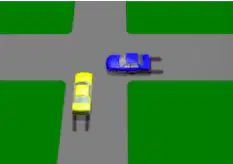
If a vehicle you are driving is involved in an accident and a person is injured, what must you do after stopping?
- Render every assistance and take immediate steps to have an ambulance notified. Then call the Police.
- Only call the Police if the accident also resulted in over $500 worth of property damage.
- Report the accident to Police within seven days.
Stop signs or flashing lights at railway crossings should always be obeyed, because -
- Trains are fast, heavy and cannot stop quickly.
- Pedestrians might be crossing.
- Car brakes often fail.
You should not drive across a railway level crossing when -
- Traffic is blocking the other side.
- You are towing a caravan.
- A station is nearby.
You should use your right-hand indicator when -
- You intend to move to the right, at any time.
- You intend to slow down.
- You are about to stop.
When merging onto the freeway from the entrance, you should-
- Look for a large enough break in the traffic and adjust your speed so as to fit into the traffic flow.
- Sound your horn, turn on your indicator lights and move onto the freeway.
- Stop and check the traffic behind you on the entrance.
If you see a sign indicating road repairs are going on, you should -
- Slow down and watch for traffic controllers and instructions
- Stop immediately and wait for instructions.
- Maintain the same speed.
You see a broken yellow line painted on the roadway adjacent to the kerb. What does it mean?
- Clearway restrictions apply - you must not stop during the clearway hours.
- You may at any time, park along this part of the road for 1 hour only
- Bicycle riders must ride along the yellow line.
If you see a horse and rider on the road what should you do?
- Slow down and give them plenty of room.
- Sound your horn to warn the rider.
- Speed up to pass the horse.
A friend lends you a van that has seats for ten passengers. What type of licence do you need to drive this type of vehicle?
- A car licence.
- A heavy rigid vehicle licence.
- A small bus licence.
What are you required to do if you develop a serious medical condition that could affect your driving?
- Once you become aware of the condition you must notify the RTA.
- Hand your licence in at the nearest police station.
- Tell your doctor and let him or her notify the RTA.
A friend lends you his car. It is very noisy and blows a lot of smoke. He tells you the vehicle has been given a defect notice but it's still OK to drive it. What should you do?
Before you borrow the car check the defect notice to make sure it is legal to drive the car.
Borrow the car, but always drive it 10 Km/h below the speed limit.
Borrow the car but only drive on streets where the car will not be a danger to others.
Your car registration expires today. You have your car inspected for registration renewal but it fails the inspection. What should you do?
- After today you must not drive the car until it has been repaired, passed another inspection and registered.
- You have seven days to have the car repaired, after which the RTA considers it to be unregistered.
- Go to the RTA and ask them to renew your registration and tell them you will soon get the car fixed.
You buy a car and find that the spare tyre is smooth; the tread is only just visible. If you get a puncture will it be legal to drive the car with a smooth spare tyre?
- No, it's illegal to drive a car with a smooth tyre even if it is the spare.
- Yes, but you must get the puncture fixed within 24 hours.
- Yes, if the tyre is correctly inflated and the side walls of the tyre are in good condition.
You borrow a friend's car and find that the position of the driver's seat puts you sitting a long way from the steering wheel and controls. What should you do?
- Adjust the seat forward so it's right for you.
- Put up with the discomfort; you should not adjust another person's seat.
Ask your friend for a cushion to place behind your back.
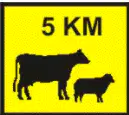
You hold an unrestricted licence and are driving at 100 km/h in the country and pass this sign. What should you do?
- Slow down to a speed that will allow you to stop to avoid crashing into farm animals on the road.
- You can continue to drive at 100 km/h if there are fences to stop farm animals from getting on the road.
- For the next 5 kilometres you must not exceed 60 km/h unless you pass an end farm animals speed limit sign.
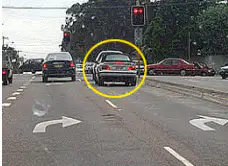
You are turning right from one of two right turn only lanes. How should you use your indicators?
- Indicate with your right hand signal the same as any other right hand turn
- You should not indicate at all because it might confuse other drivers.
- Indicating in this situation is optional. Give a right hand signal if you think it will help other road users.
You are driving on a freeway and realise you forgot something at home. You want to go back for it. Can you do a U-turn on this road?
- No, not at any time.
- Yes, any time
- Yes, providing you use the gravel joining roads.
You have a six year old child with you in your car. You have just parked so you can collect a prescription from the chemist. You should -
Take the child with you.
Leave the child in the car.
Ask an older person sitting nearby to watch the child.

You want to leave your automatic car parked on a street sloping uphill. You should -
- Put the handbrake on and put the transmission in "P" (park).
- Park only on flat areas.
- Turn the wheels away from the kerb.
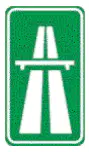
You have just passed this sign. Can you park on this road ?
- No, not at any time.
- Yes
- Yes, but only in daylight hours.

