wayground logo

Free Printable Worksheets

Font size

S
M
L
XL
Worksheets

Biology Semester 1 Midterm

Total questions: 100

Worksheet time: 6hrs 46mins

Name
Class
Date
1.

___________a molecule that is present in all living cells and that contains the information that determines the traits a living thing inherits and needs to live.

a)

Cell

b)

Stimulus

c)

Homeostasis

d)

DNA

2.
When you step out into the cold, your body shivers in order to keep its temperature at 98.6F.
a)
All living things use energy
b)
All living things contain cells
c)
All living things maintain homeostasis
d)
All living things grow
3.
Green plants produce their own food through the process of photosynthesis.
a)
All living things use energy
b)
All living things contain cells
c)
All living things maintain homeostasis
d)
All living things grow
4.
A camel has eyelashes that work to keep the dust and sand out of its eyes.
a)
All living things adapt to their environment
b)
All living things grow
c)
All living things have cells
d)
All living things use energy
5.
Over three years, Tim's height has increased from 5'4" to 5'11".
a)
All living things contain cells
b)
All living things maintain homeostasis
c)
All living things use energy
d)
All living things grow
6.
The roots of a plant grow towards a source of ground water.
a)
All living things use energy
b)
All living things reproduce
c)
All living things respond to their environment
d)
All living things grow
7.
YOU are a multi-celled organism but an amoeba is a single celled organism.
a)
All living things have cells
b)
All living things grow
c)
All living things use energy
d)
All living things respond to their environment
8.

Living things are made up of units called

a)

DNA

b)

Cells

c)

Homeostasis

d)

Seeds

9.
Rocks are not living because
a)
they never move
b)
they aren't needed for humans
c)
they are not made of cells
d)
they don't break down
10.
In order for something to be considered a living organism, it must display _____ of the eight characteristics of living things.
a)
one
b)
some
c)
all
d)
more than half
11.
The basic unit of structure and function in the human body is the....
a)
organ
b)
organ system
c)
cell
d)
tissue
12.
A group of similar cells that come together to perform a specific function is a/an
a)
organ
b)
organism
c)
organ system
d)
tissue
13.
When many organ systems work together it can form...
a)
organ
b)
cells
c)
organ system
d)
organism 
14.
This is a example of........ 
a)
organ system
b)
cells
c)
organ
d)
tissue
15.
Which is an example of an organism?
a)
a beetle
b)
a lake
c)
a rock
d)
a shell
16.

A collection of living organisms that belong to different populations but all live in the same area and interact with one another is a...

a)

Population

b)

Ecosystem

c)

Community

d)

Ecosphere

17.
The maintenance of an organism’s internal environment is called:
a)
compensating
b)
homeostasis
c)
balancing
d)
routine
18.
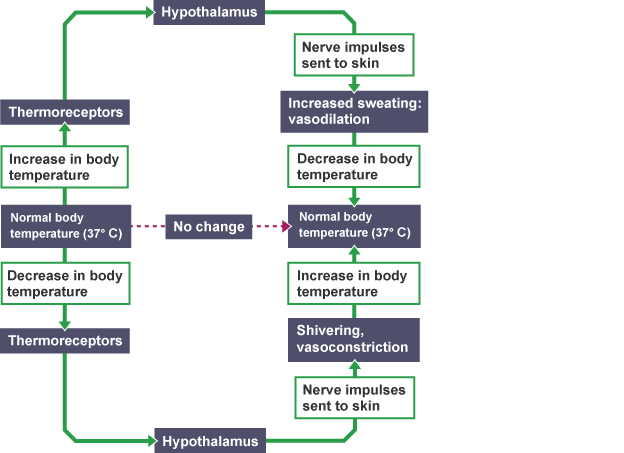
What type of feedback loop is shown?
a)
Positive
b)
Neutral
c)
Negative
19.
Name the levels of organization in the human body in order from smallest to largest:
a)
Tissue, organ, organ system
b)
Organ system, tissue, organs, cells
c)
Cells, tissue, organs, organ system
d)
Cells , organs, tissue, organ system
20.

What is the point of a feedback loop?

a)

To provide the body with more energy

b)

To provide the body with more food

c)

To make sure the conditions in the body are always changing

d)

To make sure the conditions in the body remain stable

21.

The "cause" for something to happen is called...

a)

response

b)

effector

c)

control center

d)

stimulus

22.

Which part of the feedback loop is a body part that makes a change to bring the system back to homeostasis?

a)

Effector

b)

control center

c)

response

d)

receptor

23.
Negative Feedback Loops:
a)
amplify processes
b)
prevent small changes from getting larger
c)
are initiated during childbirth
d)
are found only in plants
24.
Failure to maintain homeostasis could result in:
a)
lack of internal balance
b)
eventual death
c)
difficulty carrying on metabolism 
d)
all three
25.

The body part that senses the change inside the organism ...

a)

receptor

b)

control center

c)

effector

d)

response

26.

Which part of the feedback loop is a body part that makes a change to bring the system back to homeostasis?

a)

Effector

b)

control center

c)

response

d)

receptor

27.

What detects a signal from another body part that the system is outside of homeostasis and adjustments need to be made?

a)

effector

b)

response

c)

control center

d)

stimulus

28.
If the environment gets cold, we will often shiver in order to:
a)
keep body temperature the same as the external temperature
b)
decrease body temperature
c)
increase body temperature
d)
regulate blood pressure
29.
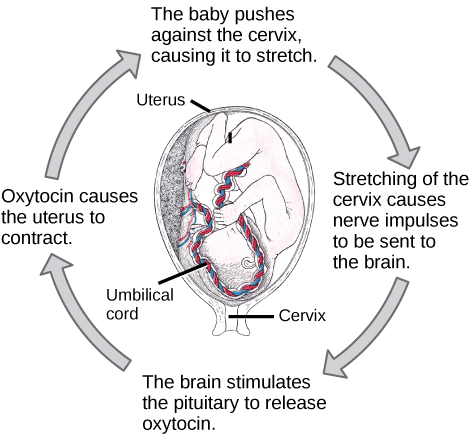
What type of feedback loop is shown?
a)
negative
b)
neutral 
c)
positive
30.
Maintaining body temperature is an example of a:
a)
negative feedback loop
b)
positive feedback loop
31.
When you get cut, your skin cells release hormones that signal platelets to come and stop the bleeding. Platelets then release more hormones that signal even more platelets to help stop bleeding. The hormone signals continue until the cut is closed.
a)
Positive Feedback Response
b)
Negative Feedback Loop 
32.

Which macromolecule is used as our main source of energy?

a)

Lipids/Fats

b)

Nucleic Acids

c)

Proteins

d)

Carbohydrates

33.

Which macromolecule stores energy?

a)

Carbohydrates

b)

Proteins

c)

Lipids/Fats

d)

Nucleic Acids

34.

Match the following

a)
1.

carbohydrate

b)
2.

lipid

c)
3.

protein

35.

Match the MACROMOLECULES and their MONOMERS.

Hint: Monomer = a single unit

a)

carbohydrate

1.

monosaccharide

b)

lipid

2.

fatty acid & glycerol

c)

protein

3.

amino acid

d)

nucleic acid

4.

nucleotide

36.

An enzyme is a ______________.

a)

carbohydrate

b)

lipid

c)

nucleic acid

d)

protein

37.

This macromolecule provides structural support and act as enzymes to catalyze metabolic reactions

a)

carbohydrate

b)

lipids

c)

protein

d)

nucleic acid

38.

This macromolecule carries hereditary information and instructions for building molecules

a)

carbohydrate

b)

lipids

c)

protein

d)

nucleic acid

39.

Which of the following statements is true about catalysts (enzymes)?

a)

Catalysts slow down the rate of chemical reactions.

b)

Enzymes help regulate pH.

c)

Catalysts are used up during a chemical reaction.

d)

Catalysts lower the activation energy of a chemical reaction.

40.

An enzyme and substrate can be compared to

a)

lock and key

b)

a faucet

c)

a door hinge

d)

light switch

41.
What type of macromolecule are enzymes?
a)
Protein
b)
Carbohydrate
c)
Lipid
d)
Nucleic Acid
42.
What is the purpose  of an enzyme?
a)
give permission for the reaction
b)
raise activation energy
c)
speed up reactions
d)
control how many reactions occur
43.
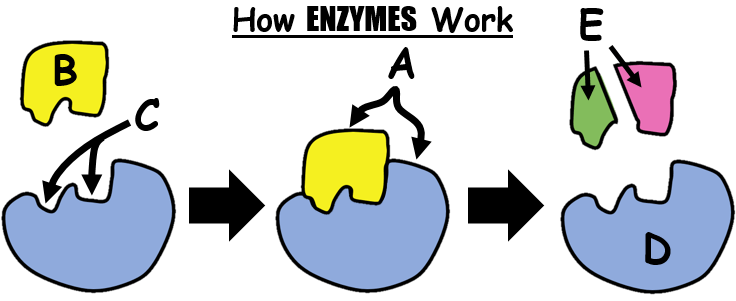
After the enzyme and substrate bind together and perform the reaction, what does the substrate become?
a)
a substrate
b)
an enzyme
c)
a product
d)
an active site
44.
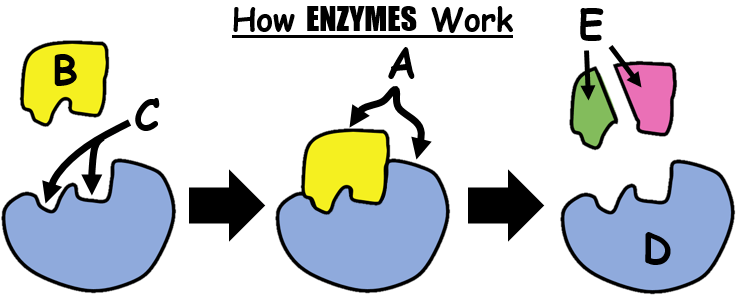
Letter D...
a)
active site
b)
enzyme
c)
substrate
d)
products
45.
Letter B...
a)
active site
b)
enzyme
c)
substrate
d)
products
46.
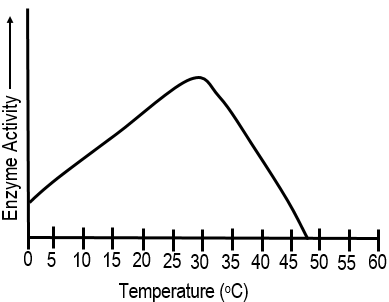
Based on the graph, what is the optimal temperature for this enzyme? 
a)
15oC
b)
40oC
c)
30oC
d)
35oC
47.

Changes in pH and temperature can ___________________ an enzyme which causes it to lose its shape and affects its function.

a)

puncture

b)

denature

c)

double

d)

delete

48.
Monosaccharides are monomers of
a)
Carbohydrates
b)
Lipids
c)
Proteins
d)
Nucleic Acids
49.
An enzyme speeds up a chemical reaction in the cell but can only be used once.  True or False? 
a)
true
b)
false
50.

Which type of cell is this?

a)

Prokaryote

b)

Eukaryote

51.
What type of cell has a nucleus? 
a)
eukaryotic
b)
prokaryotic 
52.
Plants and animal cells are examples of ___ cells 
a)
prokaryotic cells 
b)
eukaryotic cells 
53.
Which is true of prokaryotic and eukaryotic cells?
a)
Prokaryotic cells are larger than eukaryotic cells.
b)
Eukaryotic cells do not have nuclei, and prokaryotic cells do have nuclei.
c)
Prokaryotic cells lack membrane-bound organelles, and eukaryotic cells contain membrane-bound organelles.
d)
Eukaryotic cells are simpler than prokaryotic cells.
54.

Which type of cells has a chloroplast?

a)

Prokaryote

b)

Plant Cell

c)

Animal Cell

55.

All of the following contain a cell wall except:

a)

prokaryotes

b)

animal cells

c)

plant cells

d)

bacteria

56.

Which do BOTH prokaryotes and eukaryotes contain?

a)

nucleus

b)

mitochondria

c)

ribosomes

d)

cell wall

57.

Which does only eukaryotic cells contain?

a)

nucleus

b)

DNA

c)

cell membrane

d)

ribosomes

58.

Which organelle is photosynthetic?

a)

cell wall

b)

chloroplast

c)

mitochondria

d)

vesicle

59.
This is a picture of:
a)
Prokaryote
b)
Eukaryote
60.
A fossilized cell is discovered, and evidence suggests it reproduced on its own and had DNA, but a membrane did not enclose its DNA. Which type of organism would this most likely be?
a)
prokaryote
b)
eukaryote
c)
plant cell
d)
animal cell
61.

Bacteria are considered what?

a)

Eukaryotes

b)

Prokaryotes

62.

What is the function of the cell membrane?

a)

To control what comes in and out of the cell

b)

To break down food inside the cell

c)

to serve as a barrier

d)

to eat the cells food

63.

Which organelle produces the energy a cell needs to carry out its function

a)

Mitochondria

b)

Golgi Bodies

c)

Cytoplasm

d)

Nucleus

64.

Which organelle is found inside the nucleus and produces ribosomes

a)

Nucleolus

b)

Cell Membrane

c)

Lysosome

d)

Golgi Bodies

65.

Which organelle contains genetic material?

a)

Endoplasmic Reticulum

b)

Golgi Complex

c)

Nucleolus

d)

Nucleus

66.
What organelle is called the "powerhouse" of a cell?

a)
Endoplasmic Reticulum
b)
Nucleus
c)
Mitochondria
d)
Nucleolus
67.
What is the function of the vacuole?
a)
Sac that stores water, nutrients, and waste products
b)
Sac filled with digestive chemicals
c)
Jelly-like substance within the plasma membrane
d)
stack of membranes that packages chemicals
68.
I make proteins for the cell. What am I?
a)
ribosome
b)
mitochondria
c)
chloroplast
d)
lysosome
69.
Where does photosynthesis occur?
a)
mitochondria
b)
stomata
c)
xylem
d)
chloroplast
70.
What can only be found in plant cells?
a)
Cell membrane
b)
Vacuole
c)
Chloroplast
d)
Mitochondrion
71.
What cell part is NOT found in all cells?
a)
Cell Wall
b)
Cell Membrane
c)
Cytoplasm
d)
Genetic Material
72.
Complex cell. Can be plant or animal. Contains membrane bound organelles. 
a)
Eukaryotic Cell
b)
Prokaryotic Cell
c)
Bacteria
d)
Blood cell
73.
This organelle takes food and turns it into ENERGY for plant and animal cells.
a)
Chloroplast
b)
Mitochondria
c)
Lysosome
d)
Ribosome
74.
What is the fluid inside a cell called? 
a)
Endoplasimic Reticulum
b)
Orange Juice
c)
Water
d)
Cytoplasm
75.
Which of these is NOT a part of the Cell Theory?
a)
All cells are independent.
b)
Cells are the basic unit of living things. 
c)
All living things are one or more cells.
d)
Cells come from cells.
76.
This organelle eliminates waste. 
a)
Nucleus
b)
ER
c)
Vacuole
d)
Lysosome
77.
This is a double layer of phospholipids that creates a barrier between the cells internal and external environments; it controls what comes in or out of the cell (selective permeable)
a)
Nucleus
b)
Cilia
c)
Cell membrane
d)
Flagella
78.
A group of organs that work together to perform the same function is called _____________?
a)
cells
b)
tissues 
c)
organ system
d)
organs
79.
Groups of tissues that work together to perform a similar function are called_____. (Examples include the heart, lungs or stomach)
a)
cells
b)
tissues
c)
organ
d)
organ system
80.
When many organ systems work together it can form...
a)
organ
b)
cells
c)
organ system
d)
organism 
81.
What is the correct order of organization
a)
tissues-cells-organs-organ systems-organism
b)
cell-tissue-organs-organ systems-organism
c)
organism-cells-tissues-organ systems-organism
d)
tissues-cells-organs-organ sytems-organism
82.
The basic unit of life
a)
atom
b)
cell
c)
molecule
d)
organelle
83.
Describes an organism made of more than one (specialized) cell
a)
unicellular
b)
specialized
c)
interdependent
d)
multicellular
84.
The smallest level of organization of life in an organism
a)
tissue
b)
cell
c)
organ
d)
organ system
85.

A specialized cell has a specific ________ that allows it to perform a specific __________.

a)

function; idea

b)

shape; structure

c)

shape; function

d)

function; shape

86.

What are the two main reasons why cells must reproduce in a multicellular organism?

a)

Growth

b)

They want to

c)

Repair

d)

Age

87.
These blood cells deliver oxygen to the parts of the body.
a)
Red
b)
White
c)
Patelets
d)
Plasma
88.
All cells must have a
a)
cell wall
b)
cell membrane
c)
nucleus
d)
nucleoli
89.
A cell stores food, water or waste products in
a)
chloroplast
b)
nuclei
c)
ribosomes
d)
vacuole
90.

What is the job of a nerve cell?

a)

To absorb water from soil

b)

To carry oxygen around the body

c)

To photosynthesise

d)

To send electrical messages around the body

91.

What Number is the Ribosomes

a)

14

b)

13

c)

5

d)

12

92.

What is Number is the Rough ER

a)

11

b)

9

c)

10

d)

12

93.

What is Number is the Mitochondria

a)

7

b)

9

c)

6

d)

13

94.

What is Number is the Golgi Body

a)

14

b)

13

c)

7

d)

11

95.

What is Number is the Nuclear Membrane

a)

4

b)

3

c)

5

d)

2

96.

What is the function of the STOMATA in plants?

a)

Allows water to enter the plant

b)

Provides food to enter the plant

c)

Allows for gas exchange

d)

Site of photosynthesis

97.

What is a STEM CELL?

a)

Cells found in the stems of plants.

b)

Cells that can differentiate into specialized cells.

c)

Cells that control your genes to be expressed.

d)

Cells that provide nutrients to your blood.

98.

What does cell differentiation mean?

a)

Process by which a cell absorbs nutrients.

b)

Process by which a less specialized cell becomes a more specialized cell.

c)

Process by which a specialized cell becomes a less specialized cell.

d)

Process by which cells enter the cell cycle.

99.

True or False: Environmental factors, such as temperature, can affect gene expression.

a)

True

b)

False

100.

What is the function of nerve cells?

a)

Allow for gas exchange to happen.

b)

Transport oxygen throughout the body.

c)

Control DNA expression.

d)

Transmit electrical signals to different parts of the body.