Wayground logo

Free Printable Worksheets

Font size

S
M
L
XL
Worksheets

Grade-7 B

Total questions: 79

Worksheet time: 1hrs 11mins
Name
Class
Date
1.
How do covalent bonds form?
a)
Donating & receiving valence e- between atoms.
b)
Opposite slight charges attract each other between compounds.
c)
Scientists are still not sure how they form.
d)
Sharing valence e- between atoms.
2.
What two types of atoms make a covalent bond?
a)
2 Nonmetals
b)
1 Nonmetal and 1 Metal
c)
2 Metals
d)
2 Noble Gases
3.
What do we call a covalent bond where electrons are shared UNEVENLY or UNEQUALLY?
a)
Ionic
b)
Polar Covalent
c)
Nonpolar Covalent
d)
Van der Waals Force
4.
How many valence electrons does nitrogen have?
a)
3
b)
2
c)
5
d)
1
5.
What can be generalized about covalent bonds?
a)
Electrons will be exchanged.
b)
Electrons will be transferred.
c)
Electrons will be given and taken.
d)
Electrons will be shared.
6.
What is it called if there are three-pairs of electrons being shared?
a)
Triple bond
b)
Bond length
c)
Tribond
d)
Chocolate Mousse
7.
How many electrons are shared in a double bond?
a)
2
b)
4
c)
6
d)
8
8.
When two nonmetals do not share electrons evenly, the resulting covalent bond will be
a)
nonpolar
b)
polar
c)
ionic
d)
metallic
9.
A Nitrogen molecule (N2) has one triple bond. How many electrons do the nitrogen atoms share?
a)
1
1
b)
3
c)
4
d)
6
10.
Compared to ionic compounds, molecular compounds generally have...
a)
good conductivity
b)
greater densities
c)
more chemical bonds
d)
a low boiling point
11.
Compared to ionic compounds, molecular compounds generally have...
a)
stronger chemical bonds
b)
poor conductivity
c)
a high melting point
d)
lower densities
12.
In a(an) POLAR bond, one atom pulls on the shared electrons more than the other atom. 
a)
True
b)
False
13.
Why do atoms share electrons?
a)
To attain the electron configuration of a noble gas.
b)
To become ions and take a charge
c)
to increase the mass
d)
it's a nice thing to do.
14.

How many valence electrons does hydrogen have?

a)

4

b)

3

c)

2

d)

1

15.

Outer shell electrons are called

a)

outer electrons

b)

valence electrons

c)

negatives

d)

super electrons

16.
Is Hydrogen considered a metal or a non-metal?
a)
Metal
b)
Non-metal
17.

In the compound N2O, what does the subscript 2 indicate?

a)

There are 2 sodium atoms for each atom of oxygen

b)

There are 2 nitrogen atoms for each atom of oxygen

c)

There are 2 oxygen atoms for each atom of nitrogen

d)

Nitrogen atoms are twice a large as oxygen

18.

Why do all bonds form?

a)

so the number of protons equals the number of electrons

b)

so an atom can become unstable

c)

to fill the outermost energy level

19.

Valence electrons are found

a)

in the innermost energy level of an atom

b)

in the middle energy levels of an atom

c)

in the outermost energy levels of an atom

20.

How many Aluminum atoms are in Al2O3?

a)

3

b)

5

c)

2

d)

1

21.
Elements combine to form __________.
a)
compounds
b)
atoms
c)
positive ions
d)
negative ions
22.
What part of an atom is involved in chemical bonding?
a)
protons
b)
neutrons
c)
electrons
d)
nucleus
23.
A ________ is a model of an atom in which each dot represents a valence electron.
a)
Valence electron
b)
Electron dot diagram/Lewis dot structure
c)
Lewis bond structure
24.
How many valence electrons does nitrogen have?
a)
3
b)

2

c)
5
d)
1
25.
How many valence electrons does hydrogen have?
a)
3
b)
2
c)
5
d)
1
26.
Compounds made from only nonmetals are _________________ compounds.
a)
ionic
b)
covalent
c)
metallic
d)
chemical
27.
A covalent bond involves a __________ of electrons.
a)
sharing
b)
borrowing
c)
exchanging
d)
switching
28.
The chemical formula shows one carbon atom bonded to __________ oxygen atoms.
a)
one
b)
two
c)
three
d)
four
29.
Name CCl4
a)
carbon carbon tetraiodide
b)
carbon tetrachloride
c)
monocarbon tetrachloride
d)
water
30.
Name BCl3
a)
boron chloride
b)
boron (III) chloride
c)
boron trichloride
d)
boron chlorine
31.
Name CO2
a)
carbon dioxide
b)
carbon monoxide
c)
carbon oxide
d)
monocarbon dioxide
32.
How do covalent bonds form?
a)
Donating & receiving valence e- between atoms.
b)
Opposite slight charges attract each other between compounds.
c)
Scientists are still not sure how they form.
d)
Sharing valence e- between atoms.
33.
What is it called if there are three-pairs of electrons being shared?
a)
Triple bond
b)
Bond length
c)
Tribond
d)
Chocolate Mousse
34.
How many electrons are shared in a double bond?
a)
2
b)
4
c)
6
d)
8
35.
In a(an) POLAR bond, one atom pulls on the shared electrons more than the other atom. 
a)
True
b)
False
36.
Why do atoms share electrons?
a)
To attain the electron configuration of a noble gas.
b)
To become ions and take a charge
c)
to increase the mass
d)
it's a nice thing to do.
37.

Valence electrons are found

a)

in the innermost energy level of an atom

b)

in the middle energy levels of an atom

c)

in the outermost energy levels of an atom

38.

Which type of covalent bond is the strongest?

a)

Single bond

b)

Double bond

c)

Triple bond

39.

Is the following compound ionic or covalent?

Exists as a solid, liquid or gas

a)

Ionic

b)

Covalent

40.
What two types of atoms make a covalent bond?
a)
2 Nonmetals
b)
1 Nonmetal and 1 Metal
c)
2 Metals
d)
2 Noble Gases
41.

Water, H2O, is classified as what type of molecule?

a)

a polar molecule

b)

a nonpolar molecule

c)

a coordinate covalent compound

d)

an ionic compound

42.

A molecule that has a partial positive end and a partial negative end because of unequal sharing of electrons is a _______________.

a)

nonpolar molecule

b)

polar molecule

c)

ionic compound

d)

metalic compound

43.

Use your knowledge and electronegativity sheet to predict what the following compound is classified as.

a)

non-polar covalent

b)

polar covalent

c)

ionic

d)

metallic

44.
What do we call a substance consisting of a single atom?
a)
coefficient
b)
element
c)
compound
d)
molecule
45.
All ____________ are made up of two or more atoms bonded together.
a)
atoms
b)
molecules
c)
electrons
d)
elements
46.
When __________ form, the elements lose there individual chemical properties and take on new properties.
a)
compounds
b)
atoms
c)
subscript
d)
formula
47.
A recipe for a chemical substance is called a ________ _________.
a)
coefficent
b)
chemical formula
c)
Oxygen
d)
atom
48.
2H2O
How many Oxygen atoms are present?
a)
2
b)
4
c)
1
d)
5
49.

How many atoms of sulfur are in each molecule of H2SO4?

a)

1

b)

4

c)

2

d)

7

50.

How many atoms of hydrogen are in a molecule of glucose (C6H12O6)?

a)

12

b)

6

c)

18

d)

4

51.
Can you separate salt from water using filtration?
a)
yes
b)
no
52.
What is a substance that is dissolved in another substance? 
a)
solution
b)
solute
c)
solvent
d)
compound
53.
Jessica made a pitcher of lemonade. What can she do to dilute if she thinks it doesn't taste right?
a)
Add water
b)
Add sugar
c)
Boil the lemonade
d)
Put it in the refrigerator 
54.
Which one of the following solids is insoluble in water?
a)
sugar
b)
sand
c)
copper sulfate
d)
salt
55.
If a solid disappears when added to a liquid (like when sugar is stirred in water)... it is said to have...
a)
Formed a solute
b)
Dissolved
c)
Formed a solvent
d)
Become insoluble
56.

The separation technique being used is

a)

Decanting

b)

Filtering

c)

Evaporation

d)

Distillation

57.
Name the separation method that causes wet clothes on a clothes line to dry
a)
Chromatography
b)
Filtration
c)
Distillation
d)
Evaporation
58.
In filtration, the liquid part collected is called the filtrate and the solid bit that remained on the filter paper is called the residue.
In filtration, what is the part that remains called?
a)
Solid
b)
Filtrate
c)
Remainder
d)
Residue
59.
Of these mixtures, which one is a solution?
a)
A
b)
B
c)
C
d)
D
60.
The clear liquid which passes through the filter paper is called
a)
filt
b)
filter
c)
filtrate
d)
filtration
61.
Sand and gravel may be separated from each other through using..
a)
a filter funnel
b)
a sieve
c)
an evaporating basin
d)
a distillation
62.
Which one of the following techniques would best be used to separate soil and water?
a)
Decanting
b)
distillation
c)
Filtration
d)
Chromatography
63.
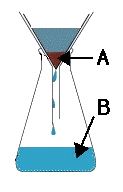
The diagram shows the apparatus for separating soil and water. What are the labelled parts?
a)
A = distillate, B = filtrate
b)
A = filtrate, B = residue
c)
A = residue, B = filtrate
d)
A = residue, B = distillate
64.
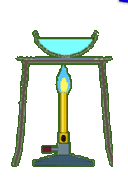
Which one of the following is the name for separation technique in the picture below
a)
distillation
b)
dissolving
c)
evaporation
d)
decanting
65.

No matter what you do, sand will not dissolve in water, because sand is _________.

a)

dissolved

b)

soluble

c)

insoluble

d)

aqueous

66.

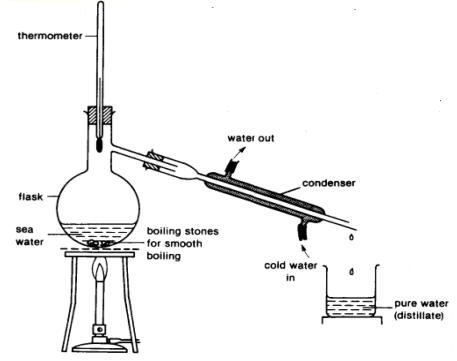
What is the name of this separation technique?

a)

Simple distillation

b)

Fractional distillation

c)

Boiling

d)

Evaporation

67.

What is the name of this separation technique?

a)

distillation

b)

filtration

c)

evaporation

d)

chromatography

68.

What separation technique does the picture show?

a)

Sieving

b)

filtering

c)

magnetic separation

d)

Distillation

69.

Ethanol and water have different boiling point. What would be the suitable separation technique for a mixture of both substances?

a)

Distillation

b)

Chromatography paper

c)

Sieving

70.

You want to separate the components of a felt tip pen. What is the suitable separation technique?

a)

distillation

b)

chromatography paper

c)

decanting

d)

sieving

71.

What is the suitable separation technique for a mixture of iron filings and salt?

a)

sieving

b)

filtering

c)

magnetic separation

72.

The picture shows what you get by performing a separation technique. What's its name?

a)

sieving

b)

paper chromatography

c)

decanting

d)

distillation

73.

The pigment responsible for the colour of spinach leaves are several substances. How can you separate them?

a)

sieving

b)

decanting

c)

paper chromatography

74.

Which separation technique is this equipment for?

a)

Sieving

b)

Decanting

c)

Paper chromatography

d)

Magnetic separation

e)

Distillation

75.

Which is the separation technique that doesn´t need filter paper?

a)

filtering

b)

decanting

c)

paper chromatography

76.
Name the separation method that causes wet clothes on a clothes line to dry
a)
Chromatography
b)
Filtration
c)
Distillation
d)
Evaporation
77.
What is the boiling point of water?
a)
0oC
b)
100oC
c)
80oC
d)
95oC
78.

How can we separate an insoluble solid from a liquid?

a)

chromatography

b)

evaporation

c)

filtration

d)

condensation

79.

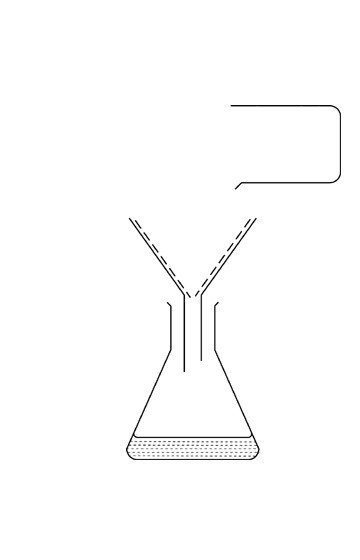
Which one of the following is the name for separation technique in the picture below

a)

distillation

b)

filtration

c)

evaporation

d)

chromatography