
Font size
 Worksheets
Topic 1&2 EOY SACE Chemistry Stage 2
Total questions: 100
Worksheet time: 2hrs 31mins
This primary pollutant creates a reddish brown gas creating photochemical smog and tropospheric ozone.
sulfuric acid
VOC
nitrogen dioxide
particulate matter
Source: burning of fossil fuels, cars are a major source
Health effects: lung damage, respiratory system illnesses
Environmental effects: an ingredient of acid precipitation
What is the most important thing in Photochemical reaction?
Light
temperature
pressure
catalyst
The amount of primary pollutants in the air increases during ___________.
sunlight
high traffic
night time
low traffic
What does a Catalytic Converter do?
Prevents overheating in a reaction
Speeds the reaction of fuel conversion
Reduces harmful emissions
Prevents production of SO2
This atmospheric compound is critical to the planet in its protection against UV radiation, but when found close to the ground is part of photochemical smog that can cause serious health problems.
particulate matter
carbon monoxide
stratospheric ozone
tropospheric ozone
Health effects: Reduces the ability of blood to bring oxygen to the body cells and tissues.
Environmental effects: May interfere with the breathing of animals
The chemical element that coal is made from
Impact
Energy
Atmosphere
Carbon
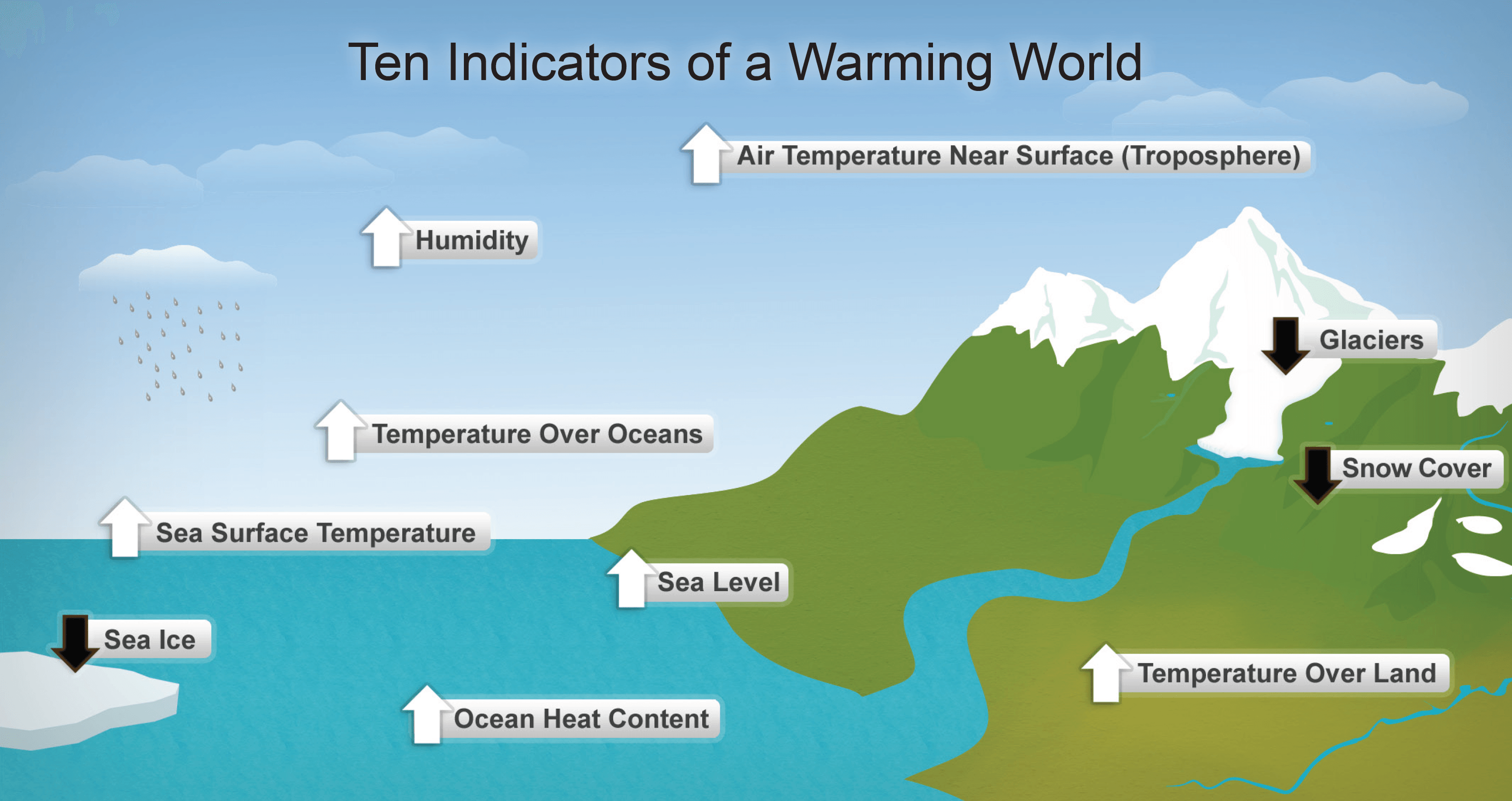

Which of the following could increase the amount of greenhouse gasses in our atmosphere?
Burning fossil fuels
Planting trees
Walking to school and work
Cutting down trees
How are greenhouse gasses harming our environment?
They aren't
Less heat is able to escape causing the Earth to cool down
Less heat is able to escape causing the Earth to warm up
More heat is able to escape

Each one of these gases is a greenhouse gas, except which one?
carbon dioxide
water vapor
hydrogen dioxide
methane

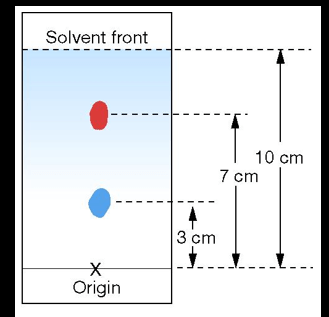
Ink can be separated by a method of -----------------------------------------------
distillation
filtration
chromatography
sedimentation


What do spectroscopes do?
Collect light to identify elements
Refract light
Absorb light
Transmit light


A line spectrum is produced when an electron moves from one energy level
into the nucleus
to a higher energy level
to another position in the same sublevel
to a lower energy level

If an electron moves from n=4 to n=2 it ____
absorbs energy
releases energy

Emission spectra emitted by an element (or compound) will produce ___ through a spectroscope.
bright lines
a continuous rainbow
dark lines
white light

Which type of spectrum is this?
Emission Spectrum
Absorption Spectrum
Continuous Spectrum
A photon is a (a) of light
If the frequency of electromagnetic radiation is high, then the wavelength will be (a)
The lowest energy configurations for electrons in an atom is called the
neutral state
home state
ground state
base state
In order to determine the concentration of a chemical in a sample using atomic spectroscopy, a ________ _________ must be made first?
(a)
In (a) spectroscopy the final spectrum is mostly black with some sharp lines of colour
When a photon is absorbed by an electron and the electron changes energy level, the electron is described as being (a)

What is this piece of apparatus called
Pipette
Burette
Janette
Cuvette
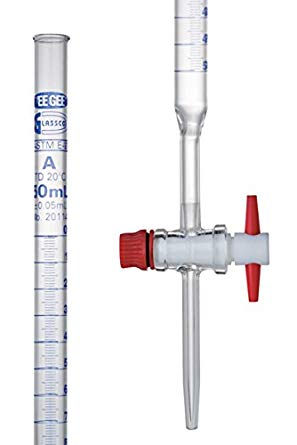
What is this piece of apparatus called
Pipette
Burette
Janette
Cuvette

What is the reading on this burette?
24.0cm3
25.8cm3
24.2cm3
23.9cm3
Which of these titres are concordant?
12.7cm3
12.3cm3
12.4cm3
12.0cm3
If potassium hydroxide is neutralised by sulphuric acid, what is the salt produced?
Hydrogen sulfate
Potassium chloride
Potassium sulfite
Potassium sulfate
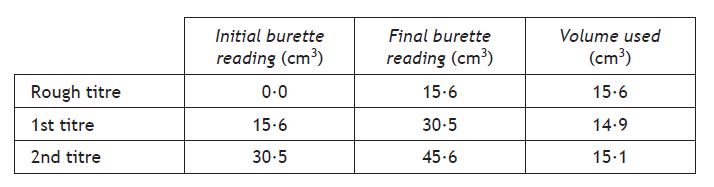
Calculate the average volume of acid needed for this neutralisation
15.2cm3
15.0cm3
35.5cm3
30.1cm3

What is the average titre needed for neutralisation?
25.2cm3
59.7cm3
25.0cm3
25.4cm3
30cm3 of NaOH is neutralised by 12.3cm3 of 0.2mol/l HCl. What is the concentration of the NaOH.
82 mol/l
0.82 mol/l
0.49 mol/l
0.082 mol/l
Volumetric analysis is a quantitative analysis
False
True
The name of the apparatus used for holding the titrant is__________
Conical flask
Burette
Pipette
Volumetric flask
The concentration of the 30ml of citric acid solution is determined to be 1.23 M. Using the titration equation, predict the titration volume for the standard solution of 2.3 M.
14 ml
15 ml
16 ml
17 ml
Using n = MV, calculate the mass required to prepare 2.5 L of 1.0 M NaOH solution. Given the MM for NaOH is 40 g/mol
1000 g
100 g
10 g
1 kg
What is the purpose of indicator solutions?
To signal the end of a reaction
To colour the solution
To complete the reaction
To equivalent the reaction
Choose the indicator solutions used for acid-base titration
Phenolphtalein solution
Methyl red solution
Methyl orange solution
Fluoresceine solution

Which best describes the target?
Precise, but not accurate
Accurate but not precise
Precise and accurate
Neither accurate nor precise

Which best describes the target?
A lot of systematic error
A lot of random error
No random error
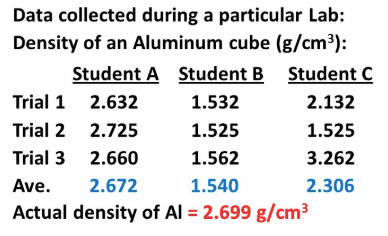
Which student is the most ACCURATE?
A
B
C

7.35 ± 0.05mL
7.35 ± 0.05 mL
6.65 ± 0.05 mL
6.650 ± 0.05 mL
Systematic errors lead to a lack of:
accuracy in the measurement.
significant digits in the measurement.
precision in the measurement.
gradation of the measuring instrument
What kind of error is Parallax error where the viewing was consistently from the wrong angle for all readings?
Systematic errors
Random errors
Both systematic and random errors
Neither systematic nor random errors
Multiple trials help you compensate for random error.
True
False

James has been asked to boil the 30cm3 of water. He knows water boils at 100 °C . Which of the following thermometers should he use?
A
B
C
D
E

2SO2(g)+O2(g) ⇌ 2SO3(g) + Heat
Adding SO2(g) will
shift equilibrium right
shift equilibrium left
increase rate of reaction
have no change
2SO2(g)+O2(g) ⇌ 2SO3(g) + Heat
Increasing the temperature will...
shift equilibrium right
shift equilibrium left
increase pressure
have no change
2SO2(g) + O2(g) ⇌ 2SO3(g) + Heat
Removing O2(g) will
shift equilibrium right
shift equilibrium left
increase pressure
have no change
2SO2(g)+O2(g) ⇌ 2SO3(g) + Heat
Adding SO3(g) will
shift equilibrium right
shift equilibrium left
increase K
have no change
2SO2(g)+1O2(g) ⇌ 2SO3(g) + Heat
Increasing the volume of the container will...
shift equilibrium right
shift equilibrium left
slow rate of reaction
have no change
2SO2(g)+1O2(g) ⇌ 2SO3(g) + Heat
Increasing the pressure on the system will...
shift equilibrium right
shift equilibrium left
slow rate of reaction
have no change
2SO2(g) + O2(g) ⇌ 2SO3(g) + Heat
Using a catalyst
shift equilibrium right
shift equilibrium left
increase the rate of reaction
have no change

CoCI42- +6H2O →Co(H2O)62+ + 4CI-.
What would happen when H2O is added?
Position of equilibrium will shift to left (and become more blue)
Position of equilibrium will shift to right (and become more pink)
Keq will increase as H2O is added
Position of equilibrium will shift to left to reduce the added H2O

1N2 + 3H2 →2NH3
When the pressure on the system is increased, the equilibrium position shifts to the right. Why?
To increase the amount of products
To reduce the pressure, as the right side has fewer molecules of gas
Keq will increase when it is shifted to the right
To increase the pressure, as the right side has more molecules of gas
CoCI42- +6H2O →Co(H2O)62+ + 4CI-
What will happen when CI- ions are added?
Position of equilibrium will shift to left and become more pink
Color of system will turn to all pink
Concentration of reactants and products remain unchanged
Position of equilibrium will shift to left to reduce the added CI- ions
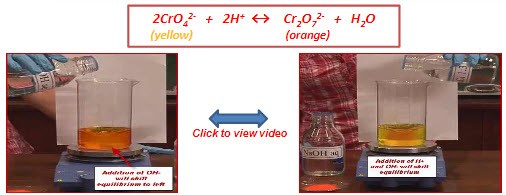
2CrO42- + 2H+ → Cr2O72- + H2O
What will happen when H+ ions are added to the system?
Position of equilibrium will shift to left and become more yellow
Color of system will turn all yellow
Color of system will turn all orange
Equilibrium will shift to right and become more orange

Heat + 1 N2O4 → 2 NO2
What will happen when the temperature is increased?
Position of equilibrium will shift to left and become lighter in color
Position of equilibrium will shift to right and become more brown
No change in position of equilibrium
Position of equilibrium will shift to right and become lighter in color

CoCI42- +6H2O →Co(H2O)62+ + 4CI- + Heat
What will happen when the temperature is increased?
Position of equilibrium will shift to left and become more blue
Position of equilibrium will shift to right and become more pink
No change in position of equilibrium
Position of equilibrium will shift to left and become more pink
2CrO42- + 2H+→Cr2O72- + H2O
What will happen when OH- ions are added to the system? HINT: They remove the H+ ions.
Position of equilibrium will shift to right and become more orange
Position of equilibrium will shift to left and become more yellow
Position of equilibrium will shift to right and become more yellow
OH- ions will not react, and thus no change is seen.
Which factors affect the rate of a reaction?
temperature
concentration
size
pressure
catalyst
Increase in temperature causes the particles to
slow down
move faster
stay apart from each other
move in the correct order
Why does a higher concentration increase the rate of reaction?
it increases the amount of reactants
it lowers the activation energy
it increases the energy of reactant particles
it increases the frequency of collision
Why does a higher temperature increase the rate of a reaction?
It increases both the frequency collision and energy of reactant particles
It only increases the frequency of collision
It only increases the energy of reactant particles
It reduces the activation energy of the reaction
A by-product is
something produced from an industrial process which is not the desired product but still has monetary value
waste from an industrial process
an intermediate product which undergoes further conversion in an industrial process
the desired product of an industrial process
Catalyst helps to
increase the amount of product obtained
to lower the activation energy
provide an alternative reaction route
decrease the frequency of collision

Which factors increase the rate of a reaction?
increasing temperature
increasing concentration
increasing total surface area
All of these
Increasing pressure causes the reacting particles
to bond together
to repel from each other
gain more kinetic energy
to move closer together
Increasing the temperature gives particles more __________.
time
energy
space
frequency
As the frequency of ________________ collision increases, the rate of reaction increases.
time
speed
effective
efficient

Continuous operation of an industrial multistep process using sequential reaction vessels is cost effective, except that...
You don't have to shut down to do a complete clean as often as the reaction vessels are not sitting idle.
You can have multiple processes going at once.
You will probably have to staff the operation continuously including overnight shift work which is expensive
You can't make use of LCP that way
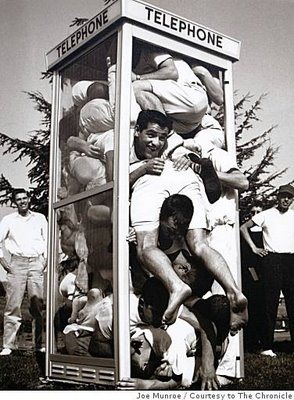
You make a space much smaller by increasing the ________________ hoping to increase the reaction rates.
temperature
concentration
catalyst
pressure
Increased pressure can be used in an industrial process to speed up the reaction. Which one of the following is a good reason why it might be avoided?
Increased pressure is costly due to energy use, equipment maintenance and calibration.
it lowers the activation energy for the reaction.
it increases the energy of particle collisions.
It doesn't affect the equilibrium position so you'd get the same final yield anyway.

