
 Worksheets
APES Unit 4 Review
Total questions: 100
Worksheet time: 2hrs 40mins



What is the correct order (starting from the surface) of Earth’s layers?
crust, outer core, inner core, mantle
mantle, outer core, inner core, crust
crust, mantle, outer core, inner core
outer core, inner core, crust, mantle
Which of these statements is correct?
Continental crust is thicker than oceanic crust
Continental crust is thinner than oceanic crust
Continental crust is smaller than oceanic crust
Continental crust is more dense than oceanic crust
Scientists at the time rejected Wegener's hypothesis of continental drift because he could not explain how or why Earth's continents move.
True
False

What evidence did Wegener use to support his theory?
Continents and fossils fitting together/matching-up like puzzle pieces
glacier scars and other climate evidence from temperature
mountain ranges and rocks line up across continents
fossils of the same species on different continents

What type of plate boundary is shown here?
Convergent
Hotspot
Divergent
Transform
Mountains are created when....
Two continental plates collide
Two oceanic plates pull apart
An Oceanic plate subducts under a Continental Plate
Two continental plates pull apart

What type of event will occur at this boundary?
Earthquake
Volcano Eruption
Tornado
Mountain Building

This image shows which of the following?
Earthquake
Mountain formation
Subduction zone
Riff Valley formation
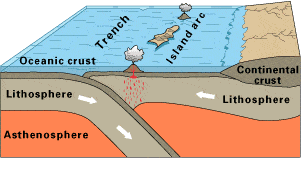
Which statement is FALSE based on the diagram?
the oceanic crust melts down into magma
the crust with the lower density gets subducted
volcanic islands form on the plate not being subducted
the tectonic plates are moving towards from each other at a convergent boundary
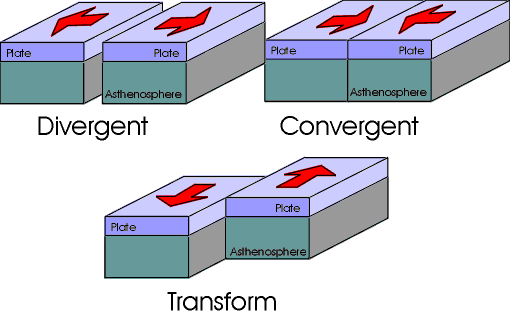
The San Andreas Fault in California is which type of boundary?
The movement of the tectonic plates is caused by
the rotation of the Earth.
convection currents in the Asthenosphere.
the gravity of the iron-nickel core.
movement of magma in the lithosphere.

What type of plate boundary is shown here?
Convergent
Subduction
Divergent
Transform
A divergent boundary occurs when plates ....
Pull apart
Come together
Slide past each other
Subduct


The process by which the ocean floor sinks beneath a deep-ocean trench and back into the mantle is known as _______
convection.
continental drift.
subduction.
conduction.

The Himalayan mountains are shown on the map below. Which student correctly identified the geologic process that formed the Himalayan mountains?
Student 1
Student 2
Student 3
Student 4
The type of plate boundary where two plates come together is a .....
Convergent Boundary
Divergent Boundary
Transform Boundary
Plate Boundary
At what boundary types can earthquakes occur?
divergent
convergent
transform
At what boundary types can volcanoes occur?
divergent
convergent
transform
The surface of the earth, otherwise known as the ______, is broken into seven major pieces and sits atop a liquid layer called the _______
lithosphere; asthenosphere
asthenosphere; lithosphere
crust; lithosphere
crust; asthenosphere
How much stronger is a magnitude 9 quake compared to a magnitude 5?
10,000 x
100 x
1,000 x
100,000 x
At minimum, how many seismic stations are needed to figure out the epicenter of an earthquake?
1
2
3
4


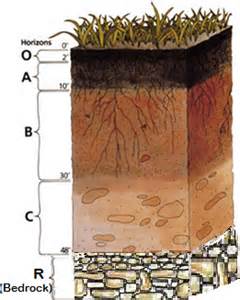
Horizon R
carbon dioxide and wind

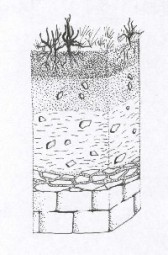
Soil profiles
Soil horizons
Has a thick O horizon and a bleached E horizon
forest biome
grasslands biome
rainforest biome
desert biome
Has a very thick A horizon (topsoil)
forest biome
grasslands biome
rainforest biome
desert biome
Has a thin O horizon and very thin A horizon
forest biome
grasslands biome
rainforest biome
desert biome
Has no O horizon, a very thin A horizon, and a very large B horizon
forest biome
grasslands biome
rainforest biome
desert biome


What are the proportions of sand, silt, and clay for the soil at point T?
5% Sand, 95% Silt, 5% Clay
5% Sand, 20% Silt, 5% Clay
40% Sand, 40% Silt, 20% Clay
60% Sand, 30% Silt, 10% Clay
Which soil particle is largest in diameter?
Clay
Silt
Sand
Loam

Soils that hold water well typically have a lot of
clay.
sand.
silt.
loam.
The rate at which water flows through the soil is called soil percolation or ______.
Groundwater
Permeability
Soil Pores
Porosity
Which has the highest CEC?
Sand
Silt
Clay
Which of the following is NOT a factor that affects the rate of soil formation?
Parent material
Topography
Climate
Vegetation
What soil would be best to add to the bottom of a constructed pond, where the goal is to have as little leakage of water as possible?
mostly clay
mostly silt
mostly sand
equal amounts of sand, silt, and clay.
Which of the following, if added to soil, would lower the base saturation?
sodium
potassium
magnesium
aluminum
What can you add to your soil to decrease the acidity and neutralize the soil.
potassium
limestone
granite
sulfur
What factor affects the rate of soil formation based on the slope of the land?
Parent material
Topography
Climate
Soil organisms
In which layer of the atmosphere does weather take place?
Troposphere
Stratosphere
Mesosphere
Thermosphere
Exosphere
What is the correct sequence of layers of the earth's atmosphere from earth's surface to space?
troposphere, stratosphere, mesosphere, thermosphere.
mesosphere, stratosphere, thermosphere, troposphere.
troposphere, mesosphere, stratosphere, thermosphere.
stratosphere, troposphere, mesosphere, thermosphere.
In which layer of the atmosphere does ozone help block UV radiation from striking the Earth?
troposphere
mesosphere
stratosphere
thermosphere
In which layer of the atmosphere do auroras occur?
troposphere
mesosphere
stratosphere
thermosphere
In which layer do meteors start to burn up?
troposphere
mesosphere
stratosphere
thermosphere
In which layer of the atmosphere do all the pressure, wind, and precipitation changes occur?
thermosphere
stratosphere
troposphere
mesosphere
mesosphere
Which gas is there the most of in the atmosphere?
Oxygen
Nitrogen
Water vapor
Carbon dioxide
As altitude increases, pressure ____________.
increases
decreases
stays the same


polar, ferrel, hadley
ferrel, hadley, polar
polar, hadley, ferrel
hadley, ferrel, polar

At some latitudes, cool air sinks down. What kind of biomes could be found at these latitudes?
a desert
a tundra
a taiga
a rainforest
At some latitudes, warm air rises. What kind of biomes could be found at these latitudes?
a desert
a tundra
a taiga
a rainforest

Look closely at the map of the watershed below. If water enters the watershed at the top of the mountain where the arrow is pointing, at which point will it stop draining?
Point A
Point B
Point C
Point D
All water in a watershed flows _______________________.
downstream
upstream
Why do humans like to settle near floodplains?
the flat land is easy to build on
the nearby water is convenient
the soil has a high nutrient level
the soil has a higher chance of becoming waterlogged

Which of the following are disadvantages to building dams?
Destroys habitat
Decimates natural salmon migration routes
Disturbs flooding cycles and nutrient deposition
Makes the soil downstream more suitable for farming
Which two factors allow earth to experience four distinct seasons?
latitude & solar intensity
tilt of axis & rotation of axis
tilt of axis & revolution around sun
distance from sun & place in orbit around sun
What is the shortest day of the year?
Summer solstice
Winter solstice
Spring equinox
Fall equinox

I. variation in the angle of sunlight that reaches Earth
II. variation in the amount of surface area over which the Sun's rays are distributed
III. variation in the amount of sunlight reflected from clouds

What season in the Northern Hemisphere at letter A?
Winter
Summer
Spring
Fall
Both Poles
Which factors affect the movement of SURFACE ocean currents?
Earth's rotation
salt content of water
winds
continents/landmasses blocking the movement of water
A rain shadow forms on the ___________ side of a mountain as a result of ___________ rainfall there.
windward; more
windward; less
leeward; more
leeward; less
What happens to the air as it rises over the mountains in the rainshadow effect?
The air becomes warmer and more humid.
The air cools and drops water vapor as precipitation.
The air flows faster and creates strong winds.
The air becomes drier and loses moisture.
ENSO events take place in which ocean basin?
Atlantic
Indian
Pacific
Arctic
La Nina
Which statement correctly defines wind?
The movement of air from areas of low pressure to areas of high pressure
The movement of air to a colder area in the atmosphere.
The movement of air from areas of high pressure to areas of low pressure.
The movement of air pushed around and bouncing off Earth's surface.
What is the initial source for global winds and convection in the atmosphere?
heat from the Earth's core
the rotation of the Earth
Moon's gravity
unequal heating of the Earth by the sun
The circular patterns of ocean currents found in each ocean basin are called __.
whirlpools
cyclones
gyres
thermohaline circulation
Why do the fisherman of Peru and South America not welcome a strong El Nino?
El Nino poisons the fish
El Nino causes strong winds and currents which move fish westward
El Nino brings cold water to the surface which kills the base of the food chain
El Nino shuts off upwelling and nutrients needed for the marine food chain do not rise to the surface
What are the climate impacts of La Niña?
Flooding in the Southern United States and cooler temperatures, heavy rains, and flooding in the Pacific Northwest
Flooding in the Southern United States and warmer, drier conditions in the Pacific Northwest
Drought in the Southern United States and cooler temperatures, heavy rains, and flooding in the Pacific Northwest
Drought in the Southern United States and warmer, drier conditions in the Pacific Northwest

The picture represents a(n) ___ event.
El Nino
La Nina
Normal Conditions

