Wayground logo

Free Printable Worksheets

Font size

S
M
L
XL
Worksheets

Biochemistry Review

Total questions: 56

Worksheet time: 38mins

Name
Class
Date
1.

A ______________ is a large molecule.

a)

Micromolecule

b)

Polymer

c)

Amino Acid

d)

Macromolecule

2.

Which of the following elements are found in all macromolecules? (Select all that apply).

a)
b)
c)
d)
3.

Which of the following is not one of the four major classes of macromolecules?

a)

Lipids

b)

Carbon

c)

Protein

d)

Carbohydrates

e)

Nucleic Acid

4.

Which macromolecule is used as our main source of energy?

a)

Lipids/Fats

b)

Nucleic Acids

c)

Proteins

d)

Carbohydrates

5.

Which of the following are examples of carbohydrates? (Select all that apply).

a)

Bread

b)

Pasta

c)

Olive Oil

d)

Cheese

6.

Which macromolecule stores energy?

a)

Carbohydrates

b)

Proteins

c)

Lipids/Fats

d)

Nucleic Acids

7.

Nucleic acids make up which of the two molecules listed below?

a)

FDA

b)

RNA

c)

DNA

d)

FDR

8.

This is one job proteins do not have in the body.

a)

structure for tissues and organs

b)

transport things through cell membranes

c)

speed up chemical reactions

d)

insulation

9.

An avocado is an example of a which macromolecule?

a)

Carbohydrate

b)

Lipid/Fat

c)

Protein

d)

Nucleic Acid

10.

This macromolecule breaks down into sugars such as glucose.

a)

Lipids/Fats

b)

Nucleic Acids

c)

Protein

d)

Carbohydrates

11.

Which type of fat is considered healthier than others?

a)

Saturated Fat

b)

Unsaturated Fat

c)

Monounsaturated Fats

d)

Trans Fat

12.

Salmon is an example of what 2 macromolecules?

a)

Carbohydrates

b)

Lipids/Fats

c)

Protein

d)

Nucleic Acids

13.
The diagram shows the general structure of an amino acid. Which type of molecule is formed from amino acids?
a)
lipids
b)
proteins
c)
carbohydrates
d)
nucleic acids
14.
You are analyzing a compound in the laboratory. You find that it is made up of carbon, hydrogen, and oxygen in a ratio of two hydrogen atoms for each carbon atom. How will you classify the compound?
a)
lipid
b)
protein
c)
carbohydrate
d)
nucleic acid
15.
Fats, oils and cholesterol are all types of what?
a)
cell membranes
b)
hormones
hormones
c)
lipids
d)
fatty acids
16.
RNA and DNA are which type of macromolecules?
a)
carbohydrate
b)
lipid
c)
nucleic acid
d)
protein
17.
Many plants have waxy coatings on some surfaces. This coating reduces water loss because it is not water-permeable. This waxy coating is which of the following types of organic molecule?
a)
protein
b)
carbohydrate
c)
nucleic acid
d)
 lipid
18.
A sugar, a phosphate group, and a nitrogen base form the building blocks of which organic compound?
a)
carbohydrates
b)
lipids
c)
nucleic acids
d)
proteins
19.
The human body maintains a temperature of around 98.6 degrees at all times. Enzymes are involved in almost every chemical reaction in the body. Which of the following describes the connection between these two statements? 
a)
Enzymes function best at a specific temperature.
b)
The body needs to be warm to prevent hypothermia.
c)
The body is kept relatively warm to prevent too much enzyme action. 
d)
There is no connection between the two statements. 
20.
Like complex carbohydrates, proteins are macromolecules that serve many functions and can be chemically broken down and restructured. Both proteins and complex carbohydrates are which of the following?
a)
 polymers of smaller subunits
b)
sequence of sugars
c)
lipids of large molecules
d)
nucleotides of DNA
21.
 In living organisms, lipids function mainly as:
a)
Sources of stored energy and transmitters of genetic information
b)
Sources of stored energy and components of cellular membranes
c)
Transmitters of genetic information and catalysts of chemical reactions
d)
Catalysts of chemical reactions and components of cellular membranes
22.
What is the function of macromolecule subunit below?
a)
energy
b)
catalyst
c)
stores genetic information
d)
composes the majority of the cell membrane
23.
What is a substance called if it speeds up a chemical reaction?
a)
reusable
b)
catalyst
c)
specific
d)
fragile
24.
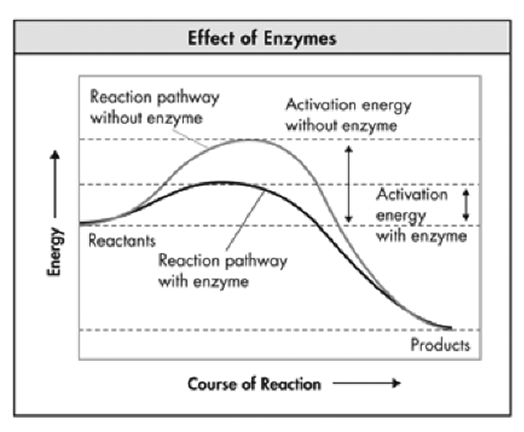
The graph shows how enzymes affect reactions in cells. Which statement best summarizes the information shown in the graph?
a)
Enzymes increase the energy of the reactants.
b)
Enzymes decrease the energy level of the products.
c)
Enzyme decrease the activation energy of the reaction.
d)
Enzymes reverse the direction of the reaction.
25.
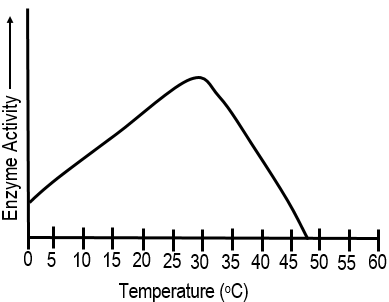
Based on the graph, what is the optimal temperature for this enzyme? 
a)
15oC
b)
40oC
c)
30oC
d)
35oC
26.
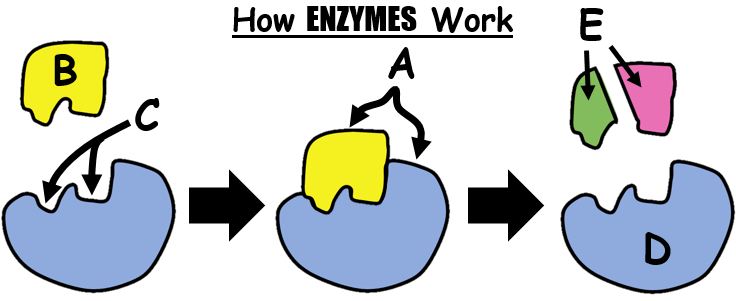
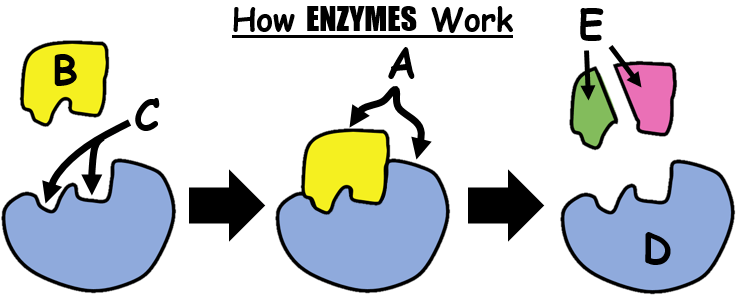
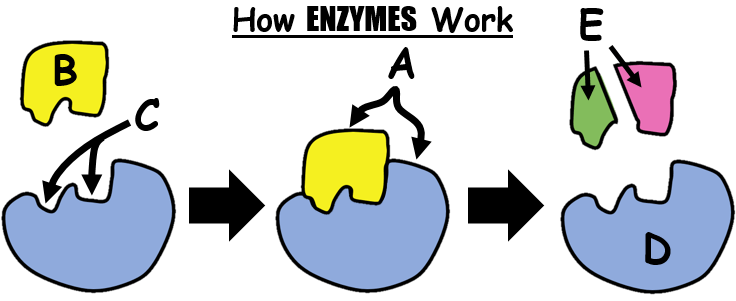
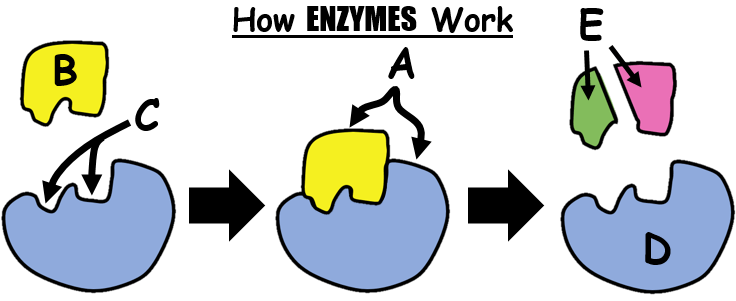
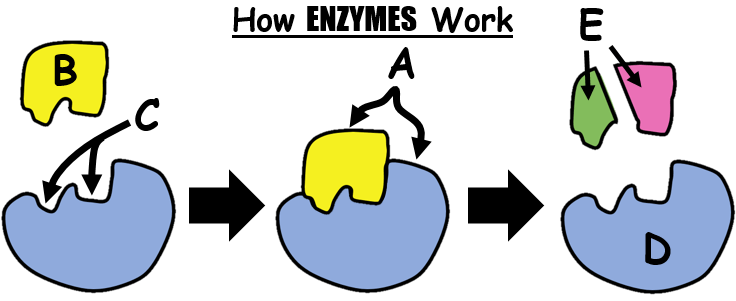
In the diagram, what is letter A? 
a)
product
b)
substrate
c)
enzyme-substrate complex
d)
active site
27.
Enzymes are...
a)
nucleic acids
b)
proteins
c)
lipids
d)
carbohydrates
28.
What is the function of an enzyme?
a)
enzymes break themselves into small pieces
b)
enzymes slow down chemical reactions
c)
enzymes speed up chemical reactions
d)
enzymes combine products to form reactants 
29.
Enzymes speed up reaction rates by changing...
a)
Activation Energy
b)
pH
c)
Hydrogen Bonds
d)
Kinetic Energy
30.
Letter D...
a)
active site
b)
enzyme
c)
substrate
d)
products
31.
Letter B...
a)
active site
b)
enzyme
c)
substrate
d)
products
32.
Letter C...
a)
active site
b)
enzymes
c)
substrate
d)
products
33.
Letter E...
a)
active site
b)
enzyme
c)
substrate
d)
products
34.
Any substance that is acted upon by an enzyme is called a(n)?
a)
Coenzyme
b)
Substrate
c)
Vitamin
d)
Polypeptide
35.
Which of the following conclusions can be drawn from this graph?
a)
The optimum pH of the enzyme is 6.6.
b)
The optimum pH of the enzyme is 5.8
c)
The enzyme’s activity increases as pH increases 5.0 to 9.0
d)
The enzyme’s activity is greater around pH of 8.0 .
36.

What happens when enzymes are heated to a high temperature?

a)

The enzymes die.

b)

The shapes of the enzyme are altered.

c)

The enzymes' amino acid sequence changes.

d)

The enzymes remain the same

37.
Enzymes will make a reaction go _______ and use ______ energy.
a)
faster, less
b)
faster, more
c)
slower, less
d)
slower, more
38.
What happens to an enzyme when it is denatured?
a)
Activation energy is lowered.
b)
It becomes stronger.
c)
It loses its shape.
d)
Activation energy is raised.
39.
Every enzyme has a optimal temperature and pH. True or False?
a)
True 
b)
False
40.
Enzymes are composed of which of the following monomers? 
a)
amino acids
b)
carbohydrates
c)
nucleotides
d)
monosaccharides
41.

The building blocks for organic compounds are called...

a)

Polygons

b)

Polymers

c)

Monograms

d)

Monomers

42.

___ are used by cells to get quick energy.

a)

Carbohydrates

b)

Lipids

c)

Proteins

d)

Nucleic Acids

43.

Nuts, butter, and waxes are examples of ____

a)

Nucleic Acids

b)

Lipids

c)

Proteins

d)

Carbohydrates

44.

_____ store genetic information.

a)

Carbohydrates

b)

Lipids

c)

Nucleic Acids

d)

Proteins

45.

What is the monomer of carbohydrates?

a)

Monosaccharide

b)

Nucleotide

c)

Fatty Acid

d)

Amino Acid

46.

What is the monomer of proteins?

a)

Amino Acid

b)

Fatty Acid

c)

Nucleotide

d)

Monsaccharide

47.

What is the monomer of lipids?

a)

Monosaccharide

b)

Fatty Acid

c)

Amino Acid

d)

Nucleotide

48.

What is the monomer of nucleic acids?

a)

Monsaccharide

b)

Nucleotide

c)

Amino Acid

d)

Fatty Acid

49.

What elements would be found in carbohydrates?

a)

Carbon, Hydrogen

b)

Carbon, Hydrogen, Oxygen

c)

Carbon, Hydrogen, Oxygen, Nitrogen

d)

Carbon, Hydrogen, Oxygen, Nitrogen, Phosphorous

50.

What elements would be found in lipids?

a)

Carbon, Hydrogen, Oxygen, Nitrogen, Phosphorous

b)

Carbon, Hydrogen, Oxygen, Nitrogen

c)

Carbon, Hydrogen, Oxygen

d)

Carbon, Hydrogen

51.

What elements would be found in proteins?

a)

Carbon, Hydrogen, Oxygen, Nitrogen, Phosphorous

b)

Carbon, Hydrogen, Oxygen, Nitrogen

c)

Carbon, Hydrogen, Oxygen

d)

Carbon, Hydrogen

52.

What elements would be found in nucleic acids?

a)

Carbon, Hydrogen, Oxygen, Nitrogen, Phosphorous

b)

Carbon, Hydrogen, Oxygen, Nitrogen

c)

Carbon, Hydrogen, Oxygen

d)

Carbon, Hydrogen

53.

Which is shown in the picture?

a)

Monosaccharide

b)

Fatty Acid

c)

Amino Acid

d)

Nucleotide

54.

Which is shown in the picture?

a)

Monsaccharide

b)

Amino Acid

c)

Fatty Acid

d)

Nucleotide

55.

Which is shown in the picture?

a)

Amino Acid

b)

Nucleotide

c)

Fatty Acid

d)

Monosaccharide

56.

Which is shown in the picture?

a)

Fatty Acid

b)

Monsaccharide

c)

Amino Acid

d)

Nucleotide