
 Worksheets
Enzymes and transport
Total questions: 45
Worksheet time: 34mins

Illustration 1 shows sugar that has formed a bond based on the action of an enzyme. Illustration 2 shows the enzyme after the addition of heat. How does the addition of heat affect the ability of an enzyme to help the sugar molecules form a bond?
Heat allows the sugar molecules to bond more quickly.
Heat provides places on the enzyme for other molecules to bond.
Heat changes the enzyme so that the sugar molecules can no longer bond.
Heat changes the chemical composition of the sugar molecules so they no longer need the enzyme.

Examine the pH data in Tables 1 and 2.
What can be inferred about the effectiveness of enzymes?
Enzymes have specific substrates and work best in any pH.
Enzymes do not have specific substrates and work best in any pH.
Enzymes have specific substrates, so they work best within a small range of pH.
Enzymes do not have specific substrates, so they work best within a small range of pH.
The enzyme pepsin catalyzes the breakdown of protein but does not affect the breakdown of lipids. What affects why enzymes catalyze reactions involving some types of molecules but not others?
the temperature of the environment
the shapes of the molecules involved
the amount of ATP available for the reaction
the number of molecules present in the reactants

An enzyme (catalase) is found in liver cells. Its function is to break down its substrate (hydrogen peroxide) into harmless water and oxygen.
What will happen to the enzyme (catalase) if the amount of substrate (hydrogen peroxide) keeps increasing?
It will be used up, and the cells will be poisoned.
It will be used up, and more of the enzyme will be produced.
It will be denatured by the hydrogen peroxide.
It will be reused to break down the hydrogen peroxide.
What type of macromolecules are enzymes?
Carbohydrates
lipids
nucleic acids
proteins

The diagram represents a series of reactions that occur in organisms.
What relationship is best represented?
antigens and immunity
mRNA and ribosomes
substrates and enzyme
carrier proteins and active transport

Enzymes are critical to metabolic function and maintenance of homeostasis in the cell.
What does the diagram illustrate about enzyme function?
The binding of the substrate to the enzyme is facilitated by the shape of the enzyme’s active site, which is specific for the substrate it binds.
The products of an enzyme-catalyzed reaction can reenter the active site of an enzyme and be fused back together into the original reactants
The substrate in an enzyme-catalyzed reaction can only be broken down when the substrate’s length-to-width ratio is roughly 3:1 in the active site.
When the substrate binds to the enzyme, the enzyme folds shut around the substrate, trapping the products of the reaction inside the protein to be digested.

Structure is critically linked to function in enzymes.
What can be concluded by looking at the image of an enzyme?
The enzyme’s active site must allow for the breakdown of a large substrate into three distinct products.
The irregular shape of the enzyme’s active site must mean that it can only accept one or a few types of substrates.
The irregular shape of the enzyme’s active site must mean that it has denatured and is nonfunctional.
The enzyme’s active site must allow for the fusion of three smaller substrates into one large substrate molecule.
Which statement explains how an enzyme acts as a catalyst to increase the speed of a reaction?
It changes the structure of the substrate.
It decreases the concentration of the substrate.
It increases the temperature of the reaction.
It lowers the activation energy of the reaction.
Many different enzymes are needed during digestion. The pH of the mouth ranges from 6.5-7.5, the pH of the stomach is 2, and the pH of the small intestine is neutral.
Which enzyme works best in the mouth?


What is the most likely outcome for an enzyme that normally breaks down its substrate into products in the human body at a pH of 2 when it is placed in a new environment with a pH of 7?
It will adapt and break down a different substrate.
It will denature and become nonfunctional.
Its activity will reverse, and products will bond back into the substrate.
Its rate of catalytic activity will increase, and more products will be formed.
Which phrase explains how an enzyme speeds up the rate of a chemical reaction?
by lowering the temperature of the substrate involved in the reaction
by lowering the minimum amount of energy required to start the reaction
by increasing the surface area of the substrate involved in the reaction
by increasing the concentration of the enzyme-substrate complex formed in the reaction

The graphs show the activity of an enzyme that causes spoiling and discoloration of a fruit at different temperatures and pH levels.
What combination of pH and temperature will prevent spoiling and discoloration of the fruit?
pH: 2.5; temperature: 90°C
pH: 3.5; temperature: 80°C
pH: 6.5; temperature: 60°C
pH: 8.5; temperature: 40°C

A team of biology students conducted an experiment in which they measured the rate of photosynthesis as a function of increasing carbon dioxide concentration. The students graphed the results of their experiment.
What explanation can be given for these results?
At some point, the enzymes that catalyze photosynthesis get saturated with substrate, and the addition of more carbon dioxide will not speed up the rate of photosynthesis any further.
Carbon dioxide can be fixed by plants in photosynthesis only during daylight hours, so the concentration levels off at sunset and will remain at that level until the following daybreak.
Carbon dioxide is a product of photosynthesis, so the rate is independent of CO2 concentration, and the graph shape reflects only the availability of light at the time.
The students must have made a mistake in their experiment because carbon dioxide is a reactant in photosynthesis, so the addition of more CO2 should increase the photosynthetic rate indefinitely.
What type of molecule diffuses across a selectively permeable membrane during the process of osmosis?
carbon dioxide
glucose
oxygen
water

Examine the graph showing the effect of pH on a particular enzyme.
Which explanation accurately describes why the enzyme is responding as shown?
At a neutral pH, the enzyme’s active site forms attractions with the enzyme, decreasing the rate of the reaction.
At low and high pH levels, the enzyme’s active site forms attractions with the enzyme, increasing the rate of the reaction.
At a neutral pH, the enzyme’s active site changes shape so the substrate can no longer form attractions with the enzyme, denaturing the enzyme.
At low and high pH levels, the enzyme’s active site changes shape so the substrate can no longer form attractions with the enzyme, denaturing the enzyme.
A student prepared two potato cubes by cutting 2 cm x 2cm sectioins from the same potato. Next, she determined the mass of each of the cubes and recorded the information in her lab notebook.
She then placed one cube in a beaker of distilled water and the other in a beaker with an equal volume of concentrated salt solution. After 20 minutes, she removed both of them from the beakers and again determined the mass of each cube.
Which statement correctly describes the effect on the mass on one of the cubes after a 20 minute period?
In distilled water, the mass of the potato cube increase due to salt leaving the cells of the potato.
In distilled water, the mass of the potato cube increased due to water moving into the cells from high concentration to low concentration.
In the concentrated salt solution, the mass of the potato cube increased due to salt moving into the cells from low concnetration to high concentration.
In the concentrated salt solution, the mass of the potato cube remained the same due to the cell wall preventing the movement of molecules into or out of the cells.

The diagram below represents a portion of a cell membrane.
The arrow indicates that the cell membrane is carrying out the process of __________.
respiration
diffusion
facilitated difusion
active transport

A diagram of a cell is shown. The cell membrane is permeable to both carbon dioxide and oxygen.
Initially the oxygen and carbon dioxide will likely move in which direction?
Oxygen will enter the cell, and carbon dioxide will exit the cell.
Oxygen will exit the cell, and carbon dioxide will enter the cell.
Both oxygen and carbon dioxide will enter the cell.
Both oxygen and carbon dioxide will exit the cell.
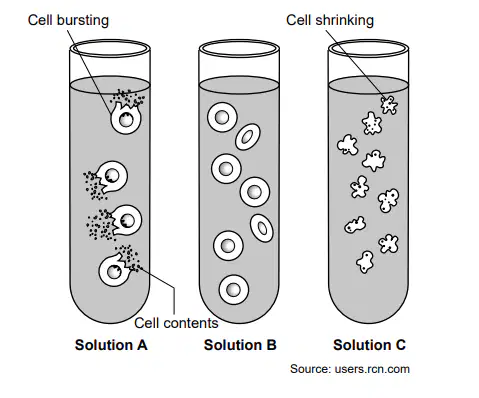
The diagram below represents red blood cells placed in three test tubes, each containing a different salt solution.
Which solution would be most similar in concentration to the normal internal environment of the human circulatory system?
solution A, only
solution B, only
solutions A and B
solutions A and C

When a plant cell is placed into hypotonic solution, water flows into the cell and is stored in the central vacuole. This causes the cell to swell, placing pressure on the cell wall.
What statement best describes the result of similar conditions on a human red blood cell?
Water will enter and leave the red blood cell at equal rates, which maintains the structure of the red blood cell.
Water will enter the red blood cell, which will cause the red blood cell to swell and burst since it lacks a cell wall.
Water will leave the red blood cell since it does not have a cell wall, which will cause the cell to shrivel.
Water will neither enter nor leave the red blood cell due to its lack of a vacuole for water storage.
A researcher claims that glucose is moved into cells by facilitated diffusion through the GLUT4 transporter.
Based on the model, which statement BEST supports the researcher's claim?
The movement of glucose across the membrane does not require ATP.
Glucose moves from an area of low concentration to an area of high concentration.
The glucose molecules diffuse freely through the membrane without a protein channel.
Glucose provides energy for the protein channel to transport materials across the membrane.
Students created flowcharts to show select types of transport that occur across the plasma membrane.
Which flowchart correctly shows the types of plasma membrane transport?


There are many ways for substances to get into the cell through the cell membrane.
Which diagram shows a process that requires the cell to use energy for the substance to get inside the cell?


Examine the structures in the diagram.
What is shown in the area labeled Z?
carrier protein
channel protein
phospholipid bilayer
peripheral membrane protein

A lab technician prepared four different suspensions of red blood cells as shown in the table.
After an hour, the technician observed a sample from each suspension under the microscope. Which suspension(s) would have larger, swollen red blood cells as compared to the others?
Suspensions J and K because there was a higher concentration of water molecules inside the cells so water diffused out of the cells.
Suspensions J and K because there was a higher concentration of water molecules outside the cells so water diffused into the cells.
Suspension L because there was a higher concentration of water molecules inside the cells so water diffused out.
Suspension M because the concentration was equal so water did not diffuse unlike all of the other suspensions whose cells lost water.

Analyze the graph showing the size of various molecules.
Which molecule most likely requires active transport to move across the plasma membrane?
w
x
y
z
A student with swollen gums gargles with warm salt water and experiences decreased swelling. Which statement best explains what has occurred?
The high temperature of the warm salt water kills all infection-causing microbes.
The saltwater solution is absorbed by cells in the gums.
The salt in the saltwater solution is transferred into the cells through passive transport.
The water in the gums moves from a high to a low concentration of water.

The diagram shows four types of transport.
Which process requires energy and is necessary for maintaining homeostasis?
J
K
L
M

Timothy is investigating the movement of molecules into and out of cells. He has made observations of four cells before and after being placed in four different solutions labeled with the same letter (A, B, C, or D). Timothy’s data can be found in the table.
Which cell has undergone active transport?
A
B
C
D

Examine the movement of particles across the cell membrane.
What is the name for this type of transport of materials?
simple diffusion
facilitated diffusion
active transport
phagocytosis
What would be an indicator that a cell uses active transport to remove a particular toxin, helping to keep the cell alive?
The toxin is in a lower concentration outside the cell than inside the cell.
The toxin is able to pass directly through the cell’s phospholipid bilayer.
The toxin is uncharged and passes through a channel protein that does not change shape.
The toxin is a large and relatively polar molecule.

Two solutions (A and B) are separated by a semi-permeable membrane that allows water to pass through the pores as shown in the figure.
The concentration of glucose in solution A is 5%, and the concentration of glucose in solution B is 15%. Which statement correctly describes the movement of water between the two solutions?
Water will diffuse from solution A to solution B.
Water will diffuse from solution B to solution A.
There will be diffusion of sugar from solution A to solution B.
There will be diffusion of sugar from solution B to solution A.

A group of students created a table listing four differences between active and passive transport.
Which differences are described correctly in the students’ table?
1 and 2
1 and 3
2 and 3
2 and 4

A student places an unknown solution on a leaf and observes the leaf cells under a microscope. The student finds that the leaf cells undergo a process known as plasmolysis, as shown in the model.
The unknown solution is hypertonic. The arrows represent water moving out of the cell.
The unknown solution is isotonic. The arrows represent water moving into the cell.
The unknown solution is isotonic. The arrows represent sugar moving out of the cell.
The unknown solution is hypotonic. The arrows represent sugar moving out of the cell.

The plasma membrane in eukaryotic cells is composed of a phospholipid bilayer with embedded proteins. Each phospholipid molecule has a water-soluble hydrophilic head and a water-insoluble hydrophobic tail arranged in a bilayer as shown in the diagram.
How is the arrangement of molecules in the plasma membrane beneficial for the cell?
It helps in the release of enzymes by the cell.
It allows the selective transport of molecules in and out of the cell.
It increases the surface area for the absorption of molecules.
It helps in capturing sunlight to make food through photosynthesis.
A student prepared two potato cubes by cutting 2 cm x 2cm sectioins from the same potato. Next, she determined the mass of each of the cubes and recorded the information in her lab notebook.
She then placed one cube in a beaker of distilled water and the other in a beaker with an equal volume of concentrated salt solution. After 20 minutes, she removed both of them from the beakers and again determined the mass of each cube.
Which statement correctly describes the effect on the mass on one of the cubes after a 20 minute period?
In distilled water, the mass of the potato cube increase due to salt leaving the cells of the potato.
In distilled water, the mass of the potato cube increased due to water moving into the cells from high concentration to low concentration.
In the concentrated salt solution, the mass of the potato cube increased due to salt moving into the cells from low concnetration to high concentration.
In the concentrated salt solution, the mass of the potato cube remained the same due to the cell wall preventing the movement of molecules into or out of the cells.

Catalase is an enzyme that speeds up the decomposition of hydrogen peroxide.
According to the data in the graphs which pH and temperature combination provides the optimum conditions for catalase activity?
pH 5 and 4 degrees C.
pH 5 and 25C
pH7 and 37C
pH7 and 50C
Which two characteristics are present in a eukaryotic cell and absent from a prokaryotic cell?
membrane organelles
ribosomes
cell membrane
DNA within a nucleus
circular DNA

A scientist observes four different cells under a microscope.
Which cell is an animal cell that can produce the most energy for making proteins?
Cell W
Cell X
Cell Y
Cell z
Which statement explains why mitochondria have the ability to act independently in the cell?
They are responsible for energy production.
They have their own double-stranded, circular DNA.
They have double lipid bilayer membranes.
They are present in large numbers inside the cell.
Leigh syndrome is a rare genetic disorder that is triggered by an infant’s first viral infection. Tests conducted on infants with the condition show they lack cellular energy in the form of ATP.
Which cellular organelle is most likely defective and responsible for Leigh syndrome?
chloroplasts
mitochondria
lysosomes
Golgi bodies
Which reaction requires water to be REMOVED from two monomers in order to MAKE a bond between them?
dehydration synthesis
protein denaturation
hydrolysis
osmosis
Which two organelles in the cell must work together in the process of protein production?
The nucleus produces DNA that directs protein production in the mitochondria.
The ribosomes produce amino acids that direct protein production in the mitochondria.
The nucleus produces RNA that directs protein production in the ribosomes.
The ribosomes produce peptides that direct protein production in the nucleus.
In humans, nerve cells and liver cells have the same set of DNA, yet their functions are different. What allows the functions of these cells to vary, despite having the same DNA?
variation in chromosome numbers
variation in DNA expression and gene activity
variation in the process of cell division
variation in the amount of cytoplasm

