
 Worksheets
Review cfa 2
Total questions: 76
Worksheet time: 2hrs 19mins

The largest grouping of organisms is ____________________ and the smallest is _________________________________.
Domain, species
Domain, kingdom
Species, domain
Kingdom, species

Using the dichotomous key, what is the name of Bird W?
Cirthidea
Geospiza
Camarhynchus
Platyspiza

The most specific level of biological classification is...
kingdom
genus
phylum
species

The order of the levels of classification is:
Domain, kingdom, phylum, class, order, genus, family, species
Domain, class, kingdom, phylum, order, genus, family, species
Domain, class, kingdom, phylum, order, genus, species, family
Domain, kingdom, phylum, class, order, family, genus, species
Which organisational tool allows you to group and identify organisms based on similar traits?
Dichotomous key
Cladogram

Giving every organism name
Classification
Binomial system
Anatomy
Morphology
Describing the external features of organisms
Anatomy
Biology
Morphology
Classification
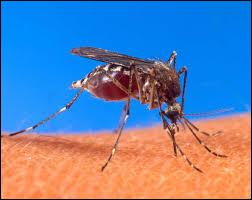

Which traits were selected for in whale ancestors?
Traits that helped them walk on land
Traits that helped them move in water
Traits that helped them give birth

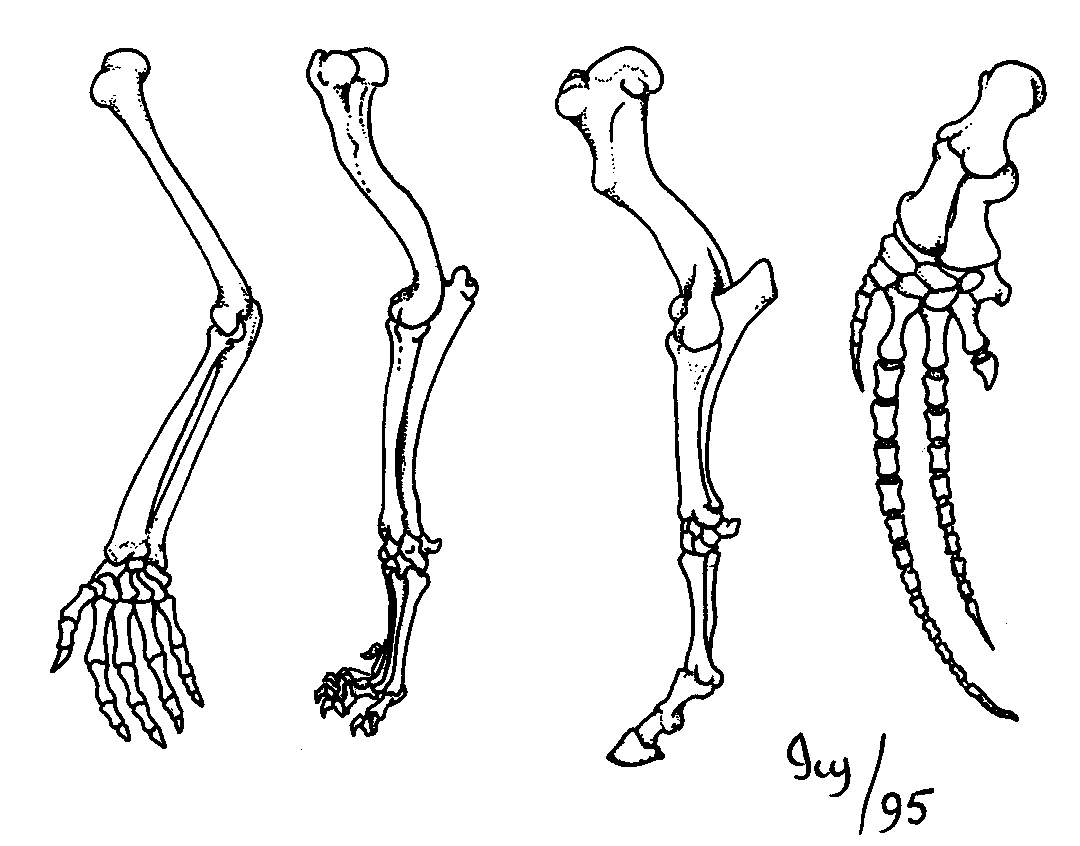
Body parts of organisms that are the same in structure and position but different in function and shared by a common ancestor.
embryos
homologous structures
analogous structures
vestigial structures

.
Which rock layer contains the youngest fossils?
B
F
E
C

Images of the embryo and adult stages of three different organisms are shown.
Which of the following is the best conclusion that can be drawn from this evidence?
Having similar embryos indicates that these organisms eat the same types of food.
Having similar embryos indicates that these organisms share a recent common ancestor.
Having similar embryos indicates that these organisms live in a similar environment.
Having similar embryos indicates that a certain protein controls how many legs the adult organisms will have.
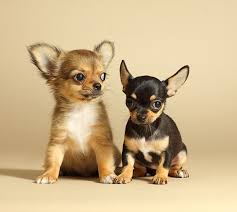
What scientific name is correct?
Quercus Alba
Quercus alba
quercus Alba
quercus alba
Canis lupus, the scientific name for a wolf, is in which genus?
Canis
lupus
Animalia
Mammalia

Which category of classification has the largest variety of organisms?
genus
phylum
species
kingdom

Aristotle is said to be the first to classify organisms. Into which two groups did he classify all living things?
fungi and bacteria
humans and animals
living and nonliving
plants and animals
Which is the best prediction regarding the current classification system?
The system may change as new information and organisms are discovered.
Scientists will become bored with the current system and develop a new one.
Over time, organisms will become extinct, so classification will become simpler.
The system is set in stone and most likely will not change.

An organism identified with binomial nomenclature includes which two taxa?
class and order
family and genus
genus and species
kingdom and phylum

Carl Linnaeus developed a binomial classification system for living things. Why is this contribution important?
because it created new species for identification
because it created specific scientific names for living things
because it created the taxonomy system as it is known today
because it created common names for species with existing scientific names
Which taxonomic category is higher than the others?
Class
Genus
Family
Phylum
Scientists currently classify organisms based on features they share. How will this most likely change in the future?
They will be classified based on DNA analysis.
They will be classified based on similar organs.
They will be classified based on common descent.
They will be classified based on protein production.

What is the order of the taxonomic levels from least specific to most specific?
Kingdom, Family, Species, Order, Class, Phylum, Genus
Kingdom, Phylum, Class, Order, Family, Genus, Species
Species, Order, Kingdom, Family, Genus, Phylum, Class
Species, Genus, Family, Order, Class, Phylum, Kingdom


Fill in the blanks
autotrophic, no, unicellular
autotrophic, yes, multicellular
heterotrophic, no unicellular
heterotrophic, yes, multicellular
Organisms with traits that are best suited for their environments are likely to have a greater chance for survival. These helpful traits, which arise due to genetic mutations, are known as _____________________.
Mutation
Adaptations
Natural Selection
Evolution
Choose which scientist corresponds best with the statement:
survival of the fittest; those with naturally better traits survive to reproduce and pass off those traits to offspring
Darwin
Lamarck


The lizard has all these derived characteristics EXCEPT
Jaws
Lungs
Bipedal

According to this cladogram, sharks are MOST closely related to which organism?
Amphibians
Ray-Finned Fish
Primates

What number is the common ancestor of C and D
1
2
4
Which would most likely result in primary succession?
old forest growing
undisturbed prairie
pollution kills mountain lake species
a Newly formed volcanic island
Which progression best explains secondary succession?
lichens>grass>shrubs>small trees> big trees
mosses>creates soil>grasses>small trees> big trees
Volcano destroys ecosystem>grasses>shrubs>small trees>big trees
Volcano forms new island> lichens>grasses>shrubs>small trees>big trees
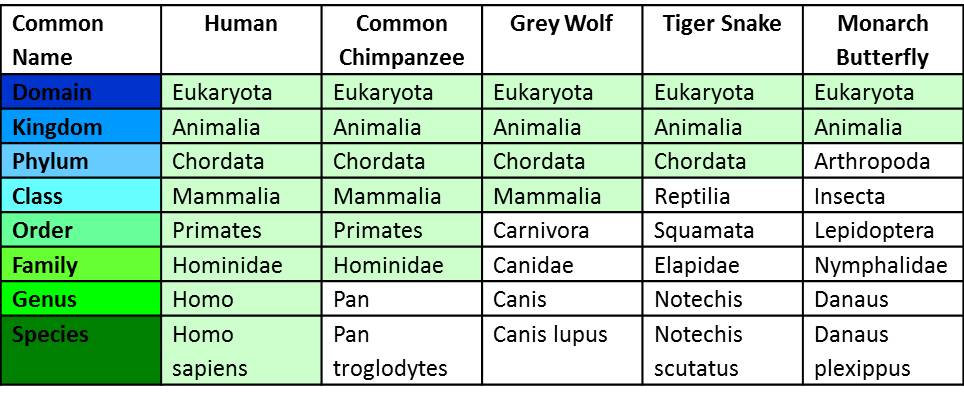
Which of the following is the correct order for least related to most related?
Domain
Kingdom
Phylum
Class
Order
Family
Genus
Species
Species
Kingdom
Phylum
Class
Order
Family
Genus
Domain
Species
Genus
Family
Order
Class
Phylum
Kingdom
Domain
Domain
Kingdom
Class
Phylum
Order
Genus
Family
Species
Which of the following sets of animals would be the most closely related?
Animals in the same order
Animals in the same genus
Animals in the same class
Animals in the same family
Which of the following sets of insects would be the most closely related?
Insects in the same class
Insects in the same family
Insects in the same order
Insects in the same species

Heterotrophs- obtain food from other animals.
Observing the table above, Fungi and Animals are________?

Which organism is most likely extinct?
A
B
C
D

According to key above, which animal has wings covered by an exoskeleton and a round body?
Ladybug
Grasshopper
Dragonfly
Housefly

