
 Worksheets
Biology A Final Exam Practice - 2023/2024
Total questions: 197
Worksheet time: 3hrs 48mins
How many sentences should a claim be?
1
2
3
It doesn't matter
Which of these statements is NOT a claim?
Global temperatures are increasing due to carbon dioxide.
Missing assignments do not affect your grades.
I like blue Jolly Ranchers.
What should NOT be included in your evidence?
Observations from an investigation.
Numbers from your data table.
Opinions about the scientific data.
Why do you need to include reasoning in your CER?
It shows how or why the evidence supports the claim
It provides justification about why the evidence is important
It includes the scientific principle to support the claim
All of the above

What is the best claim based on the data in this graph?
When the weight of particles increase, the length decreases
When the weight of particles increase, the length also increases
The length of particles is not related to weight of particles.

What is the best claim based on the data in this graph?
More cars are being made every year
Electric cars are better than gas cars
The number of electric cars worldwide is increasing
Electric cars stopped being sold in 2019
CER is a form of writing that...
can be used to make an argument
can be used to summarize a story
can be used to tell a fictional story
How could this claim be improved?
EXAMPLE CLAIM: She is a good person because she defended child laborers when others wouldn't.
Add an opinion
Be specific about who "she" is
Restate the question
Add another claim sentence
How could this evidence best be improved?
EXAMPLE: According to the text he says, "juggling emails, phone calls and other incoming information can change how people think and behave." (Ritchel 1).
Add quotation marks around the quote
Include a quote from the text
Include the exact title of the text and the name of the person who wrote the quote
Write the quote in your own words
What is an example of a claim?
Mr. Smith likes Star Wars
In the fall, because of changes in the length of daylight and changes in temperature, the leaves stop their food-making process.
The data shows that when leaves are taken away from sunlight, they change colors.
What is an example of reasoning?
Honey is stored in hives.
Honeybees store their honey in hives.
Honeybees use hexagons to store the honey and pollen they bring to the hive.
What is an example of evidence?
Football players are 33% more likely to get injured than baseball players.
Football is more dangerous than baseball.
Baseball is a fun sport.
Why do we need evidence?
To answer a question
To show how and why
To prove our claim is true
Which one of these is an evidence sentence starter?
Answers a question
The data shows…
This is important because…
Why do we need reasoning?
To show how and why
to answer a question
To prove your claim is true
What does a reasoning sentence look like?
Starts with the words Therefore or Because
Answers the question
Information from books
The information you collect while doing your experiment is called
conclusions
data
hypotheses
procedures
The variable that is being measured or observed is called the _______________. Hint: this is the variable that is the result or effect
independent variable
dependent variable
control variable
What is a constant/control in an experiment?
Things that do not change in a experiment. It's the variable that stays the same. You can have many variables stay the same.
It's the variables that the scientist changes in the experiment
It's the variables that are being measured in an experiment


How many independent variables should you have in an experiment?
two
as many as possible
four
one


What is the dependent variable of the graph?
A student wants to test the effects of different types of exercise on heart rate. What would be the dependent variable of the experiment?
the measurement of heart rate


What conclusions can you draw from this graph?
The deer population went down over time.
The deer population went up over time.
The deer population went up quickly, then down, but then stayed the same.
There are less deer because of hunters
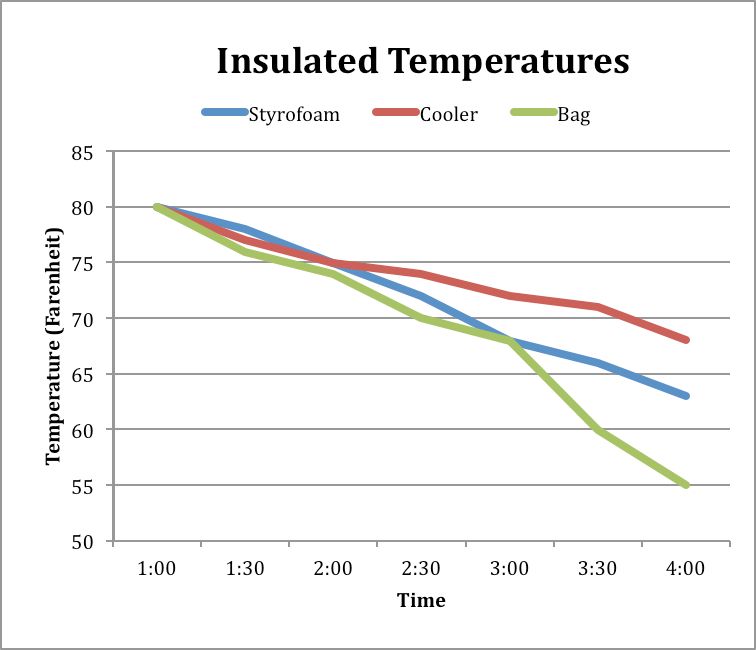
What data does this graph represent?
Change in temperature of a liquid over time in 3 different containers
How temperature can change the molecules in a material
The phase changes of a material
What type of container people use the most to store hot liquids.

What information could you get from this graph?
how much water is on Earth
the percentage of the Earth that is covered in water
how land is available on Earth
how tall the highest mountain is


This graph shows the temperature in the lab for an entire experiment. (Determine which statement(s) is/are true.)
The temperature reached its highest point during the experiment at Hour 12.
The temperature was at its lowest when the experiment began.
The temperature was decreasing for more hours than it was increasing during the experiment.
The temperature at the end of the experiment was equal to the temperature at the beginning of the experiment.


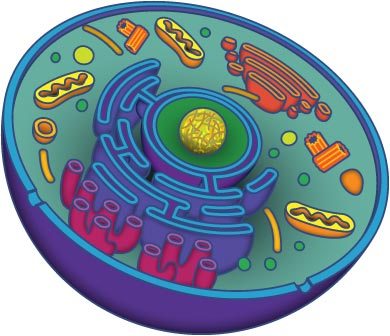
All cells -----
come from other dead cells
come from other living cells
crystallize out of the air
Unicellular organism that lacks a nucleus
Prokaryotic Cell
Eukaryotic Cell
Organism whose cells contain a nucleus
Prokaryotic Cell
Eukaryotic Cell
Contains DNA
nucleus
mitochondria
chloroplast
endoplasmic reticulum
Converts solar energy to chemical energy stored in food
nucleus
mitochondria
chloroplast
endoplasmic reticulum
Powerhouse of the cell
nucleus
mitochondria
chloroplast
endoplasmic reticulum
The heart is an organ because it is a group of _____________ working together.
organelles
cells
tissues
systems
Choose the correct order of organization from simplest to most complex.
tissues --> cells --> organs --> organism --> organ system
organism --> organ system --> organs --> tissues --> cells
organs --> organ system --> tissues --> organism --> cells
cells --> tissues -->organs --> organ systems --> organism
Choose the correct order of organization from most complex to simplest.
tissues --> cells --> organs --> organism --> organ system
organism --> organ system --> organs --> tissues --> cells
organs --> organ system --> tissues --> organism --> cells
cells --> tissues -->organs --> organ systems --> organism
Which of the following examples is correctly matched with its level of organization?
A monarch butterfly is an organ system.
The brain is a type of tissue.
A mitochondrion is an organelle.
A liver is a type of cell.
Membrane enclosed structures that carry out specialized functions within a cell.
organs
organelles
ions
molecules

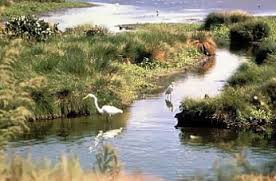
This bird is a(n)
Organism
Population
Ecosystem
Community

All of the macaroni penguins in the image.
Organ
Organism
Population
Community

Living things are based on a universal genetic
code. What molecule is responsible for that code?
RNA
Lipid
Protein
DNA
Maintaining a stable internal
environment is called
homeostasis
equilibrium
balance
evenness
Identify the characteristic: when you step out into the cold, your body shivers in order to keep its temperature at 98.6oF.
All living things use energy
All living things contain cells
All living things maintain homeostasis
All living things grow and develop
Identify the characteristic: green plants produce their own food through the process of photosynthesis.
All living things use energy
All living things contain cells
All living things maintain homeostasis
All living things grow and develop
Which of the following is an example of homeostasis?
adapting to your environment
maintaining an appropriate respiration rate
the sum of all of your chemical reactions
being composed of more than one cell
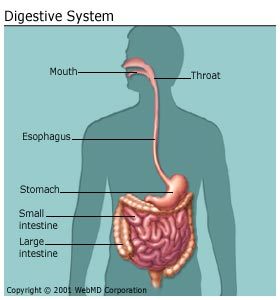
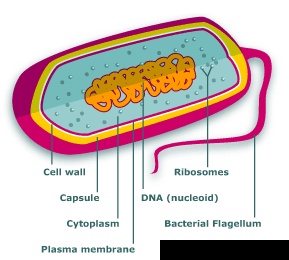
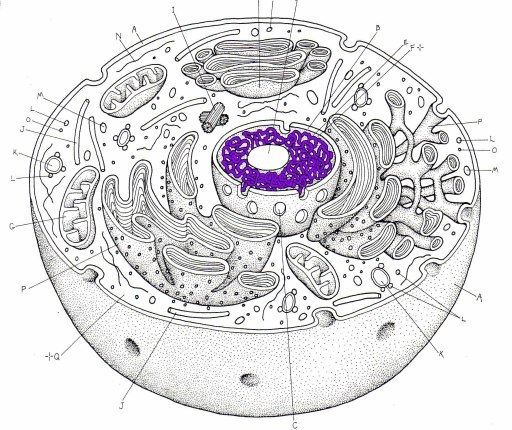
cells can have different numbers or organelles because of the cell's function.
Which cell feature is responsible for making proteins?
Lysosomes
Ribosomes
Mitochondria
Cell Wall
What is the name of the jelly-like substance that is inside the cell?
Cytoplasm
Nucleolus
Cytokineses
Flagella
What cell feature is responsible for powering the cell?
Rough ER
Smooth ER
Golgi Bodies
Mitochondria
What are two features plant cells have that animal cells do not have?
lysosomes and cell wall
cell wall and chloroplasts
cell membrane and nucleolus
plasma membrane and vacuoles
What cell feature is responsible for storing water in plant cells?
Mitochondria
Lysosomes
Large Central Vacuole
Plasma Membrane
What is the main function of the cell wall?
To protect and provide support for the cell
Builds proteins
Convert solar energy into chemical energy
Break down enzymes
You will not find a cell wall in which organism?
Fungi
Plants
Animals
Which organelle would you expect to find in a plant cell but not in an animal cell?
Mitochondria
Ribosome
Chloroplast
Cytomplasm
What part of the cell regulates what enters and leave the cell as well as provides protection and support
Nucleus
Cell Membrane
Ribosomes
Rough ER

What organelle is L pointing to?
Nucleolus
Mitochondria
Nucleus
Golgi Body


Identify Number 1
Cell Wall
Cell Membrane
PLasma membrane
Cytoplasm


Aerobic cellular respiration uses the Sun to make energy.
True
False
Cellular Respiration release energy.
True
False
Photosynthesis uses carbohydrates to make ATP.
True
False
Photosynthesis converts 1 molecule of glucose into 6 molecules of carbon and 6 molecules of water.
True
False
Cellular respiration removes carbon dioxide from the air.
True
False
Photosynthesis releases oxygen into the air.
True
False
Cellular respiration removes carbon dioxide from the air.
True
False
Cellular respiration removes oxygen from the air.
True
False
6CO2 + 6H20 + energy ------> C6H12O6 + 6O2 is the equation for ?
Cellular Respiration
Photosynthesis
The reactants in cellular respiration are ?
6C02 and 6H2O
C6H12O6 and 6O2
The products of photosynthesis are ?
C6H12O6 and 6O2
6CO2 and 6H2O
What is cellular respiration?
the breakdown of glucose to release ATP
the breakdown of glucose to release carbon
Which statement about photosynthesis is correct?
Plants get the energy they need for photosynthesis from water.
Plants get the energy they need for photosynthesis from soil.
Plants get the energy they need for photosynthesis from sunlight.
Plants do not require energy to perform photosynthesis.
Select all that are inputs for Photosynthesis.
Water
Carbon Dioxide
Oxygen
Sunlight (Light Energy)
Glucose (Sugar/food)
Select all that are outputs of Photosynthesis.
Water
Carbon Dioxide
Oxygen
Sunlight (Light Energy)
Glucose (Sugar/food)

BTB was used to indicate the amount of carbon dioxide present in the test tubes. A plant was placed in each test tube. The test tube on the left was placed in the dark and the one on the right was in the light. Which of the following best explains the results?
The solution in the right test tube became more blue because the algae was doing more photosynthesis and using carbon dioxide.
The solution in the right test tube became more blue because the algae was doing more photosynthesis and producing carbon dioxide.
The solution in the right test tube became more blue because the algae was only doing cellular respiration and producing carbon dioxide.
The solution in the right test tube became more yellow because the algae was only doing cellular respiration and using carbon dioxide.
If the amount carbon dioxide is increased what happens to the rate of photosynthesis?
it increases
it decreases
it doesn't change
it is not affected
What are organic molecules?
Molecules based on oxygen
Molecules based on carbon
Molecules that are made in laboratories
Molecules that organisms cannot make on their own
What is unique about carbon and its bonding ability?
It can bond with any element because it has 1 valence electron
It can only bond with other carbon atoms
It can form up to four different bonds because it has 4 valence electrons
It can break down bonds in other molecules
One type of organic molecule is a MACROMOLECULE. What are the 4 types of macromolecules?
Carbohydrates
Lipids
Proteins
Sulfates
Nucleic acids
Macromolecules are often POLYMERS. What are polymers?
Really large molecules made from smaller molecules
Small building blocks
Inorganic materials
Large molecules made from oxygen
What is the name of the reaction that builds polymers from monomers?
hydrolysis
acidification
organic synthesis
dehydration synthesis
What is the name of the reaction that breaks apart a polymer into monomers?
dehydration synthesis
condensation reaction
hydrolysis
acidification


Enzymes belong to which class of macromolecules?
lipids
carbohydrates
proteins
nucleic acids
Sugar belongs to which class of macromolecules?
proteins
lipids
nucleic acids
carbohydrates

This image shows the monomer for
lipid
protein
nucleic acid
carbohydrate


This image shows the monomer for

This image shows the monomer for

Identify the Reactants in this equation.
A
B

How many atoms of nitrogen are in the compound shown above?
1
2
3
4

How many atoms of nitrogen are present in this molecule?
1
2
3
4

What does the symbol inside the circle mean?
"yields, or produces"
"dissolved in water"
"forms a precipitate"
"released as a gas"

Is the compound in the pink box a Reactant or a Product?
Reactant
Product

How many molecules of KNO3 are shown?
1
2
3
4

How many atoms of oxygen are represented in the picture?
2
3
5
6
a combination of symbols that shows the element(s) in a molecule or compound and the ratio of atoms
mathematical formula
mathematical equation
chemical formula
chemical equation
a representation of a chemical reaction that uses symbols to show the relationship between the reactants and the products
mathematical formula
mathematical equation
chemical formula
chemical equation
a substance that takes part in and undergoes change during a reaction.
coefficient
subscript
reactant
product
a substance that forms in a chemical reaction
coefficient
subscript
reactant
product
Suppose you have 15g of baking soda and mix it with 15g of vinegar. When they are combined they bubble and fizz a lot. The final solution has a mass of 25g. What happened to the "lost" 5g?
it dissappears
it is still there just not weighted
it is in the gas that is formed
nothing happened

Which of the models of a chemical reaction best represents the Law of Conservation of Mass?
A
B
C
D
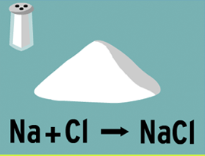
When sodium and chlorine combine to form sodium chloride, sodium chloride is the:
Originator
Reactant
Product
Produce

Which of the models of a chemical reaction best represents the Law of Conservation of Mass?
A
B
C
D
Based on the Law of Conservation of Matter, describe the relationship between the mass of the reactants and the mass of the products.
The mass of the products is always greater than the mass of the reactants.
The mass of the reactants is less than the mass of the products.
The mass of the reactants equals the mass of the products.
The mass of the reactants is greater than the mass of the products.
Enzymes are responsible for-
Speeding up reactions
Giving the body energy
Slowing down reactions
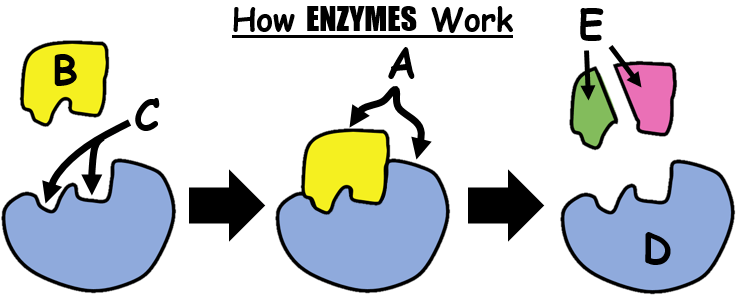
Letter D...
active site
enzyme
substrate
products
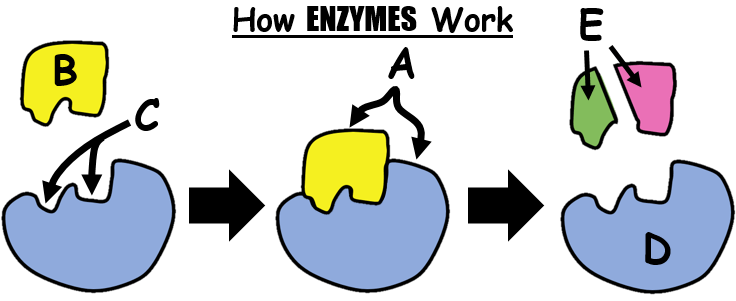
Letter B...
active site
enzyme
substrate
products
Letter c...
active site
enzyme
substrate
products
An enzyme speeds up a chemical reaction in the cell but can only be used once. True or False?
true
false

What information is provided in this graph?
temperature and weather
temperature and climate
temperature and precipitation
temperature and trees

What graph feature is used for temperature?
y axis
x axis
bars
line

Which side of the graph will you read to determine the temperature?
right side
left side
bottom
top

Which climate has the lowest precipitation level?
Climate A
Climate B
Climate C
none of the climates are low

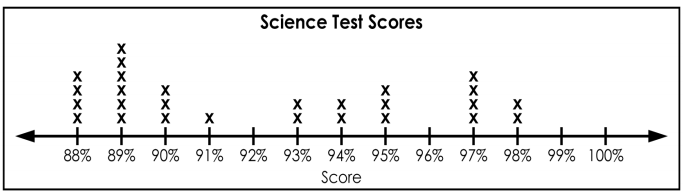

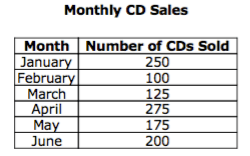
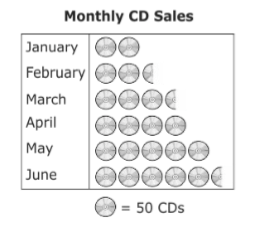
In the chart , a music store listed the number of CDs sold each month for 6 months. Which graph correctly represents the information in the chart?
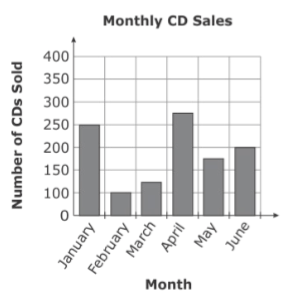
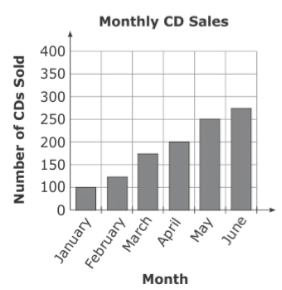
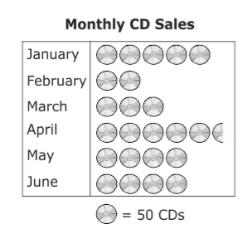

The graph shows the number of cars sold from January to April. How many more cars were sold in March than in January?
2,000
5,000
7,000
8,000
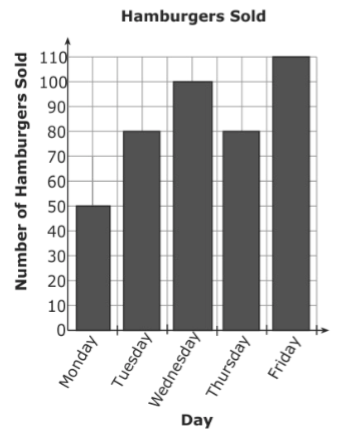
The bar graph shows the number of hamburgers sold at Bob’s Burger Shack. On which days were more than 80 hamburgers sold?
Wednesday and Friday
Tuesday and Thursday
Monday, Tuesday, and Thursday
Tuesday, Wednesday, Thursday, and Friday

