
Font size
 Worksheets
Periodic Table Basic Part 2
Total questions: 68
Worksheet time: 1hrs 8mins
Which of these is a distinguishing property for the noble gases?
Soft - can cut with a plastic knife
Unreactive - don't give or receive electrons
Shiny - exhibits luster
Poor conductors of electricity
Which of these is a distinguishing property for the alkali metals?
Soft - can cut with a plastic knife
Unreactive - don't give or receive electrons
Shiny - exhibits luster
Poor conductors of electricity
Which of these is a distinguishing property for the nonmetals?
Soft - can cut with a plastic knife
Unreactive - don't give or receive electrons
Shiny - exhibits luster
Poor conductors of electricity
Which of these will form a -1 charge?
transition metals
non-metals
halogens
alkali metals
Which of these are silvery-white?
transition metals
alkali earth metals
halogens
alkali metals
Which of these are excellent conductors of heat & electricity and are hard, yet malleable & ductile?
transition metals
alkali earth metals
halogens
alkali metals
Which of these are not good conductors of heat & electricity?
noble gases
alkali earth metals
halogens
non-metals

The shaded elements shown here are the...
transition metals
non-metals
alkali earth metals
alkali metals
Which of the following will have similar properties?
O, S, Se
O, F, Ne
N, Ne, Na
H, K, P
lithium
2 energy levels
helium
1 energy level
aluminum
3 energy levels
bromine
4 energy levels
strontium
5 energy levels
Which group of the periodic table is composed of inert (not reactive) gases?
answer choices
alkali metals
alkaline earth metals
halogens
noble gases
True or False: The reactivity of metals tends to decrease as you move from left to right across the periodic table.
True
False
Transition elements are.......... elements.
s- block
p- block
d- block
f- block
How many energy levals are in sodium(Na)?
1
2
3
4

Elements in a .................. have similar chemical properties.
period
group
row
Elements in the same group have : (2 correct answers)
Similar chemical properties
Similar names
Same number of outer (valence) electrons)
The same number of protons
lithium
2 energy levels
helium
1 energy level
aluminum
3 energy levels
bromine
4 energy levels
strontium
5 energy levels

which 2 elements have the same number of valence electrons?
Mg
Ca
B
He
Based on chemical properties, iodine (I) belongs in the same group as ___.
Helium and Neon
Iron and Zinc
Hydrogen and Lithium
Bromine and Chlorine
Which family of elements does not combine with other elements unless under special conditions in a laboratory?
Halogens
Metalloids
Alkaline Earth Metals
Actinides
Noble Gases
Which of the following is the most reactive?
Potassium
Sodium
Cesium
Lithium
Which family of elements reacts violently with water and exposure to oxygen?
Transition Metals
Alkaline Earth Metals
Actanides
Lanthanides
Alkali Metals
What is the most reactive nonmetal?
Iodine
Fluorine
Chlorine
Bromine
Which family(group) of metals have two electrons in the outer most energy level?
Lanthanides
Halogens
Oxygen family
Alkaline earth metals
Which of the following is an inert gas?
Hydrogen
Helium
Oxygen
Carbon dioxide
The electrons in the outer most energy level of an atom is also known as
Active electrons
Inert electrons
Valence electrons
None of the above
Noble gases are inert because
They are highly reactive
They are unreactive
They are noble
They have 8 electrons in their outer most energy level
Alkaline earth metals are always found as compounds in nature because
They are metals
They are essential nutrients
They are highly reactive
None of the above
Which of the follwing group of elements have 7 electrons in their outer most energy level?
Actinides
Noble gases
Lanthanides
Halogens
Elements of the same group have similar chemical properties
False
True
Not enough information
May be true


The elements in this family are soft, silvery, and very reactive with water.
Alkaline Earth Metals
Alkali Metals
Transition Metals
Lanthanides
What group is the family found? These halides are very reactive and almost have full outer energy level/shell.
1
2
16
17
Why are the elements in Group 8A (18) called Noble gases?
They were discovered by the royal family.
They are more valuable than other gases.
They rarely take part in a reaction.
They are highly reactive.

Why are these elements referred to as Representative Elements?
they all have the same chemical properties
they react in similar ways
they display a wide range of chemical properties
they have no chemical properties
Which list of elements includes members of the transition metals?
Iron, nickel, zinc
helium, neon, argon
hydrogen, lithium, sodium
boron, aluminum, gallium

What is the name of this chemical family?
Noble gases
representative elements
alkali metals
alkali earth metals
Which family of elements is incredibly stable, odorless, colorless?
noble gases
metals
metalloids
halogens

These elements most likely belong to which group?
alkali metals (group 1)
Transition Metals (Groups 3-12)
Non-metals
metalloids (semimetals)
Select the statements that describe a group on the periodic table.
(a) (b) (c)
Which group of elements have the most reactive metals?
metalloids
alkali earth metals
halogens
alkali metals
Atoms of elements in a group on the Periodic Table have similar chemical properties. This
similarity is most closely related to the atom's
atomic mass
valence electrons
atomic orbitals
principle energy levels

The table above contains a list of properties for an unidentied element, X. Based on the properties in the table, to which of the following groups from the periodic table does element X most likely belong?
1 (1A)
2 (2A)
14 (4A)
16 (6A)
Which pair of elements has the most physical and
chemical properties in common?
Ge and Se
K and Kr
Al and Ga
Ba and Bi
This family/group are highly reactive metals because they only have 1 valence electron to get rid of so they react with everything. Even reacting violently with water.
Alkali Metals
Alkaline Earth Metals
Halogens
Transition Metals
Among the group of elements listed below, which of the following will have the same number of electrons in their outermost energy level (valence shell)?
Li, B, C, F
Na, Mg, Al, S
K, Ca, Rb, Sr
N, P, As, Sb
Which group of the periodic table has eight valence electrons?
alkali metals
alkaline earth metals
halogens
noble gases

How many valence electrons does this atom have?
8
16
17
18
Which two elements have the same number of valence electrons?
C and O
Cl and Br
Na and Mg
Fe and Zn
Groups 3-12: These metals have a moderate range of reactivity and a wide range of properties. They are shiny and good conductors of heat and electricity. They have higher densities and melting points than Groups 1 and 2. These have 1 or 2 valence electrons.
Transition Metals
Alkali Metals
Alkaline-earth Metals
Lanthanides
Group 17: All nonmetals. Very reactive. Poor conductors of heat and electricity. Tend to form salts with metals. Example NaCl: sodium chloride which is known as table salt. These elemtns have 7 valence electrons (Group # minus 10).
Boron Group
Oxygen Group
Nitrogen Group
Halogens
Group 18: Unreactive nonmetals. All are colorless, odorless gases at room temperature. These elements have a full outer energy level, usually 8 valence electrons, except for Helium which only has 2 valence electrons.
Nitrogen Group
Oxygen Group
Noble Gases
Halogens
Group 2: Slightly less reactive because they have 2 valence electrons. They are silver colored and more dense that Group 1 metals.
Transition Metals
Alkali Metals
Alkaline-earth Metals
Actinides
Group 1: These metals are extremely reactive. They all have one valence electron. They are shiny and silver in color. They are soft and can be cut with a knife.
Transition Metals
Alkali Metals
Alkaline Metals
Lanthanides
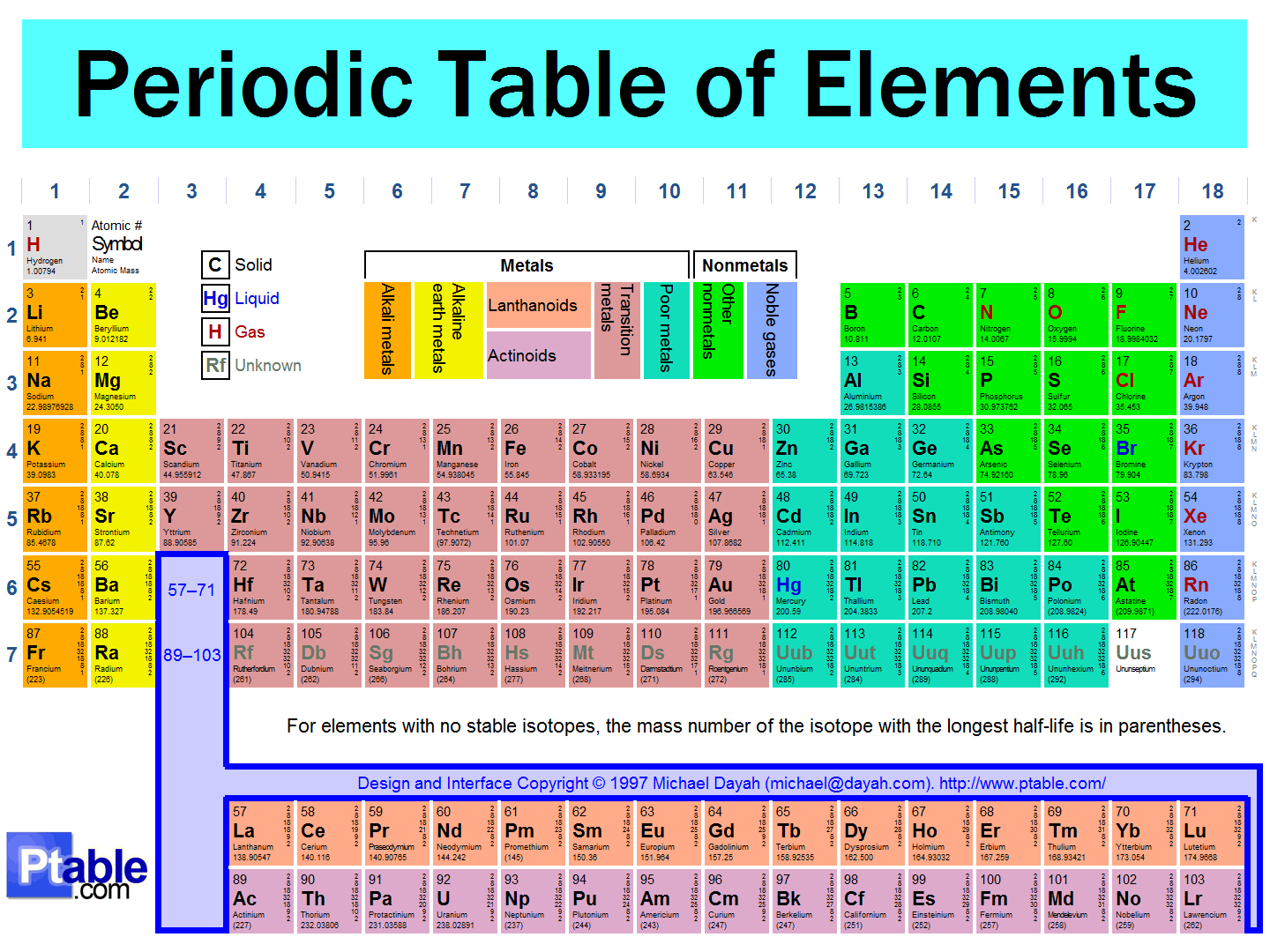
What element has 5 electron shells and 2 valence electrons?
Vanadium (V)
Strontium (Sr)
Phosphorous (P)
Boron (B)
Which element has the same number of energy levels as Potassium (K)?
Sodium (Na)
Vanadium (V)
Mangesium (Mg)
Strontium (Sr)
How many groups or families and periods does a Periodical Table have?
There are 17 groups or families and 7 periods.
There are 18 groups or families and 7 periods.
There are 7 groups or families and 18 periods.
There are 18 groups or families and 6 periods

