
 Worksheets
Plate Tectonics and Natural Disasters
Total questions: 131
Worksheet time: 5hrs 14mins


What is the process that moves the continents?
Conduction
Convection currents
Radiation
Conveyor belts
Wegener's idea of Continental Drift was rejected by geologists because _________.
He used too many pieces of evidence to support the idea.
It is impossible to predict what Earth looked like millions of years ago.
He couldn't explain HOW or WHY the continents moved.
They were afraid of the new idea.
Underwater mountain ranges are called ____________.
deep sea trenches
mid-ocean ridges
seafloor spreading
continental drift
Underwater canyons are called ____________.
deep sea trenches
mid-ocean ridges
seafloor spreading
continental drift
The OLDEST rocks on the seafloor are located?
Closest to the mid-ocean ridge
Farthest from the mid-ocean ridge
The YOUNGEST rocks on the seafloor are located?
Closest to the mid-ocean ridge
Farthest from the mid-ocean ridge
Where is new oceanic crust formed?
mid-ocean ridge
deep sea trench
Where is old oceanic crust recycled?
mid-ocean ridge
deep sea trench
What theory states that the continents were once part of a super continent called Pangaea and have moved slowly to their current locations over hundreds of millions of years.
Oceanic wandering
Land-form Evidence
Continental Drift
Fossil Distribution
How long did it take the continents to move from Pangaea into their current position?
Hundreds of years
Thousands of years
Millions of years
The process of new seafloor forming when magma rises at the mid-ocean ridges and solidifies, pushing older rock away is called _____.
Seafloor Spreading
Continental Drift
Hot magma (melted rock) is ______ dense than the solid crust.
more

At the Mid-Ocean Ridges you can find:
underwater trees and bushes
deep sea trenches
the oldest crust
the newest crust
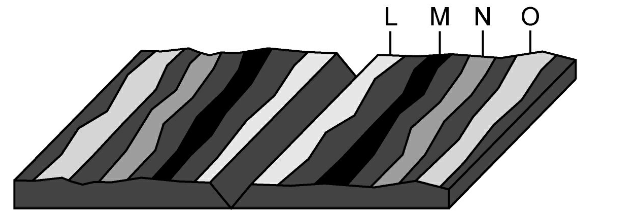
The image shows a diagram of the ocean floor near a mid-ocean ridge. Where would the oldest rock be found?
True or false: The tectonic plates will never stop moving
True
False
Put the repeating steps of seafloor spreading in order.
Magma MOVES to the SURFACE
Magma FLOWS from the CRACKS
Magma COOLS to form new SEAFLOOR
Convection currents in the _________ pull the seafloor apart.
Crust
Mantle
Core
What is the Theory of Continental Drift?
Earth's continents do not move.
Earth's continents moved in the past and continue moving today.
Earth's continents will eventually fall off the planet.

What is the name for the large landmass of all the continents that formed 175 million years ago?
Pangaea
Laurasia
United Continents
What piece of evidence for Continental Drift states that the continents fit together like puzzle pieces?
Continent Shape
Fossil/Climate Evidence
Landform/Rock Evidence
Glacial Evidence
What piece of evidence for Continental Drift states that the same plant and animal fossils are found on continents separated by oceans.
Continent Shape
Fossil/Climate Evidence
Landform/Rock Evidence
Glacial Evidence
What piece of evidence for Continental Drift states that similar types and ages of rocks are found on different continents?
Continent Shape
Fossil/Climate Evidence
Landform/Rock Evidence
Glacial Evidence
What is the process of magma pushing up through a mid-ocean ridge, forming new crust, and pushing continents apart called?
seafloor spreading
seafloor growing
volcanic volleyball
What is the process of magma in the mantle rising and cooling and sinking and warming that causes the continents to move?
a tiny mouse running on a wheel
magma wheel
convection currents
The Appalachian Mountains in the U.S. match up with a similar mountain range in Northern Europe. How does this support Wegener's theory of Continental Drift?
The similarities provide evidence that North America and Europe were connected when the mountains formed.
The similarities show that the continents must have been closer to the equator at some point in time.
This does not provide any evidence to support his theory.
The theory that states that pieces of Earth's crust are in constant, slow motion is the theory of...
continental eruption
plate boundaries
plate tectonics
lithospheric drift
What type of plate boundary creates new sea floor?
Divergent
Convergent
Transform
Subduction

What type of plate boundary is represented in the picture?
Athensphere
Divergent
Transform
Convergent

What type of plate boundary is represented in the picture?
Transform
Divergent
Convergent
Lithosphere


What is true of tectonic plates?
They are constantly moving
Earthquakes cause them to move
They don't move for centuries at a time
There are fewer and fewer of them
What is the underlying force that drives plate tectonics?
ocean tides
Volcanic eruptions
convection currents
the rock cycle
Cracks or breaks in earth's crust where plates slip past each other
subduction
faults
mid-ocean ridge
san andreas
Occurs when a more dense plate slides under a less dense plate
tectonic plates
subduction
continental drift
landmass

What type of plate boundary is shown in the picture
convergent
divergent
transform
faults
Plates boundary where plates slide or move past each other
divergent
continental drift
transform
convergent

What plate boundary is shown in the picture?
convergent
divergent
transform
neither

What type of plate boundary is shown in the picture?
folded mountains
transform
convergent
divergent
Plates collide or converge into each other
divergent
convergent
transform
convection

What is happening in the picture?
layers of the Earth are changing positions
the inner and outer core are solid
convection currents are causing the tectonic plates to move
the mantle is growing
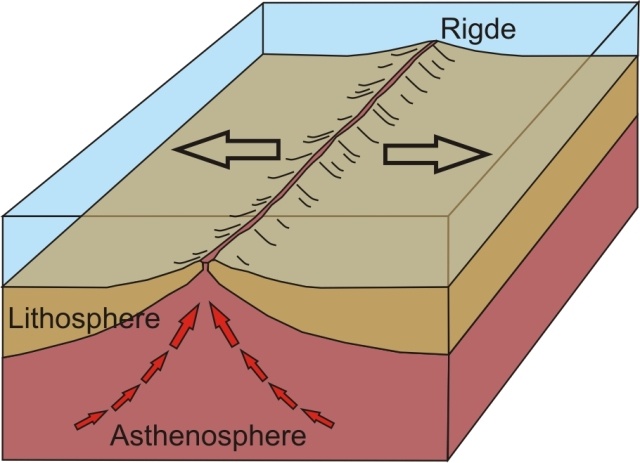

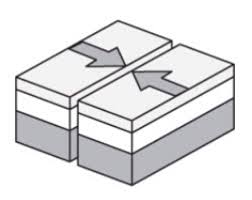

Which layer is made of plates?
Crust
Mantle
Outer Core
Inner Core
Plates Spread Apart
Convergent
Divergent
Transform
Plates Come Together
Convergent
Divergent
Transform
Plates Rub Against Each Other
Convergent
Divergent
Transform

Convergent
Divergent
Transform

Convergent
Divergent
Transform

Convergent
Divergent
Transform
Match the plate boundary to its definition.
Plates spread apart
Divergent
Plates come together
Convergent
Plates rub against each other
Transform
Match the plate boundary to its diagram.

Divergent

Convergent

Transform
Match the plate boundary to the type of stress formed

Convergent

Divergent

Transform
Match the plate boundary to the type of fault formed

Convergent

Divergent

Transform
Forces that changes rock shape or volume is called
tension
compression
stress
Reverse fault has a ______________________ boundary.
divergent
convergent
transform
Normal fault has a ______________________ boundary.
divergent
convergent
transform
Reverse faults create _________________.
valleys
mountains
faults
Normal faults create _________________.
valleys
mountains
faults
Reverse faults ______________________ at an angle.
pull apart
push together
slip past each other
Normal faults ______________________ at an angle.
pull apart
push together
slip past each other
Strike slip faults move by ____________________.
pulling apart
pushing together
slipping past each other
What is a divergent plate boundary?
The point where two plates collide
The point where two plates move apart
The process of a force changing the size or shape of a rock
A volcanic region where magma from a mantle plume has caused the Earth's crust to melt and thin
What is Earth's crust?
The thin outer shell of the Earth
The Earth's layer the plates move on
The boundary between plates
What is a convergent plate boundary?
The point where two plates collide
The point where two plates move apart
The process of a force changing the size or shape of a rock
A volcanic region where magma from a mantle plume has caused the Earth's crust to melt and thin
What is Earth's mantle?
The thin outer shell of the Earth broken into piece
The part of the Earth's interior between the crust and the central core
The water that sits on the crust
A submarine mountain range formed when two oceanic plates diverge

The Mid-Atlantic Ocean Ridge is created:
Where two plates collide
Where two plates move apart
Where two plates slide against each other
At a hotpsot
What is a plate boundary?
The edge of the plates
The space between the silverware and a placemat
The location of a hotspot
The line between countries
The process of subduction is when:
Two plates slide against each other creating friction
Two plates are moving apart causing mid-ocean ridges
A force causing change in the size or shape of a rock
Two tectonic plates meet and one plate sinks below the other
What is a tectonic plate?
The point where two plates collide
The point where two plates move apart
The process of a force changing the size or shape of a rock
A piece of the Earth's crust that sits on and moves over the Earth's mantle

This area is called the....
Arc of Volcanoes
Ring of Fire
Horseshoe of Magma

Which type of crust is the densest?
oceanic crust
continental crust
divergent crust
transform crust

The 2 types of crusts are :
Oceanic and continental
divergent and convergent
slip and slide
collide and slide

__________ in the mantle of earth create the movement of plates.
Movement
Collision
Convection Currents
Divergent movement
Why does the continental crust rise over the oceanic crust?
The continental crust is less dense.
The oceanic crust is thinner.
The continental crust is not made of granite.
The oceanic crust is younger.

The diagram shows a cross section of a tectonic plate boundary. Which terms best describes features 1,2 and 3?
1 continental crust, 2 mantle, 3 oceanic crust
1 mantle, 2 oceanic crust, 3 continental crust
1 oceanic crust, 2 mantle, 3 continental crust
1 continental crust, 2 oceanic crust, 3 mantle
A difference between the the oceanic crust and the continental crust is that the oceanic crust is
composed chiefly of sedimentary rocks
more dense than the continental crust
older than the continental crust
continually being created

The diagram below shows the development of an ocean. The process results from
the ocean forcing the plates apart slowly
the ocean forcing the plates apart rapidly
convection in the mantle dragging apart the plats slowly
convection in the mantle dragging the apart the plates rapidly
Which type of crust is less dense?
Continental
Oceanic
They are the same
It depends

Crust can be either oceanic, which is thin and dense, or continental, which is thick and less dense; both are known as crust rock material.
True
False

Density is the amount of matter in a given space or volume; the oceanic crust is thinner, but denser, than continental crust. This sentence describes...
the volume of plates
the density of plates
the thickness of plates
the food on the plates

Which box has a higher density?
A
B
They are the same
The Ring of Fire, where many earthquakes occur, is located around the rim of which ocean?
Atlantic
Artic
Indian
Pacific
Which seismic wave is the first to reach a seismic station?
P Wave
S Wave
Q Wave
Surface Wave
Which type of seismic wave causes the most destruction to property?
P Wave
S Wave
Q Wave
Surface Wave
Which type of seismic wave can move through solid layers of the earth but not through the liquid outer core?
P wave
S wave
Q Wave
Surface Wave
Which seismic waves are call "push/pull" because they compress and extend as they move through the earth?
P Wave
S Wave
Q Wave
Surface Wave
The point within the earth where the earthquake originates.
Epicenter
Fault
Focus
Strike-Slip

Compression
Shearing
Tension

Match the stress on the rock with the type of fault.
Compression
Shearing
Tension

Match the stress on the rock with the type of Fault.
Compression
Shearing
Tension

Where is the epicenter of this earthquake?
Salt Lake
Los Angeles
San Francisco
Portland
How is energy transferred from the focus underground
to the epicenter on the surface?
By waves
By teleporters
By gravity
Earthquakes happen near the Pacific Ocean because ____.
The Pacific Ocean includes many transform plate boundaries.
A magnet buried in the Pacific Ocean attracts waves of energy.
An angry Seamonster throws tantrums in the Pacific Ocean.
Which description of Earthquakes is most accurate?
Earthquakes are very rare, but when they happen they always cause severe damage.
Earthquakes happen every day, but most are too small to notice.
Earthquakes happen every day, so they are the number one cause of death in the US.
The vibrations in the earth caused by the sudden release of energy is called an ______________.
epicenter
aftershock
earthquake
tsunami
What is the point on the surface of the earth directly above the focus of an earthquake?
epicenter
fault
focus
intensity
What is a wave generated by earthquake vibrations called?
seismogram
surface wave
seismic wave
seismology
What is a series of sea waves caused by underwater earthquakes called?
storm surge
rip current
tsunami
massive flooding
What is the zone of intense earthquake and volcanic activity called?
Circle of Fire
Oval of Fire
Ring of Fire
Earthquake Central


What is the shaking and trembling that results from the movement of rock beneath Earth's surface
epicenter
earthquake
richter
seismograph
The epicenter is above the ______________.
focus
P wave
S wave
fault

