wayground logo

Free Printable Worksheets

Font size

S
M
L
XL
Worksheets

1st Semester Final Exam Review

Total questions: 133

Worksheet time: 1hrs 13mins

Name
Class
Date
1.
Which BEST describes the rock cycle?
a)
New rocks form from older rocks.
b)
Lunar rocks change into terrestrial rocks.
c)
Rocks in the ocean become rocks on land.
d)
Layers of rock are broken by faults.
2.
How are sedimentary rocks, such as shale and sandstone, formed?
a)
Particles are changed into liquids.
b)
Particles are compressed into layers.
c)
Particles are melted together by magma.
d)
Particles are heated by the Sun.
3.
In order for sediments to become rock, the sediments are generally
a)
liquefied.
b)
compacted.
c)
returned to their origins.
d)
mixed with organic material.
4.
One condition necessary to produce diamonds is
a)
low temperatures
b)
quick cooling
c)
intense pressure
d)
high altitude
5.
Which of these substances is a mineral?
a)
sandstone
b)
granite
c)
quartz
d)
coal
6.
Which processes must occur in order for an igneous rock to change into a metamorphic rock?
a)
heating and pressure
b)
compaction and cementation
c)
melting and cooling
d)
uplift and erosion
7.
Which process forms the mineral halite?
a)
the slow crystallization of magma deep in the crust
b)
the cementing together of sediment particles
c)
the hardening of lava in seawater
d)
the evaporation of seawater
8.
Which process forms both metamorphic and sedimentary rock?
a)
recrystallization
b)
heating
c)
weathering
d)
compacting
9.
Which process forms both metamorphic and sedimentary rock?
a)
recrystallization
b)
heating
c)
weathering
d)
compacting
10.
When buried sediments are subjected to pressure, the mineral grains are squeezed together. This causes
a)
layers to rise to the surface
b)
new rock to be formed
c)
earthquakes
d)
volcanoes
11.
Which processes change magma into igneous rock?
a)
weathering and erosion
b)
heat and pressure
c)
compaction and cementation
d)
cooling and crystallization
12.
Gneiss is a rock because it
a)
is hard and round.
b)
has crystals.
c)
is made of minerals.
d)
has mass.
13.
Which statement is true about rocks?
a)
Magma is made of solid rock.
b)
Rocks are made of one or more minerals.
c)
Crystals are made of rocks.
d)
Minerals are made of one or more rocks.
14.
Minerals are made of one or more
a)
minerals.
b)
sediments.
c)
elements.
d)
rocks.
15.
One rock was formed from rapidly cooling lava and is smooth and glassy. The other rock was formed from slow-cooling magma, so has large crystals. Which rock property is represented by these characteristics?
a)
color
b)
texture
c)
fracture
d)
hardness
16.
Which sentence BEST describes a process in the rock cycle?
a)
Sedimentary rocks can melt to become metamorphic rocks.
b)
Volcanoes can deposit sedimentary rock to form mountains.
c)
Metamorphic rocks can form by the weathering process.
d)
Igneous rocks can become metamorphic and sedimentary rocks.
17.
Which process causes sand grains to stick together to form sandstone?
a)
cementation
b)
abrasion
c)
combustion
d)
erosion
18.
Which type of rock is formed when particles are compacted and cemented together?
a)
igneous
b)
metamorphic
c)
sedimentary
d)
metallic
19.
Coal is formed from
a)
plant remains decomposed under pressure.
b)
melted and cooled metamorphic rock.
c)
natural gas subjected to heat.
d)
seas that have evaporated.
20.
Sedimentary rock forms when rock is first
a)
broken down by weathering.
b)
melted into liquid magma.
c)
exposed to great temperature.
d)
crystallized into natural glass.
21.
Minerals are formed by which process?
a)
sedimentation
b)
metamorphosis
c)
fault lines moving
d)
magma cooling
22.
1)  Name the fossil fuels.
a)
Coal, Oil, Natural Gas
b)
Coal, Petroleum, Nuclear
c)
Petroleum, Natural Gas, Nuclear
d)
Nuclear, Coal, Wind
23.
1)  What other non-renewable energy source is not a fossil fuel?
a)
Wind
b)
Uranium
c)
Water
d)
Geothermal
24.
1)  What do we call natural resources that we can replace as we use them?
a)
Nonrenewable resources
b)
Renewable resources
25.
1)  Which fossil fuel is the cleanest to burn?
a)
Coal
b)
Petroleum/Oil
c)
Nuclear
d)
Natural Gas
26.
1)  Name one advantage of using solar energy.
a)
It is inexpensive to begin using
b)
It will be around for millions of years
c)
It can be used on cloudy days
d)
It can be used day and night
27.
1)  Which of these would cause cars to use less energy? 
a)
Bigger and more metal
b)
Going faster speeds
c)
Running on electricity
d)
Using only unleaded gasoline
28.
1)  What is the source of almost all energy on earth?
a)
Sun
b)
Earth
c)
Air
d)
Water
29.
1)  Name two energy sources that do NOT come from the sun.
a)
Wind and water
b)
Biomass and geothermal
c)
Coal and oil
d)
Nuclear and geothermal
30.
1)  What is the source of the most products from any fuel?  Examples are wax, crayons, tires, plastics…
a)
Coal
b)
Petroleum/Oil
c)
Natural Gas
d)
Hydro
31.
1)  Which of these did NOT come from once living organisms?
a)
Plastics
b)
Ethanol
c)
Car tires
d)
Uranium
32.
What word to we use for “taking care of natural resources and not wasting them?”
a)
Reservation
b)
Conservation
c)
Observation
d)
Chlorination
33.
1)  What energy source comes from earth’s heat deep inside?
a)
Hydro
b)
Solar
c)
Geothermal
d)
Biomass
34.
1)  Layer of material that slows heat transfer is called what?
a)
Insulation
b)
Percolation
c)
Barrier
d)
Thermostat
35.
1)  The following conserves energy.
Using compact fluorescent light bulbs
a)
True
b)
False
36.
1)  The following conserves energy.
Leaving lights on when you leave the room
a)
True
b)
False
37.
1)  The following conserves energy.
Carpooling
a)
True
b)
False
38.
1)  The following conserves energy.
Reducing insulation in your home
a)
True
b)
False
39.
1)  The following conserves energy.
Timing your errands to avoid driving @ rush hr
a)
True
b)
False
40.
Which energy resources are the most polluting?
a)
Coal and oil
b)
Oil and nuclear
c)
Natural gas and nuclear
d)
Oil and natural gas
41.
Name the 5 renewable resources.
a)
wind, solar, hydro, biomass, geothermal
b)
wind, oil, hydro, biomass, geothermal
c)
wind, solar, hydro, uranium, geothermal
d)
wind, solar, coal, biomass, geothermal
42.
Which greenhouse gas effects our global climate the most?
a)
Oxygen
b)
Hydrogen
c)
Carbon Dioxide
d)
Helium
43.
1)  Name two biomass fuels.
a)
Crops and wood
b)
Crops and plastics
c)
Crops and man-made products
d)
Crops and fertilizers
44.

What do we call an inorganic solid found in nature?

a)

Rock

b)

Mineral

c)

Granite

d)

Conglomerate

45.

Two or more minerals together are called... ?

a)

Crystal

b)

Minerals

c)

Rocks

d)

Gem

46.

If you heat and pressure any rock/mineral, it will change into...?

a)

Igneous Rock

b)

Sedimentary Rock

c)

Detrital Rock

d)

Metamorphic Rock

47.

If you melt a rock/mineral and then let the magma/lava cool, you end with...?

a)

Igneous rock

b)

Metamorphic rock

c)

Sedimentary rock

d)

Chemical rock

48.

When a rock undergoes weathering and erosion, it becomes...?

a)

Metamorphic rock

b)

Sediment

c)

Igneous rock

d)

Organic rock

49.

An ore is a(an).....

a)

sample of rocks big enough to be sold

b)

sample of rocks with valuable minerals inside that need to be smelted

c)

sample of rocks not worth anything, and is best thrown away

d)

sample of rocks with gemstones already inside

50.

The Rock Cycle....

a)

is always happening

b)

stopped a long time ago

c)

starts and stops randomly

d)

does not exist

51.

A crystal....

a)

Is shiny(lustrous)

b)

has an orderly pattern of atoms, which gives it a patterned look

c)

can be valuable

d)

is all of the above

52.

What are loose pebbles, dirt, and shells called?

a)

Worthless

b)

Sediment

c)

Rocks

d)

Sedimentary Rocks

53.

Sedimentary rock....

a)

is made up of sediment that is compacted and cemented together

b)

is made from molten lava

c)

is made by people walking around on the beach

d)

is made by igneous and metamorphic rocks being weathered and eroded

54.

What rock is made from molten magma or lava?

a)

Crystal

b)

Igneous rock

c)

Metamorphic rock

d)

Sedimentary rock

55.

If you want a large crystal, one would....

a)

let the lava/magma cool over a long period of time.

b)

let the lava/magma cool over a short period of time

c)

make the magma/lava cool instantly

d)

never let the lava/magma cool

56.

How do you test streak color for rocks/minerals?

a)

Throw the sample onto the ground

b)

Scratch/drag the sample across a streak plate

c)

Bring the sample up to light and decide how shiny it is.

d)

Put the sample in water and see if it floats.

57.

A foliated metamorphic rocks has....

a)

smooth break lines

b)

shiny crystals

c)

rough texture

d)

visible layers

58.

A fracture break on a rock/mineral has...

a)

a smooth break line

b)

a jagged break line

c)

no break line

d)

shattered the rock/mineral entirely

59.

If I break a rock in half, and both halves are smooth and flat where I broke it, that is an example of....

a)

A fracture break

b)

A total break

c)

A hairline break

d)

A cleavage break

60.

When water with minerals in it evaporates, and leaves the minerals behind, the rock that is formed is called....

a)

Detrital rock

b)

Chemical rock

c)

Organic rock

d)

Extrusive rock

61.

If I cut and polish a crystal, I have changed it into a....

a)

Gem

b)

Rhinestone

c)

Rock

d)

Marble

62.

When sediment is pressed and compacted by the weight of sediment above it, that creates.....?

a)

A crystal

b)

A mineral

c)

A detrital rock

d)

An igneous rock

63.

Which of the following must be true for a substance to be considered a mineral?

a)

it must be organic

b)

it must be glassy

c)

it must be a gem

d)

it must be naturally occurring

64.

What is the direct cause of rising sea levels?

a)

Melting Sea Ice

b)

Melting Land Ice

c)

Climate Change

65.
Which of the following is the best conclusion that can be made from this graph?
a)
atmospheric carbon dioxide levels have been decreasing since 1960
b)
Hawaii has a lot of carbon dioxide
c)
humans have been working hard to decrease carbon dioxide levels
d)
atmospheric carbon dioxide levels have increased steadily since 1960
66.

Which of the following have been changed or altered due to climate change ?

a)

droughts

b)

flooding

c)

melting of polar ice caps

d)

all of the above

67.

The main human activity that releases greenhouse gases is

a)

using public transportation and there by reduce the affects of greenhouse gases.

b)

burning fossil fuels

c)

texting on cellphones

d)

eating meat

68.

The main human activity that releases greenhouse gases is

a)

using public transportation and there by reduce the affects of greenhouse gases.

b)

burning fossil fuels

c)

texting on cellphones

d)

eating meat

69.

Which of the following is contributing to an INCREASE in carbon dioxide in the atmosphere?

a)

deforestation

b)

photosynthesis

c)

oceans

d)

all of the above

e)

the loss of animal species

70.
 What is the greenhouse effect?
a)
The warming of a planet due to trapped radiation.
b)
The cooling of Earth due to air pollution.
c)
The heating of a solid, such as a rock.
71.
What gas from the list below is a cause for global warming?
a)
Urethane
b)
Oxygen
c)
Carbon Dioxide
72.
What do scientists think the effect will be of having more greenhouse gases in our atmosphere?
a)
More warming of the atmosphere
b)
More cooling of the atmosphere
c)
More air in the atmosphere
d)
Less air in the atmosphere
73.
What do humans do that releases greenhouse gases into the atmosphere?
a)
Burn fossil fuels (like gas and coal)
b)
Build cement buildings
c)
Ride bikes and use solar energy
d)
Compete in the Olympics
74.
T/F: Water vapor is a greenhouse gas
a)
True
b)
False
75.
T/F: Some greenhouse gases are naturally present in the Earth's atmosphere
a)
True
b)
False
76.
Which of the following is an example of a greenhouse gas?
a)
Carbon Dioxide
b)
Nitrogen
c)
Oxygen
d)
Neon
77.
Increased carbon dioxide may cause global warming by trapping more ____________ in the atmosphere.
a)
water
b)
gases
c)
heat
d)
water vapor
78.
Which is a natural source of greenhouse gases?
a)
aerosols
b)
deforestation
c)
volcanic eruptions
d)
burning fossil fuels
79.
Which natural process removes carbon dioxide from the atmosphere?
a)
forest fires
b)
volcanic eruptions
c)
cellular respiration
d)
photosynthesis
80.
Which is a green-house gas?
a)
Methane
b)
Oxygen
c)
Hydrogen
d)
Ammonium
81.
How does the concentration of carbon dioxide in the atmosphere affect climate?
a)
As carbon dioxide concentrations increase, temperatures increase
b)
As carbon dioxide concentration increase, temperatures decrease.
c)
Carbon dioxide concentrations have no affect on climate
d)
As carbon dioxide concentrations increase, temperatures become more random.
82.
This is the process of dropping sediment in a new location.
a)
Weathering
b)
Erosion
c)
Deposition
83.
The driveway is long and winding because it bends around a huge old oak tree. The pavement near the tree bulges upward and has many more cracks than the other sections of the driveway
a)
Weathering
b)
Erosion
c)
Deposition
84.
When camping in west Texas, we wake one morning to discover that our car and tent are covered with a thin layer of sand. 
a)
Weathering
b)
Erosion
c)
Deposition
85.
This is the process of breaking rock into smaller pieces.
a)
Weathering
b)
Erosion
c)
Deposition
86.
A beautiful display of bluebonnets bloomed along the bank of the river, but after the storm last night, the flowers and a large section of the soil in which they grew is gone.
a)
Weathering
b)
Erosion
c)
Deposition
87.
When we walk along the seashore, we look for shark teeth in the sand. Sometimes we also find unbroken sand dollars, too. 
a)
Weathering
b)
Erosion
c)
Deposition
88.
We love to go rock climbing on the rugged cliffs in the mountains, but our first challenge is to scramble up the large pile of sand and pebbles at the base of the cliff.
a)
Weathering
b)
Erosion
c)
Deposition
89.
Which type of weathering occurs when natural forces, such as wind, water and temperature change mechanically crumbles or breaks down rock into smaller pieces?
a)
Chemical
b)
Physical
c)
Biological
90.
Which process of biological weathering has plants grow roots into crevices of rock and cause the rock to break apart?
a)
carbonation
b)
root wedging
c)
hydratoin
d)
oxidation
91.
Which process of chemical weathering has oxygen react with minerals, especially those that contain iron, and cause them to break down?
**Rust is an example of this process.**
a)
Oxidation
b)
Carbonation
c)
Hydation
d)
Hydrolysis
92.
What is the process of movement of soil and/or sediment from one location to another?
a)
Erosion
b)
Weathering
c)
Deposition
93.
What is the geological process by which sediment and soil builds up in an area?
a)
Erosion
b)
Weathering
c)
Deposition
94.

Which will deposit first, smaller particles of sediment or larger particles?

a)

smaller particles

b)

larger particles

95.
The growth of plant roots and animal activity may result in ________________.
a)
erosion
b)
mechanical weathering
c)
chemical weathering
d)
abrasion
96.
The definition of weathering is _______________________.
a)
the carrying away of rock
b)
the leaching of rock
c)
the breaking down of rock
d)
the permeability of rock
97.
The agent of mechanical weathering in which rock is worn away by the grinding action of other rock particles is called _______________.
a)
plant growth
b)
oxygen
c)
abrasion
d)
ice wedging
98.
The most important factors in determining the rate of weathering are _____________________.
a)
carbon dioxide and acid rain
b)
abrasion and acids from plant roots
c)
animal actions and oxygen
d)
rock type and climate
99.
What kind of weathering causes the mineral composition of rock to change?
a)
mechanical weathering
b)
permeable weathering
c)
chemical weathering
d)
general weathering
100.
Mechanical weathering is the removal of rock particles by gravity, wind, water, and ice.
a)
true
b)
false
101.
Which of the following is a type of mechanical weathering?
a)
abrasion
b)
plant growth
c)
freezing and thawing
d)
all of the above
102.
In the fall, Winston noticed a small crack on a boulder where he played in his backyard. The following spring, he saw that the small crack was much larger than he remembered. What most likely caused the change?
a)
gravity had caused the rock to shift
b)
acid rain had caused the crack to erode
c)
winds had caused the rock to break down
d)
water had frozen and thawed inside the rocks
103.
What is the relationship between wind erosion and plant cover?
a)
More plants means less erosion
b)
More plants means more erosion
c)
There is no relationship
d)
Less plant cover means less erosion
104.
When plants, animals, and other organisms die, they break down and become part of the soil. What is this part of the soil called?
a)
sand
b)
silt
c)
clay
d)
humus
105.
Rock samples brought back from the moon show absolutely no evidence of weathering. This is MOST LIKELY due to ______________________________.  
a)
the lack of atmosphere on the moon
b)
extremely low surface temperatures on the moon
c)
lack of biological activity on the moon
d)
lack of running water on the surface of the moon
106.
What force causes all types of mass movement?
a)
convection
b)
temperature
c)
gravity
d)
compaction
107.
Which layer of soil has more dead things in it?
a)
Top Soil
b)
Sub soil
c)
Parent materials
d)
Bed rock
108.
What layer has lots of rocks?
a)
Top soil
b)
sub soil
c)
Parent materials
d)
Bed rock
109.
Humus is.....
a)
the dead parts of plants and animals in soil.
b)
A food we eat with pretzels.
c)
The tiny particles inside of soil
d)
The roots that come off of a plant and live in soil.
110.
Layers of soil are also known as:
a)
Soil Profiles
b)
Soil Horizons
c)
Soil sheets
d)
Soil cores
111.
Which layer of soil is on bottom?
a)
Topsoil
b)
Sand
c)
Bedrock
112.
There are FOUR components of soil: water, air, organic material, and ________.
a)
conservation
b)
rock
c)
subsoil
d)
loamy
113.
All soils begin with what process?
a)
Nutrients
b)
Subsoil
c)
Weathering
d)
Fertile
114.
Fertile soil is rich in _________.
a)
Conservation
b)
Bedrock
c)
Water
d)
Nutrients
115.
The physical layer of Earth made of solid rock and soil is called the ___________. 
a)
mesosphere
b)
lithosphere
c)
asthenosphere
d)
mantle
116.
The type of plate boundary where two plates come together is a .....
a)
Convergent Boundary
b)
Divergent Boundary
c)
Transform Boundary
d)
Plate Boundary
117.
Which of the following causes Earth's tectonic plates to move?
a)
Energy from the Sun
b)
Magnetic Pole Reversal
c)
Convection currents in the mantle
d)
Faults in Mountain Ranges
118.
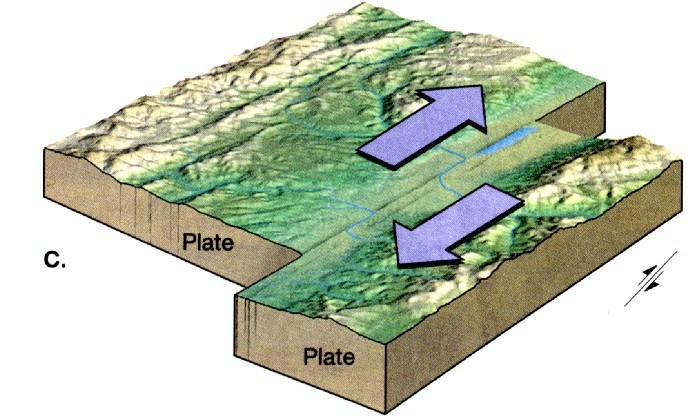
What type of plate boundary is this?
a)
Plate
b)
Divergent
c)
Convergent
d)
Transform
119.
What type of event will occur at this boundary?
a)
Earthquake
b)
Volcano Eruption
c)
Tornado
d)
Mountain Building
120.
A divergent boundary occurs when plates ....
a)
Pull apart
b)
Come together
c)
Slide past each other
d)
subducting
121.
What type of plate boundary is this?
a)
Transform
b)
Convergent
c)
Divergent
d)
Plate
122.
Oceanic Trenches are formed by _______ plate boundaries
a)
Convergent
b)
Transform
c)
Plate
d)
Divergent
123.
A fault is formed by the movement of a __________ plate boundary
a)
Transform
b)
Convergent
c)
Divergent
124.
Islands can from from magma which is pushed up at a __________ plate boundary
a)
Divergent
b)
Convergent
c)
Transform
125.
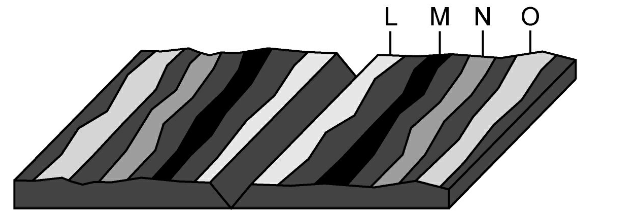
Where would the oldest rock be found?
a)
L
b)
M
c)
N
d)
O
126.
How is it possible for new crust to be formed without increasing the surface area of the Earth?
a)
Crust is destroyed at the same time it is created
b)
New crust is underwater where it sinks
c)
New crust breaks more easily than old crust
127.
Mountains are created when....
a)
Two continental plates collide
b)
Two oceanic plates pull apart
c)
An Oceanic plate subducts under a Continental Plate
d)
Two continental plates pull apart
128.
The Great Rift Valley in Africa and the Mid-Ocean Ridge were all created by this boundary
a)
Divergent
b)
Convergent
c)
Reform
d)
Transform
129.
What are the two types of crust
a)
continental and oceanic
b)
ocean and upper
c)
lower and upper
d)
pizza and subway
130.
When an oceanic plate and a continental plate collide, which one will subduct?
a)
oceanic
b)
continental
c)
neither
131.
The area where two tectonic plates meet.
a)
mantle
b)
focus
c)
plate boundary
d)
convection
132.
This landform can occur at a divergent plate boundary.
a)
ocean trench
b)
mid-ocean ridge
c)
tall mountains
d)
transform fault
133.
A subduction zone is formed...
a)
when one tectonic plate sinks below another
b)
at every type of convergent plate boundary
c)
at every type of divergent plate boundary
d)
at transform boundaries