Wayground logo

Free Printable Worksheets

Font size

S
M
L
XL
Worksheets

CFE Life Science Review

Total questions: 128

Worksheet time: 2hrs 39mins

Name
Class
Date
1.

What is this diagram know as?

a)

Food Web

b)

Energy Pyramid

c)

Biomass Chart

d)

Biome

2.

An organism that gains its energy from consuming producers is what level consumer?

a)

Producer

b)

Primary Consumer

c)

Secondary Consumer

d)

Tertiary Consumer

3.

What level consumer is the hawk?

a)

Primary

b)

Secondary

c)

Tertiary

d)

Quaternary

4.

Why is the sun so important to life?

a)

It allows animals to see and play.

b)

It provides the original source of energy it most ecosystems.

c)

It gives off heat that causes things to energize.

d)

Life doesn't need the sun.

5.

As a rule, about _____% of energy makes it to the next trophic level in any given energy pyramid.

a)

10

b)

20

c)

40

d)

80

6.

Which organism has the most energy stored in their cells?

a)

Grass and Wildflowers

b)

Mouse

c)

Snake

d)

Hawk

7.

In the food web pictured, which organism is sometimes a secondary consumer and sometimes a tertiary consumer?

a)

Mouse

b)

Rabbitt

c)

Snake

d)

Hawk

8.

What are the products of Cellular Respiration?

a)

Oxygen and Glucose

b)

Oxygen, Water, ATP (energy)

c)

Carbon Dioxide, Water

d)

Carbon Dioxide, Water, ATP (energy)

9.

What are the products of photosynthesis?

a)

Oxygen and Hydrogen

b)

Oxygen and ATP

c)

Oxygen and Glucose

d)

Oxygen and Carbon Dioxide

10.

What would happen if the gazelle population did not rebound (go back up)?

a)

The lion population would stay high.

b)

The lion population would not rebound (go back up).

c)

The lion population would be out of control.

d)

The lion population would not be affected.

11.

Which of the following is an abiotic factor in the environment? Choose all that apply.

a)

Sun

b)

Water

c)

Plants

d)

Weather

12.

powerhouse of the cell

a)

chloroplast

b)

mitochondria

c)

nucleus

13.

found ONLY in plant cells

a)

chloroplast

b)

mitochondria

c)

nucleus

14.

Where a plant cell makes food

a)

chloroplasts

b)

mitochondria

c)

nucleus

15.

the control center of the cell

a)

chloroplasts

b)

mitochondria

c)

nucleus

16.

the process a plant uses to turn sunlight energy into oxygen and food

a)

producer

b)

photosynthesis

c)

chlorophyll

d)

glucose

17.

Which of the following lists ONLY abiotic factors?

a)

plants, animals, water

b)

fungus, soil, water

c)

soil, water, sunlight

d)

fungus, animals, plants

18.

Which of the following lists ONLY biotic factors?

a)

plants, animals, water

b)

fungus, animals, plants

c)

water, soil, sunlight

d)

water, fungus, soil

19.

Animals that eat only plants

a)

herbivore

b)

carnivore

c)

omnivore

20.

An organism that breaks down dead plants and animals into simpler materials that enrich the soil.

a)

producer

b)

primary consumer

c)

secondary consumer

d)

decomposer

21.

Natural selection results in change in a population's _____________ traits over time.

a)

inherited

b)

acquired

22.

Brown mice survive and reproduce in their desert environment better than white mice because owls can see and eat the white mice more easily. In this situation, what part of the environment is doing the selecting?

a)

predator

b)

soil composition

c)

mouse fur color

d)

sexual preferences

23.

Individuals undergo evolution.

a)

True

b)

False

24.

Which of the following is NOT an example of natural selection?

a)

People selectively breeding hamsters for size.

b)

Insect populations developing resistance to certain pesticides.

c)

Bacteria becoming resistant to antibiotics.

d)

Male birds of certain species inheriting colorful feathers that are more attractive to females.

25.

Evolution, gravity, and plate tectonics are all examples of scientific...

a)

hypotheses

b)

theories

c)

laws

26.

How does a species change over time?

a)

by adapting to the environment

b)

changes in the gene frequencies in a population

c)

acquiring new traits

d)

they do not change

27.

The pelvic bone of whales is not needed for movement within the water. This is an example of a(n) ______________ structure.

a)

vestigial

b)

analogous

c)

homologous

28.

The forelimbs of mammals have similar anatomy because these groups descended from a recent common ancestor. Their bone structure is an example of a(n) ______________ structure.

a)

vestigial

b)

analogous

c)

homologous

29.

Many different groups of organisms have wings, even though they do not share a recent common ancestor. This is because they evolved in environments with similar selective pressures. Wings are an example of a(n) ______________ structure.

a)

vestigial

b)

analogous

c)

homologous

30.

Which is an example of a hypothesis?

a)

evolution

b)

a highly tested explanation

c)

If I put my bananas in the fridge, they will take longer to ripen.
31.
The law of superposition states
a)
the oldest rock layer is on the top, the younger rock layer is on the bottom
b)
rock layers are always in sequence from oldest to youngest
c)
the youngest rock layer is on the bottom and the oldest is on the top
d)
the oldest layer is on the bottom and the youngest is on the top when it is undisturbed
32.
Dolphins have the same arm structure as wolfs, what type of evidence for evolution does this represent?
a)
DNA
b)
vestigial structures
c)
homologous structures
d)
embryology
33.
What would indicate that a series of fossils represent evolution?
a)
the fossils were identical
b)
the fossils were found in the same layers of rock
c)
the fossils show similarities
d)
the fossils were completely different
34.
Why do embryologist study embryos?
a)
to see if they are related
b)
to understand adaptations
c)
to determine the age
d)
to learn what parents are vestigial
35.
What is embryology?
a)
the age of organisms
b)
the oldest stage of development
c)
the life span of an organism
d)
the earliest growth stage of development
36.
Change over time is
a)
evolution
b)
generation
c)
growth
d)
biogenesis
37.
This makes an organism more suited to its enviornment
a)
species
b)
lifespan
c)
adaptation
d)
mutation
38.
Which of the following is not a piece of evidence for evolution?
a)
Homologous structures
b)
embryology
c)
fossil age
d)
vestigial structures
39.
The scientific name for an organism is made from the:
a)
class and family name
b)
genus and species name
c)
domain and kingdom name
d)
kingdom and phylum name
40.
Term given to describe the 2 name naming system is:
a)
dichotmous key
b)
binomial nomenclature
c)
2 scientific names
d)
binomial key
41.
The 8 levels of classification, most broad to most specific.
a)
Domain, Genus, Family, Order, Class, Phylum, Kingdom, Species
b)
Domain, Species, Kingdom, Genus, Phylum, Family, Class, Order
c)
Domain, Kingdom, Phylum, Class, Order, Family, Genus, Species
d)
Order, Kingdom, Species, Domain, Phylum, Family, Class, Genus
42.
Who first proposed binomial nomenclature as a way of classifying organisms?
a)
Carolus Linnaeus
b)
Carl's Jr.
c)
Charles Darwin
d)
Henry Groseclose
43.
What is the most specific level of classification?
a)
Family
b)
Domain
c)
Species
d)
Carolus Linnaeus
44.
A dichotomous key for trees is provided. Hikers found a tree that has large brown cones and single sharp needles. What species of tree have the hikers found?
a)
Juniper
b)
Pine
c)
Spruce
d)
Fir
45.
A dichotomous key for insects is given. To what order does an insect with two pairs of scaly wings belong?
a)
Coleoptera
b)
Heteroptera
c)
Diptera
d)
Lepidoptera
46.
A student discovers an arachnid with a segmented abdomen, long legs, and a tail with no stinger. The student uses the dichotomous key below to identify it. Which arachnid has the student found?
a)
Whip Scorpion
b)
Wind Scorpion
c)
Daddy long legs
d)
Scorpion
47.
In the energy pyramid here, which organisms have the most energy available? 
a)
Producers
b)
Carnivores
c)
Herbivores
d)
Top Predator
48.
Members of this kingdom never have a cell wall
a)
Animalia
b)
Plantae
c)
Archaebacteria
d)
Protista
49.
Molds, yeast, and mushroom belong to kingdom:
a)
Eubacteria
b)
Archaebacteria
c)
Protista
d)
Fungi
50.
Tool used by a taxonomist to identify an unknown organism is a:
a)
dichotomous key
b)
binomial nmenclature
c)
scientific name
d)
binomial key
51.
The three Domains are:
a)
Plant, Animal, Bacteria
b)
Bacteria, Archaea, Eukarya
c)
Fungi, Animal, Plant
d)
Invertebrates, Vertebrates, Plants
52.
What is diffusion?
a)
when molecules move from a low concentration to a high concentration 
b)
when molecules move from a high concentration to a low concentration.
c)
no movement 
d)
molecules move everywhere
53.
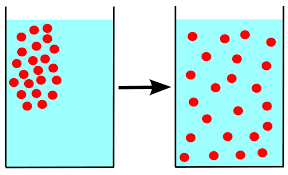
The picture below is an example of _________________.
a)
osmosis
b)
isotonic
c)
diffusion
d)
active transport
54.
What is the definition of Osmosis?
a)
the movement of WATER molecules across the cell membrane.
b)
the state where molecules are equally concentrated (balanced) on both sides of the cell membrane.
c)
the process that brings LARGE particles INTO the cell through the cell membrane
d)
he movement of molecules across the cell membrane that REQUIRES ENERGY output from the cell
55.
What is the definition of Equilibrium?
a)
the process that brings LARGE particles INTO the cell through the cell membrane
b)
The movement of molecules from an area of high concentration (where the molecules are more crowded together) to a area of low concentration (where molecules are more spread apart)
c)
the state where molecules are equally concentrated (balanced) on both sides of the cell membrane.
d)
the movement of WATER molecules across the cell membrane.
56.
Which of the following is the correct equation for PHOTOSYNTHESIS?
a)
CO2 + light + H2O --> O2 + Sugar
b)
CO2 + sugar + H2O --> O2 + light
c)
O2 + light + H2O --> CO2 + Sugar
d)
CO2 + O2 + H2O --> Light+ Sugar
57.
What process occurs when light energy is captured in autotrophs and converted into sugar?
a)
Photosynthesis
b)
Cellular Respiration
58.
What is the pigment in chloroplasts that performs photosynthesis?
a)
Methylene blue
b)
Chlorophyll
c)
Carotene
d)
Green
59.
What is photosynthesis?
a)
The process in which humans eat their food
b)
When a photographer takes a photo.
c)
To get your pictures from the photo lab.
d)
The process in which plants make their food.
60.
Which organelle from the plant cell is primarily responsible for converting sunlight to energy?
a)
Mitochonria
b)
Nucleus
c)
Vacuole
d)
Chloroplast
61.
Cellular respiration takes place in the
a)
nucleus
b)
cytoplasm
c)
ribosomes
d)
mitochondria
62.
This process releases chemical energy from sugars and other carbon-based molecules to make ATP when oxygen is present.
a)
Photosynthesis
b)
Osmosis
c)
Cellular respiration
d)
Diffusion
63.
What are the products of cellular respiration?
a)
Glucose and oxygen
b)
Carbon dioxide, water, and Energy
c)
Lactic acid
d)
Carbon monoxide
64.
The movement of substances through a cell membrane with the use of cell energy
a)
Osmosis
b)
Diffusion
c)
Passive Transport
d)
Active transport
65.
Osmosis is important to cell because
a)
Cells are filled with fluids that are mostly water
b)
Cells need to get rid of large particles they don't need
c)
Cells need to move from place to place
d)
Cells need to stay on balance
66.

What happens if there is a mess up in the DNA structure?

a)

Mutations, like autism and down syndrome

b)

cancer

c)

mutations; deformities

d)

nothing

67.

what is the split phase called

a)

telophase

b)

antiphase

c)

metophase

d)

prophase

68.

What is the stage where you "prep" everything called?

a)

Pro phase

b)

Meta phase

c)

Derp-phase

d)

anti phase

69.

what is this phase?

a)

metaphase1

b)

antiphase

c)

metaphase2

d)

telaphase

70.

what is this phase?

a)

anaphase

b)

prophase

c)

telaphase

d)

enter phase

71.

what is this phase

a)

prophase

b)

metaphase

c)

anaphase

d)

teloophase

72.

Meiosis goes through twice

a)

True

b)

False

73.
When a cell divides, what do we call the 2 new cells?
a)
mother cells
b)
father cells
c)
daughter cells
d)
son cells
74.
In which type of cells will mitosis occur?
a)
egg cells
b)
sperm cells
c)
jail cells
d)
Body cells except the sperm and egg cells
75.
What is the name of the process in which DNA (genetic information) is exchanged during meiosis?
a)
crossing under
b)
crossing over
c)
melding
d)
blending
76.
In meiosis, the haploid number of chromosomes in a human sex cell is:
a)
46
b)
92
c)
22
d)
23
77.
What is the diploid number of cells found in a human body cell?
a)
23
b)
46
c)
92
d)
47
78.
The process on the left is:
The process on the right is:
a)
Left: meiosis
Right: meiosis
b)
Left: meiosis
Right: cloning
c)
Left: mitosis
Right: meiosis
d)
Left: mitosis
Right: mitosis
79.
What scientific process is being shown?
a)
Mixing
b)
Crossing under
c)
Crossing over
d)
square dancing
80.
Most of the cells in the human body are produced by
a)
mitosis
b)
meiosis
81.
Another name for a sex cell is a:
a)
gamete
b)
embryo
c)
bone cell
d)
muscle cell
82.
Characteristics that are passed down from parents to offspring.
a)
Manners
b)
Acquired Traits
c)
Money
d)
Inherited Triats
83.
The hidden form of an inherited trait
a)
dominant trait
b)
recessive trait
c)
purebred
d)
hybrid
84.
The form of an inherited trait that masks the other form of the same trait.
a)
dominant trait
b)
recessive trait
c)
purebred
d)
hybrid
85.

Genotype or Phenotype: ff

a)

Genotype

b)

Phenotype

86.

Genotype or Phenotype: Black hair

a)

Phenotype

b)

Genotype

87.

Genotype or Phenotype: Freckles

a)

Genotype

b)

Phenotype

88.

Homozygous or Heterozygous: ff

a)

Homozygous

b)

Heterozygous

89.

Homozygous or Heterozygous: Ff

a)

Homozygous

b)

Heterozygous

90.

The heterozygous DOMINANT trait of dimples?

a)

DD

b)

dd

c)

Dd

91.

A mom with the heterozygous gene for Widows peak and a father with the heterozygous gene for Widows peak: odds their baby HAS a widow's peak?

a)

0%

b)

25%

c)

75%

d)

100%

92.

If a mother has the homozygous dominant trait FF, what is her phenotype?

a)

Freckles

b)

Tall

c)

No PTC taste

d)

Widow's Peak

93.
What body system removes the waste from your body? 
a)
Circulatory
b)
Excretory
c)
Digestive
d)
Respiratory
94.
What body system consists of the kidneys?
a)
Circulatory
b)
Excretory
c)
Digestive
d)
Muscular
95.
What body system consists of the heart?
a)
Excretory
b)
Digestive
c)
Circulatory
d)
Respiratory
96.
My heart is a _________, that pumps blood through the body. 
a)
Cell
b)
Tissue
c)
Muscle
d)
Bone
97.
The air I breathe in goes down my trachea to my ______?
a)
Heart
b)
Lungs
c)
Brain
d)
Stomach
98.
The food I eat goes down my esophagus to my __________.
a)
Bladder
b)
Kidney
c)
Stomach
d)
Big Toe
99.

My small and large ___________ break down the food so my body can use it for energy.

a)

Intestines

b)

Kidneys

c)

Stomach

d)

Bladder

100.
What organs make up the skeletal system?
a)
Muscles
b)
Bones
c)
Heart
d)
Lungs
101.
What is the purpose of the muscular system?
a)
To breathe
b)
To digest food
c)
To move
d)
To release hormones
102.
Which system is responsible for breathing?
a)
Digestive system
b)
Endocrine system
c)
Respiratory system
d)
Muscular system
103.
What is the main organ involved in the nervous system?
a)
Heart
b)
Lungs
c)
Brain
d)
Bones
104.
What is the purpose of the digestive system?
a)
To digest food
b)
To breathe
c)
To move
d)
To create hormones
105.
What main organ powers the cardiovascular system?
a)
Brain
b)
Lungs
c)
Muscles
d)
Heart
106.
What is the main function of the nervous system?
a)
To communicate with the rest of the body
b)
To pump blood
c)
To breathe
d)
To clean the body
107.
Where does the digestive system begin?
a)
The brain
b)
The mouth
c)
The lungs
d)
The stomach
108.
What is the musculoskeletal system made of?
a)
Bones  & heart
b)
Brain & lungs
c)
Muscles & bones
d)
Mouth & stomach
109.
What three parts make up the nervous system?
a)
Brain, lungs and heart
b)
Brain, spine and nerves
c)
Lungs, heart and spine
d)
Spine, nerves and vessels
110.

What is the biggest function of the respiratory system?

a)

to pump blood

b)

to help us digest food

c)

to take in oxygen and release carbon dioxide

d)

to help us fight disease and infection

111.

Which two body systems are primarily responsible for gas exchange between the body and the environment?

a)

skeletal and muscular

b)

circulatory and respiratory

c)

circulatory and digestive

d)

respiratory and excretory

112.

How does the respiratory system depend on the circulatory system in order to function?

a)

The circulatory system brings waste gases to the lungs and exchanges them for oxygen.

b)

The circulatory system provides structural support and protection to the respiratory system.

c)

The circulatory system pushes gases out of the body through the mouth and nose.

d)

The circulatory system sends messages to the lungs so that one can breathe in and out.

113.

How does the circulatory system depend on the skeletal system?

a)

The skeletal system removes carbon dioxide from the circulatory system.

b)

The skeletal system produces blood cells in the bone marrow.

c)

The skeletal system is responsible for voluntary movement.

d)

The skeletal system helps to digest food for the circulatory system.

114.

Which two systems are responsible for voluntary movement?

a)

circulatory and excretory

b)

digestive and circulatory

c)

skeletal and muscular

d)

skeletal and circulatory

115.

How do the circulatory and excretory systems work together?

a)

The circulatory system brings nutrients and oxygen so our cells can produce energy.

b)

The circulatory system brings blood to the kidneys to filter and remove waste.

c)

The circulatory system bring white blood cells around the body to fight infection and disease.

d)

The circulatory system helps the excretory system digest food.

116.

Which of the following statements describes the function of the small intestine?

a)

The small intestine transports blood to other organs.

b)

The small intestine helps digest food and absorbs nutrients.

c)

The small intestine releases carbon dioxide from the body.

d)

The small intestine produces cells needed for reproduction.

117.

Which two systems work together to remove wastes?

a)

digestive and excretory

b)

respiratory and skeletal

c)

skeletal and circulatory

d)

digestive and respiratory

118.

____ is credited with being the first scientist to observe cork cells.

a)

Leewenhoek

b)

Shleidon

c)

Hooke

119.

Check all the boxes for each organelle that plant and animal cells both have.

a)

lysosomes

b)

cell membrane

c)

mitochondria

d)

nucleus

e)

cell wall

120.

Bacteria is classified as a what?

a)

Prokaryote

b)

Eukaryote

121.

______ is keeping conditions in the cell balanced. (This will be a matching question on the test)

a)

Homeostasis

b)

Response

c)

Metabolism

d)

Nutrition

122.
This scientist concluded that animals and, in fact, all living things are made of cells:
a)
Hooke
b)
Leeunwenhoek
c)
Schleiden
d)
Schwann
123.
This scientist was the first to identify cells and name them:
a)
Hooke
b)
Leeunwenhoek
c)
Schleiden
d)
Virchow
124.
This scientist proposed that all cells come from other cells:
a)
Leeunwenhoek
b)
Schleiden
c)
Schwann
d)
Virchow
125.
This scientist concluded that plants are made of cells:
a)
Virchow
b)
Schwann
c)
Schleiden
d)
Leeunwenhoek
126.
All organisms are made of:
a)
organelles
b)
cytoplasm
c)
DNA
d)
cells
127.
All existing cells are produced by other
a)
living cells
b)
dead cells
c)
atom cells
d)
animal cells
128.
The Cell Theory states...
a)
atoms create all matter
b)
living things evolve
c)
the cell is the backbone of all matter
d)
cells are the basic unit of structure and organization of organisms