
Font size
 Worksheets
Y10 earth science revision
Total questions: 68
Worksheet time: 1hrs 15mins

Rohan, Aiden, and Anika are studying Earth's water. Which sphere of the Earth do they need to focus on?
Cryosphere
Geosphere
Hydrosphere
Biosphere
Arjun, Olivia, and Oliver are discussing which sphere of Earth contains all living things. What do they conclude?
Biosphere
Geosphere
Atmosphere
Hydrosphere
Elijah, Noah, and Emma are discussing the carbon cycle. They come to the conclusion that all of the carbon in existence is continually recycled in the carbon cycle. Is their conclusion correct?
True
False
Harper noticed that the plant population in her neighborhood decreased due to construction. What would happen to the amount of carbon dioxide in the atmosphere?
Stay the same
Increase
Decrease
Abigail, Avery, and Luna are discussing the human impact on the carbon cycle. Which of the following examples do they mention?
Increased production of methane gases from cattle farms
Burning fossil fuels
Driving cars
All of the above

Emma, Abigail, and Henry are studying the graph showing CO2 emissions and temperatures from 1909 to 1949 for their science project. Which conclusion is best supported by the graph?
There is no relationship between carbon dioxide concentrations and temperatures
As carbon dioxide concentrations increase, temperature decreases
As carbon dioxide concentrations increase, temperature increases
As carbon dioxide concentrations decrease, temperature increases
During a school trip, Liam, Arjun, and Evelyn were discussing the envelope of gases surrounding the Earth while looking at the sky. What is this envelope called?
Atmosphere
Hydrosphere
Biosphere
Geosphere
Benjamin, Grace, and Avery are working on a science project about the Earth's atmosphere. They are debating about which gas is the most abundant in the atmosphere. Can you help them decide?
hydrogen
oxygen
helium
nitrogen
Grace, Elijah, and Jackson are discussing about the environment. They are curious to know where carbon is stored in the environment. Can you help them?
Fossil fuels
Wood of trees
Calcium carbonate (shells and bones)
All of the above
Anika, Ava, and Priya were on a camping trip when they saw a forest fire in the distance. They started discussing what would happen to the carbon in the forest due to the fire. What do you think?
It will go into the soil
It will go into the atmosphere
It will runoff into nearby streams and rivers
It will be destroyed

Kai, Benjamin, and Mia went on a field trip to a science museum. They saw a model of a cycle and were asked to identify it. The model showed processes like photosynthesis, respiration, and decomposition. Which cycle do you think they were looking at?
The Water cycle
The Carbon cycle
The Nitrogen cycle
The Phosphorus cycle

Aria, Oliver, and David are studying different cycles in their science class. They come across a picture in their textbook. Oliver thinks it's the Water cycle, Aria believes it's the Carbon cycle, but David insists it's the Nitrogen cycle. Identify the cycle they are looking at based on David's assertion.
The Water cycle
The Carbon cycle
The Nitrogen cycle
The Phosphorus cycle
Emma, Daniel, and Henry were discussing in their science class. Emma said that plants can use nitrogen directly from the atmosphere. Is Emma's statement true or false?
True
False
Which of the following describes a climate?
It rained in the rainforest yesterday.
The long-term average of precipitation, temperature, patterns of storm events, etc.
Ocean currents.
Daily weather patterns.
It was foggy this week.
Which of the following BEST describes the greenhouse effect?
Gasses like CO2 reflect heat (infrared) back to Earth, which helps to keep the atmosphere warm.
A glass house with plants in it that stays warm.
Oxygen in the atmosphere is destroyed when in contact with gasses like methane.
The ozone layer develops a hole that allows too many of the sun's rays through.
The sun heats the Earth unevenly because the Earth is tiled on its axis.
What is the biosphere?
Herbivores, Carnivores & Omnivores
The atmosphere
The living organisms in the lithosphere, hydrosphere & atmosphere
Weather & Climate

The total amount of the carbon on Earth is constant.
True
False

Since the mid- 1800's, _____________ activity has significantly altered the carbon cycle.
animal
plant
unknown
human
Any amount of CO2 (Carbon Dioxide) in the atmosphere is bad for our planet.
true
false
The worlds current levels of CO2 in the atmosphere are:
decreasing
at record high levels
increasing at regular pace
rapidly decreasing
Climate change causes extreme weather conditions such as:
flooding
heat waves
cyclone
all of the above
During photosynthesis, the sun’s energy is used by green plants to produce glucose, which the
plant’s then use for food. Which of the following is the energy transformation that is taking
place?
Light energy is converted to chemical energy
Light energy is converted to mechanical energy
Mechanical energy is converted to heat energy
Mechanical energy is converted to kinetic energy

The diagram below shows the Nitrogen Cycle.
What is the role of Nitrates in the cycle?
It is used by plants for protein synthesis
It is used by bacteria to synthesize ammonia
It is used by animals for atmospheric nitrogen
It is used by animals for carbohydrate synthesis
Which gas is the greatest contributor to climate change?
Ozone
Methane
Nitrous Oxide
Carbon Dioxide
12. What is a limitation to using models for studying systems in science?
Models are always very simple and never include details.
Most models are not to scale and actual sizes cannot be studied.
It always takes more work to create a model than to study the real system.
It is always more expensive to create a model than to study the real system.

The balance of energy that is absorbed, reflected, and emitted (radiated) by Earth.
Albedo
Energy Budget
Carbon Cycle
Fusion

The amount of light reflected by a surface. Represented by a value between 0-1.
Carbon Cycle
Albedo
Photosynthesis
Nuclear Fusion
Temperature changes, wind blowing and rain are caused by...
The movement of heat in the atmosphere.
The movement of the planets.
The movement of the moon.
The heat from the sun.

If you want to keep your house cool all year, should you design the house roof to have a high or a low albedo?
High
Low
Which object below would have an albedo score of 0.
A green forest
A deep blue ocean
Fresh clean snow
A pitch black rooftop
Why do areas near the coasts have warmer winters?
the water absorbs heat from the air around the coasts
the water releases heat into the air around the coasts
What does most sunlight do when it reaches earth?
Gets absorbed by the surface
Gets reflected by the surface
Gets absorbed by the air
Gets reflected by the air
Snow on the ground prevents polar climates from gaining heat because of what?
the heating of the Earth by greenhouse gases
heat spreading from the equator
cold spreading from the poles of the Earth
reflection of solar radiation from the surface
_____ is the conversion of organic nitrogen into ammonia (from living things waste/death)
What converts nitrogen gas into a usable form for plants and animals?
bacteria
rain
fungi
car exhaust
What process occurs when dead plant and animal matter decomposes and nitrogen is released back into the atmosphere?
Assimilation
Fixation
Ammonification
Denitrification
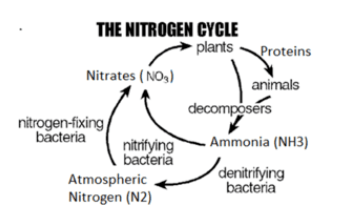
According to this diagram, plants use nitrogen to make _________________________
bacteria
animals
proteins
decomposers
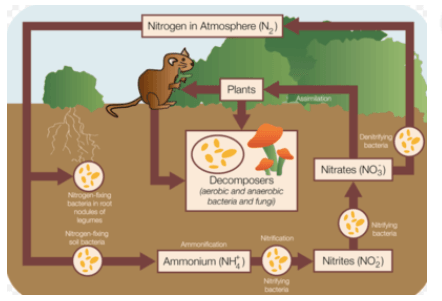
A correct path that nitrogen could take would be
air -> animals -> plants -> bacteria
animals -> air -> bacteria -> plants
bacteria -> air -> plants -> animals
air -> bacteria -> plants -> animals

Which process makes nitrites from ammonia?
ammonification
denitrification
nitrification
nitrogen fixation
What converts nitrogen gas into a usable form for plants and animals?
bacteria
rain
fungi
car exhaust
How is nitrogen "fixed" into a usable form for plants?
Through action of bacteria only
Through lightning only
Through action of bacteria and lightning
Through photosynthesis
What is the formula for atmospheric nitrogen?
N
N2
NH3
NO3
Match the following steps of the nitrogen cycle to how they move bacteria.
Atmosphere to Geosphere
Nitrogen Fixation
Geosphere to Biosphere
Assimilation
Biosphere to Geosphere
Ammonification
Geosphere to Atmosphere
Denitrification
The process in which nitrogen circulates and is recycled is called
The nitrogen cycle
The carbon cycle
The water cycle
The phosphorus cycle
What affects the density of water?
Salt
Temperature
The seasons of the year
Both Salt content (salinity) and temperature
______ causes surface currents.
The Coriolis Effect
gravity
density differences
wind
The more scientific name of the Global Conveyor Belt is _____.
halinethermal circulation
thermohaline circulation
thermodensity circulation

Which of the following processes most directly affects the amount of water entering earth's atmosphere?
precipitation and runoff
condensation and precipitation
transpiration and evaporation
infiltration and recharge
What is transpiration?
Excess water being released from the aerial parts of plants in the form of water vapor
Excess sugar being released from the leave
The way a plant makes its food
When the plant uses sugar for energy
What is the role of plants in the water cycle?
A ________________ feedback loop makes a system more stable.
Positive
Neutral
Negative
Circular
A _________________ feedback loop moves a system to an extreme.
Positive
Neutral
Circular
Negative
Polar Ice Caps are melting due to an increase in Earth's temperature. This lowers the albedo of Earth, which in turn increases Earth's temperature. This is an example of what type of feedback?
Negative
Neutral
Positive
Ecosystem
Heat energy reflected back by the Earth's surface in the form of long wave radiation is known as
Terrestrial radiation
Insolation
Earth's energy budget is
Terrestrial radiation is:

