
 Worksheets
Revision I
Total questions: 100
Worksheet time: 1hrs 12mins
Which condition represents homeostasis?
Having a stroke
Shivering on a cold day
Breaking a bone
Anatomy is the study of the functions of the body and its parts
True
False
The frontal plane divides the body into
Front and Back
Upper and Lower
Right and Left
Study of the large easily observable structures in an organism (bones, organs, muscles)
Gross Anatomy
Microscopic Anatomy
Development Anatomy
Regional Anatomy
Water is a(n)
atom
cell
molecule
tissue
Atoms,molecules, and macromolecules make up which level of structural organization?
Chemical
Cellular
Tissue
Organ
Basic unit of ALL living things
Cell
Atom
Tissue
Organ
The small intestine is _____ to the stomach
posterior
medial
inferior
superior
Anatomical direction meaning front or in front of
posterior
lateral
superior
anterior
The brain is _____ to the ear
lateral
proximal
medial
superior
Your dorsal cavity houses your
brain
lungs
heart
stomach
The study of the structure or form of the body and its parts
Physiology
Anatomy
System Analysis
Dissection
Which of the following is NOT a region of the abdominal pelvic cavity?
hypochondriac
lumbar
epigastric
thoracic
Study of the skeletal system is an example of
Systematic Anatomy
Regional Anatomy
Gross Anatomy
Developmental Anatomy
Molecules are two or more atoms bonded together
True
False
Which of the following is NOT a type of muscle tissue?
Cardiac
Smooth
Skeletal
Epithelial
Tissue type that protects the body by covering internal and external surfaces AND produces secretions (sweat, hormones)
Epithelial
Connective
Muscle
Nervous
Anatomical position is when you are facing forward, arms at your side, palms facing up, feet flat on the ground.
True
False
Anatomical direction for toward the point of attachment
distal
lateral
proximal
medial
Which body cavity contains the thoracic and abdominopelvic cavity?
Dorsal cavity
Posterior cavity
Ventral cavity
Transverse cavity
The word structure relates to the study of _____(1)_____, whereas the word function relates to the science of _____(2)_____.
(1) physiology;
(2) anatomy
(1) cytology;
(2) histology
(1) anatomy;
(2) physiology
(1) biology;
(2) chemistry
From the following selections, choose the one that correctly identifies the levels of organization, from the smallest to the largest units.
cell, tissue, organ, chemical, organ system, organism
organism, cell, organ system, organ, tissue, chemical
chemical, cellular, tissue, organ, organ system, organism
cellular, molecular, tissue, organ, organ system, organism
The smallest living units in the human body are
cells.
atoms.
molecules.
organs.
An example of the organ-system level of organization is the
lungs.
cardiovascular system.
heart.
kidneys.
Homeostasis refers to the
arrangement of atoms and molecules at the chemical level of organization.
existence of a stable internal environment.
interdependent, interconnected organ systems of the body.
shared environment of cells, tissues, organs, and systems in the body.
Homeostasis regulation usually involves a receptor, a __________, and an effector.
stimulus
response
control centre
feedback
The regulatory mechanism that occurs when a variation outside of normal limits triggers an automatic response that corrects the situation is
negative feedback.
positive feedback.
effector regulation.
receptor regulation.
When the initial stimulus produces a response that reinforces the stimulus, the mechanism is called
thermoregulation.
positive feedback.
set-point integration.
negative feedback.
When body temperature rises, a center in the brain initiates physiological changes to decrease body temperature. This is an example of
positive feedback.
set-point integration.
receptor regulation.
negative feedback.
Increasingly forceful labor contractions that lead to childbirth are an example of
negative feedback.
positive feedback.
effector regulation.
receptor regulation.
The plane that divides the body into left and right sections is the
sagittal plane.
coronal plane.
transverse plane.
frontal plane.
The anatomical term that refers to the back of the human body is
ventral.
posterior.
coronal.
cephalic.
The smallest units of matter whose identifies cannot be altered by a chemical change are
electrons.
mesons.
protons.
atoms.
The three subatomic particles that are stable constituents of atomic structures are
carbon, hydrogen, and oxygen.
protons, neutrons, and electrons.
atoms, molecules, and compounds.
cells, tissues, and organs.
The subatomic particles found in the nucleus of an atom include
protons and electrons.
neutrons and electrons.
protons and neutrons.
protons, neutrons, and electrons.
The basic structural units of all plants and animals are
atoms.
cells.
molecules.
protons, neutrons, and electrons.
The smallest functioning units of life are
tissues.
organs.
atoms.
cells.
The mitochondria are small organelles in cells that
provide energy for the cell.
perform essential recycling functions inside the cell.
absorb and break down fatty acids and other organic compounds.
All of the above are correct.
The organelles that manufacture proteins, using information provided by the DNA of the nucleus, are the
centrioles.
ribosomes.
proteasomes.
lysosomes.
The four basic tissue types found in the human body are
squamous, cuboidal, columnar, and glandular.
adipose, elastic, reticular, and cartilage.
skeletal, cardiac, smooth, and muscle.
epithelial, connective, muscle, and nervous.
Collections of specialized cells and cell products that perform a limited range of functions are called
systems.
organs.
tissues.
organelles.
The two types of layering used to classify epithelia are
cuboidal and columnar.
simple and stratified.
columnar and squamous.
squamous and cuboidal.
The three recognizable cell shapes used to classify epithelia are
fibroblasts, macrophages, and mast cells.
skeletal, cardiac, and smooth.
squamous, cuboidal, and columnar.
simple, stratified, and columnar.
The three types of muscle tissue found in the body are
elastic, hyaline, and fibrous.
striated, nonstriated, and fibrous.
voluntary, involuntary, and nonstriated.
skeletal, cardiac, and smooth.
Smooth muscle tissue is most likely found in the
entrances and exits to the digestive and respiratory systems.
walls of hollow internal organs.
areas of the body where contractions are associated with strength.
areas where joints articulate with bones.
Structurally, neurons are unique because they are the only cells in the body that have
lacunae and canaliculi.
axons and dendrites.
satellite cells and neuroglia.
soma and stroma.
A group of related cells and tissues that work together to perform a function make up ____.
a system
an organism
an organ
a cell

Organs that work together are part of a(n) ________________________.
cells
tissue
organ system
Basic unit of ALL living things
Cell
Atom
Tissue
Organ
What is the correct order of organization?
cells->tissue->organs->organ systems-> organism
tissue->cells->organs->organ systems-> organism
organs->organ systems-> organism->cells->tissue

The control center of a cell is the
cytoplasm
cell membrane
nucleus
chromosome
Skin, ears, and kidneys are examples of
organs
tissues
organ systems
cells
This system removes waste products from the body
endocrine
excretory
integumentary
circulatory


Homeostasis
allows for a wildly fluctuating internal environment
Is regulated by one body system
is the maintenance of a relatively stable internal environment and often incorporates a form of feedback regulation
The diaphragm is a muscular structure found between what body cavities
Spinal and Cranial
Oral and Nasal
Thoracic & Abdominal
Abdominal & Pelvic
The toes would _______ to the knees?
Inferior
Superior
Anterior
Posterior


What muscle is highlighted in the picture?
Triceps
Biceps
Quads
Deltoids
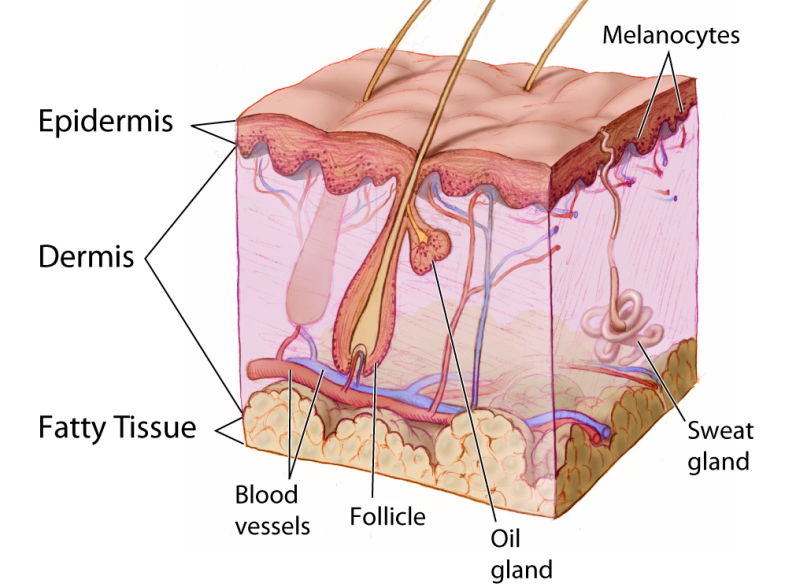
What is the oily substance that protects the skin against water called?
seaweed
callus
sebum
skin
Which of the following is NOT a layer of skin?
Dermis
Epidermis
Hypodermis
Polydermis
The outermost layer of skin is the ____________ layer.
Dermis
Epidermis
Hypodermis
The layer of skin made up of adipose connective tissue (fatty tissue) is the ____________ layer.
Dermis
Epidermis
Hypodermis
The layer of skin made up of adipose connective tissue (fatty tissue) is the ____________ layer.
Dermis
Epidermis
Hypodermis
Which layer of skin is the thickest and where most of the "work" is done?
Dermis
Epidermis
Hypodermis
"Thin" skin is composed of _____ layers, while "thick skin" is composed of ____ layers.
4; 5
5; 4
1; 2
1; 5
The oldest layer of skin is found ______________.
Deeper
on the outermost layer of skin
Choose the correct order of the 5 layers of the epidermis, starting from the outermost layer.
Corneum, basale, lucidum, granulosum, spinosum
Corneum, lucidum, granulosum, spinosum, basale
Basale, spinosum, corneum, lucidum, granulosum
What is the function of the stratum basale layer (within the epidermis)?
Cleaning skin
Pain receptors
New cell production
Which layer of skin contains hair follicles, sweat glands, and blood vessels?
Dermis
Epidermis
Hypodermis
Keratin is a protein that keeps your _____________ strong. (Select all that apply)
Hair, skin, and nails
Teeth, eyes, and hair
Which of the following is responsible for skin pigmentation (color)?
Keratin
Melanin
Adipose tissue
The epidermis is ____________, meaning it does not receive blood supply.
Vascular
Avascular
True or False? Exocrine glands secrete directly into the blood.
A. True
B. False
a
b
True or False? The cells in some mucous membranes are supplied with cilia that wave away foreign particles.
A. True
B. False
a
b
Select the one FALSE statement about mucous and serous membranes.
The epithelial type is the same in all serous membranes, but there are different epithelial types in different mucous membranes
Serous membranes line closed body cavities, whereas mucous membranes line body cavities open to the outside
Serous membranes always produce serous fluid, and mucous membranes always secrete mucus
Body membranes contain an epithelium plus a layer of loose connective tissue
The Plasma membrane mainly consists of
Proteins embedded in carbohydrate-lipid layer
Proteins embedded in a carbohydrate bilayer
Proteins embedded in a phospholipid layer
Proteins embedded in a lipid molecules
The following are the components of plasma membrane. EXCEPT one?
cholesterol
proteins
carbohydrates
nucleotide
Plasma membranes are selectively permeable. This means
anything can pass in and out
the membrane regulates the passage of the material in and out of the cell
glucose cannot enter the cell
cholesterol cannot enter

