
 Worksheets
Semester 2023 - Review PT 2
Total questions: 50
Worksheet time: 1hrs 15mins
Select all the correct names for the cell membrane that covers the cell. (Multiple answers)
Plasma membrane
Phospholipid bilayer
Nuclear membrane
Lipid bilayer

Match the following:
Stabilizes and maintains flexibility of cell membrane
Cholesterol
2 layers; Allows small molecules to pass through the membrane
Phospholipid bilayer
Regulates what goes in and out of the cell
Plasma or Cell Membrane
Allows large molecules to pass through the membrane
Transport or Protein Channel
Located outside of the membrane; Helps with cell communication and cell-to-cell connections
Carbohydrates


When a cell forms a vesicle around unwanted particles and expels it OUT of the cell.
Pinocytosis
Endocytosis
Phagocytosis
Exocytosis
A type of active transport that brings particles into a cell when the cell membrane encloses a particle to make a vesicle.
Facilitated diffusion is the movement of materials into and out of the cell...
With the use of energy
With the use of proteins but no energy
By moving water
By using ATP
The movement of water from a high concentration to a low concentration is called ________.
Diffusion
Osmosis
Facilitated diffusion
Active transport

What does the term semi-permeable mean for the cell?
All materials can go across the membrane.
Only some materials can go across the membrane.
No materials can cross the membrane.
Only water is allowed to cross the membrane.

Match the following functions to each biomolecule in the cell membrane:
Cell recognition
Carbohydrates
Transports large molecules through the membrane through channels
Proteins
Allows small molecules to pass through the membrane
Phospholipids
Helps maintain fluidity in the membrane
Cholesterol
How does the cell membrane help maintain homeostasis in each cell?
The cell membrane allows all substances to pass through freely
The cell membrane controls the movement of substances in and out of the cell
The cell membrane provides energy for the cell
The cell membrane produces proteins necessary for cell function
Passive transport (a) require energy because it moves (b) the concentration gradient, from (c) .
Active transport (a) require energy because it moves (b) the concentration gradient, from (c) .

Using the image, choose the correct form of transport and explanation of how you know:
Active transport, because the molecules are crossing the membrane using a protein
Passive transport because the molecules are crossing the membrane using a protein
Active transport because the molecules are moving from low to high concentration
Passive transport because the molecules are moving from high to low concentration
Organize these options into the right type of transport:
does NOT require energy
requires energy
molecules move WITH the gradient
molecules move AGAINST the gradient
molecules move from high concentration to low
molecules move from low concentration to high
What happens during osmosis?
Movement of small molecules from high concentration to low concentration
Movement of water molecules from an area of high concentration to an area of low concentration
Which of the following images show transport that REQUIRES ENERGY? (Two answers)


Which of the following images show transport that DOES NOT require energy? (Two answers)
When molecules move backwards
When molecules move from a high concentration to a low concentration.
When molecules move from a low concentration to a high concentration
In osmosis, what does isotonic mean?
More water will move inside the cell
More water will move outside the cell
There will be little to no movement of water inside to outside the cell
Which cell transport has movement of molecules against a concentration gradient?
Simple diffusion
Facilitated diffusion
Active transport
Osmosis
What type of cell transport has molecules move down a concentration gradient?
Simple diffusion
Facilitated diffusion
Active transport
Osmosis
Match the following information:
Which type of osmosis has water leaving the cell? (Shrink)
Hypertonic
Which type of osmosis has water entering the cell? (Burst)
Hypotonic
Which type of osmosis no water leaving or entering?
Isotonic
What happens to the cell when it is hypertonic?
Shrink
Swell
Nothing, it stays the same
What happens to the cell when it is hypotonic?
Swell
Shrink
Nothing, it will stay the same
Provides energy for cells
Stores genetic information
Provides structure in the nucleus
A phosphate group is added
Adenine bonds to ribose
A phosphate group is removed

What are the REACTANTS of CELLULAR RESPIRATION? (2 Answers)
ATP
Carbon dioxide
Glucose
Oxygen
Water
What are the REACTANTS for PHOTOSYNTHESIS? (3 Answers)
ATP
Carbon dioxide
Glucose
Sunlight
Water
What are the PRODUCTS of PHOTOSYNTHESIS? (2 Answers)
ATP
Carbon dioxide
Glucose
Oxygen
Water
What are the PRODUCTS of CELLULAR RESPIRATION? (3 Answers)
ATP
Carbon dioxide
Glucose
Oxygen
Water
Which organisms perform cellular respiration?
Plants
What is cellular respiration?
The process by which cells break down glucose into energy.
The process by which cells break light down into energy.
The process by which cells communicate with other cells.
The process by which cells create glucose for food.
What is an energy carrier molecule called? (a)
Match the following information:
Reactants to Photosynthesis
Sunlight, Water, Carbon Dioxide
Reactants to Cellular Respiration
Glucose, Oxygen
Reactants
Substances needed to start a processes
Products
A new substance that is created.
Match the following information:
Products of Cellular Respiration
ATP, Carbon Dioxide, Water
Products of Photosynthesis
Glucose, Oxygen
Site of Cellular Energy Production
Mitochondria
Site of Photosynthesis
Chloroplast
Energy-Carrying Molecules
ATP
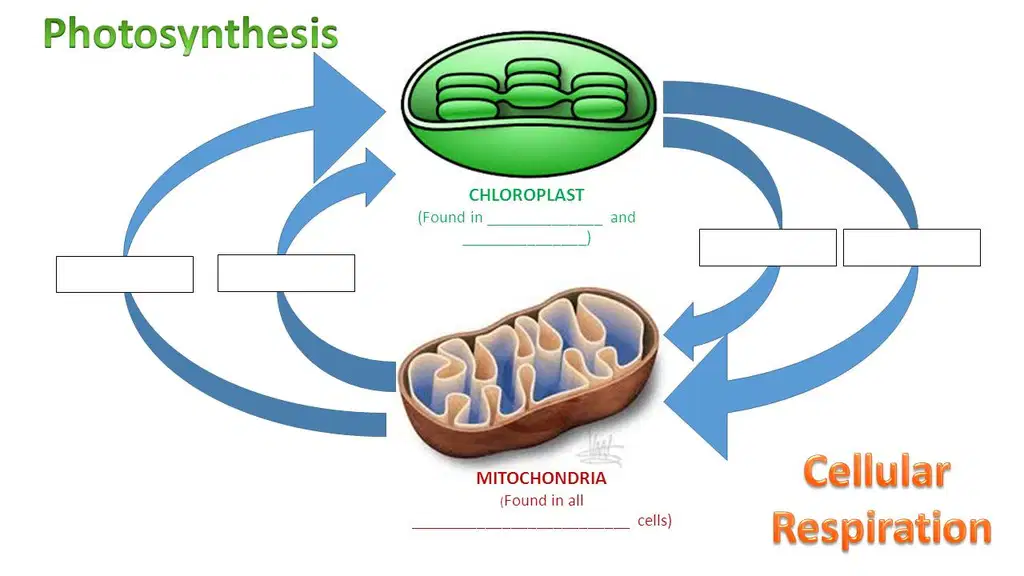
What are the products of Cellular Respiration? (3 Answers)
Glucose
Oxygen
Water
Carbon Dioxide
ATP - Energy
What are the products of Photosynthesis? (2 Answers)
Glucose
Oxygen
Carbon Dioxide
ATP - Energy
What are the reactants of Cellular Respiration? (2 Answers)
Glucose
Oxygen
Carbon Dioxide
ATP - Energy
Water
What are the reactants of Photosynthesis? (3 Answers)
Glucose
Oxygen
Carbon Dioxide
Light Energy
Water
Cellular respiration occurs in which organelle?
Chloroplasts
Mitochondria
Golgi Aparatus
Ribosome
Nuclues
Photosynthesis occurs in which organelle?
Chloroplasts
Mitochondria
Golgi Aparatus
Ribosome
Nuclues
What is the chemical equation for photosynthesis?
6O2+ 6H2O → C6H12O6 + 6CO2
6CO2 + Light → C6H12O6 + 6O2
6CO2 + 6H2O + light → C6H12O6 + 6O2
What is the equation for photosynthesis?
Water + Carbon Dioxide → Glucose + Carbon Dioxide
Carbon Dioxide + ATP → Glucose + Oxygen
Carbon Dioxide + Water + Sunlight → Glucose + Oxygen
Glucose + Oxygen → Carbon Dioxide + ATP + Water
6CO2 + light + 6H2O --> 6O2 + Sugar
6CO2 + sugar + 6H2O --> O2 + light
6O2 + light + 6H2O --> 6CO2 + Sugar
6CO2 + 6O2 + 6H2O --> Light+ Sugar
What are the products of cellular respiration?
Carbon dioxide, ATP, and water
ATP + oxygen + Water
Carbon monoxide + ATP
What is a reactant for cellular respiration?
Energy
Glucose
Carbon dioxide
Water
What is the correct chemical equation for cellular respiration?
6O2 + C6H12O6 → 6CO2 + 6H2O + Energy
6O2 + C6H12O6 + Energy → 6CO2 + 6H2O
6CO2 + 6H2O → 6O2 + C6H12O6 + Energy
6CO2 + 6H2O + Energy → 6O2 + C6H12O6
Oxygen + Glucose → Carbon Dioxide + Water + Energy
Oxygen + Glucose + Energy → Carbon Dioxide + Water
Carbon Dioxide + Water → Oxygen + Glucose + Energy
Carbon Dioxide + Water + Energy → Oxygen + Glucose
Match the following information:
Chemical Name for Glucose
C6H12O6
Chemical Name for Water
H2O
Chemical Name for Oxygen
O2
Chemical Name for Adenosine Triphosphate
ATP
Chemical Name for Carbon Dioxide
CO2

