
 Worksheets
Semester 2023 - Review PT 4
Total questions: 50
Worksheet time: 1hrs 15mins
During what phase of the cell cycle does the cell make sure duplications were copied correctly and prepare for mitosis?
G1 phase
S phase
G2 phase
M phase
Put the following stages of mitosis in order: Anaphase, Prophase, Metaphase, and Telophase.
Prophase, Metaphase, Telophase, Anaphase
Prophase, Anaphase, Metaphase, Telophase
Prophase, Metaphase, Anaphase, Telophase
Prophase, Telophase, Metaphase, Anaphase
Put the following in order: Cytokinesis, G2, Mitosis, G1, S.
G1, G2, S, Mitosis, Cytokinesis
G1, S, G2, Mitosis, Cytokinesis
G1, G2, S, Cytokinesis, Mitosis
G1, S, G2, Cytokinesis, Mitosis
Put the following actions in order: DNA replicates, Cell grows, Cell divides, Cell prepares for mitosis.
DNA replicates, Cell grows, Cell prepares for mitosis, Cell divide
Cell grows, Cell prepares for mitosis, DNA replicates, Cell divides
Cell grows, DNA replicates, Cell prepares for mitosis, Cell divides
DNA replicates, Cell prepares for mitosis, Cell grows, Cell divides

Why would it be important to replicate DNA before a cell divides in mitosis?
In order for genetic information to be transferred into daughter cells.
In order for the cell to be able to increase in size.
In order for the DNA to be contained in the nucleus.
In order for the cell to re-order the DNA sequencing in the new cells.
What is loose strands of DNA called?
Centromere
Chromatid
Chromosome
Chromatin
Identical halves of a chromosome are called?
Cousins
Chromatids
Centromere
Centrosome
After mitosis the number of chromosomes in the newly created cells will be?
Half the number of the original cell
The same number as the original cell
Twice as much as the original cell
What type of cell will form a cell plate during mitosis?
Haploid cells
Plant Cells
Animal Cells
Diploid Cells
Uncontrolled growth can result in:
G0 phase
S phase
Replication
Tumor

During interphase, what is the resting phase is called?
G0
G1
G2
S
Cancer creates abnormal cells by disrupting _________?
The cell cycle
Red blood cell formation
DNA replication
ATP synthesis
What definition best describes an uncontrolled growth of cells that damages tissues?
Cancer
Cyst
Lesion
Polyp
Any substance that is known to cause cancer is called a _______?
Carcinogen
Nicolyte
Pathogen
Retrovirus
What moves chromosomes around the cell during mitosis?
Cytoplasm
Spindle Fibers
Golgi Apparatus
Mitochondria
What organelle controls spindle fibers?
Mitochondria
Chloroplast
Endoplasmic Reticulum
Centrioles / Centrosomes
Which of the following is TRUE about Bacteria?
Bacteria can easily be seen with the human eye
Bacteria have multiple cells
All bacteria are Non-living
Bacteria are single-celled organisms
Hernando has a bacterial eye infection that won't go away. His doctor wants to prescribe him something to help. Should his doctor give him antibiotics or a vaccine?
Antibiotics
Vaccine
True or False: ALL bacteria is bad for you
True
False
Antibiotics are commonly used to fight viruses.
True
False
Washing your hands with soap and water is one of the best ways to prevent illness.
True
False
What is the outer protein coat of a virus is called?
(a)
How does a virus attach to a cell?
The protein projections (spikes) on a virus touches the cell's proteins.
By bouncing off of the cell's membrane.
Uses it's fibers to lasso itself to the cell.
Surrounds the cell until it lets it in.
Which occurs during the lysogenic cycle of a virus infection?
Viral genes instruct the host cell to make more viral protein capsids and enzymes needed for viral replication.
The virus produces active, immediate infections.
The virus takes over the cell, makes copies of itself, and usually kills the host cell.
The viral genes become a part of the host cell DNA, so the cell continually makes more copies of the virus.
Viruses can affect which types of organisms? Select TWO correct answers.
Plastic
Animals
Bacteria
Bricks
What is the one thing that eukaryotic cells, prokaryotic cells, and viruses have in common?
(a)
Viruses cause infection by ______________.
Producing toxins that harm the body.
Reproducing independently inside the body.
Forming endospores.
Entering body cells and replicating.
If Andy is feeling symptoms from a virus that he contracted, the virus must be in the cycle.
(a)
In which type of cell cycle(s) does viral DNA become integrated into the host cell's DNA?
Lytic
Lysogenic
Neither lytic nor lysogenic
Lytic and lysogenic
Bacteria reproduce through.
(a)

Increase its size
Synthesize needed oxygen
Obtain nutrients
Reproduce
Bacteria are often beneficial to both organisms and the .
(a)
(a)
Which of the following is TRUE?
Both bacteria and viruses are living things.
Viruses are living things, bacteria are not.
Bacteria are living things, viruses are not.
Neither bacteria or viruses are living things.
What is antibiotic resistance?
An explanation for viruses not being affected by antibiotics.
The ability of bacteria to resist the effects of an antibiotic to which they were once sensitive.
A rare genetic disease that makes it so that your body is resistant to the effects of an antibiotic.

(a)
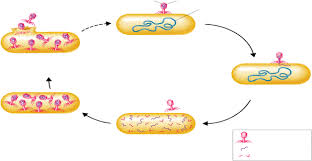
When the viral DNA becomes active in the lysogenic cycle, which life cycle does it enter?
Lytic
Lysogenic
Cell cycle
DNA replication
What is the first step to both cycles?
The virus attaches to a host.
The virus injects genetic material.
The host gets sick.
The cell is destroyed.

Phagocytosis
Lytic cycle
Lysogenic cycle
Formation of antibodies
Reorder the Lytic Cycle in sequence order.
Virus attaches to a living cell host.
Virus injects its DNA into the host cell.
The cell begins to replicate virus DNA and particles.
New viruses are assembled within the host cell.
Host cell breaks open and releases new viruses.
What is the best defense / protection against viruses?
Vaccines

