NEW
Font size
 Worksheets
Practice Test for LE1
Total questions: 57
Worksheet time: 2hrs 54mins


__?__.
The SI unit for mass is _________.
Pounds
Inches
Kilograms
Ounces
Newtons could be used to measure __________ and __________.
mass, speed
momentum, work
force, weight
direction, power
100.00
4004
0.000008
0.00400
5.00000008
direction
Which would be used for the situation, scalar or vector:
The temperature change from noon to 6 pm
scalar
vector


Billy runs 400 meters to Andy's house, turns around, and runs 400 meters back home. What is Billy's distance?
0 meters
400 meters
800 meters
1600 meters
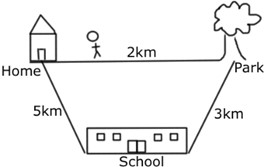
Jerry walked from home to school, then from the school to the park. What is his total displacement?
2 km
5 km
8 km
10 km

Two people walk across a parking lot. Their paths are shown in the image. Who traveled with a larger displacement?
Person A
Person B
They both had the same displacement.


The graph shows the velocity of a bicycle as the rider begins to move from a stop
What does the slope of the graph represent?
acceleration
displacement
time
velocity
Which of the following shows an object at rest?
HINT: Read each graph carefully!


When the velocity of an object does not change, what happens to its acceleration?
Nothing, it does not accelerate.
It is constant acceleration
It is changing acceleration
Need more information to determine

If you throw a baseball straight up, what is its vertical velocity at the highest point?
9.8 m/s2
9.8 m/s
0 m/s2
0 m/s
15. Joe jumps out of a helicopter. Which free body diagram(FBD) illustrates Joe's free fall motion?


Heavier objects free fall faster than lighter objects.
True
False

At what point is vy= 0 m/s?
A
B
C
D
None of these points
Which vector pair (arrow pair) correctly represents the acceleration and velocity at point P?


A ball is thrown into the air at some angle, with initial velocities vx (horizontal) and vy (vertical). At the very top of the ball’s path:
What is its velocity in the vertical direction?
vy
Greater than vy
Zero
In the absence of air resistance, the angle at which a thrown ball will go the farthest is?
90°
30°
60°
45°

A skateboarder rolls off a bridge into the river as shown. If the skateboarder was originally moving at 7.0 m/s, how much time did the skateboarder spend in the air?
1.3 s
0.79 s
38.5 s
0.70 s
Not enough information given.

A ball rolls off a table and strikes the floor, as shown. If the time the ball spent in the air was 0.58 s, how fast did the ball leave the table?
3.6 m/s
1.2 m/s
2.9 m/s
0.99 m/s
A projectile is launched with a horizontal velocity of 20 m/s and an initial vertical velocity of 20 m/s. Which graph correctly shows the vertical velocity of the projectile over time?


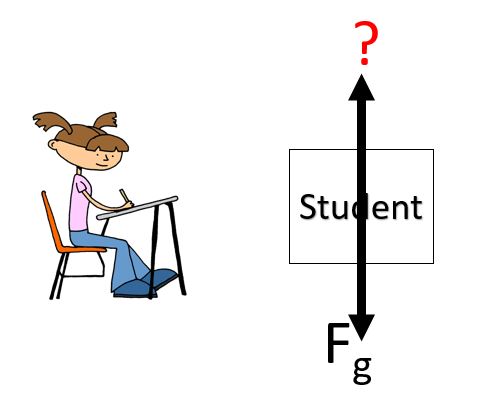
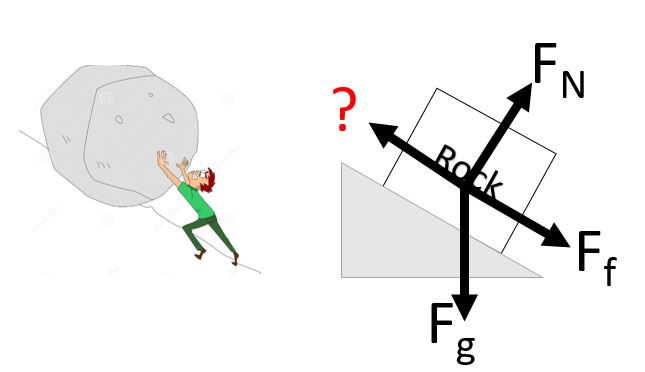
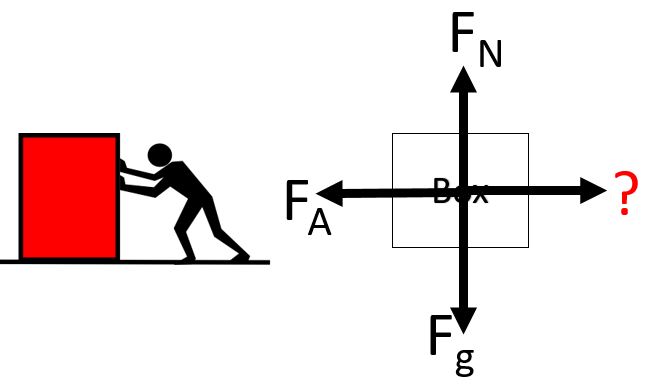
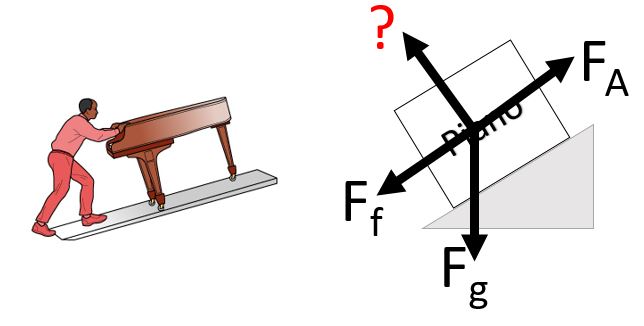
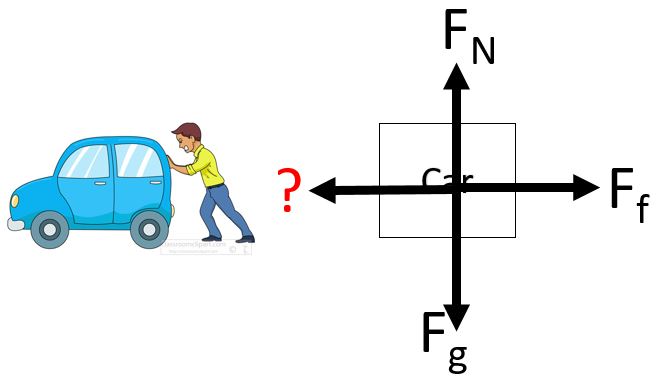
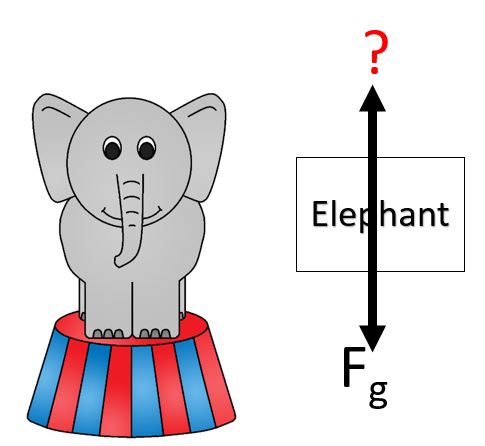
Whenever an object is moving, there is always this force opposing the motion:
inertia
momentum
friction
applied force
The force that keeps objects on top of surfaces instead of letting them sink into the surface is known as:
normal
abnormal
static
inertia
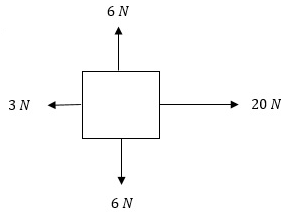
What is the NET FORCE of this diagram?
17 N, right
17 N, left
23 N, right
12 N, up
Inertia depends on ______
Velocity
Speed
Distance
Mass
An object at rest stays at rest and an object in motion stays in motion with the same speed and in the same direction unless acted upon by a(n) ____________________.
unbalanced force
inertia
mass
balanced force
More mass = More inertia
True
False

This equation goes with which law?
Newton's first law of motion
Newton's second law of motion
Newton's third law of motion

A skater pushes another skater forward, but the one pushing moves backwards.
Newton's 1st Law
Newton's 2nd Law
Newton's 3rd Law

The harder you hit a baseball, the faster it accelerates.
Newton's 1st Law
Newton's 2nd Law
Newton's 3rd Law

You push against a wall and the wall is pushing back on you.
Newton's 1st Law
Newton's 2nd Law
Newton's 3rd Law

Which law best explains why more force must be applied to the bowling ball to make it accelerate at the same rate as the tennis ball.
Newton's 1st Law
Newton's 2nd Law
Newton's 3rd Law