wayground logo

Free Printable Worksheets

Font size

S
M
L
XL
Worksheets

Grade 5

Total questions: 149

Worksheet time: 1hrs 15mins

Name
Class
Date
1.

What are properties?

a)

They give us an idea of what the object can do.

b)

They describe the object.

c)

They tell us what an object cannot do.

2.

Which words best describe NON-METALS?

a)

ductile, shiny, brittle

b)

malleable, dull, brittle, ductile

c)

brittle, dull, insulators

3.

What does "malleable" mean?

a)

Can be made into a shape.

b)

Brittle

c)

Ductile

d)

Shiny

4.

Are metals good insulators?

a)

No

b)

Yes

5.

According to the YouTube video, what is the structure called where iron ore is extracted?

a)

Oven

b)

Smelter

c)

Furnace

6.

According to the YouTube video, what is coke?

a)

A refreshing drink.

b)

A substance found in rocks.

c)

A fuel used in iron smelting.

7.

According to the YouTube video, what are "tuyeres"?

a)

Nozzles on the furnace.

b)

The glass on the furnace.

c)

It is what the furnace is made of.

8.

According to the YouTube video, what temperature can the furnace heat up to?

a)

4000 degrees Celsius

b)

14 000 degrees Fahrenheit

c)

4000 degrees Fahrenheit

d)

14 000 degrees Celsius

9.

According to the YouTube video, it is said that under the extreme heat, the mixture "liquifies". What does this mean?

a)

The mixture turns into a solid.

b)

The mixture turns into a liquid.

c)

The mixture turns into a gas.

10.

Which of the following are all examples of METALS?

a)

glass, gold, copper, silver

b)

copper, gold, bronze, plastic

c)

wood, iron, aluminium, steel

d)

copper, silver, iron, gold

11.
Which of these is a property of metals?
a)
It's malleable
b)
It can't conduct electricity
c)
They are used in food
d)
It's very brittle
12.
Brittle
a)
Metal
b)
Nonmetal
13.
Good conductor of heat
a)
Metal
b)
Nonmetal
14.
All of the following would classify an element as a metal except?
a)
Dull
b)
Luster
c)
Malleable
d)
Hard
15.
Iron is a good conductor, malleable and magnetic. What type of element is Iron? 
a)
Metal
b)
Nonmetal
c)
Metalloid
d)
Pretty
16.
Which of the following is a property of a non-metal?
a)
Conducts electricity and heats well
b)
Can be hammered into thin sheets
c)
Is brittle and breaks easily
d)
Has a shiny, metallic luster
17.
The word “luster” refers to which property of matter?
a)
The ability to conduct electrical or thermal energy
b)
Capable of being drawn out into thin wires
c)
The way a surface appears when it reflects light
d)
Suitable for being shaped by beating or rolling
18.
If a material can easily be drawn into the shape of a wire, it is
a)
Ductile
b)
Magnetic
c)
Malleable
d)
Reactive
19.
If a substance is magnetic it is most likely a 
a)
metal 
b)
non-metal
20.
Which of the following is a good conductor of heat?
a)
Metal
b)
Nonmetal
c)
Metalloid
21.
Pure sodium has luster, bends easily, and conducts electricity.  Based off these properties, it would be classified as?
a)
A Metal
b)
A non metal
c)
A metalloid
22.
Fluorine is used in many tooth pastes because it helps maintain healthy teeth.  At room temperature it is gaseous, and does not conduct electricity. Based off these properties, it would be classified as?
a)
A metal
b)
A non metal
c)
A metalloid
23.
Describe what luster means
a)
How an object reflects light
b)
How soft an object is
c)
If an object floats
d)
If an object can be dug out of the earth.
24.
When an object changes shape when struck by a hammer.
a)
luster
b)
malleable
c)
brittleness
d)
ductile
25.

Most metals are solid at room temperature

a)

False

b)

True

26.

Metals are sonorous in nature. What is sonorous?

a)

Making into powder

b)

Drawn into wires

c)

Make sound on beating

d)

None of these

27.

Able to be drawn into wire is

a)

malleable

b)

insulator

c)

lustre

d)

ductile

28.
Where are the non-metallic elements found in the periodic table?
a)
In the middle
b)
In the top rows
c)
On the left-hand side
d)
On the right-hand side
29.
The list which contains only metals is .......
a)
aluminium, copper, nitrogen
b)
iron, oxygen, hydrogen
c)
iron, silver, aluminium
d)
iron, sulphur, copper
30.
Metalloids _____________
a)
have no properties of metals.
b)
have no properties of nonmetals.
c)
have some properties of both metals and nonmetals.
d)
none of the above
31.
Formed by heat and pressure
a)
Sedimentary
b)
Metamorphic
c)
Extrusive Igneous
d)
Intrusive Igneous
32.

This rock is formed in layers.

a)

Sedimentary

b)

Igneous

c)

Metamorphic

33.

Fossils are often found in this rock.

a)

Sedimentary

b)

Igneous

c)

Metamorphic

34.

This rock is often found near water.

a)

Sedimentary

b)

Igneous

c)

Metamorphic

35.

You would most likely find this rock near a volcano.

a)

Sedimentary

b)

Igneous

c)

Metamorphic

36.

What kind of rock is "Granite"?

a)

Sedimentary

b)

Igneous

c)

Metamorphic

37.

What kind of rock is "Marble"?

a)

Sedimentary

b)

Igneous

c)

Metamorphic

38.

What kind of rock is "Limestone"?

a)

Sedimentary

b)

Igneous

c)

Metamorphic

39.

What kind of rock is "Sandstone"?

a)

Sedimentary

b)

Igneous

c)

Metamorphic

40.

What kind of rock is "Basalt"?

a)

Sedimentary

b)

Igneous

c)

Metamorphic

41.

This rock is usually made up of pieces of rock called sediments that have been pressed and cemented together.

a)

Sedimentary

b)

Igneous

c)

Metamorphic

42.
The top layer of sediments in a sedimentary rocks is...
a)
The newest and youngest layer.
b)
The oldest layer.
c)
The only layer that is made from pebbles.
d)
The second layer of sediments.
43.
Which of the following is technically not a sediment?
a)
Bits of sand
b)
Crushed pieces of bone
c)
Shells
d)
Tiny pieces of dried leaves
44.
A __________ is a natural, nonliving substance that makes up rocks. 
a)
Sedimentary rock
b)
Igneous Rock
c)
Mineral
d)
Sediment
45.

A diamond is a type of metamorphic rock.

a)

TRUE

b)

False

46.

A naturally occurring solid mixture of one or more minerals or organic matter

a)

Rock

b)

Mineral

c)

Glass

d)

Gas

47.

Type of rock made from the cooling and hardening of magma or lava; Derived from the Latin word meaning fire**most common on the surface**

a)

Igneous

b)

Metamorphic

c)

Sedimentary

d)

Coal

48.

Molten/hot melted rock beneath the earth's surface

a)

Lava

b)

Magma

49.

liquid magma that reaches the surface

a)

Lava

b)

Magma

50.

Rock that is formed by the cooling and hardening of magma on the inside of the Earth's crust

a)

Intrusive Igneous

b)

Extrusive Igneous

51.

Rock that is formed by the cooling and hardening of lava on the outside of the Earth's crust

a)

Intrusive Igneous

b)

Extrusive Igneous

52.

A rock that forms from compressed or cemented layers of sediment/evaporation leaves behind a mixture of hardened minerals

a)

Igneous

b)

Metamorphic

c)

Sedimentary

53.

Rocks formed by heat and pressure deep below Earth's surface

a)

Igneous

b)

Metamorphic

c)

Sedimentary

54.

A classification of a metamorphic rock that has visible layers or bands

a)

Foliated

b)

Nonfoliated

55.

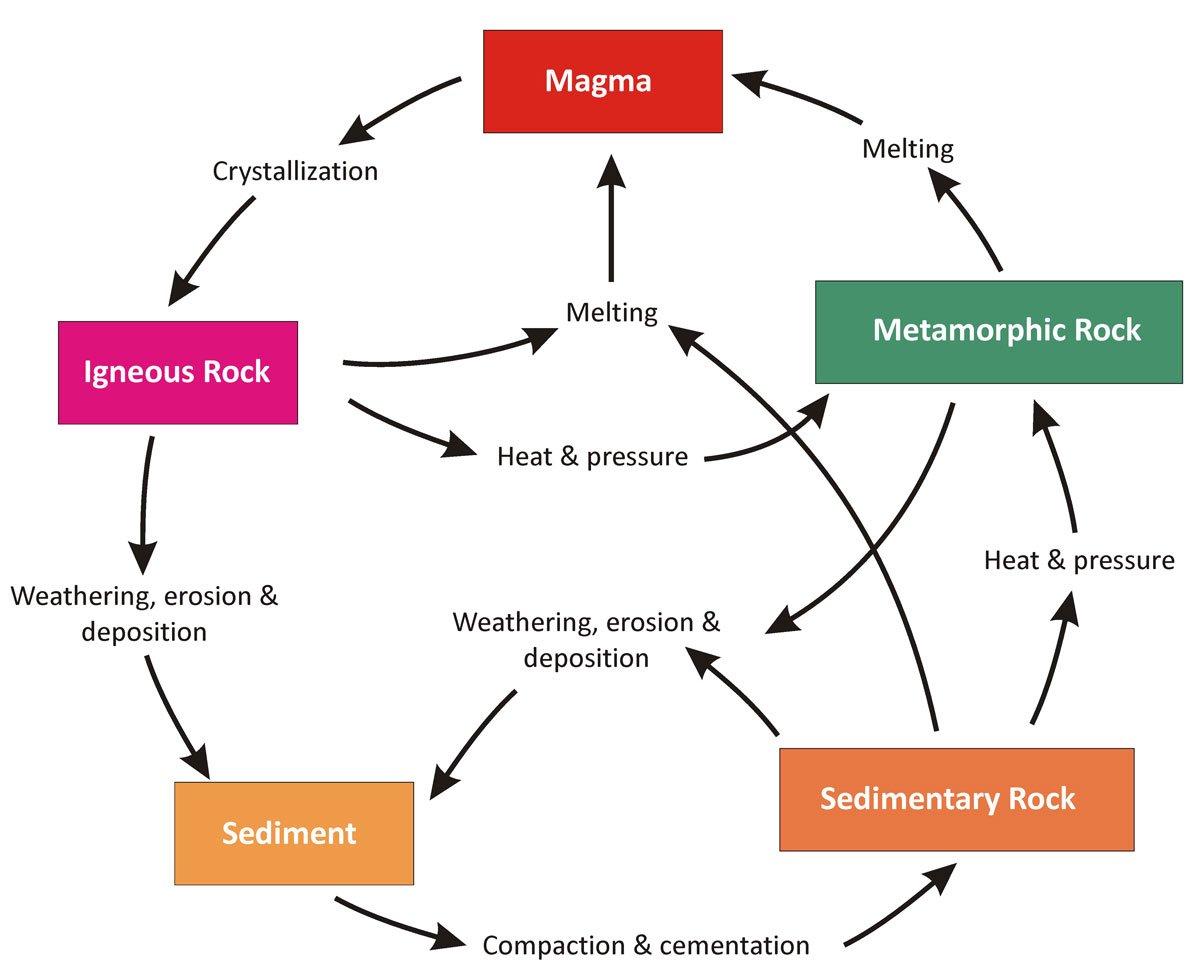
The rock cycle

a)

Has no beginning or end

b)

Involves rocks never changing

c)

Ends at the Igneous phase

d)

Ends at the metamorphic phase

56.

A fossil fuel that forms underground from partially decomposed plant material

a)

Obsidian

b)

Pumice

c)

Coal

d)

Sulfur

57.

Rocks are classified based on

a)

how they form

b)

where they are found

c)

how old they are

d)

none of the above

58.

Marble is a rock formed by heat and pressure. What type of rock is marble?

a)

Igneous

b)

Metamorphic

c)

Sedimentary

59.

A process in which something changes completely is

a)

Deposition

b)

Weathering

c)

Erosion

d)

Metamorphosis

60.

The type of rock known for layers and fossils.

a)

Igneous

b)

Sedimentary

c)

Metamorphic

61.

Obsidian forms when lava cools quickly on the surface, making a glass like rock. It is a(an)

a)

Intrusive Igneous

b)

Metamorphic

c)

Sedimentary

d)

Extrusive Igneous

62.

Granite is a type of rock that forms from magma cooling below earth's surface. What type of rock is it?

a)

Intrusive Igneous

b)

Sedimentary

c)

Metamorphic

d)

Extrusive Igneous

63.

The process that move sediment is

a)

Weathering

b)

Erosion

c)

Deposition

d)

Uplift

64.

One cause of metamorphism in rocks is:

a)

sedimentation

b)

pressure

c)

cold temperatures

d)

weathering

65.

Limestone often contains fossils. In which category would these rocks be classified?

a)

sedimentary

b)

igneous

c)

granite

d)

metamorphic

66.

What are the traits of a metamorphic rock?

a)

There are many layers of sediment in the rock.

b)

The rock is transformed by heat and pressure.

c)

The rock often has layer upon layer compacted together.

d)

Hot lava that cools can form this type of rock.

67.

Lava cools to form:

a)

sandstone

b)

metamorphic rock

c)

igneous rock

d)

sedimentary rock

68.

When comparing fossil A to fossil B, which is most likely correct?

a)

Fossil B is larger.

b)

Only fossil B was once an organism.

c)

Fossil B is older.

d)

Only fossil B is metamorphic.

69.

Which part of an organism is LEAST likely to be found in a fossil?

a)

Claw

b)

Teeth

c)

Bone

d)

Muscle

70.

Which layer is thicker than the outer core?

a)

Crust

b)

Mantle

c)

Outer Core

d)

Inner core

71.

Which of these can happen when rocks and soil in the Earth move suddenly?

a)

Landslides

b)

Tornadoes

c)

Blizzards

d)

Hurricanes

72.

Igneous Rock is formed after:

a)

Weathering

b)

Sediment

c)

Volcanic Eruption

d)

Magma

73.

Which of the following is NOT one of the three types of plate boundaries?

a)

divergent

b)

convergent

c)

sliding/transformation

d)

erosion

74.
Metamorphic rocks are foliated if their mineral grains are arranged randomly.
a)
true
b)
false
75.
The metamorphic rock __________ usually forms when limestone is subjected to heat and pressure deep beneath the surface.
a)
marble
b)
slate
c)
sandstone
76.
Marble is often used in sculpture because its even color allows it to be carved into complex and detailed shapes.
a)
true
b)
false
77.
Because the foliated metamorphic rock __________ splits easily into flat pieces, it is used for roofing material.
a)
marble
b)
slate
c)
sandstone
78.
Heat and pressure change the sedimentary rock shale into slate.
a)
true
b)
false
79.
Any rock formed when another rock is changed by heat or __________ is a metamorphic rock.
a)
pressure
b)
arrangement
80.
Metamorphic rock can form out of other metamorphic rock.
a)
true
b)
false
81.
Geologists classify metamorphic rocks according to the __________ of the grains making up the rocks.
a)
pressure
b)
arrangement
82.
The deeper a rock is buried in the crust, the greater the pressure on that rock.
a)
true
b)
false
83.
Quartzite forms when the quartz particles in __________ recrystallize.
a)
marble
b)
slate
c)
sandstone
84.

Term used to describe metamorphic rocks that have grains arranged in parallel layers or bands.

a)

exfoliated

b)

foliated

c)

nonfoliated

d)

unfoliated

85.

Which terms best describe igneous rocks?

a)

light and easily broken

b)

soft and smooth

c)

hard and dense

d)

soft and dense

86.

Magma that is low in silica usually forms light-colored rocks, such as granite.

a)

True

b)

False

87.

How do coarse-grained intrusive igneous rocks form?

a)

from sedimentary rocks changed under pressure

b)

from large rock particles cemented together

c)

from rapidly cooling lava

d)

from slow cooling magma

88.

Basalt is used for cobblestones and in landscaping.

a)

True

b)

False

89.

Which igneous rock is mixed with soil and used for starting vegetable seeds?

a)

perlite

b)

obsidian

c)

basalt

d)

granite

90.

Igneous rocks are classified by their origin, texture, and mineral composition.

a)

True

b)

False

91.

Which igneous rock is an extrusive rock?

a)

porphyry

b)

rhyolite

c)

pegmatite

d)

granite

92.

Extrusive rocks have larger grains than intrusive rocks.

a)

True

b)

False

93.

When all the grains in a rock are large and easy to see, the rock is described as

a)

Fine-grained

b)

Coarse-Grained

c)

Glassy

94.

An igneous rock commonly used as building material is

a)

Slate

b)

Sandstone

c)

Granite

95.

An igneous rock that is formed from lava is called an

a)

Extrusive

b)

Intrusive

96.

The slower magma cools, the smaller the mineral crystals form.

a)

True

b)

False

97.

Extremely rapid cooling of lava in which no crystals form, creates what type of texture?

a)

Fine-Grained

b)

Coarse-Grained

c)

Glassy

98.

High silica content in magma=

a)

Darker-colored rock

b)

Lighter-colored rock

99.

Low silica content in lava=

a)

Darker-colored rock

b)

Lighter-colored rock

100.

The non-metal which is liquid at room temperature is

a)

Mercury

b)

Bromine

c)

Chlorine

d)

sodium

101.

Name the metal which is the best conductor of electricity.

a)

copper

b)

silver


c)

gold

d)

none of these

102.

Name the metal which is used as a thermometric liquid

a)

mercury

b)

tin

c)

lead

d)

magnesium

103.

Metal that can be cut with a knife is 

a)

Sodium

b)

Iron 

c)

Gold

d)

calcium

104.

Which of the following is a non-metal.

a)

Iron

b)

Bromine

c)

Silver

d)

gold

105.

Which of the following is a metal.

a)

Carbon

b)

Hydrogen

c)

Gold

d)

nitrogen

106.

Name the metal which is brittle.

a)

iron

b)

copper

c)

zinc

d)

potassium

107.

Name the metal which is as precious as gold.

a)

platinum

b)

iron

c)

copper

d)

zinc

108.

Which of the following describes metals

a)

can not conduct heat and electricity and can be easily shaped.

b)

can conduct heat and electricity and can be easily shaped.

c)

they are in powder form.

d)

None of the above.

109.

Metals can be hammered into thin sheets. This property is called

a)

ductility

b)

sonority

c)

malleability

d)

strength

110.

Which of the following is the property of non metal?

a)

All are solids

b)

have lustre

c)

poor conductor of electricity

d)

sonorous

111.

Non metal which is hard

a)

Diamond

b)

graphite

c)

nitrogen

d)

phosphorus

112.

All metals are solids except

a)

Sodium

b)

Calcium

c)

Mercury

d)

Hydrogen.

113.

Metal used in galvanisation is

a)

sodium

b)

copper

c)

potassium

d)

zinc

114.

Brass is an alloy of

a)

copper and zinc

b)

copper and tin

c)

calcium and zinc

d)

mercury and zinc

115.
Which of these is a property of metals?
a)
It's malleable
b)
It can't conduct electricity
c)
They are used in food
d)
It's very brittle
116.

What is just so typical of NON-metals?

a)

They don't know what colours go well together.

b)

Malleable.

c)

Form acidic oxides.

d)

Good conductors of electricity.

e)

High melting points.

117.

A metal high in the reactivity series.....

a)

Forms unstable compounds.

b)

Can be obtained by the reduction of the ore with the carbon.

c)

Readily gains electrons.

d)

Burns to form basic oxides.

e)

Reacts readily with cold water to form Hydrogen.

118.

Which of the following is true of all metals?

a)

They react with acids to form Hydrogen

b)

They are denser than water

c)

They conduct electricity

d)

They're silver in colour.

119.

what temperature does mercury melt at ?

a)

1200 Celsius

b)

120 degrees Fahrenheit

c)

12 degrees Celsius

d)

room temperature

120.
Where are the non-metallic elements found in the periodic table?
a)
In the middle
b)
In the top rows
c)
On the left-hand side
d)
On the right-hand side
121.
A metal  which occur in free state
 
a)
gold 
b)
zinc 
c)
lead 
d)
calcium
122.
Metalloids _____________
a)
have no properties of metals.
b)
have no properties of nonmetals.
c)
have some properties of both metals and nonmetals.
d)
none of the above
123.
Which of these elements is unlikely to be found native?
a)
gold
b)
platinum
c)
aluminium
d)
silver
124.
What is a conductor?
a)
Heat and electricity move through them easily
b)
able to be drawn into a wire
c)
able to be hammered into different shapes
d)
shiny
125.
Where are metalloids located on the periodic table?
a)
to the right of nonmetals
b)
along the zig-zag line
c)
to the left of the zig-zag line
d)
to the right of the zig-zag line
126.
A student is examining the physical properties of a sample. The sample is malleable, but does not conduct electricity nor have luster. This sample would be a...
a)
metal 
b)
nonmetal 
c)
metalloid
127.
If a student observes a silvery solid that is malleable, good conductor, and ductile it is a...
a)
nonmetal 
b)
metal 
c)
metalloid
128.
Which type of elements are used in computer chips, lasers, and transistors?
a)
Metals
b)
Nonmetals
c)
Metalloids
d)
Metals and Metalloids
129.
When an object changes shape when struck by a hammer.
a)
luster
b)
malleable
c)
brittleness
d)
ductile
130.
Where is magma?
a)
inside 
b)
outside
131.
Intrusive Igneous rocks will be 
a)
coarse grain
b)
fine grain
132.
What is the most common Extrusive igneous rock?
a)
Granite
b)
Basalt
c)
Pumice
d)
Scorie
133.
If an Igneous rock is dark-colored, what is the amount of silica?
a)
high
b)
low
c)
doesn't matter
134.
What is one use of Granite?
a)
gravel
b)
weapons
c)
building materials
d)
skin abrasives
135.
Is Granite high or low in Silica?
a)
high
b)
low
136.
What do we call where Igneous rocks form?
a)
location
b)
destination
c)
origin
d)
spawn point
137.
What is the most common Intrusive Igneous rock?
a)
Basalt
b)
Gabbro
c)
Diorite
d)
Granite
138.
Why do we use Silica?
a)
clean countertops
b)
seasoning on food
c)
control humidity
d)
kind of like soap
139.
If a rock is formed from lava, what will the grains be?
a)
coarse
b)
fine
140.
High or Low Silica?
a)
high
b)
low
141.
Coarse or Fine?
a)
coarse
b)
fine
142.
How do Intrusive Igneous rocks cool?
a)
quickly
b)
slowly
c)
really fast
143.
How is Pumice used?
a)
countertops
b)
skin abrasive
c)
gravel
d)
weapons
144.
Where can we find Basalt?
a)
mountains
b)
valleys
c)
deserts
d)
ocean floor
145.
Coarse or Fine
a)
coarse
b)
fine
146.
What does Ignis mean?
a)
hot
b)
fire
c)
steam
d)
flame
147.
High or Low Silica?
a)
high
b)
low
148.
Where do we find Granite?
a)
ocean floor
b)
deserts
c)
mountains
d)
valleys
149.
Describe this rock
a)
Intrusive , High Silica
b)
Intrusive , Low Silica
c)
Extrusive , High Silica
d)
Intrusive , Low Silica