
 Worksheets
CambriLearn December Revision middle School
Total questions: 222
Worksheet time: 7hrs 24mins


Match the following.
Proton
Nucleus
Electron
Electron Cloud
Neutron
Nucleus
Match the following.
Proton
Positive (+)
Electron
Negative (-)
Neutron
Neutral (0)
Define atoms
A positively charged particle
the smallest particleof an element that keep theproperties of the element
A neutral particle.
A negatively charged Particle
Why is an electron important within the atom?
I'ts important because it tells you the identity of the atom
It's important becaue the atom repells other atoms.
Important becuase is exerts a strong force to balance the atom.
Important because it determines chemical reactivity
Why is the Proton important within the atom?
I'ts important because it tells you the identity of the atom
It's important becaue the atom repells other atoms.
Important becuase is exerts a strong force to balance the atom.
Important because it determines chemical reactivity
Never trust an atom because they make up
Nothing
Protons
everything
somethings
The atomic number on the periodic table can tell us. Use period table https://ptable.com/#Properties
# of electrons
# of protons and the identitiy of the atom.
# of neutrons
# or protons and neutrons.
Use the periodic table: If an atom have 12 protons what element is it. https://ptable.com/#Properties
Magnesium
Manganese
Carbon
Hydrogen
All atoms are nuetral means
Neutrons = protons
Protons = electrons
Neutrons = electrons
None of the above
Which one best desribes PURITY?
it is a substance that is made of the same and different types of atoms
it is a substance that is made of same and one type of atoms
it is a substance that is a mixture of same and different type of atoms
it is a substance that is chemically combined with different type of atoms
Gold is divided into 24 parts, with each single unit called a karat. The higher the karat, the purer the gold. How much is the concentration of gold in a 10 K neclace?
99.5 %
50 %
75 %
41.7 %
if 24 carat gold is considered as pure gold, what is the percentage or purity of the gold you received from your parents a christmass gift having 16 carat gold?
50 %
66 %
75 %
80 %
What is the purity of 24 carat gold?
25 %
50 %
75 %
100 %
What percentage of 9 carat gold is gold?
37.50 %
47.50 %
57.50 %
67.50 %
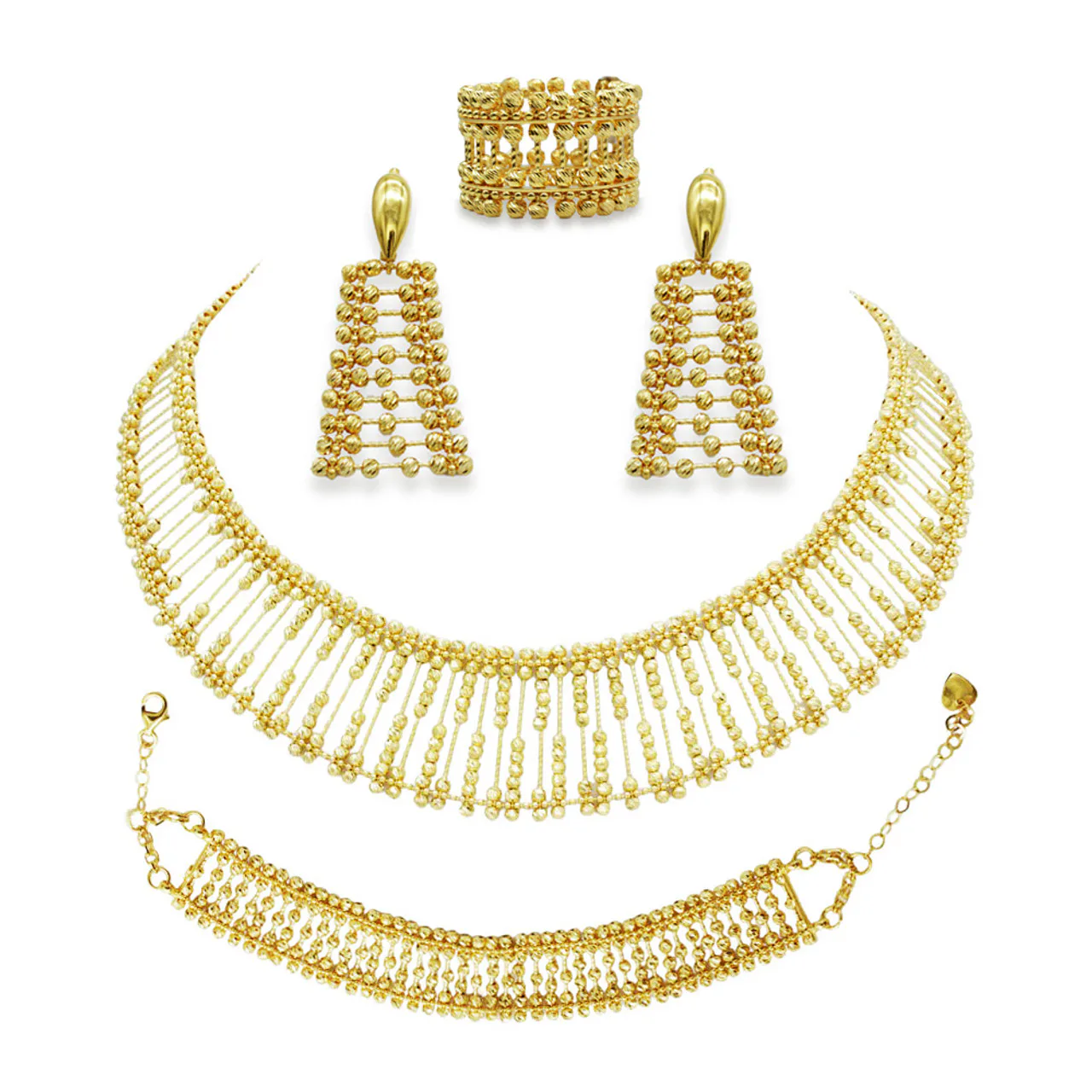
Gold is divided into 24 parts, with each single unit called a karat. The higher the karat, the purer the gold. How much is the concentration of gold in a 14 K neclace?
99.5 %
75 %
58.3 %
41.7 %
Gold is divided into 24 parts, with each single unit called a karat. The higher the karat, the purer the gold. How much is the concentration of gold in a 10 K neclace?
99.5 %
75 %
58.3 %
41.7 %
If a diamond has 1000 parts, it is said to be pure diamond. If the diamond is mixed with parts of other atoms, what is the concentration of a diamond if it has at least 700 parts?
50 %
70 %
90 %
100 %
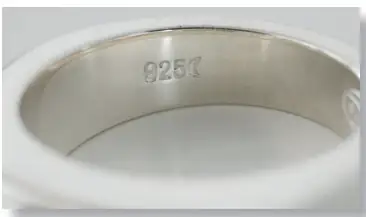
A silver is marked by its purity with the number of parts per thousand. So, the silver that is marked 925 has 92.5 % purity of silver and the rest is made of other metallic elements.
If you got yourself an 800 parts of a silver necklace, what is the concentration of the silver in your necklace?
20 %
40 %
60 %
80 %
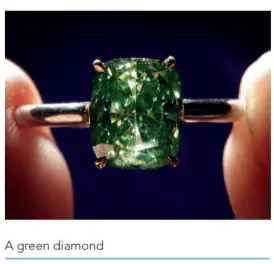
Which elements may cause a diamond to be green?
Select all that applies
carbon
nitrogen
nickel
hydrogen
Diamonds are made of______(1) atoms. When diamonds are coloured they have______of different______ mixed in with the carbon atoms. When they have______atoms the diamonds will be a blue colour. If diamonds have nitrogen atoms mixed with the carbon atoms, the diamond will be a______ colour. The______colour of diamond is green. Green diamonds have nitrogen, ______or hydrogen mixed in with the carbon atoms.

carbon

elements

boron

nickel
Diamonds are made of CARBON atoms. When diamonds are coloured they have ______(2) of different_____ mixed in with the carbon atoms. When they have______ atoms the diamonds will be a blue colour. If diamonds have nitrogen atoms mixed with the carbon atoms, the diamond will be a______ colour. The______ colour of diamond is green. Green diamonds have nitrogen, ______or hydrogen mixed in with the carbon atoms.
nickel
atoms
elements
boron
Diamonds are made of CARBON atoms. When diamonds are coloured they have ATOMS of different______(3) mixed in with the carbon atoms. When they have______ atoms the diamonds will be a blue colour. If diamonds have nitrogen atoms mixed with the carbon atoms, the diamond will be a______ colour. The______ colour of diamond is green. Green diamonds have nitrogen, ______or hydrogen mixed in with the carbon atoms.
elements
atoms
rarest
carbon
Diamonds are made of CARBON atoms. When diamonds are coloured they have ATOMS of different ELEMENTS mixed in with the carbon atoms. When they have______(4) atoms the diamonds will be a blue colour. If diamonds have nitrogen atoms mixed with the carbon atoms, the diamond will be a______ colour. The______ colour of diamond is green. Green diamonds have nitrogen, ______or hydrogen mixed in with the carbon atoms.
elements
atoms
boron
carbon
Diamonds are made of CARBON atoms. When diamonds are coloured they have ATOMS of different ELEMENTS mixed in with the carbon atoms. When they have BORON atoms the diamonds will be a blue colour. If diamonds have nitrogen atoms mixed with the carbon atoms, the diamond will be a______(5) colour. The______ colour of diamond is green. Green diamonds have nitrogen, ______or hydrogen mixed in with the carbon atoms.
green
blue
red
yellow
Diamonds are made of CARBON atoms. When diamonds are coloured they have ATOMS of different ELEMENTS mixed in with the carbon atoms. When they have BORON atoms the diamonds will be a blue colour. If diamonds have nitrogen atoms mixed with the carbon atoms, the diamond will be a YELLOW colour. The______(6) colour of diamond is green. Green diamonds have nitrogen, ______or hydrogen mixed in with the carbon atoms.
colourless
rarest
most common
famous
Diamonds are made of CARBON atoms. When diamonds are coloured they have ATOMS of different ELEMENTS mixed in with the carbon atoms. When they have BORON atoms the diamonds will be a blue colour. If diamonds have nitrogen atoms mixed with the carbon atoms, the diamond will be a YELLOW colour. The RAREST colour of diamond is green. Green diamonds have nitrogen, ______ (7)or hydrogen mixed in with the carbon atoms.
carbon
boron
hydrogen
nickel
When there is more than one product they are mixed up together, this means that the product produced is ______.
pured
compound
impured
atom
Some reactions would lead to impurity because it has two or more products during the reaction. Why do you think it is hard to produce pure product?
Select two correct responses.
because some different types of atoms of compounds are mixed up
atoms do not react each chemically
atoms are attracted to each other
because reactants are made up of two different compounds reacting together

The diagram shows a ray of light going from medium A into medium B. Which one of the following statements cannot be correct?
A is air and B is glass.
A is water and B is vacuum.
A is water and B is air.
A is glass and B is vacuum.

A ray of light is shone on a rectangular glass block as shown. Identify A, B and C.
A = Refracted ray, B = Incident ray, C = Normal
A = Incident ray, B = Refracted ray, C = Normal
A = Normal, B = Refracted ray, C = Incident ray
A = Refracted ray, B = Angle of incidence, C = Angle of refraction

When a drinking straw is placed in a container of water so that it is partly submerged, it appears bent because of
apparent depth
Snell's Law
Refraction
lateral inversion

The diagram shows a ray of light AB striking the interface of medium X and medium Y. BC is the refracted ray. Which one of the following statements is correct?
Medium X is optically less dense than Y and ray BC travels faster than AB.
Medium X is optically denser than Y and ray BC travels slower than AB.
Medium X is optically denser than Y and ray BC travels faster than AB.
Medium X is optically less dense than Y and ray BC travels slower than AB.
When light passes from one medium into another, refraction occurs. This is because of
reflection of light.
a change in color of the light.
a change in velocity of the light.
the absorption of light.
A light ray does not bend at a boundary between two media of different optical densities if its angle of incidence is
180o
45o
0o
90o
The quantity which does not changes during refraction is
direction
speed
frequency
wavelength
The ratio of sin (x °) of the angle of incidence to sin (x °) of the angle of refraction is
Gravitational law
Reflection law
Snell's law
refraction law
The best definition of refraction is ____.
passing through a boundary
changing direction when crossing a boundary
changing speed at a boundary
bouncing off a boundary
When light travels from air into water, the light bends ____________.
towards the normal line
away the normal line
perpendicular to the normal line
in an odd shape

What does the picture below illustrate?
Visible Light Spectrum
Electromagnetic Spectrum
Frequency Indicator
Color Line
What is the saying that can help you remember the order of the visible spectrum?
ROYGBIV
RYOBIVG
ROYBVIG
RIBYOVG
How are we able to see the color white?
All colors except red are absorbed
All colors are absorbed
All colors are reflected
All colors except red are reflected
What does reflection mean?
Bending Light
Bouncing Light
Of the visible spectrum, what color has the longest wavelength?
Blue
Green
Yellow
Red
Violet
What type of wave does a light wave resemble?
Transverse wave
Compressional wave
Light is a type of energy that travels as an ______________ ____________.
Longitudinal Wave
Electric Current
Electromagnetic Wave
Magnetic Wave
A prism can be used to...
separate visible light into colors
make a beam of light brighter
measure the speed of light
make UV light visible
What happens when light transitions into a new medium?
Reflection
Absorbing
Refraction
Mirror
A blue dish appears blue because it
absorbs blue light
absorbs white light
reflects white light
reflects blue light

What is this a picture of?
Reflection
Refraction
___________ is a form of energy that we can see with our eyes.
Radio Waves
Visible Light
Ultraviolet
Reflection
What is visible light used in?
Light Bulbs, TVs, Lasers
Nothing, Visible light cannot be used
Sound
When we Breathe
Is Visible Light Dangerous?
No, Visible light cannot harm you
Yes, visible light is highly radioactive and should be handled carefully. Visible light when in contact with human skin can cause aerial skin cancer.
No, this is because visible light isn't real
Yes, Visible light at high concentrations can cause burns, blindness, and indirect DNA damage but at low levels is harmless
What is the Corona? (BONUS)
The temperature of the sun
The outer most layer of the Sun's atmosphere
Another name for the Electromagnetic Spectrum
The measurement of the crests and troughs on a transverse wave
Found attached to bones throughout the body
smooth
cardiac
skeletal
all
Found in the heart
smooth
cardiac
skeletal
all
Found in the walls of hollow organs; also called visceral
smooth
cardiac
skeletal
all
Use to move materials through contractions
smooth
cardiac
skeletal
all


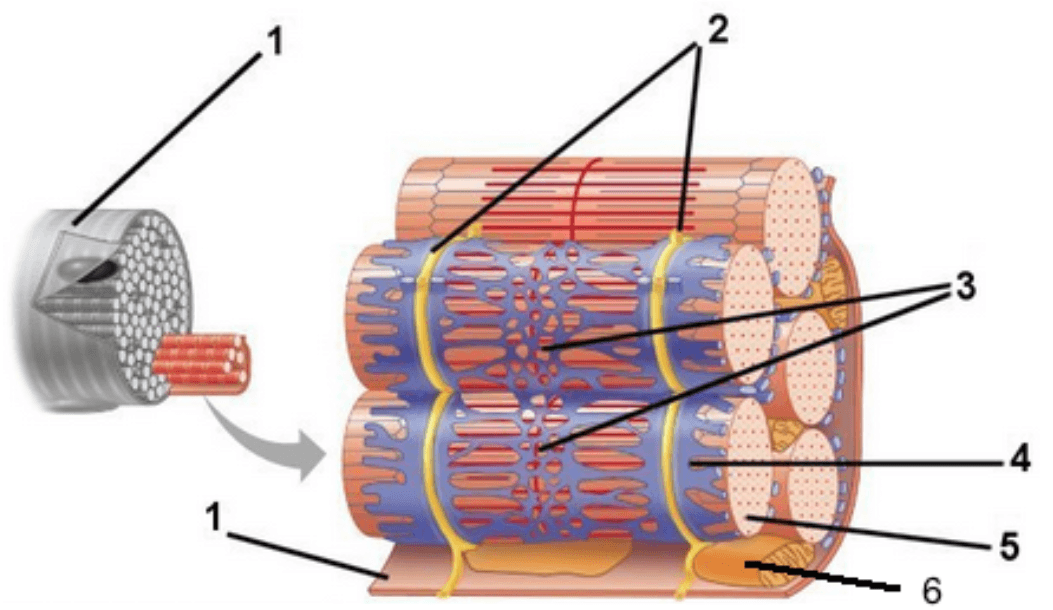
What is shown in the colored part of this diagram?
a whole muscle
five muscle fibers
five muscle fascicles
five myofibrils
What is labeled "4" (the blue/purple part) in the diagram?
sarcolemma
sarcoplasmic reticulum
transverse tubules
myofibril
Name the following in order from largest to smallest:
muscle, muscle fascicle, muscle cell, myofibril, filaments
muscle, muscle fascicle, muscle cell, filaments, myofibril
muscle, muscle cell, muscle fascicle, myofibril, filaments
muscle, muscle cell, muscle fascicle, filaments, myofibril
What is the length between Z-lines of an actin molecule called?
fascicle
sarcomere
myosin binding site
sarcoplasmic length
____________ attaches to actin to form the cross bridge.
Troponin
Tropomyosin
Myosin
Calcium

What muscle is the arrow pointing toward?
biceps
traps
pecs
triceps


What muscle is the arrow pointing to?
Pectoralis (Pecs)
Biceps
Triceps
Lats

What muscle is the arrow pointing to?
Biceps
Triceps
Lats
Quads


What connects muscles to bones?
cartilage
tendons
ligaments
flexors
What connects bone to bone?
Tendon
Ligament
Filament
Cartilage
Al(OH)3 --> Al2O3 + H2O
CUO + CO2 --> CuCO3
Ca + MgCl2 --> CaCl2 + Mg
_Bi + _O2 > _Bi2O3
Why must chemical equations be balanced?
So that the equation doesn't explode
The reaction won't happen until it is balanced
Based on the Law of Conservation of Matter, matter cannot be created or destroyed.
Based on the Law of Conservation of Energy, energy cannot be created or destroyed.e


2HI --> H2 + I2
What type of reaction is illustrated below?
Zn + H2S --> ZnS + H2
synthesis
decomposition
single replacement
double replacement
__HNO2 + __O2 --> __HNO3
__K + __Br2 --> __KBr
A + B > AB
What type of chemical reaction is this?
2Ca + O2 > 2CaO
What is the 2 located behind oxygen (O) called?
Al(OH)3 --> Al2O3 + H2O
CUO + CO2 --> CuCO3
Ca + MgCl2 --> CaCl2 + Mg
C2H2 + O2 --> CO2 + H2O


In a _______ a spinning turbine moves magnets which generates an electric current.
Motor
Generator
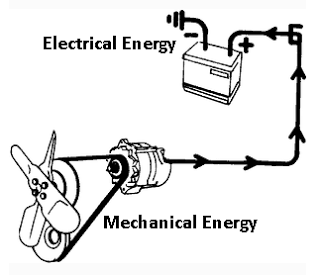
What is the transfer of energy in when you plug in a motor and it spins?
chemical to mechanical
electrical to mechanical
mechanical to electrical
physical to potential
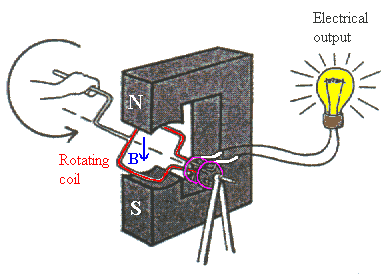
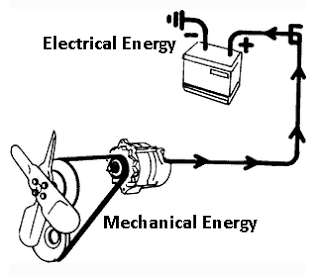
Process used by plants and other autotrophs to capture light energy and use it to power chemical reactions that convert carbon dioxide and water into oxygen and energy-rich carbohydrates such as sugars and starches
Photosynthesis
ATP synthase
Calvin Cycle
Photosystems
Organism that obtains food by consuming other living things; also called a consumer
Autotroph
Heterotroph
Chlorophyll
Stroma
Series of electron carrier proteins that shuttle high-energy electrons during ATP-generating reactions
NADP+
Light-independent
Light-dependent
Electron transport chains
Light-absorbing molecule used by plants to gather the sun's energy
Pigment
Chlorophyll
Stroma
Thylakoid
Saclike photosynthetic membranes found in chloroplasts
Stroma
Thylakoid
Pigments
Photosystems
Compound used by cells to store and release energy
ATP
ATP synthase
Stroma
NADP+
Light-independent reactions of photosynthesis in which energy from ATP and NADPH is used to build high-energy compounds such as sugar
Stroma
ATP synthase
Calvin Cycle
Electron Transport Chains
Cluster of proteins that span the cell membrane and allow hydrogen ions to pass through it
Photosystems
Calvin Cycle
Electron Transport Chain
ATP synthase
Principal pigment of plants and other photosynthetic organisms
Stroma
Chlorophyll
NADP+
ATP
Nicotinamide adenine dinucleotide phosphate; carrier molecule that transfers high-energy electrons from chlorophyll to other molecules
NADP+
ATP
ATP synthase
Calvin Cycle
Cluster of chlorophyll and proteins found in thylakoids
Photosystems
Stroma
Pigments
Electron transport chains
Fluid portion of the chloroplast; outside of the thylakoids
Chlorophyll
Stroma
ATP
NADP+
Set of reactions in photosynthesis that use energy from light to produce ATP and NADPH
Light-dependent
Light-independent
Calvin Cycle
Electron transport chains
Set of reactions in photosynthesis that do not require light; energy from ATP and NADPH is used to build high-energy compounds such as sugar; also called the Calvin Cycle
Light-dependent
Light-independent
Electron transport chain
ATP synthase
Organism that is able to capture energy from sunlight or chemicals and use it to produce its own food from inorganic compounds; also called a producer
Autotroph
Heterotroph
Thylakoid
Stroma
ATP is also known as
aldehyde triphosphate
arginine titraphosphate
adenine tetra phosphate
adenine triphosphate
An organism that can make its own food is known as a/an
heterotroph
autotroph
eukaryote
prokaryote
What is the formula for GLUCOSE?
C6H6O6
C12H6O12
C6H12O6
C12H12O12
Which statements is true about both ATP and Glucose?
ATP transfers energy and Glucose stores energy.
ATP and Glucose both store energy.
Which of the following is the correct BALANCED Equation for Photosynthesis?
Light + H2O + CO2 --> 6O2 + C6H12O6
6O2 + C6H12O6 --> Light + 6H2O + 6CO2
Light + 6O2 + C6H12O6 --> 6H2O + 6CO2
Light + 6H2O + 6CO2 --> 6O2 + C6H12O6
What organelle is the site of photosynthesis?
mitochondria
chloroplast
nucleus
central vacuole

What structure is #1 pointing to?
Granum
Thylakoid
Stroma
What are the molecules that absorb light for photosynthesis called?
NADPH
ATP
Chlorophyll
Chloroplast
Which molecule safely carries high energy electrons during Photosynthesis?
NADPH
ATP
Glucose
Phosphates
Which of the following pigments reflect orange light?
chlorophyll a
chlorophyll b
caretenoid
Carbon Dioxide is a gas produced by _ and used by _
plants and animals
photosynthesis and carbon dioxide
animals and plants
carbon dioxide and photosynthesis

If the plant population decreased, the amount of carbon would _________.
Stay the same
Increase
Decrease

Carbon can be found in...?
The atmosphere
Inside of the Earth
Fossil fuels
All of the above!

If there is a fire in a forest, there will be more _ in the environment?
nitrogen
oxygen
carbon dioxide

How is the burning of fossil fuels related to global warming?
Magic
Fuels are hot
Greenhouse effect
Photosynthesis
The circulation of the element Carbon among Earth's atmosphere, land, oceans, and organisms is called _____________.
the Carbon Cycle
the Oxygen Cycle
the Carbon dioxide Cycle
the Water Cycle

How do scientists collect evidence about climate?
using remote sensing from space with satellites
by ground-based measurements of surface temperatures, carbon dioxide concentration and sea level
by collecting “proxy data” from tree rings, ice cores, and historical records
all of the above

Which of the following have been linked to climate change?
droughts
flooding
melting of polar ice caps
all of the above


Climate change causes extreme weather conditions such as:
excessive heat
drought
extreme storms
all of these

Which food source would contribute to climate change the least?
Corn
Eggs
Pork
Beef

