wayground logo

Free Printable Worksheets

Font size

S
M
L
XL
Worksheets

Cellular Metabolism Test

Total questions: 65

Worksheet time: 49mins
Name
Class
Date
1.
A student is collecting the gas given off from a plant in bright sunlight at a temperature of 27°C. The gas being collected is probably ________.
a)
oxygen
b)
carbon dioxide
c)
ATP
d)
glucose
2.
If carbon dioxide is completely removed from a plant’s environment, what would you expect to happen to the plant’s production of high-energy sugars (rate of photosynthesis)?
a)
Sugar production will likely increase.
b)
Sugars will not be produced.
c)
The rate of sugar production will decrease .
d)
Fewer sugars will be produced at first, but then the plant will recover.
3.
The area that the substrate fits into on the enzyme is called the:
a)
Active Site
b)
Allosteric Site
c)
DiSulphide Bridge
d)
β-Pleated Sheet
4.
Most enzymes have the ending:
a)
-ase
b)
-ose
c)
-ic acid
d)
-ate
5.
The molecule an enzyme is working on is called the:
a)
Substrate
b)
Solvent
c)
Allosteric Inhibitor
d)
CoEnzyme
6.
When a molecule can occupy the same active site as the substrate, a situation called __________________ can result
a)
Competitive lnhibition
b)
Allosteric Regulation
c)
Non-Competitive Inhibition
d)
Feedback Inhibition
7.
The enzyme responsible for Carbon Fixation in C3 Photosynthesis is
a)
RuBisCo
b)
PEP Carboxylase
c)
Hexokinase
d)
Pyruvate DeHydrogenase
8.
Carbon fixation in CAM plants occurs during the:
a)
Day
b)
Night
9.
Which of the following molecules is not needed for the Calvin Cycle?
a)
CO2
b)
ATP
c)
NADPH
d)
H2O
10.
Which is not a product of the Calvin Cycle?
a)
ADP
b)
NADP+
c)
G3P
d)
FADH2
11.

Where do the dark reactions (Calvin cycle) take place?

a)

thylakoid membrane

b)

lumen

c)

stroma

12.
How many G3P molecules make one molecule of glucose? 
a)
1
b)
2
c)
3
d)
4
13.

What happens most of the G3P molecules in the last step of the dark reactions (Calvin cycle)?

a)

They are used to make glucose.

b)

They are reshuffled to make CO2 by adding ATP.

c)

They exit the cycle.

d)

They are reshuffled to make RuBP by adding ATP.

14.
Where do NADP+ and ADP produced in the Calvin cycle go? 
a)
Back to the light reactions
b)
out of the chloroplast
15.

Fermentation enables glycolysis to continue under

a)

anaerobic conditions.

b)

photosynthetic conditions.

c)

aerobic conditions.

d)

All of these

16.

The major atmospheric by-product of aerobic respiration is

a)

oxygen

b)

water

c)

carbon dioxide

d)

nitrogen

17.

The process of cellular respiration

a)

breaks down food molecules to release stored energy.

b)

occurs only in animals.

c)

occurs before plants are able to carry out photosynthesis.

d)

is performed only by organisms that can't do photosynthesis.

18.

Which type(s) of cells can perform cellular respiration?

a)

animal cells

b)

plant cells

c)

anaerobic prokaryotes

d)

fungal cells (like yeast)

e)

aerobic prokaryotes

19.

A cell that requires a large amount of energy would have larger numbers of ___.

a)

mitochondria

b)

cytoplasm

c)

chloroplasts

d)

Golgi

20.
When animals exercise with a lack of oxygen their muscles can form
a)
lactic acid
b)
alcohol
c)
minions
d)
oxygen
21.
Lactic acid fermentation occurs in your muscles after a workout because your cells are struggling to get
a)
Glucose
b)
Sunlight
c)
Oxygen
d)
Water
22.
In which way are photosynthesis and cellular respiration different?
a)
Cellular respiration stores ATP, while photosynthesis releases ATP.
b)
Cellular respiration produces oxygen, while photosynthesis uses oxygen.
c)
Photosynthesis releases energy, while cellular respiration stores energy.
d)
Photosynthesis used carbon dioxide, while cellular respiration produces carbon dioxide.
23.
If oxygen is not present what process will occur in yeast cells?
a)
Alcoholic fermentation
b)
Respiration
c)
Photosynthesis
d)
Lactic acid fermentation
24.
The purpose of cellular respiration is to 
a)
make water
b)
make ATP
c)
make glucose
d)
make  oxygen
25.
In cellular respiration, the electron transport chain takes place in
a)
the membrane of the mitochondrion
b)
the folds of the mitochondrion
c)
the cytoplasm
d)
the cell nucleus
26.
When glycolysis occurs,
a)
a molecule of glucose is split
b)
two pyruvate are made
c)
some ATP is produced
d)
all of these
27.

The end products of the citric acid cycle include all of the following except

a)

carbon dioxide

b)

pyruvate

c)

ATP

d)

NADH

28.

In the electron transport chain, electrons are passed from one electron transport molecule to another and are finally accepted by

a)

an oxygen molecule

b)

a molecule of carbon dioxide

c)

a molecule of water

d)

ADP

29.

How many ATP are produced in the Electron Transport Chain?

a)

2

b)

30

c)

32-34

d)

38

30.
What is a product of the Electron Transport Chain?
a)
CO2
b)
O2
c)
C6H1206
d)
H2O
31.

What is needed from the Citric Acid Cycle in order for the Electron Transport Chain to occur?

a)

ATP

b)

NADH & FADH2

c)

CO2

d)

H20

32.
In photosynthetic cells, synthesis of ATP by chemiosmosis occurs during
a)
photosynthesis only
b)
cellular respiration only
c)
both photosynthesis and cellular respiration
d)
photophosphorylation only
33.
What is the primary function of the Calvin cycle?
a)
regenerate ATP for use in the light reactions of photosynthesis
b)
produce carbon dioxide for use in the light reactions of photosynthesis
c)
produce oxygen by oxidizing water
d)
produce simple sugars from carbon dioxide
34.
Where do the enzymatic reactions of the Calvin cycle take place?
a)
stroma of the chloroplast
b)
thylakoid membranes
c)
matrix of the mitochondria
d)
thylakoid space
35.
Which of the following statements best represents the relationships between the light reactions and the Calvin cycle?
a)
The light reactions provide ATP and NADPH to the Calvin cycle, and the Calvin cycle returns ADP, ℗i, and NADP+ to the light reactions.
b)
The light reactions provide ATP and NADPH to the carbon fixation step of the Calvin cycle, and the Calvin cycle provides water and electrons to the light reactions.
c)
The light reactions supply the Calvin cycle with CO2 to produce sugars, and the Calvin cycle supplies the light reactions with sugars to produce ATP.
d)
The light reactions provide the Calvin cycle with oxygen for carbon fixation, and the Calvin cycle provides the light reactions with sugars to produce ATP.
36.
In chemiosmosis in mitochondria, protons flow from the intermembrane space into the matrix, whereas in chemiosmosis in chloroplasts, protons flow from
a)
stroma into the cytosol
b)
stroma to the thylakoid space
c)
thylakoid space to the stroma
d)
intermembrane space to the stroma
37.

Prior to the Kreb's Cycle, the 2 pyruvic acids must first be converted into what?

a)

2 NADH

b)

2 ATP

c)

2 RuBP

d)

2 Acetyl CoA

38.
The process of using electrons to pump H+ to create an electrochemical gradient that must flow through a protein is called:
a)
Chemiosmosis
b)
Fantasia
c)
Induced Fit
d)
Electrolysis
39.

Chemiosmosis occurs as H+ ions move through ____ in the cristae, making ATP.

a)

foldings

b)

ATP synthase

c)

protein channels

40.

By what principle does the electron transport chain work (why is it that electrons move from one part of the chain to another)?

a)

Reduction and oxidation

b)

Anabolism

c)

Diffusion

d)

Exocytosis

41.

When protons are pumped outside the matrix, across the inner membrane...

a)

water is made

b)

a concentration gradient of H+ ions (protons) is created

c)

NADH gets reduced

d)

CO2 is produced

42.
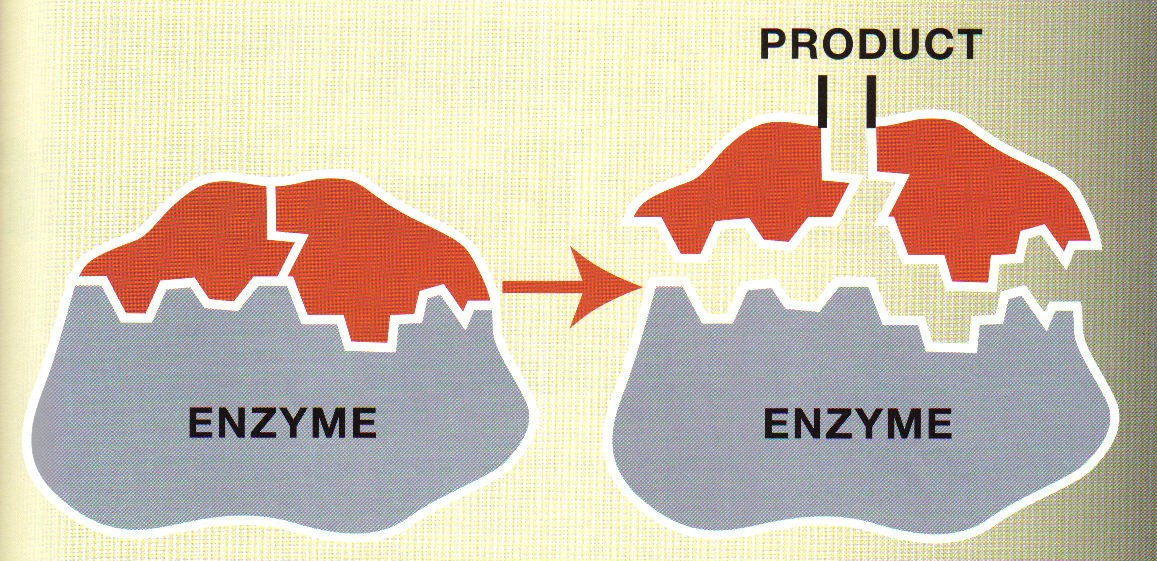
Which substrate would this enzyme catalyze?
a)
Δ
b)
σ
c)
d)
μ
43.
The "lock and key hypothesis" attempts to explain the mechanism of?
a)
Vacuole formation
b)
Pinocytosis
c)
Sharing of electrons
d)
Enzyme specificity 
44.
How do competitive inhibitors affect enzymes?
a)
It binds to the active site, blocking the substrate
b)
It changes the shape of the enzyme
c)
It increases the activation energy
d)
It decreases the activation energy
45.
What is the correct equation for cellular respiration?
a)
6O2 + C6H12O6 -> 6CO2 + 6H2O + Energy
b)
6O2 + C6H12O6 + Energy -> 6CO2 + 6H2O
c)
6CO2 + 6H2O -> 6O2 + C6H12O6 + Energy
d)
6CO2 + 6H2O + Energy -> 6O2 + C6H12O6
46.
 The diagram below shows the relationship between photosynthesis and cellular respiration and the organelles in which they occur. Which statement describes how photosynthesis and cellular respiration are interrelated?
a)
 Oxygen is produced during cellular respiration and stored during photosynthesis.
b)
Carbon dioxide and water released by cellular respiration are used in photosynthesis.
c)
Photosynthesis releases the energy that is stored during the process of cellular respiration.
d)
 Glucose is used during cellular respiration to produce food that is broken down during photosynthesis.
47.
 Mike has four aquatic plants of the same size and the same species. He submerges the plants in a separate beaker filled with 200 ml of water. She then sets each beaker under a different intensity of light. Mike observes that, of the four plants, the plant in the beaker under the most intense light gives off the most gas bubbles in a 20 minute period.Which of the following statements best explains Mike’s observations?
a)
Cells decompose most quickly under the most intense light.
b)
Water evaporates from plants faster under the most intense light.
c)
Photosynthesis occurs at the highest rate under the most intense light.
d)
Gases in the leaves of plants expand most under the most intense light
48.
Two different species of bacteria are examined. Scientists find that species X always produces CO2 and H2O during cellular respiration. Species Y always produces ethyl alcohol and CO2. Which conclusion can be made from these observations?
a)
 Only species Y is aerobic.
b)
 Only species Y is anaerobic.
c)
 Both species X and Y are aerobic.
d)
 Both species X and Y are anaerobic.
49.
A weightlifter is using heavy weights in short bursts for a competition. Because his muscle cells are not able to take in enough oxygen to make very much ATP the weightlifter begins to get fatigue in his muscles. Which of the following processes is most likely going on in the muscles of the weightlifter as he competes in his event?
a)
 As the cells run out of oxygen they switch to anaerobic respiration, which allows the cell to make small amounts of ATP in the absence of oxygen.
b)
As the cells run out of oxygen, they die off gradually and the weightlifter's muscles have fewer contracting muscle cells.
c)
The cells will never run out of oxygen if the weightlifter is breathing.
d)
As the cells run out of oxygen, they will continue to make the same amount of ATP, since oxygen is not required to make ATP.
50.

which of these processes takes place in the cytoplasm of a cell

a)

glycolysis

b)

electron transport

c)

Krebs cycle

d)

photosynthesis

51.

Most plants are green because chlorophyll:

a)

absorbs green light

b)

absorbs violet light

c)

does not absorb green light

d)

does not absorb violet light

52.

How does the carbon dioxide needed for photosynthesis enter the plant?

a)

through the stroma

b)

through the stomata

c)

it comes up through the roots of the plants

d)

through the thylakoid

53.

The role of water molecule in light dependent reaction is to

a)

Hydrolyse NADP+ at the end of the ETC

b)

Involve directly in the production of ATP

c)

Replace the excited electron of reaction centre molecule in photosystem II

d)

Involve directly in Calvin Cycle

54.

Which of the following plants fixes carbon dioxide at night?

a)

Sugarcane

b)

Cactus

c)

Oryza sativa

d)

Hibiscus rosa-sinensis

55.

Which of the following molecule below is fixed during light dependent reaction?

a)

Oxygen

b)

Carbon dioxide

c)

ATP

d)

NADPH

56.

How many carbon dioxide molecule must be added to RuBP to make a single molecule of glucose?

a)

3

b)

4

c)

5

d)

6

57.
The number of ATP molecules produced out of Krebs Cycle is:
a)
2
b)
3
c)
4
d)
0
58.
How many NADH molecules are produced by a molecule of glucose through the Krebs' Cycle?
a)
2
b)
3
c)
4
d)
6
59.

How many ATP produced for each NADH that enter the electron transport chain from Kreb's cycle? (Let's see how much you paid attention in class)

a)

1

b)

2

c)

3

d)

4

60.

If the ETC was blocked by cyanide what would happen?

a)

the mitochondrion would over heat

b)

excessive NAD+ would build up in the cells and blood

c)

oxygen levels would decrease

d)

NADH and FADH2 would be in high levels

61.

Which of the following is not true?

Cellular respiration...

a)

happens only in animals.

b)

results in 36-38 ATP.

c)

converts food to energy.

d)

consists of glycolysis, citric acid cycle, oxidative phosphorylation.

62.
Which is not part of the net products of Glycolysis?
a)
2 ATP
b)
2 NADH
c)
2 Pyruvate
d)
2 CO2
63.
What is the correct equation for cellular respiration?
a)
6O2 + C6H12O6 -> 6CO2 + 6H2O + Energy
b)
6O2 + C6H12O6 + Energy -> 6CO2 + 6H2O
c)
6CO2 + 6H2O -> 6O2 + C6H12O6 + Energy
d)
6CO2 + 6H2O + Energy -> 6O2 + C6H12O6
64.
What is the purpose of photosynthesis?
a)
make glucose
b)
make ATP
c)
make light
d)
release carbon dioxide
65.
After Krebs Cycle, how many Carbon atoms from the original glucose molecule remain?
a)
0
b)
1
c)
3
d)
2