
Font size
 Worksheets
Review for Grosstest y5
Total questions: 66
Worksheet time: 48mins

Auricle
What is #2?
Auricle
What is #3?
Auricle
Ear Drum
What is #4/5/10?
Auricle
Ossicles
What is #6?
Auricle
Semicircular Canals
Vestibulocochlear nerve
Cochlea
What is #9?
Eustachian Tube
Semicircular Canals
Vestibulocochlear nerve
Cochlea
What is #8?
Eustachian Tube
Semicircular Canals
Vestibulocochlear nerve
Cochlea
What is #12?
Eustachian Tube
Semicircular Canals
Vestibulocochlear nerve
Cochlea

Structure 4
Cornea
Lens
Pupil
Vitreous humor

Structure 1
Iris
Lens
Pupil
Sclera
Structure 2
Iris
Vitreous Body
Pupil
Cornea

Structure 5
Choriod Coat
Iris
Lens
Vitreous Humor
Structure 7
Iris
Retina
Lens
Vitreous Humor
Structure 10
Iris
Retina
Lens
Vitreous Body
Structure 9
Iris
Retina
Lens
Optic Nerve
Structure 3
Iris
Pupil
Anterior Chamber
Optic Nerve
Area where 3 is pointing
Iris
Pupil
Anterior Chamber
Optic Nerve
Cones are light sensitive cells in the retina that
Give you color vision
See black, white, and shades of grey
Rods are light sensitive cells in the retina that
Give you color vision
See black, white, and shades of grey
Part of the eye that gives its color is
retina
iris
cornea
optic nerve
Outer front part of the eye. Clear, protects the eye.
Cornea
Pupil
Iris
Sclera
Retina
Opening that allows light to enter the eye.
Cornea
Pupil
Iris
Sclera
Retina
Controls the amount of light entering the eye.
Cornea
Pupil
Iris
Sclera
Retina
White part of your eye.
Cornea
Pupil
Iris
Sclera
Retina
In the back of the eye, contains rods and cones.
Cornea
Pupil
Iris
Sclera
Retina
Liquid part of the eye.
Cornea
Pupil
Iris
Vitreous humor
Retina
Carries messages from the eye to the brain.
Optic Nerve
Pupil
Iris
Vitreous humor
Retina
What receptor reacts to pressure changes ?
Chemoreceptor
Mechanoreceptor
Nociceptors
Thermoreceptor
What receptor reacts to chemical changes (taste or smell)?
Chemoreceptor
Mechanoreceptor
Nociceptors
Thermoreceptor
What receptor reacts to temperature changes ?
Chemoreceptor
Mechanoreceptor
Nociceptors
Thermoreceptor
What receptor detects pain/itch?
Thermoreceptor
Mechanoreceptor
Photoreceptor
Nocioreceptor
What sensory receptor reacts to light?
Chemoreceptor
Nociceptor
Photoreceptor
Mechanoreceptor
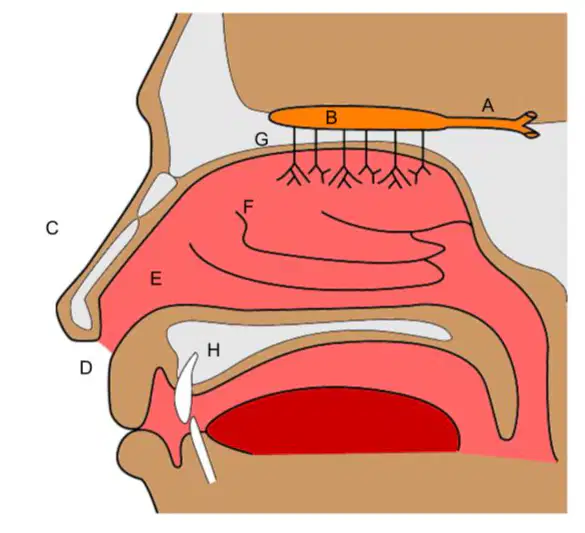
Olfactory Nerve
A
B
C
D
Olfactory Bulb
A
B
C
D
Olfactory Epithelium or receptors
A
B
F
G
Nose
H
B
C
G
Nostrils
H
B
D
G
Nasal Cavity
H
F
E
G
Nasal Conchae
H
F
E
G
Palate
H
F
E
G

Anything that causes you to react is called
sound
response
stimulus
memory
What is the correct order?
Sensory Input, Integration, Motor output
Sensory Input, Motor output, Integration
Integration, Sensory Input, Motor output
Motor output, Integration, Sensory Input,
The hard part of the skeleton of a vertebrate
Bone
Cartilage
Joint
Ligament
Marrow
Tough, flexible connective tissue
Bone
Cartilage
Joint
Ligament
Marrow
Places where two bones meet
Bone
Cartilage
Joint
Ligament
Marrow
Tissue that connects bone to bone
Bone
Cartilage
Joint
Ligament
Marrow
Tissue in the bone that makes blood cells
Bone
Cartilage
Joint
Ligament
Marrow
Which supports, provides a framework for, and protects the body?
Nervous System
Skeletal System
Muscular System
Digestive System
Which is important for both voluntary and involuntary movement of the body?
Nervous System
Skeletal System
Muscular System
Digestive System
Tendons connect
muscles to bone
bone to bone
muscles to ligaments
muscle to muscle
______________ can be found in the ears and nose as well as the cushioning at the end of bones.
Tendons
Smooth muscles
Marrow
Cartilage

Name the two bones of the FOREARM.
humerus and radius
ulna and humerus
radius and ulna
femur and tibia
Check ALL the organs that are involuntary muscles.
Heart
Lungs
Stomach
Intestines
Arm Muscle

