
 Worksheets
Diet Health digestive system Food test Diseases
Total questions: 100
Worksheet time: 5hrs 0mins
What is a balanced diet?
Consuming high amounts of sugar and processed foods
Skipping meals and fasting for long periods
A balanced diet includes a variety of foods that provide the right nutrients in the right amounts for optimal health.
Eating only one type of food
Which of the following is not a food group in a balanced diet?
Dairy products
Fruits and vegetables
Protein
Entertainment
What is the main function of teeth in the digestive system?
Chewing and grinding food
Storing food for later use
Protecting the throat from food particles
Producing saliva for digestion
Which part of the human digestive system is responsible for absorbing nutrients from food?
Large intestine
Esophagus
Small intestine
Stomach
What is the process of breaking down food into simpler substances called?
expansion
fusion
digestion
construction
Which food test is used to detect the presence of starch?
Vinegar test
Baking soda test
Salt test
Iodine test
Which food test is used to detect the presence of protein?
Benedict's test
Litmus test
Biuret test
Iodine test
Which food test is used to detect the presence of lipids (fats and oils)?
Sudan III test
Barfoed's test
Benedict's test
Molisch test
Which food test is used to detect the presence of reducing sugars?
Benedict's test
Barfoed's test
Biuret test
Iodine test
What is the function of the large intestine in the digestive system?
Breaking down food into nutrients
Absorbing water and electrolytes and storing waste
Producing digestive enzymes
Transporting nutrients to the body
What is the function of the stomach in the digestive system?
Storing food for later use
Producing saliva for digestion
Breaking down food into smaller particles and mixing it with digestive juices
Transporting nutrients to the body
Which food test is used to detect the presence of sugars?
Benedict's test
Emulsion test
Biuret test
Iodine test
What is the main function of the small intestine in the digestive system?
Breaking down food into nutrients
Absorbing water and electrolytes and storing waste
Producing digestive enzymes
Transporting nutrients to the body
What is the function of the pancreas in the digestive system?
Producing digestive enzymes
Breaking down food into nutrients
Storing food for later use
Transporting nutrients to the body
What is the main function of the liver in the digestive system?
Producing digestive enzymes
Breaking down food into nutrients
Storing food for later use
Detoxifying harmful substances and producing bile
Substances in food that your body needs to function are called
Health
Calcium
Unsaturated Fats
Nutrients
The main Nutrients names are:
Carbohydrates. Fish, Vitamins, Minerals and Water
Carbohydrates. Chicken. Fats. Vitamins, Minerals and Water
Grains. Protein. Fats. Vitamins, Minerals and Water
Carbohydrates. Protein. Fats. Vitamins, Minerals and Water

The liver produces a digestive enzyme that breaks down fats in the small intestine. What is this enzyme called?
mucus
hydrochloric acid
bile
saliva
What substance coats the inside of the stomach to protect it from its own acid?
mucus
hydrochloric acid
bile
saliva
Where does digestion begin?
mouth
esophagus
stomach
small intesine
Where does excess water get absorbed from undigested food?
esophagus
stomach
small intestine
large intestine

Amylase is an enzyme found in our saliva. Amylase changes starch into...
glucose
salt
iron
starch
enzymes present in the saliva breaksdown _________________?
starch
sugar
salt
none of the above
Peristalsis in the esophagial tissue means___________
digestion of food
a process of chewing the food
a series of defined muscular contractions, that propels the food into the stomach
none of the above
which part of the digestive organ that releases acids and enzyme rich juices that starts to dissolve the food and breakdown its proteins.
salivary gland
stomach
pancreas
none of the above
a yellowish green-liquid that digests fat is called___________?
bile
enzyme
saliva
none of the above
the absorption of molecules happens in the lower portion of the intestine which are coated in millions of tiny projections called ___________________
enzymes
villi
peristalsis
none of the above
What carries food from the pharynx to the stomach?
larynx
trachea
esophagus
bronchioles
What enzyme is found in saliva that starts digesting carbohydrates?
amylase
chyme
pepsin
bile
Where does the absorption of nutrients from food take place?
stomach
liver
small intestine
large intestine
What are the rhythmic muscular contractions of your esophagus called to help food move along?
swallowing
peristalsis
inertia contractions
paralysis
What is the purpose of the digestive system?
To exchange gasses in your body
to get rid of waste in the body
to break down food into nutrients the body can use
to break down food into oxygen
Nausea, heartburn, constipation, upset stomach and diarrhea are all
symptoms of digestive system problems or illness
always preventable
minor problems that should be ignored no matter how long they last
reasons to call 911
What is digestion?
The process of breaking down food into smaller components
The process of eliminating foods from the body
Eating various types of foods
Which of the following is the journey food takes?
mouth, throat, stomach, large intestines, small intestines
mouth, throat, stomach, small intestines, large intestines
mouth, esophagus, stomach, small intestines, large intestines
esophagus, mouth, stomach, small intestines, large intestines
Proteins are broken down into _______.
Fatty acids
Glycerol
Glucose
Amino acids
Large carbohydrates are chemically digested into smaller _____ molecules
proteins
amino acids
glucose
enzymes
The structure that keeps food from entering the trachea is called the _____________.
Salivary gland
Epiglottis
Pharynx
Esophagus
The chewed up food moves from the mouth to the stomach through the ___________.
esophagus
pancreas
liver
small intestine

The main function of the stomach is to:
Store food
Produce hydrochloric acid
Begin protein digestion
All the above
Which enzyme does the stomach produce?
amylase
lipase
maltase
pepsin
Which of the following kills bacteria in the human digestive system?
Hydrochloric acid
Mucus
Amylase
Pepsin
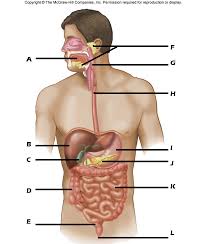
Which digestive organ is represented by the letter B?
Pancreas
Liver
Mouth
Small intestine
Which food is unsuitable for a person who cannot secrete enough bile?
butter
lean meat
spinach
rice
The majority of digestion occurs in the:
mouth
stomach
small intestine
large intestine
Where does protein digestion begin?
mouth
stomach
small intestine
large intestine


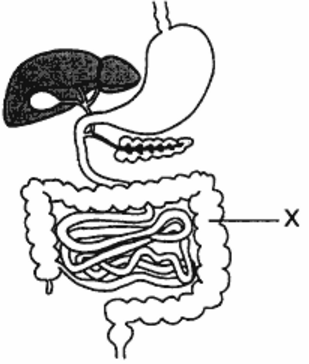
The diagram represents a portion of a human body. The principal function of structure X is to
produce amylase
produce pepsin
absorb water
absorb nutrients
3. A person who has had the gallbladder removed may be expected to have some difficulty in ____.
Absorbing minerals
Digesting Fats
Excreting Urea
Storing Glycogen
The sphincter between the stomach and the small intestine is the _____.
Epiglottis Sphincter
Pyloric Sphincter
Esophageal Sphincter
Cardiac Sphincter
One of the three basic food types: needed for building and repair of tissue in the body. Found in beef, egg whites, nuts, and beans.
Starch
Sugar
Fiber
Protein

Name the test to identify the presence of fat in food.
Grease spot test
Filter paper test
Iodine test
Benedict's test

The grease spot that is formed on the paper is ....................
transparent
translucent
transgender
translocation
Which of the following tests for starch?
Iodine
Benedict's
Biuret
Emulsion
Which of the following tests for protein?
Iodine
Benedicts
Biuret
Emulsion
When starch is present iodine turns...
purple
blue-black
orange
brick red
When protein is present Biuret turns...
purple
blue-black
orange
brick red
A negative test for starch will cause Iodine to stay...
straw coloured (orange yellow)
blue
black
brick red
A negative test for protein will cause Biuret to stay...
brick red
blue
black
orange
How do you test for lipids?
By using Ethanol and water
By using Benedicts solution
By using Iodine
By using Biuret test
What is a positive result for the lipid emulsion test?
cloudy white precipitate (milky white colour)
clear
yellow
green
The building blocks of proteins are
carbohydrates
amino acids
sugars
fatty acids
The building blocks of lipids are
Starches
Fatty acids and Glycerol
Sugars
Amino Acids
I am used to test for the presence of lipids (fats)
Benedict's Test
Biuret Test
Iodine Test
Ethanol Emulsion Test
I am used to test for the presence of protein
Benedict's Test
Biuret Test
Iodine Test
Ethanol Emulsion Test
What is the deficiency disease of proteins?
Anaemia
Kwashiokor
Scurvy
Night Blindness
Fibre helps with?
Scurvy
Vitamin C
Peristalsis
Constipation
Good source of fibre?
Nuts, pasta
Banana
Beans, lentils
Cake
Rickets symptoms?
Bent, soft bones
Cannot see in the darkness
Mental confusion and partial paralysis
Bleeding gums

Identify the disease and name the deficiency that causes it?
Kwashiorkar, caused due to deficiency of proteins
Kwashiorkar, caused due to deficiency of proteins and carbohydrates
Marasmus, caused due to deficiency of proteins
Marasmus, caused due to deficiency of proteins and carbohydrates
A lack of iron can cause __________. This causes tiredness and shortness of breath.
Kwashiorkor
Anemia
Scurvy
Rickets
The vitamin synthesized by human skin using sunlight is
A
E
K
D
Night blindness is caused by a lack of which food nutrient?
Vitamin A
Vitamin B
Calcium
Protein
A person lacking iodine may suffer from a deficiency disease called _______________________
Goiter
Kwashiorkor
Rickets
VKDB
A combination of which three nutrients can prevent Rickets?
calcium, nitrogen and water
calcium, phosphorus and vitamin D
Vitamin C, carbon and phosphorus
carbon, calcium and Vitamin K
If a patients blood does not clot, or takes unusually long to do so, that patient may be suffering from a _____________________ deficiency
iodine
vitamin C
calcium
vitamin K
If a patients blood does not clot, or takes unusually long to do so, that patient may be suffering from a _____________________ deficiency
iodine
vitamin C
calcium
vitamin K
Night blindness is caused by a lack of which food nutrient?
Vitamin A
Vitamin B
Calcium
Protein

