
 Worksheets
EOC Units 5-6
Total questions: 105
Worksheet time: 2hrs 34mins
Genetically modified food (or GM food) is food produced from plants or animals whose DNA has been altered through genetic engineering.
True
False

The process of asexually producing a cell, group of cells, or organism that is produced asexually from and is genetically identical to a single ancestor.
Genetic Modification
Genetic Engineering
Cloning
Bioremediation
The discipline dealing with what is good and bad and with moral duty and obligation.
Biotechnology
Ethics
Genetic Engineering
Bioremediation
Which of the following best describes a gene?
A section of DNA
A bundle of DNA
Every cell in your body has 23 pairs of genes
All of the genetic material in your cells
Which of the following best describes "genome"?
A section of DNA
A bundle of DNA
Every cell in your body has 23 pairs of genes
All of the genetic material in an organism
Besides the nucleus, which other organelle in your cell has DNA in it?
Mitochondria
Vacuole
Ribosomes
Lysosomes
SELECT ALL THAT APPLY: Which of the following best describes "stem cells?"
A cell without a job
A cell with a specific job in your body
A cell that can turn into ANY type of cell in your body
A cell that has procured a viral infection
Gene therapy is when:
A person's genes are edited
New genes are added to a person's genome
Bacterial DNA is incorporated into the human genome
Stem cells are used to cure a disease
Adaptations can be:
camouflage
ability to survive cold weather
hunting skills
all of the above
Natural selection occurs during the lifetime of a single organism.
True
False

What is most likely to happen to moth populations in the picture shown?
Light moths--hunted easily, dark moths--population increase
Dark moths--hunted easily, dark moths--population increase
Light moths--hunted easily, light moths--population increase
Lights moths will change their color to match dark moths.
TRUE or FALSE: Natural selection will still occur if individuals are exactly the same.
TRUE
FALSE
How do you "win" at natural selection?
survive
go extinct
survive & reproduce

Due to pollution, a pond becomes darker over time. Which trait variation became more common?
light fish
dark fish
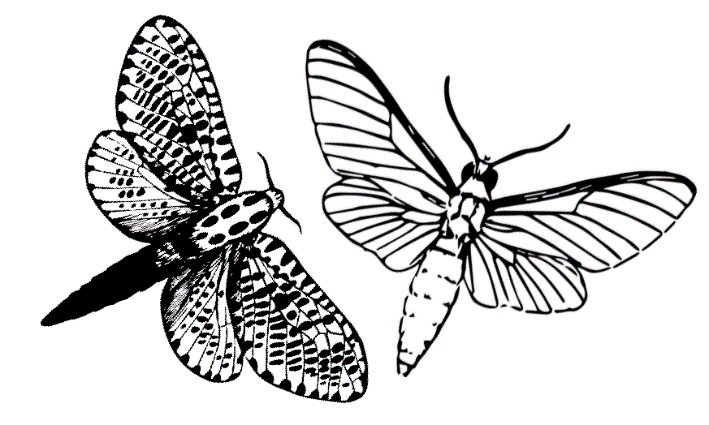
According to natural selection, light colored tree trunks would favor
light colored moths
dark colored moths
red colored moths
red and light colored moths
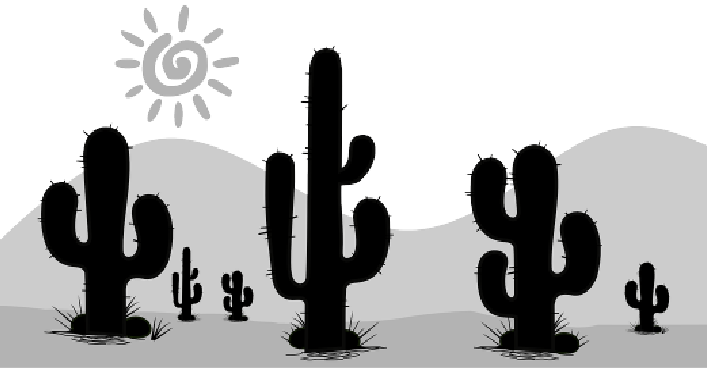
Natural Selection is driven by a change in the environment and survival of the
Earth
Fastest
Fittest
Biggest
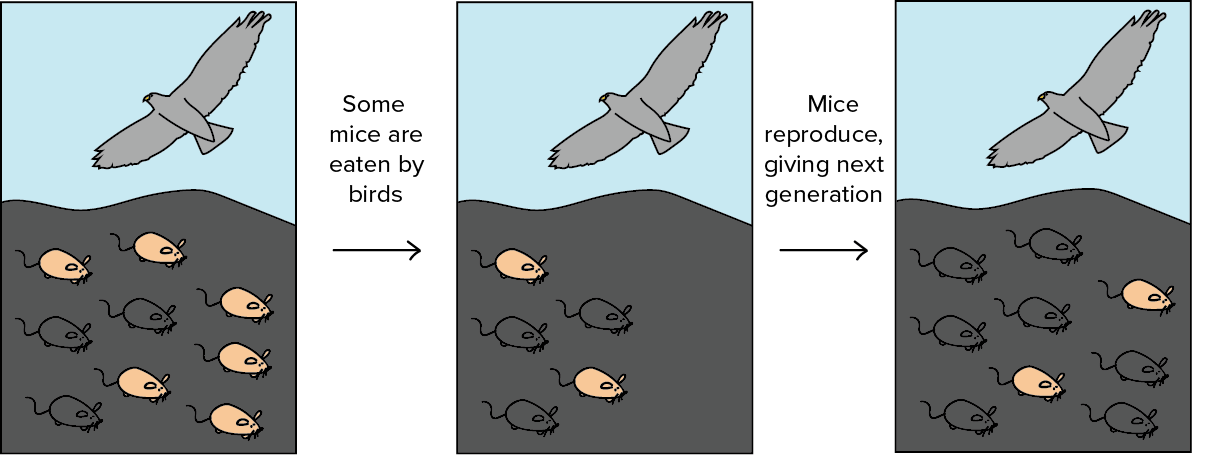


Adaptations that result from natural selection are expected to increase the fitness of an organism. In terms of natural selection, which of the following best describes fitness?
Being able to escape from predators
Being among the strongest organisms in a population
Being able to survive, find a mate, and produce offspring
Being able to survive long enough to reach the adult stage

Which statement is best supported by the observable structures of the different humerus bones?
The primates lived in similar environments.
The primates shared a common ancestor.
The primates interbreed with similar organisms in a population.
The primates had diets that consisted of similar types of foods.
Scientists use zebra fish to study human genetic diseases because zebra fish and humans share many of the same genetic diseases.
Which statement describes why zebra fish experience similar genetic diseases as humans?
Zebra fish have an omnivorous diet similar to that of humans.
Zebra fish have nucleotide sequences similar to those of humans.
Zebra fish go through embryonic stages similar to those of humans.
Zebra fish produce gametes through a process that is similar to that of humans.

The diagram below gives evidence to what principle of evolution?
Species that live in the same geographic region are more likely to be closely related.
Embryonic similarities indicate how some species develop in common ways.
Humans are anatomically more advanced than other species.
Bones structures are homologous among many different species.

The diagram above can be used as a model for:
cell division through mitosis
resemblances in embryonic development
DNA similarities between organisms
natural selection
Two organisms are closely related on an evolutionary tree. They should:
share the same predators and prey
have similar embryonic development
have no anatomical differences
have undergone the same genetic mutations

Which of the following are possible scenarios for this model?
I. A new predator migrates into an ecosystem and preys on lizards that are unable to camouflage.
II. A virus kills a number of organisms that do not have a specific genetic resistance.
III. A forest fire reduces the population of cedar trees in a particular region.
I and II only
I and III only
II and III only
I, II and III
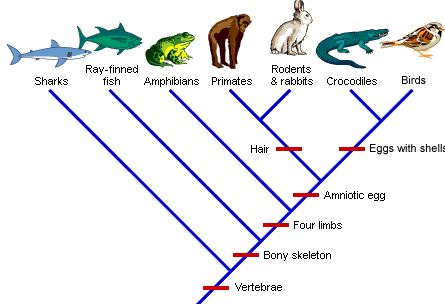
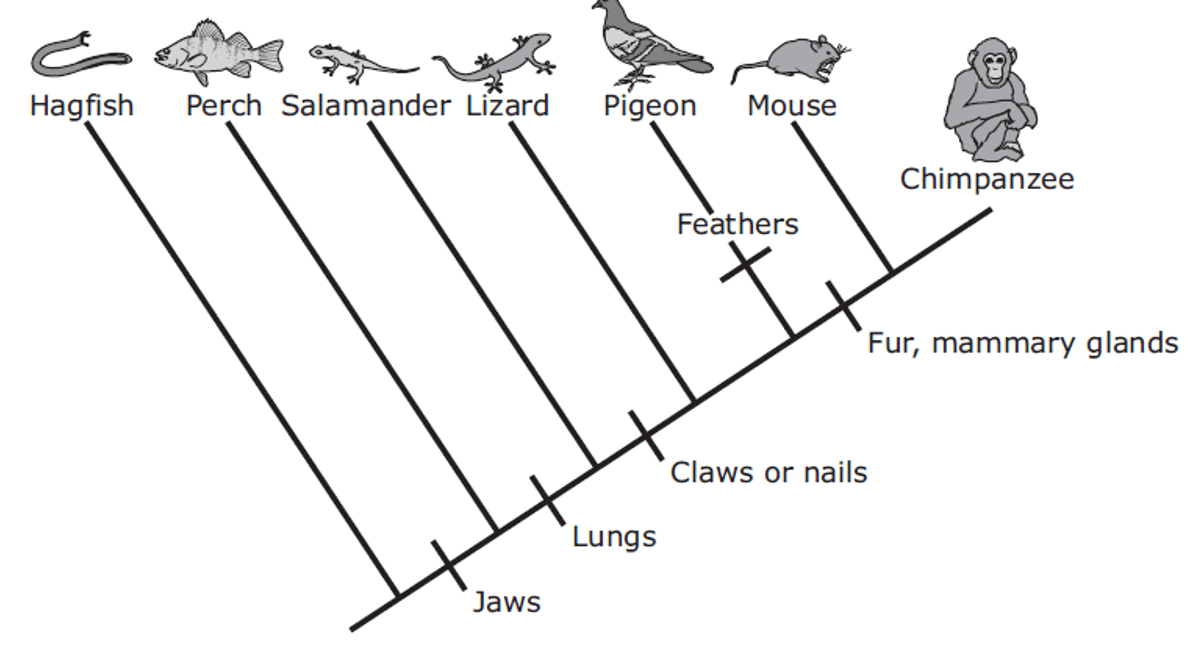
All the animals to the right of the salamander would have the common characteristic of...
Fur
Claws or nails
Lungs
Jaws
The arm of a human, the flipper of a whale, and the wing of a bat all have similar bone structures. Therefore, these parts of the body would all be considered...
homologous structures
vestigial structures
transitional fossils
common ancestors
The tail bone, wisdom teeth, and appendix are all parts of the human anatomy that would be considered...
homologous structures
vestigial structures
fossils
extinct
A bird's wing and a butterfly's wing have the same function, but they have very different structures. These structures are classified as follows:
homologous structures
analogous structures
vestigial structures
embryological homologues

Based on the number of differences in amino acid sequence, which pair of organisms is least related to each other?
Fruit fly-wheat
Human - wheat
Fruit fly- pigeon
Human-horse

In this example of natural selection, what environmental factor is acting as a selection force - or environmental pressure - on the giraffe?
Food is found on tree tops
Having a long neck
Being cursed with beauty
Having spots that act as camouflage
The study of embryological development provides anatomical evidence for evolution because...
all vertebrate embryos pass through the same stages of development in the same sequence.
all vertebrates are born with gills and a tail.
all vertebrate embryos have completely different stages of development that look nothing alike.
all plants and animals have wings, even if you can't see them when they are born.
Convergent evolution is when
Species share traits due to a common ancestor
Species have similar traits because of similar environment
Species have same traits due to different environments
If you have a dramatic change resulting in a new species in between long stretches of time with no change this would be
Gradualism
Swift speciation
Punctuated Equilibrium
Which of the following is an example of divergent evolution
homologous structures
analogous structures
Coevolution is the
Species looking similar due to a common ancestor
Species looking similar due to a common environment
evolution of two species that do not interact
evolution of one species in response to evolution in another species
If an animal evolves to be more camouflaged in an environment, and another animal evolves a better ability to sense movement. This would be
Divergent Evolution
Coevolution: predator Pray
Coevolution: mimicry

Which of the following are selection pressures in nature?
Selective breeding by humans
Available food
classification of organisms
Competition for mates
Hot, dry climate
Which of the following are examples of geographic isolation?
When a storm blows a population of finches to a new island so they can no longer mate with the finches on the mainland
A mountain range prevents two types of goat from mating, causing the gene pool to become less varied
Two populations of deer living near each other happen to mate during different times of the year
A deepening canyon cuts two populations of squirrels off from each other
Two populations of birds have developed different mating calls

What does the similarity of these structures tell us about these organisms?
They grow at different rates
they have a common ancestor
They evolved slowly
They do the same thing
The Endosymbiotic Theory explains
the origin of prokaryotes
how bacteria lives
the origin of eukaryotes
how species develop

Bacteria are an example of a ____ cell.
prokaryotic
eukaryotic
plant
animal
_____ and _____ are organelles that arose from endosymbiosis
nucleus and cell membrane
mitochondria and chloroplasts
cell wall and chloroplasts
mitochondria and nucleus
Which type of cell does NOT contain membrane-bound organelles?
plant cells
animal cells
prokaryotic cells
eukaryotic cells
Which of the following is evidence to support the endosymbiotic theory?
Mitochondria and chloroplasts have their own DNA, which is similar to prokaryotic DNA.
Fossil evidence shows that the first forms of life were prokaryotic cells.
All eukaryotic cells have a double-layered membrane composed of phosplipids and proteins.
Prokaryotes have the same number and types of enzymes as eukaryotes.
Thermophiles, Halophiles, and Methanogens all exist in extreme environments. What domain do these organisms belong to?
Eukarya
Archaea
Bacteria

Where is the alligator and T. rex's common ancestor?
Point A
Point B
Point C
Point D


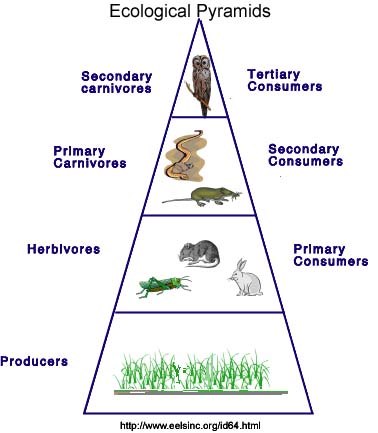
What amount of percentage does the energy decrease as it goes up the pyramid?
100%
1000%
10%
1%
Photosynthesis is important because...
it makes carbon dioxide
it makes food for the food webs
it makes water
it's not important
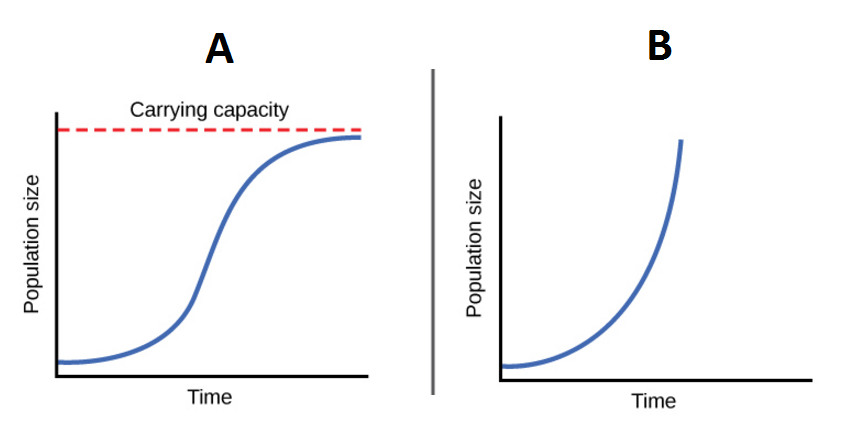
What type of growth model is shown in image B?
Exponential
Logistic
What type of growth model is shown in image A?
Exponential
Logistic

This graph shows ....
When one population increases, the other decreases.
When one population decreases, the other increases.
When one population increases, the other increases instantly.
When one population increases, it causes the other to increases shortly after.
Which of the following are density dependent factors?
competition for resources
predation
disease
natural disasters
Which of the following are examples of a density independent factors?
forest fire
seasonal cycles
storms
disease


In the energy pyramid here, how much of the energy in each level gets lost as heat?
80%
90%
10%
20%
What is the correct order of changes during primary succession?
Climax community, consumers, producers, pioneer species
Soil, producers, consumers, climax community
New rock, pioneer species, producers, consumers, climax community
What is the order that plants grow to repopulate the area in primary succession, such as a glacier receding or a volcano covering land with lava?
Lichens → Shrubs → Grasses → Trees
Lichens → tree → shrubs→Grasses
Grasses → Lichens → Shrubs → Trees
Lichens → Grasses → Shrubs → Trees
Which of these is an abiotic factor?
Competition between organisms for food
Seasonal variations in precipitation and temperature
Predators
Parasites that affects the host
Why is nitrogen limited when the atmosphere is 78% nitrogen?
It isn't limited
Not many organisms can fix nitrogen, which means turn it into a useful form
Nitrogen is so light that it floats above the rest of the gases in the atmosphere and most organisms can reach it
Cell membranes are semipermeable, which means that some things can go through the membrane, but some things cannot. If a membrane is permeable to iodine, but not permeable to starch, which molecules will move through the membrane
Only starch
Only iodine
Neither
Both
What would happen if an alien destroyed all the decomposers in an ecosystem?
The ecosystem would become more stable because there would be fewer organisms.
The ecosystem would become less stable because nutrients could not be recycled and returned to the soil
Nothing would change.

Using this picture, how is carbon dioxide removed from the atmosphere?
root respiration
factory emission
sunlight
photosynthesis

What is the usable form of nitrogen that plants need according to this diagram?
assimilation
nitrites
nitrates
ammonification
Why do plants need nitrogen?
to build proteins
to get energy
to photosynthesize
to transport water from roots to leaves

What process not pictured can be completed by symbiotic bacteria in bean plants and by lightning?
nitrification
nitrogen fixation
respiration
ammonification
Which organisms conduct nitrification?
animals
bacteria
plants
humans

What process will transfer carbon dioxide directly out of the food chain?
consumption
decomposition
photosynthesis
respiration
Which of the following processes does not return CO2 into the atmosphere?
Cellular respiration
Photosynthesis
Burning fossil fuels
Decomposition

This image represents the
Water Cycle
Carbon Cycle
Nitrogen Cycle
Phosphorous Cycle
The most important factor in converting nitrogen into usable forms during the nitrogen cycle is...
Animals
Plants
Bacteria
Decomposers
You can use the nitrogen in the atmosphere
True
False

Too much nitrogen and phosphorus from fertilizers can runoff into freshwater and....
be used to synthesize lipids.
be absorbed directly by phosphate rock.
be decomposed and returned to large bodies of water.
lead to algal blooms, which causes eutrophication
When water turns to vapor and rises into the atmosphere from the ocean, it is called
condensation
transpiration
evaporation
sublimation
How does most of the carbon in an organism's body return to the environment after the organism dies?
Decomposers break the body down into simpler compounds
Heat from the sun causes the carbon in the body to evaporate
Geological processes cause the body to turn into a fossil fuel
Rain water dissolves the carbon in the body and carries it to the ocean.

What is a keystone species?
A species that helps to hold an ecosystem together
A species that lives in or around rocks
Keys and stones have nothing to do with ecology
A keystone isn't a living thing, it's just a stone
Why are bees considered a keystone species?
The honey they make supports the bear population
They pollinate flowers that produce fruit which supports the ecosystem
They sting when threatened
They live in hives
Why are some sharks considered a keystone species?
Because they are a top predator
They scare off smaller fish that may overgraze an area of sea grass
They are tertiary consumers
They are cartilaginous

What is the carrying capacity of the graph?
1000
8000
800
600
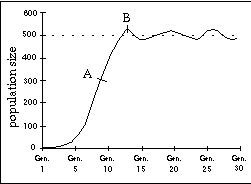
What is the carrying capacity of the graph?
around 500
more than 800
less than 300
around 700
What is the carrying capacity of the graph?
around 500
more than 800
less than 300
around 700
When the death rate rises and the birth rate lowers...
population increases
population decreases
population stays the same
all of these


