
 Worksheets
Chemistry Final Review
Total questions: 111
Worksheet time: 1hrs 1mins
Which of the following is most likely a covalent bond?
Na-I
N-H
O-O
Ca-O
Consider the following equilibrium:
HPO42-(aq) + H2O(l) ⇌ H2PO4-(aq) + OH-(aq)
Which of the following is correct?
The equilibrium lies predominantly to the left and Kc > 1
The equilibrium lies predominantly to the right and Kc < 1
The equilibrium lies predominantly to the right and Kc > 1
The equilibrium lies predominantly to the left and Kc < 1
The equilibrium lies predominantly to the right and Kc = 1
The pH of 0.200 M Sr(OH)2(aq) is ______________.
0.70
13.3
0.40
13.60
Kb for Sr(OH)2 is needed to calculate the pH

1. Given the following data for the reaction A --> B, determine the activation energy, Ea, of the reaction.
2.34 kJ/mol
19.4 kJ/mol
2.02 kJ/mol
38.2 kJ/mol
18.6 kJ/mol
The National Primary Drinking Water Regulations limit the concentration of lead in drinking water to 0.015 mg/L, which is __________.
0.015 ppb
15 ppm
150 ppb
1.5 ppb
15 ppb
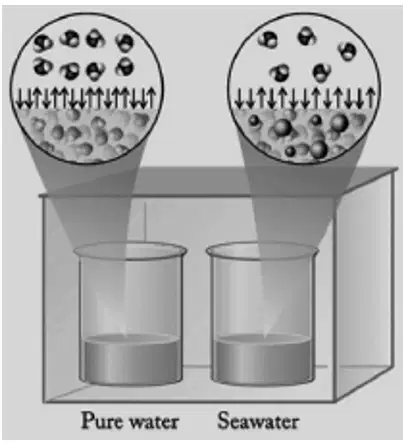
In the diagram below, one beaker contains pure water and the other contains an equal volume of seawater. Seawater has various salts dissolved in it. The beakers are sitting in a totally enclosed chamber, and the outside temperature and pressure are held constant. Identify the statements below about this situation that are not correct.
I. Water will be transferred from the pure water beaker to the seawater beaker.
II. Water will be transferred from the seawater beaker to the pure water beaker.
III. The vapor pressure of the pure water is higher than the vapor pressure of the seawater.
IV. Pure water evaporates at a faster rate than seawater.
V. Water in the gas phase condenses into both beakers at the same rate.
I
II
III
IV
V
Which of the following gases do you expect to be most soluble in water?
NH3
O2
CO2
Ar
N2
3. Which of the solutions shown here will have the lowest vapor pressure (highest boiling point)? White circles indicate solvent molecules; black circles indicate molecules of a nonvolatile solute.


4. The solubility of any gas in a liquid can always be increased by __________________
using a solvent that can form hydrogen bonds.
increasing the temperature.
decreasing the pressure of the gas above the solvent.
using a solvent that is nonpolar.
increasing the pressure of the gas above the solvent.
A solution contains 6.50 mol water, 0.300 mol sucrose, and 0.200 mol glucose. The solutes are nonvolatile. What is the vapor pressure of the solution at 35 °C given that the vapor pressure of water is 42.2 torr?
35.0 torr
36.0 torr
37.0 torr
39.2 torr
39.0 torr
2. A 15.0 mg sample of a protein was dissolved in water to produce 5.00 mL of solution at 25.1°C. The osmotic pressure of this solution was measured and found to be 6.50 torr. What is the molar mass of this protein?
427 g/mol
941 g/mol
8580 g/mol
4270 g/mol
561 g/mol
A 300 mg sample of compound Z (nonelectrolyte) was dissolved in 10.0 g of camphor (Kf = 39.7 °C/m), decreasing the freezing point of camphor by 3.07 °C. What is the molar mass of Z?
47.0 g/mol
194 g/mol
388 g/mol
94.0 g/mol
97.0 g/mol
4. A 1.35 m aqueous solution of compound X had a boiling point of 101.4 °C. Which one of the following could be compound X? The boiling point elevation constant for water is 0.52 °C/m.
CH3CH2OH
C6H12O6
Na3PO4
CaCl2
KCl
Indicate which aqueous solution has the fastest evaporation rate
0.1 M KCl
0.2 M Na2CO3
0.2 M NaCl
0.1 M MgCl2
0.2 M MgCl2
Which solution will have the lowest osmotic pressure when measured against pure water?
0.10 M sodium chloride
0.10 M sodium sulfate
0.10 M sodium sulfide
0.10 M sodium phosphate
0.10 M sodium carbonate
1. Which of the following statements regarding chemical kinetics is incorrect?
The rate of a chemical reaction typically decreases with time.
The instantaneous rate of a reaction can be obtained from the slope of a line tangent to a plot of concentration versus time
A reaction that is spontaneous will be a fast reaction.
Understanding a reaction mechanism allows us to facilitate a reaction.
The series of steps by which a reaction takes place is called a reaction mechanism
Which of the following statements regarding chemical kinetics is incorrect?
A spontaneous reaction may occur so slowly that no appreciable products are formed for months or years.
In order to be useful, a chemical reaction must occur at a reasonable rate.
The area of chemistry that studies reaction rates is called chemical kinetics.
One goal of the study of chemical kinetics is to understand the mechanism of a reaction
The rate of a reaction is defined as the difference between the initial and final concentrations of a reactant
In general, as activation energy increases, reaction rate _________________.
goes down if it is exothermic
goes down if it is exothermic
goes down regardless of whether the reaction is endothermic or exothermic
does not change regardless whether the reaction is endothermic or exothermic
none of the above
Of the following, _________ will lower the activation energy for a reaction.
increasing the concentrations of the reactants
increasing the concentrations of the products
adding a catalyst for the reaction
removing products as the reaction proceeds
increasing the pressure
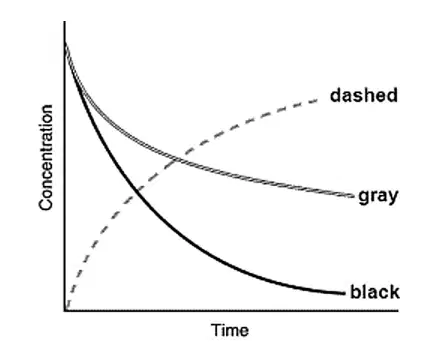
Using the formula:
N2(g) + 3H2(g) 2NH3(g).
Which curve is nitrogen?
dashed curve
gray curve
clack curve
black or gray
all of the above
2. For the reaction.
2A + 3B 4C + 5D
How is the rate of this reaction related to the rate at which the concentration of a reactant or product changes?
I. Rate = (-½)[A]/t II. Rate = -[B]/t
III. Rate = [C]/t IV. Rate = (1/5)[D]/t
I
II
III
IV
3. At a certain time in a reaction, substance A is disappearing at a rate of 4.0 × 10⁻² M/s, substance B is disappearing at a rate of 2.0 × 10⁻² M/s, and substance C is appearing at a rate of 6.0 × 10⁻² M/s. Which of the following could be the stoichiometry for the reaction being studied?
2A + B → 3C
A → 2B + 3C
2A → B + 3C
4A → 2B + 3C
A + 2B → 3C

4. A flask is charged with 0.124 mol of A and allowed to react to form B according to the reaction A(g) →B(g). The following data are obtained for [A] as the reaction proceeds:
The average rate of disappearance of A between 10 s and 20 s is ________ mol/s.
2.2 × 10⁻³
1.1 × 10⁻³
454
4.4 × 10⁻³
9.90 × 10⁻³
Which of the following must be true of an intermediate in a reaction mechanism? An intermediate is ________
I. produced by an elementary step
II. consumed in an elementary step
III. not included in the overall balanced reaction equation.
I only
II only
III only
all of the above

For a hypothetical reaction, the rate of the reaction in terms of the changes in the concentrations of the reactants and products is in the picture. The balanced equation is:
3C + 2D --> A + 2B
A + 1/2 B --> 1/3 C + 1/2 D
A + 3B --> 4C + 5D
A + 2B --> 3C + 2D
The rate law of the overall reaction:
3A + 2B + 5C → D
is:
Rate = k[A]2[C]
Which of the following is not correct?
Doubling [A] will increase the rate by a factor of 4
The unit of k is M-2.s-1
The reaction is zero order in [B]
The reaction is third order overall
Doubling the [B] will double the reaction rate
A proposed mechanism for the decomposition of ozone in the stratosphere is:
Step 1: Cl(g) + O3(g) --> ClO(g) + O2(g)
Step 2: ClO(g) + O3(g) --> Cl(g) + 2 O2(g)
What is the molecularity of step 2?
unimolecular
bimolecular
termolecular
zeromolecular
there is not enough info
Arrange the following bonds in order of increasing bond polarity. Start with the least polar bond.
A.) Mg-F
B.) F-F
C.) O-F
D.) Be-F
E.) K-F
F.) N-F
G.) I-I
G=B, C, F, D, A, E
G, B, C, F, D, A, E
A, E, D, F, C, B=G
A, E, D, F, C, B, G
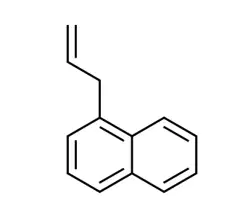
What is the molecular formula for the molecule below?
C13H28
C13H12
C13H52
C13H13
4ED has ____ hybridization
sp
sp2
sp3
sp3d
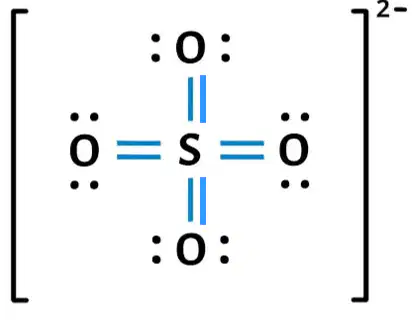
Consider the following Lewis structures for the sulfate (SO42-) ion. Which of these structures is the best one (i.e., has the greatest contribution toward the actual structure of the ion?

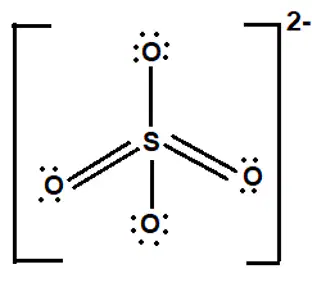
How many valance electrons are in the (PO43-) ion?
32
29
26
35
Is the (PO43-) ion polar or nonpolar?
polar
nonpolar
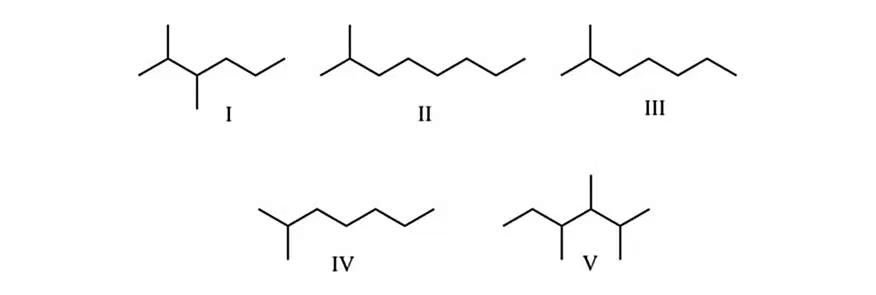
which of the following are structural isomers of n-octane (C8H18)?
I
II
III
IV
V

The name of the compound it:
1-chloro-6-bromohexane
1-chloro-8-bromooctane
1-chloro-7-bromoheptane
1-bromo-8-chlorooctane
1-bromo-6-chlorohexane
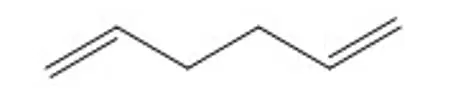
How many sigma bonds are present?
5
7
10
2
Arrange the following ionic compounds in order of increasing the lattice energy:
FeP, MgCl2, CsBr, SrCl2, NaF
CsBr < NaF < SrCl2 < MgCl2 < FeP
FeP < MgCl2 < SrCl2 < NaF < CsBr
MgCl2 < SrCl2 < CsBr < NaF < FeP
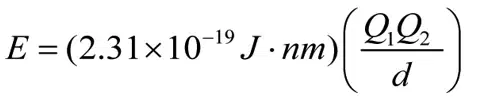
Determine the interaction (binding) energy of calcium oxide if the radius of the calcium ion is 146 pm and that of the oxide ion is 94 pm.
−3.85×10⁻¹⁸
3.85⋅10−18
−3.85⋅1018
Which of the following regarding LDF is not true?
At room temperature, F2 is a gas and I2 exists as a solid because I2 is more polarizable and has a stronger LDF
n-heptane has a stronger LDF than n-hexane
At room temperature, H2O(l) has a stronger LDF than H2S(g)
All hydrocarbons only have LDF
When mixed together, LDF is the only type of intermolecular forces that exist between H2O (l) and CCl4 (l)
Which of the following is not true?
NaCl has a higher bp than CH3-CH2-OH
Both CH3F and CH3-O-CH3 have H-bonding in them
The predominant attractive force between the particles in MgF2(s) is ion-dipole forces.
ICl (bp = 97 °C; molecular weight = 162 amu) has a higher boiling point than Br2 (bp = 59 °C; molecular weight = 160 amu) due to the dipole-dipole interactions in ICl that do not exist in Br2.
Ice is less dense than liquid water due to hydrogen bonding.
Which of the following pairs of compounds (liquids) is most likely to be immiscible?
H2O and CH3OH
C6H14 and C6H6
Br2 and CCl4
HF and CH3CH2OH
HF and CH3CH2OH
Which of the following has the highest rate of evaporation?
He
CH3CH2OH
C3H8
Br2
HOCH2OH
List the substances
Ar,Cl2,HCl(aq), CaBr2,CH3COOH
in order of increasing strength of intermolecular attraction forces. Start with the substance that has the weakest intermolecular forces
Ar < HCl < Cl2 < CH3COOH < CaBr2
Ar < Cl2 < HCl < CH3COOH < CaBr2
Ar < Cl2 < HCl < CaBr2 < CH3COOH
CaBr2 < CH3COOH < HCl < Cl2 < Ar
Cl2 < Ar < HCl < CH3COOH < CaBr2
What information about water is needed to calculate the enthalpy change for converting 1.0 mol H2O(s) at 0 °C H2O(g) at 100 °C?
heat of fusion
heat of vaporization
specific heat of H2O (g)
specific heat of H2O (l)
Which alcohol should be most soluble in hexane, C6H14?
CH3OH
CH3CH2CH2OH
CH3CH2CH2CH2OH
CH3CH2CH2CH2CH2OH
CH3CH2OH
Which of the following is not true?
The viscosity of a liquid decreases as the temperature increases
The surface tension of a liquid increases as the molecular weight of the liquid increases
The attractive force that holds NaCl(s) in the solid state operate only between adjacent Na+ and Cl- ions
The attractive force that holds NaCl(aq) in solution are LDF and ion-dipole forces
The boiling point of NaCl(s) is higher than that of NaCl(aq)

Based on the following table, answer the questions
_______ is most likely to have the strongest DDF.
HCl
Br2
HBr
HI
Ne
________ is likely to have the weakest DDF.
Br2
HI
HBr
HCl
______ is likely to have the strongest LDF
I2
Br2
I2
Ne
________ is likely to have the weakest LDF
HCl
Br2
Ne
I2
HI
Arrange the following in order of increasing boiling point. Start with the compound that has the lowest boiling point.
A) H2O
B) CO2
C) CH3OH
D) CH3-CH2-O-CH2-CH3
E) CH3-CH2-OH
A < E < C < D < B
B < D < C < E < A
A < B < C < D < E
A < B < C < E < D
ΔS is positive for the reaction ________.
2H2(g) + O2(g) → 2H2O(g)
2NO2(g) → N2O4(g)
CO2(g) → CO2(s)
BaF2(s) → Ba2+(aq) + 2F-(aq)
2Hg(l) + O2(g) → 2HgO(s)
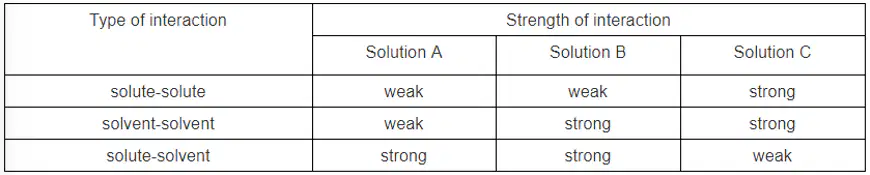
Rank the following solutions A, B, and C from the most exothermic to the most endothermic.
A, C, B
C, A, B
A, B, C
C, B, A
B, C, A
The dissolution of CH3OH in CCl4 is principally prevented by
London dispersion forces between CCl4 molecules
dipole-dipole attraction between CCl4 molecules
ion-dipole attraction between CH3OH and CCl4 molecules
repulsion between like-charged CH3OH and CCl4 molecules
hydrogen bonding between CH3OH molecules
The solubility of a compound is determined by
solute–solvent interactions
solute–solute interactions
solvent–solvent interactions
ΔS
all of the above
A supersaturated solution ________.
is one with more than one solute
is one that has been heated
must be in contact with undissolved solid
exists only in theory and cannot actually be prepared
is one with a higher solute concentration than the solubility
Which one of the following is most soluble in C6H6?
CH3OH
CH3CH2CH2CH2CH2OH
CH3CH2CH2OH
CH3CH2OH
CH3CH2CH2CH2OH
A solution contains 20% by mass of potassium nitrate. This means that _____________.
there are 20 g of potassium nitrate in 1.0 mL of this solution
100 mL of the solution contains 20 g of potassium nitrate
100 mL of the solution contains 20 g of potassium nitrate
100 mL of the solution contains 20 g of potassium nitrate
100 mL of the solution contains 20 g of potassium nitrate
The solubility of nitrogen gas (N2) in water at 25 °C and a nitrogen pressure of 0.80 atm is 5.5 × 10⁻⁴ M. The solubility of nitrogen in water at a nitrogen pressure of 1.00 atm is __________ M.
5.5 × 10⁻⁴
8.6 × 10⁻⁴
1.2 × 10³
6.9 × 10⁻⁴
0.80
Calculate the molality of a 17.5% (by mass) aqueous solution of nitric acid (MM = 63.01 g/mol).
0.274 m
3.04 m
3.37 m
4.33 m
density is needed to solve the problem
A solution is prepared by dissolving aluminum sulfate, Al2(SO4)3, in water and diluting to 500.0 mL. If this solution contains 48 ppm sulfate ions, the concentration of aluminum ions is _____________ ppm.
16
32
48
64
96
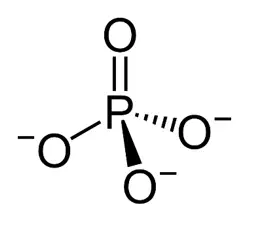
What is the molecular geometry of the ion?
tetrahedral
square planar
square pyramidal
bent
If there are 3ED, the angle measurement is ____.
180
120
109.5
90
63Ni decays by a first-order process via the emission of a beta particle. The 63Ni isotope has a half-life of 100. years. How long will it take for 67% of the nickel to undergo decay?
58 years
160 years
77 years
69 years
25 years

What is the predicted rate law for the following mechanism for the reduction of nitrogen in NO by hydrogen?
Rate = k[H2][NO]2
Rate = k[H2][NO]
Rate = k[H2]2[NO]2
Rate = k[H2]2[NO]2[N2O]2
Rate = k[H2]2[NO]
A first-order reaction is 45% complete at the end of 31 minutes. What is the length of the half-life of this reaction?
27 min
45 min
36 min
1.9 hr
59 min

The steps in a reaction mechanism are as follows. Which species is acting as a catalyst? Which is acting as an intermediate?
Ag+ and Ag2+ are catalysts while Tl2+ is an intermediate
Ag+ and Ag2+ are catalysts while Tl2+ is an intermediate
Tl+ is a catalyst while Ag2+ and Tl2+ are intermediates
Ag+ is a catalyst while Ag2+ and Tl2+are intermediates
Ag2+ is a catalyst while Tl2+is an intermediate
2NOB(g) → 2NO(g) + Br2(g)
is a second-order reaction with a rate constant of 0.80 M-1s-1 at 11 °C. If the initial concentration of NOBr is 0.0440 M, the concentration of NOBr after 6.0 seconds is ________.
0.0276 M
0.0324 M
0.0363 M
0.0348 M
0.0402

Nitric oxide and nitrogen dioxide are found in photochemical smog. Nitrogen dioxide is formed from nitrogen monoxide in the exhaust of automobile engines. A possible mechanism for this reaction is given below. What is the rate law predicted by the mechanism?
Reaction: 2NO(g) + O2(g) --> 2NO2(g)
Rate = k[NO]2[O2]
Rate = k[NO]2
Rate = k[NO][O2]
Rate = k[NO][O]
Rate= [NO2]2/[NO]2[O2]
Which of the following is true for a chemical reaction at equilibrium?
only the forward reaction stops
only the reverse reaction stops
both the forward and reverse reactions stop
the rate constants for the forward and reverse reactions are equal
the rates of the forward and reverse reactions are equal
Which of the following is true for a chemical reaction at equilibrium regarding the concentration of products?
They will not change because there are no more reactants
They will not change because the limiting reagent is gone
They will not change because this is a constant for each reaction
They will not change because the forward reaction and reverse rates are equal
They will change continually because of reversibility
1. A chemical equilibrium
2A(aq) ⇌ B(aq)
has a forward rate constant, kf = 10. M –1 s–1, and a reverse rate constant, kr = 5.0 s–1. If the system has a concentration of [A] = 0.10 M at equilibrium, what must be the concentration of B at equilibrium?
20.0 M
2.0 M
0.20 M
0.020 M
200 M
For the hypothetical reaction:
2A(aq) + 3B(g) + C(s) ⇌ 2D(l) + E(aq) + 3F(aq)
Which of the following mixtures, if placed in a reaction vessel, would not reach equilibrium?
A, B, C, D
B, C, E, F
C, B, A, F
D, E, A, B, C
All of the mixtures will reach equilibrium

For the following hypothetical equilibrium, what is the value of the equilibrium constant (Kc) if the concentrations at equilibrium are as shown?
0.22
4. 3 × 10⁵
2.3 × 10⁸
9.5 × 10³
9.9

The equilibrium constant (Kc) for the formation of hydrogen iodide from hydrogen and iodine is 45.0 at a certain temperature.
Which of the following is true regarding this equilibrium?
I. The reaction is product-favored.
II. The reaction is reactant-favored.
III. Equilibrium lies to the right.
IV. Equilibrium lies to the left
I
II
III
IV
None are true

Find the equilibrium constant if K is 10.
0.010
0.10
0.20
10
20

Given the following reaction at equilibrium, if Kc = 5.84 × 10⁵ at 230.0 °C, Kp = ________.
3.67 × 10⁻²
1.41 × 10⁻⁴
6.44 × 10⁵
2.40 × 10⁶
2.41 × 10⁷

Given the equilibrium constants for the following two reactions in aqueous solution at 25 ℃, what is the value of Kc for the reaction?
5.4 × 10⁻³
8.2 × 10⁵
4.1 × 10⁵
4.9 × 10⁻¹³
1.8 × 10²
Two students measured an equilibrium constant for the same chemical reaction. Ken obtained a value of 130 for the equilibrium constant, but Barbie obtained a value of 11.4. The instructor checked their results and said they were both correct. How can that be?
The values vary according to the way the measurement is made. Ken must have measured product concentrations, while Barbie measured reactant concentrations.
The values vary according to the starting conditions of the reaction prior to equilibrium. Ken must have started with all reactants, while Barbie must have started with all products.
The values vary according to the stoichiometric coefficients that are used. The balancing coefficients that Ken used must have been twice those that Barbie used.
The values vary according to direction of the reaction. Ken must have used the reverse reaction.
The instructor must have made a mistake, because the equilibrium constant for a reaction must always be the same.
Which of the following occurs when products are removed from a chemical reaction in solution or the gas phase at equilibrium?
Q increases and the equilibrium shifts to produce more products
Q increases and the equilibrium shifts to produce more reactants
Q decreases and the equilibrium shifts to produce more products
Q decreases and the equilibrium shifts to produce more reactants
Q is unchanged by the removal of products

In a particular experiment, the partial pressures of H2 and I2 at equilibrium are 0.678 and 0.788 atm, respectively. The partial pressure of HI is ________ atm.
7.87
27.0
5.19
0.103
0.01066
Addition of reactants to a chemical reaction in solution or gas phase at equilibrium results in ___________________________________
an increase in K and a shift in equilibrium to produce more products
a decrease in K and a shift in equilibrium to produce more products
an increase in K and a shift in equilibrium to produce more reactants
a decrease in K and a shift in equilibrium to produce more reactants
no change in K and a shift in equilibrium to produce more products

The water gas shift reaction shown below can be used to produce hydrogen from water and coal. Given the data in the following table, which experiment will proceed in the forward direction to produce more hydrogen? Under the experimental conditions, Kc = 25 for this reaction.
I
II
III
IV

Nitrosyl bromide decomposes according to the equation. A sample of NOBr (0.64 mol) was placed in a 1.00-L flask containing no NO or Br2 . At equilibrium, the flask contained 0.16 mol of NOBr. How many moles of NO and Br2, respectively, are in the flask at equilibrium?
0.48, 0.24
0.48, 0.48
0.16, 0.08
0.16, 0.16
0.24, 0.42

Dinitrogentetraoxide partially decomposes according to the equilibrium. A 1.00-L flask is charged with 0.0400 mol of N2O4. At equilibrium at 373 K, 0.0055 mol of N2O4 remains. Keq for this reaction is ________.
2.2 × 10⁻⁴
13
0.22
0.022
0.87

The gaseous compound BrCl decomposes at high temperature in a sealed container.
0.040
0.030
0.50
33
2.0
Of the following equilibria, only ________ will shift to the left in response to a decrease in volume.
H2(g) + Cl2(g) ⇌ 2HCl(g)
2SO3 (g) ⇌ 2SO2(g) + O2(g)
N2(g) + 3H2(g) ⇌ 2NH3(g)
4Fe(s) + 3O2(g) ⇌ 2Fe2O3(s)
Solid mercury(II) oxide decomposes when heated to produce liquid mercury and oxygen.
2HgO(s) ⇌ 2Hg(l) + O2(g)
An amount of mercury(II) oxide is placed in a vessel at a particular temperature and allowed to reach equilibrium. How could the amount of liquid mercury in the vessel be increased?
I. Adding more mercury(II) oxide.
II. Removing some oxygen.
III. Increasing the volume of the vessel.
I
II
III
all of the above
Consider the following aqueous reaction:
Cu(H2O)42+(aq) + 4CN-(aq) ⇌ Cu(CN)42-(aq) + 4H2O(l), ΔH = −348 kJ/mol
light blue dark blue
If the solution is cooled in an ice bath, the equilibrium will _____________ and the absorbance (A) will ___________.
shift left; increase
shift left; decrease
shift right; increase
shift right; decrease
shift right; no change
Consider the following aqueous reaction:
Cu(H2O)42+(aq) + 4CN-(aq) ⇌ Cu(CN)42-(aq) + 4H2O(l), ΔH = −348 kJ/mol
light blue dark blue
If some H2O(l) is removed, the equilibrium will _____________ and the absorbance (A) will _________.
shift left; increase
shift left; decrease
shift right; increase
shift right; decrease
not change; not change
Consider the following aqueous reaction:
Cu(H2O)42+(aq) + 4CN-(aq) ⇌ Cu(CN)42-(aq) + 4H2O(l), ΔH = −348 kJ/mol
light blue dark blue
If some CN- ion is removed, the equilibrium will _____________ and the absorbance (A) will _________.
shift left; increase
shift left; decrease
shift right; increase
shift right; decrease
not change; not change
Consider the following reaction at equilibrium:
C(s) + H2O(g) ⇌ CO(g) + H2(g)
Which of the following conditions will decrease the partial pressure of CO?
decreasing the volume of the reaction vessel
increasing the volume of the reaction vessel
decreasing the amount of carbon in the system
decreasing the pressure of the reaction vessel
adding a catalyst to the reaction system
Dry ice (solid carbon dioxide) is placed in a sealed container. It sublimes to produce carbon dioxide gas and reaches equilibrium at a given temperature. If the amount of dry ice in the container is doubled, then ________.
CO2(s) ⇌ CO2(g)
the amount of CO2(g) would double.
the amount of CO2(g) would increase but not double.
the partial pressure of CO2(g) would increase.
the amount of CO2(g) would not change.
the equilibrium amount of CO2(s) would be less.
Carbon dioxide and argon, which is a noble or inert gas, are placed in a vessel and heated. Equilibrium is reached at some particular temperature. Carbon dioxide dissociates by the following reaction.
2CO2(g) ⇌ 2CO(g) + O2(g)
What is the result of increasing the pressure by adding more argon?
I. The equilibrium shifts to produce more carbon dioxide and reduce the pressure.
II. The equilibrium shifts to remove carbon dioxide and reduce the pressure.
III. The equilibrium does not change because argon is not involved in the reaction.
IV. The equilibrium does not change because the concentrations are not affected.
I
II
III
IV
none of the above
Increasing the temperature of an exothermic reaction results in ________
more products and fewer reactants
fewer products and more reactants
more reactants and products
fewer reactants and products
no change in the reactants or products
Which of the following is true regarding the effect of a catalyst on chemical equilibrium?
Only the forward rate increases, so the quantity of products increases.
Only the forward rate increases, but the quantity of products remains the same.
Both the forward and reverse rates increase, and the quantity of products increases.
Both the forward and reverse rates increase, but the quantity of products is unchanged.
The effect varies depending on whether the reaction is endothermic or exothermic
Addition of reactants to a chemical reaction in solution or gas phase at equilibrium results in ________
an increase in K and a shift in equilibrium to produce more products
an increase in K and a shift in equilibrium to produce more reactants
a decrease in K and a shift in equilibrium to produce more products
a decrease in K and a shift in equilibrium to produce more reactants
no change in K and a shift in equilibrium to produce more products
Which of the following occurs when reactants are added to a chemical reaction in solution or the gas phase at equilibrium?
Q increases and the equilibrium shifts to produce more products
Q increases and the equilibrium shifts to produce more reactants
Q decreases and the equilibrium shifts to produce more products
Q decreases and the equilibrium shifts to produce more products
Q is unchanged by the addition of reactants
According to the Arrhenius concept, an acid is a substance that ______________.
is capable of donating one or more H+
causes an increase in the concentration of H+ in aq solutions
can accept a pair of electrons to form a coordinate covalent bond
reacts with the solvent to form a cation formed by ionization of the solvent
Which of the following compounds cannot be a Brønsted–Lowry acid?
OH-
H2O
NH3
NH4+
S2-
In the following reaction in aqueous solution, the acid reactant is ________ and its conjugate base product is __________________.
CH3COOH + NH3 ⇌ CH3COO– + NH4+
CH3COOH; CH3COO–
CH3COOH; NH4+
NH3; CH3COO–
NH3; NH4+
CH3COOH; H3O+
The Ka of hypochlorous acid (HClO) is 3.0 × 10⁻⁸ at 25 °C. What is the percent ionization of hypochlorous acid in a 0.015 M aqueous solution of HClO at 25 °C?
4.5 × 10⁻⁸
14
2.1 × 10⁻⁵
0.14
1.4 × 10⁻³
The hydride ion, H-, is a stronger base than the hydroxide ion, OH-. The product(s) of the reaction of hydride ion with water is/are ___________________.
H3O+(aq)
OH-(aq) + H2(aq)
OH-(aq) + 2H(g)
H2O(aq)
no reaction occurs

Solutions of each of the hypothetical acids in the following table are prepared with an initial concentration of 0.100 M. Which of the four solutions is the most acidic?
HA
HB
HC
HD
All will have the same acidity because the concentrations are the same
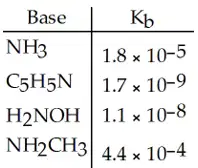
Using the data in the table, which of the conjugate acids below is the weakest acid?
NH4+
C5H5NH+
H3NOH+
NH3CH3+
They are all equal
Sometimes liquid ammonia, NH3, is used as a solvent rather than water. Which expression defines the ammonia autoionization counterpart of Kw?
[H3O+][OH–]
[NH3][NH4+]
[NH2–][NH4+]
[H3O+][NH2–]
[NH4+][OH–]
A solution with a pOH of 4.3 has a [H+] of ________
6.8 × 10⁻⁹ M.
3.2 × 10⁻⁴ M.
4.8 × 10⁻⁵ M.
2.0 × 10⁻¹⁰ M.
4.3 M.
Butanoic acid contributes to the rancid odor of spoiled butter. Calculate the acid dissociation constant for butanoic acid if a 0.155 M solution is 1.15% ionized. The abbreviated structural formula for butanoic acid is CH3CH2CH2COOH.
5.1 × 10⁻³
1.8 × 10⁻³
1.2 × 10⁻²
2.1 × 10⁻⁵
1.5 × 10⁻⁵
Boric acid frequently is used as an eyewash to treat eye infections. The pH of a 0.050 M solution of boric acid is 5.28. What is the value of the boric acid dissociation constant, Ka?
5.25 × 10⁻⁶
5.51 × 10⁻¹⁰
5.43 × 10⁻⁸
5.79 × 10⁻⁴
5.33 × 10⁻¹²
What is the pH of a 0.010 M solution of acetic acid? Ka for acetic acid is 1.8 × 10⁻⁵.
2.74
4.74
2.00
3.37
6.74
The degree of ionization of a weak acid ________
I. varies with the concentration of the acid.
II. depends on which weak acid it is.
III. is 100%.
IV. is greater than 50% but less than 100%.
I
II
III
IV
Vitamin C, which is ascorbic acid, is a diprotic acid with pKa1 = 5.00 and pKa2= 11.3. What is the pH of a 0.125 M solution of ascorbic acid?
2.95
3.05
5.00
6.10
3.54
The acid-dissociation constant, Ka, for gallic acid is 4.57 × 10⁻³. What is the base-dissociation constant, Kb, for the gallate ion?
4.57 × 10⁻³
2.19 × 10⁻¹²
5.43 × 10⁻⁵
7.81 × 10⁻⁶
2.19 × 10²
What is the pH of a 0.500 M solution of trimethylamine (pKb = 4.13)?
2.22
11.8
0.00609
4.42
5.91

