
 Worksheets
After Deep Work
Total questions: 25
Worksheet time: 17mins
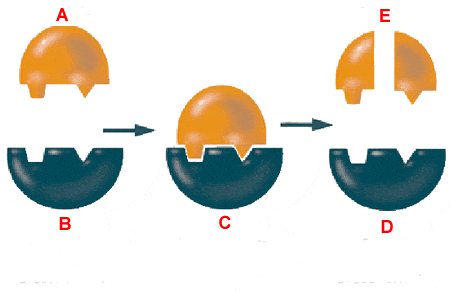
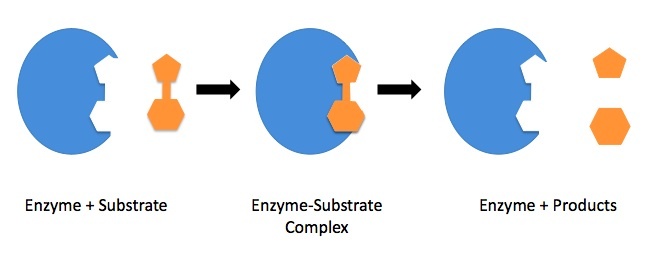
Which type of reaction is depicted in the following scenario?
Catabolic
Anabolic
Dehydration Synthesis
Halogenation
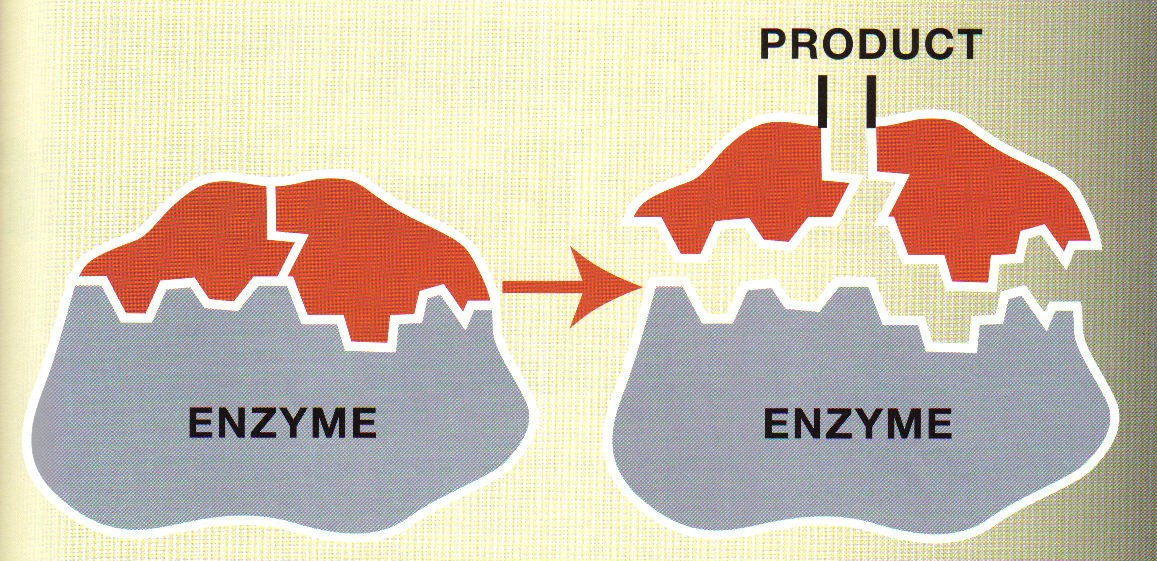
Hey students! Can you tell me, what's the name of the area on the enzyme where the substrate fits perfectly?
Active Site
Allosteric Site
Disulfide Bridge
β-Pleated Sheet
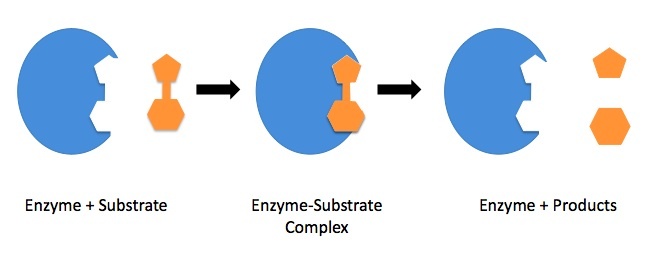
The current model of enzyme action is known as the:
Induced Fit Model
Lock & Key Model
Singer-Nicolson Model
Davson-Danielli Model
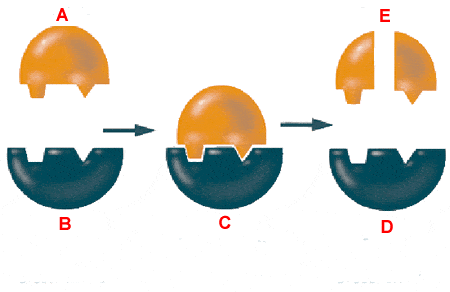
Which of the following best describes how enzymes work to lower the activation energy of a reaction?
By increasing the activation energy
By decreasing the activation energy
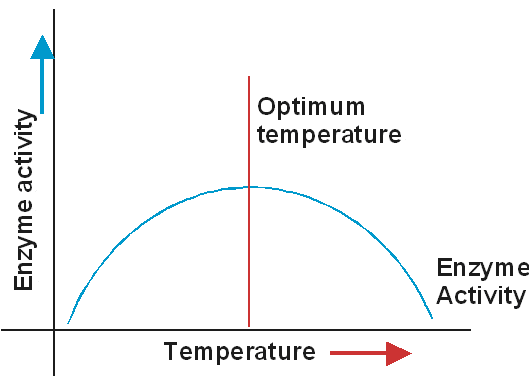
Why does enzyme activity decline at high temperatures?
Denaturation
Decreased Kinetic Motion
Increased H-Bonding
Dissociation of Ionic Compounds
Why does enzyme activity decline at low temperatures?
Denaturation
Decreased Kinetic Motion
Increased H-Bonding
Dissociation of Ionic Compounds
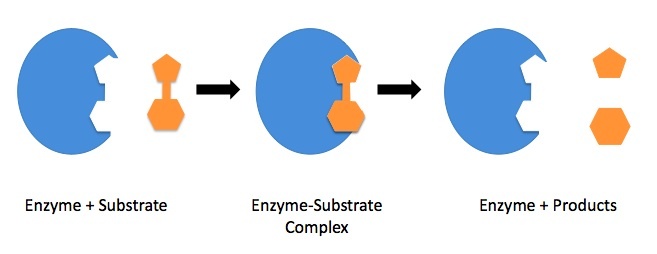
When a molecule can occupy the same active site as the substrate, a situation called competitive inhibition can result. How would Nora, Anika, and Maya react to this scenario?
Competitive Inhibition
Allosteric Regulation
Non-Competitive Inhibition
Feedback Inhibition
When a molecule can occupy the same active site as the substrate, a situation called competitive inhibition can result. Which of the following is an example of competitive inhibition?
Competitive Inhibition
Allosteric Regulation
Non-Competitive Inhibition
Feedback Inhibition
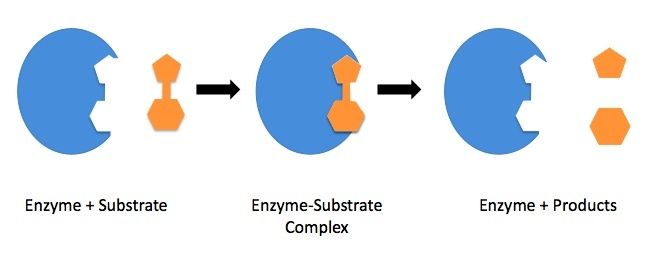
Which receptor site can a molecule bind to, changing the shape of the active site?
Allosteric Site
Active Site
Disulfide Bridge
MHC Receptor
What is the EC for argininosuccinate lyase, according to Olivia, Kai, and Abigail?
EC1
EC2
EC3
EC4
EC5
Which of the following factors can affect the rate of an enzyme reaction? (Select all correct answers)
temperature
pH
atmospheric pressure
substrate concentration
pesticide
Which statement is correct according to Anika, Daniel, and Luna?
low Km is interpreted as a low affinity of enzyme for the substrate
high Km is interpreted as a low affinity of enzyme for the substrate
Oliver, Aria, and Scarlett are trying to solve a Lineweaver-Burk plot problem. How can they calculate the Km? (Select all correct answers)
Km = (slope) x (Vmax)
Km= 1/intercept value at y axis
Km = -1/intercept value at x axis
Km = Intercept value at y axis x V max
Which of the following statements is true about competitive inhibitor according to Lineweaver-Burk plot?
It has the same Km as the normal enzyme-substrate system
It has the same Vmax as the normal enzyme-substrate system
It has a different Vmax value
Which of the following can help identify a non-competitive inhibitor from a Lineweaver-Burk plot?
Sharing the same Vmax
Sharing the same Km value
Having different Km value
Which of the following is a characteristic of uncompetitive inhibitor?
It shares the same Vmax and Km
It shares the same Vmax
It shares the same Km
It has different Km and Vmax
Which of the following is not true about enzymes?
Enzymes are denatured at temperatures above 60oC.
Enzymes can catalyze chemical reactions.
All enzymes react optimally at a neutral pH.
Reaction of enzymes is reversible.
Why can a small amount of enzymes act on a large amount of substrate?
Because enzymes do not change after a reaction and can be used again.
Because a little enzyme can supply enough energy to carry out a reaction.
Because as the reaction is going on, more enzymes are produced.
Because enzymes act in an all or none situation.
Which of the following is a molecule that competes with the substrate for the active site (toxin/poison)?
competitive inhibitor
coenzyme
substrate
denature

Maya, Aria, and Arjun are investigating the energy levels of the reactant and product of a biochemical reaction in the presence of its enzyme:
What type of process is the reaction shown in the graph?
an anabolic process because energy is absorbed.
an anabolic process because energy is released.
a catabolic process because energy is absorbed.
a catabolic process because energy is released.

What changes can Henry, Aria, and Grace make to boost the reaction rate once more?
slightly raise the temperature (not exceeding 40o)
significantly lower the pH
introduce more enzyme
include a competitive inhibitor

Why does the curve flatten out?
enzyme gets used up
available enzyme is working at full capacity
not enough substrate is available
the reaction rate slowed down

Which of the following best represents the effect of increasing substrate concentration on the rate of an enzyme-catalyzed reaction in the presence of...
A = No Inhibitor
B = Non-competitive inhibitor
C = Competitive Inhibitor
A = No Inhibitor
B = Competitive inhibitor
C = Non-competitive Inhibitor
A = Non-competitive Inhibitor
B = No Inhibitor
C = Competitive Inhibitor
A = Competitive Inhibitor
B = Non-competitive Inhibitor
C = No Inhibitor

