
 Worksheets
L5&6 Study Stuff
Total questions: 123
Worksheet time: 2hrs 20mins
What does heat do when convection currents are moving?
Sinks
Rises
Stays in place
Colder, more dense magma near the crust...
rises.
sinks.
Hotter, less dense magma near the core...
rises.
sinks.
The plates of the crust move because...
volcanoes erupt violently.
of the weight of the oceans.
of convection currents in the mantle.
of the moon's gravity.
Convection currents occur due to...
rotation of earth
differences in temperature and density
electrons moving
gravitational pull
Which of the following is one reason Earth's tectonic plates to move?
energy from the Sun
magnetic Pole Reversal
convection currents in the mantle
faults in Mountain Ranges
Convection cycles move in the mantle. How does this affect the crust?
crust has no motion
crust moves in random directions
crust moves in same direction convection cycle moves

Name the type of heat transfer shown in the picture.
convection
conduction
radiation
Earth's (a) is always changing because of the (b) of magma in the (c)

Which layer of the Earth is the LEAST DENSE?
crust
mantle
outer core
inner core

Which of the following best describes this diagram?
The oceanic crust is subducting under the continental crust because it is denser
The trench is froming a lake of water along the edge of the lithosphere.
Mountains are forming because 2 contiential crust are converging
The ocean water will put out the fire caused by the volcano.

The Ring of Fire is located around the Pacific Plate. How did this land feature form?
dinosaurs moved the plates to this location.
mountains formed along the ring because of uplifting.
movement along the edges caused earthquakes and volcanoes.
ice formed during the ice age and left rocks behind in this pattern,

Which of the following is the correct difference between the oceaninc and the continetal crust?
The ocean crust is thicker and less dense
The continential crust it thicker and more dense
The oceanic crust is thiner but is more dense.
The contiential crust is thinner and less dense.
Where do convection currents occur? Circle the correct layer.

What is Plate Tectonics?
movement of the Earth in space
movement of the oceans against Earth's land
movement of the Earth around the sun
movement of the pieces of Earth's crust
Why do Earth's plates move?
because of tornadoes and hurricanes
because of Earth spinning on its axis
because of Earth orbiting the sun
because of molten rock heating and cooling within the mantle
how did Pangaea break apart
dynamite
cave men
Minecraft
continental drift theory


Why did other scientists did no believe in Wegener’s theory?
He could not explain how the continents moved
He didn’t have evidence
His data was wrong
He didn’t use the right technology to gather data
A large, giant supercontinent land mass is called
continental drift
plate tectonics
pangaea
oceanic crust
Plates that diverge or move apart from each other
divergent
transform
convergent
lithosphere
Cracks or breaks in earth's crust where plates slip past each other
subduction
faults
mid-ocean ridge
san andreas
Continental plate collides with another continental plate creates
volcanoes
earthquake
trench
folded mountains
Occurs when a less dense plate slides under a more dense plate
tectonic plates
subduction
continental drift
landmass

What type of plate boundary is shown in the picture
convergent
divergent
transform
faults
Plates boundary where plates slide or move past each other
divergent
continental drift
transform
convergent
The type of geological event that occurs under transform boundaries
folded mountains
earthquakes
volcanoes
tsunamis
Ocean plate collides with ocean plate creates
mid- ocean ridge
sea floor spreading
earthquakes
volcanic ark of islands

What plate boundary is shown in the picture?
convergent
divergent
transform
neither
Which of the following geological events do not occur under divergent boundaries?
sea floor spreading
mid- ocean ridge
volcanoes
rift valley

What type of plate boundary is shown in the picture?
folded mountains
transform
convergent
divergent
Plates collide or converge into each other
divergent
convergent
transform
convection
Which of the following answer choice describes an ocean plate vs continental plate?
creates trench or volcano
creates earthquakes at subduction zones
creates folded mountains or new land
creates rift valleys
Which natural occurance causes the tectonic plates to move?
ocean plates subducted under continental plates
convection currents
continental drift
earthquakes
Subduction occurs under which plate boundary?
lithosphere
divergent
convergent
transform
The plastic like layer of the Earth where the plates move around on like a raft
ecology
tectonic plates
asthenosphere
lithosphere
What is the lithosphere?
upper most part of the crust and lower part of the mantle
upper most part of the mantle and lower part of the crust
mid mantle where convection current occur
part of the liquid outer core
The deepest part of the ocean floor located on both sides of a mid ocean ridge is called
new forming rock under water
oceanic plate
mid ocean ridge
ocean basin

What is happening in the picture?
layers of the Earth are changing positions
the inner and outer core are solid
convection currents are causing the tectonic plates to move
the mantle is growing
The element that is the product of radioactive decay is known as the...
daughter element
half-life
parent element
carbon-14

How many grams of Carbon-14 will remain after 17,100 years- C-14 has a half life 5,730 so 17,100 is about 3 half lives?
32 g
16 g
8 g
4 g

What percentage of Rubidium-87 will remain after 4 half-lives?
25%
12.5%
6.25%
3.125%


After 22,800 years, approximately what percentage of the original carbon-14 remains?

If the original mass of a radioactive isotope was 24 grams, how many grams would remain after 3 half-lives?

According to the graph, what is the half-life of this isotope?
occurrence in sediment

Tectonic Plates


The place where an earthquake originates inside the Earth's surface is called...
Epicenter
Focus
Underground
Crust

Which city is closest to the epicenter?
A
B
C

Which seismogram represents a city that is far from the epicenter of an earthquake?
New York, NY
Nome, Alaska
Guadalajara, Mexico
S-waves can move through which of the following?
Gas
Liquid
Solid
All of these
What is the minimum number of seismograph stations needed to locate an earthquake epicenter?
1
2
3
5
Which wave can travel through all materials?
P - primary
S - secondary
L - Long
What is the measure of the amount of energy released in an earthquake?
Intensity
Epicenter
Magnitude
Seismogram
Primary (p-wave) waves
Secondary (s-wave) waves
Surface Waves
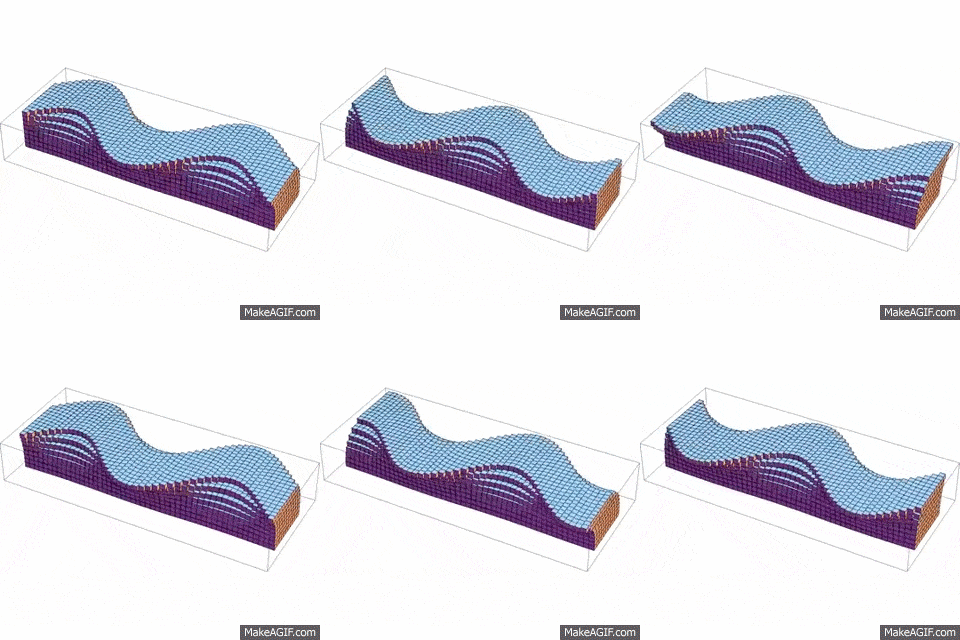
Which Seismic Wave is pictured?
P-Wave
S-Wave
Surface Wave
Which is the strength of an earthquake?
Plate boundaries
Magnitude
Fault
Seismic
Main type of seismic waves that can only travel through the surface of the Earth.
seismic waves
surface waves
secondary waves
primary waves
The point beneath the Earth's surface where the earthquake begins.
epicenter
fault
focus
magnitude
Which is a fracture in Earth's crust?
Plate boundaries
Magnitude
Fault
Seismic
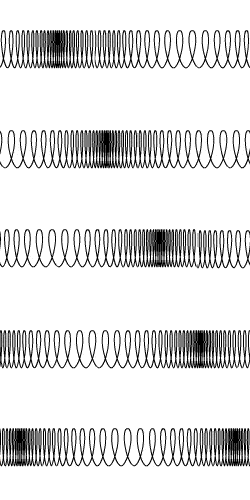
Primary Wave
Secondary
Which is a disturbance or shaking of Earth's surface?
Landslide
Earthquake
Epicenter
Focus
Which is the location of an earthquake ON EARTH'S SURFACE?
Landslide
Seismic
Epicenter
Focus
It can travel through only the mantle and the crust.
Seismic waves
Surface waves
Primary waves
Secondary waves
Which are waves that carry large amounts of energy?
Richter Scale
Magnitude
Fault
Seismic
Which measures the strength of an earthquake on a scale of 1 - 10?
Richter Scale
Magnitude
Fault

Which of the following statement correctly identifies the focus and epicenter of an earthquake in the given illustration?
Point A is the focus and Point B is the epicenter.
Point A is the epicenter and Point C is the focus
Point A is the epicenter and Point B is the focus.
Point A is the focus and Point C is the epicenter.

What layer of the Earth is labeled A?
inner core
outer core
mantle
crust
Match the layer of the Earth with what it is made of.
Iron
inner core
Iron and nickel
outer core
solid rock and water
crust
fluid rock
Mantle
Which layer is liquid?
crust
mantle
outer core
inner core
Which layer is the HOTTEST?
Crust
Mantle
Outer Core
Inner Core
What state of matter is the inner core?
Solid
Solid but flexible
Liquid
What layer has convection currents?
Crust
Mantle
Inner Core
Outer Core
What layer is liquid and makes a magnetic field (polarity)?
Outer Core
Mantle
Inner Core
Crust
What layer of the Earth is labeled B?
inner core
outer core
mantle
crust
What layer of the Earth is labeled C?
inner core
outer core
mantle
crust
What layer of the Earth is labeled D?
inner core
outer core
mantle
crust
Match the layer with its temperature.
Crust
0-70 C
Mantle
1800-6700 C
Outer Core
8000-9000 C
Inner Core
9300 C
What 3 kinds of evidence were used to prove that the seafloor spread?
Rock formations, age of rocks, WWII shipwrecks
Age of rocks, magnetic seafloor stripes, WWII ship logs
Rock formations, magnetic seafloor stripes, age of rocks
Process by which new ocean crust forms.
Seafloor spreading
Continental drift
Mid-ocean ridge
Rift

Sea-floor spreading begins at the
Deep ocean trench
Mid-ocean ridge
Continent's edge
What is label D
Trench
Mid ocean ridge
abyssal plain
sea mount
This scientist was the first to propose seafloor spreading
William Watts
Harry Hess
Alfred Wegener
Tenzing Norgay

