Wayground logo

Free Printable Worksheets

Font size

S
M
L
XL
Worksheets

Classification, Cladograms & Dichotomous Keys

Total questions: 42

Worksheet time: 49mins

Name
Class
Date
1.

What is the purpose of a cladogram?

a)

To map the ancestral relationships and shared traits of different organisms.

b)

To trace the inherited traits of a single species over time.

c)

To check the likelihood of an offspring having a particular trait.

d)

To monitor mutations that arise among different populations.

2.

According to this image, which two domains of life are most related?

a)

Bacteria & Archaea

b)

Archaea & Eukarya

c)

Eukarya & Bacteria

3.

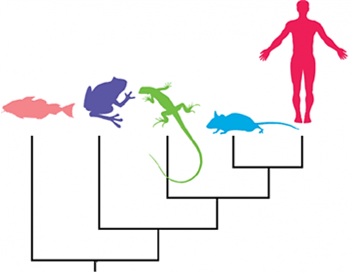
What is the human most closely related to?

a)

Fish

b)

mouse

c)

Salamander

d)

Human

4.
According to the cladogram, which organism is most distantly related to the human?
a)
crayfish
b)
rat
c)
perch
d)
frog
5.

What is the common ancestor of Letters A, B, C, D, E?

a)

1

b)

2

c)

3

6.

According to this phylogenetic tree, which creature is the least related out of all pictured?

a)

Fish

b)

Frog

c)

Salamander

d)

Human

7.

Who is most closely related to Taxidea taxus?

a)

Lutra lutra

b)

Panthera pardus

c)

Canis latrans

d)

Canis lupus

8.
The scientific name for an organism is made from the:
a)
class and family name
b)
genus and species name
c)
domain and kingdom name
d)
kingdom and phylum name
9.
What do protists, plants, fungi, and animals ALWAYS have in common? They are all...
a)
Multicellular
b)
Eukaryotic
c)
Prokaryotic
d)
Consumers
10.
Tool used by a taxonomist to identify an unknown organism is a:
a)
dichotomous key
b)
binomial nmenclature
c)
scientific name
d)
binomial key
11.

Which of the following is the least closely related animal:
Gray Wolf: Canis lupus
Aardwolf: Proteles cristatus
Coyote: Canis latrans

a)
Coyote
b)
Aardwolf
c)
Gray Wolf
d)
Need more information on body characteristics
12.
A dichotomous key for trees is provided. Hikers found a tree that has large brown cones and single sharp needles. What species of tree have the hikers found?
a)
Juniper
b)
Pine
c)
Spruce
d)
Fir
13.
What is the name of bird W?
a)
Certhidea
b)
Geospiza
c)
Camarhynchus
d)
Platyspiza
14.
Cells that have a true nucleus are called....
a)
eukaryotes
b)
prokaryotes
c)
unicellular
d)
multicellular
15.
Using this dichotomous key, identity the name of the circled fish.
a)
band-tail puffer
b)
spotted goat fish
c)
peacock flounder
d)
trumpet fish
16.
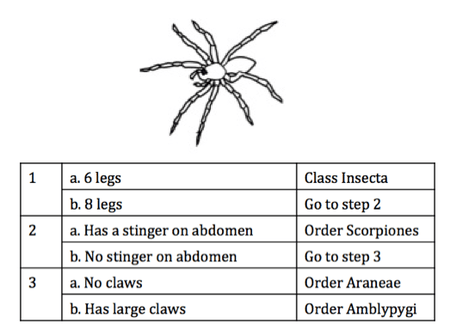
An illustration and a dichotomous key are given. What is the correct classification for this organism?
a)
Class Insecta
b)
Order Amblygygi
c)
Order Araneae
d)
Order Scorpiones
17.
A table of arachnid and insect characteristics is shown. Which characteristic could be used to distinguish between
arachnids and insects?
a)
Jointed legs
b)
Body segments
c)
Presence of eyes
d)
Presence of antennae
18.
When using a dichotomous key to identify organisms, what do we look at?
a)
physical features
b)
weather patterns
c)
environment
d)
diet
19.
What step do we always start with when using dichotomous keys?
a)
1
b)
2
c)
3
d)
4
20.
A student discovers an arachnid with a segmented abdomen, long legs, and a tail with no stinger. The student uses the dichotomous key below to identify it. Which arachnid has the student found?
a)
Whip Scorpion
b)
Wind Scorpion
c)
Daddy long legs
d)
Scorpion
21.

Leaf S (3RD LEAF)

a)

Eastern white pine

b)

balsam poplar

c)

sweet gum

d)

ginko

22.
Which taxa has more organisms, family or phylum?
a)
phylum
b)
family
c)
they are equal
d)
not enough information to answer
23.
What are the 8 levels of classification of living things from most general to most specific?
a)
domain, kingdom, phylum, class, order, family, genus, species
b)
domain, kingdom, phylum, class, order, family, genius, species
c)
domain, kingdom, phamily, class, order, family, genus, species
d)
domain, king, phillip, class, order, family, genus, species
24.

The scientific name for water bear is Hypsibius dujardini.  What is its genus?

a)

Hypsibius 

b)

dujardini

c)
water 
d)
tardigrade
25.
Use the dichotomous key above to classify the unknown organism in the picture
a)

Kentuckyus

b)

Californius

c)

WalaWala

d)

Beverlus

26.
The first part of a scientific name is an organism's _______________ and the second part is its ________________.
a)
species, genus
b)
phylum, order
c)
class, spices
d)
genus, species
27.

In which kingdom would you find an organism that is prokaryotic, unicellular, autotroph or heterotrophic, and have cell walls composed of peptidoglycan? Many members of this group are pathogens of disease.

a)

Eubacteria

b)

Archaebacteria

c)

Protista

d)

Fungi

28.

In which kingdom would you find an organism that is prokaryotic, unicellular, autotrophic or heterotrophic and cell walls that do not contain peptidoglycan? This group are considered extremophiles because of the extreme conditions they can survive in.

a)

Eubacteria

b)

Archaebacteria

c)

Protista

d)

Fungi

29.

Which kingdom is considered the "misfit" kingdom? They have a nucleus and may be plant-like, fungus-like or animal-like.

a)

Eubacteria

b)

Archaebacteria

c)

Protista

d)

Fungi

30.

What kingdom contains organisms that are all eukaryotic, multicellular, and all autotrophic?

a)

Protsista

b)

Fungi

c)

Plantae

d)

Animalia

31.

What kingdom contains organisms that are eukaryotic, mostly unicellular, autotrophic and heterotrophic and they live in water or moist environments?

a)

Fungi

b)

Protista

c)

Plantae

d)

Animalia

32.

What kingdom contains organisms that are eukaryotic, all are multicellular, all are heterotrophic, and all of them move at some point in their life cycle.

a)

Protista

b)

Fungi

c)

Plantae

d)

Animalia

33.

What kingdom contains organisms that are mostly multicellular, heterotrophic, has cell walls made of chitin and is ecological important in the recycling of nutrients?

a)

Protista

b)

Fungi

c)

Plantae

d)

Animalia

34.

What domain contains only eukaryotic organisms?

a)

Arachaea

b)

Bacteria

c)

Eukarya

d)

None of the Above

35.
a)

A

b)

B

c)

C

d)

D

36.
a)

F

b)

G

c)

H

d)

J

37.
a)

A

b)

B

c)

C

d)

D

38.
a)

A

b)

B

c)

C

d)

D

39.
a)

A

b)

B

c)

C

d)

D

40.
a)

A

b)

B

c)

C

d)

D

41.
a)

F

b)

G

c)

H

d)

J

42.
a)

F

b)

G

c)

H

d)

J