
NEW
Font size
 Worksheets
Neurological System Quiz 1 material
Total questions: 65
Worksheet time: 34mins
What is a nerve impulse?
A chemical signal that travels along the neuron
A thermal signal that travels along the neuron
A mechanical signal that travels along the neuron
An electrical signal that travels along the neuron
What is the resting potential of a neuron?
The extracellular space is positively charged and the intracellular space is negatively charged
The extracellular and intracellular spaces are negatively charged
The extracellular space is negatively charged and the intracellular space is positively charged
The extracellular and intracellular spaces are positively charged
What happens during depolarization?
Sodium rushes into the neuron and reverses the charges
Potassium diffuses out of the neuron
The resting potential returns
The sodium-potassium pump restores ion concentrations
What occurs during repolarization?
Potassium diffuses out of the neuron and charge goes slightly further than the resting potential (hyperpolarization)
Sodium rushes into the neuron and reverses the charges
The sodium-potassium pump restores ion concentrations
The resting potential returns
What is the role of the sodium-potassium pump?
To release neurotransmitters across the synaptic cleft
To restore ion concentrations to normal
To open voltage-gated K+ channels
To open voltage-gated Na+ channels
How does the myelin sheath affect nerve impulse conduction?
It decreases the speed of the nerve impulse.
It increases the speed of the nerve impulse by insulating the axon and facilitating saltatory conduction.
It prevents the nerve impulse from occurring.
It has no effect on the speed or quality of the nerve impulse.
What is the primary role of neurotransmitters in neuron communication?
To create the myelin sheath around axons
To serve as the metabolic fuel for neurons
To facilitate the transmission of nerve impulses across the synaptic cleft
To maintain the resting potential of neurons
What is the function of neurotransmitter receptors at the postsynaptic membrane?
To synthesize neurotransmitters
To degrade neurotransmitters
To initiate a nerve impulse in the postsynaptic neuron
To prevent the release of additional neurotransmitters
What is the significance of the synaptic cleft in neural communication?
It is the site where myelination of axons occurs
It is the gap that allows electrical signals to pass directly between neurons
It is the space where neurotransmitters are released from the presynaptic neuron
It is the location of the sodium-potassium pump
What is the term for the brief period after an action potential during which a neuron cannot be stimulated to fire another action potential?
Threshold period
Refractory period
Depolarization phase
Hyperpolarization phase
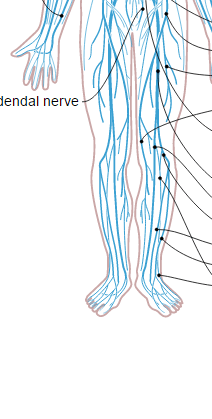
Cranial nerves and spinal nerves are part of the peripheral nervous system.
True
False
Which nervous system structure causes someone to have dry mouth and tachycardia after sustaining an injury from a car accident?
Central
Autonomic
Peripheral
Cerebral
Major functions of the Nervous system
Detects impulses from the senses
Sends efferent signals
Integrates information
All of the these
What is the Central Nervous system?
The spine and brain
Peripheral and cranial nerves
The spinal cord and interneurons
Neurons and neuroglia
What is the peripheral nervous system
The spine and brain
Neurons and neuroglia
Cranial Nerves and Spinal Nerves
Bipolar and unipolar neurons
Afferent Division
Sends impulses TO the CNS
Sends impulses FROM the CNS
Both of these
None of these
Efferent Division
Sends impulses TO the CNS
Sends impulses FROM the CNS
Both of these
None of these
Autonomic Nervous System
Controls involuntary functions
Controls voluntary Functions
Responsible for executive function
Creates consciousness
Somatic Nervous System
Controls involuntary functions
Controls voluntary Functions
Responsible for executive function
Creates consciousness
Parasympathetic Nervous System
"Fight or Flight"
"Rest and Digest"
Both of these
Neither of these
The Nervous System can be divided into
The main and outside nervous system
The central and peripheral nervous system
The logical and creative nervous system
The cerebral and spinal nervous system
What is the role of Neuroglia in the Nervous System?
They transmit nerve impulses
They support and protect neurons
They are responsible for thinking and memory
They are responsible for muscle contraction

What kind of neuron is this?
Unipolar
Bipolar
Multipolar
None of these

What kind of neuron is this?
Unipolar
Bipolar
Multipolar
None of these

What kind of neuron is this?
Unipolar
Bipolar
Multipolar
None of these
What is the function of the dendrites in a neuron?
They transmit nerve impulses away from the cell body
They transmit nerve impulses towards the cell body
They generate nerve impulses
They stop the transmission of nerve impulses
What are the major parts of the nervous system?
Stomach, intestines, pancreas, gallbladder
Muscles, bones, skin, blood vessels
Heart, lungs, liver, kidneys
Brain, spinal cord, sensory organs, nerves
Which division of the nervous system sends impulses from the CNS to the muscles and glands?
Somatic Nervous System
Sympathetic Division
Motor Division
Autonomic Nervous System
Which division of the autonomic nervous system is responsible for the 'fight or flight' response?
Sympathetic Division
Parasympathetic Division
Motor Division
Somatic Nervous System
Which division of the autonomic nervous system reduces the sympathetic response and provides resting functions such as digestion and urination?
Parasympathetic Division
Somatic Nervous System
Sympathetic Division
Motor Division
What is the main function of the nervous system?
To control the body by receiving sensory input, integrating messages, and responding
To produce hormones and regulate body functions
To coordinate voluntary muscle movements
To provide support and protection for the body
What are the two major types of nerve cells?
Dendrites and axons
Sensory and motor neurons
Astrocytes and microglia
Neurons and neuroglia
What is the main function of neuroglia?
To send impulses away from the cell body
To bring impulses towards the cell body
To support, insulate, and protect neurons
To conduct impulses around the body
What is the structure that wraps around the axon and helps the nerve impulses to travel more quickly?
Neurilemma
Astrocyte
Axon terminal
Myelin sheath
Which type of neuron carries impulses toward the CNS?
Afferent neuron
Efferent neuron
Interneuron
Multipolar neuron
What is the function of the myelin sheath?
To secrete and circulate cerebrospinal fluid
To protect the neuron from damage
To provide support and anchor neurons
To help the nerve impulses travel more quickly
Which type of neuroglia forms the myelin sheath in the central nervous system?
Oligodendrocytes
Astrocytes
Microglia
Schwann cells
What is the role of the sensory neurons in the nervous system?
To transmit signals from the brain to the rest of the body
To transmit signals from the body to the brain
To provide support and protection for neurons
To form the myelin sheath around the axon
audi-/oto-
self
hearing
membrane
nerve
auto-
more
few
self
car
-ellum
smaller
bigger
nerve
end
What is the function of the dendrites in a neuron?
To transmit signals away from the cell body
To form the myelin sheath around the axon
To transmit signals towards the cell body
To provide support and protection for the neuron
Which type of neuroglia is responsible for immune functions within the CNS?
Oligodendrocytes
Astrocytes
Microglia
Schwann cells
Which of the following is NOT a function of the nervous system?
Control of body movements
Regulation of body temperature
Production of hormones
Processing sensory information
Astro-
star
membrane
hearing
treelike
cereb-/enceph-
light
brain
vision
start
dendr
treelike
glue
smaller
bigger
inter
between
beginning
end
light
meing-
nerve
membrane
light
few
neuro -
brain
spine
nerve
glue
oligo
few
many
vision
light
opt-
vision
light
sky
trees
photo-
nerve
brain
light
membrane
polar-
end
beginning
start
exit
gli-
between
vision
membrane
glue
What is threshold when we talk about nerve signal transmission?
-55mv
The point of no return, once this is met an action potential will propagate down the entire axon.
It's reached due to sodium channels opening and allowing positive sodium ions into the nerve
all these answers are correct
What is the intracellular space?
The space inside of the nerve membrane
The space outside of the nerve membrane
The space between cells.
None of these answers are correct
What happens first at a synapse?
A. Neurotransmitter is released into the synaptic cleft
B. Vesicles full of neurotransmitter are signaled by Ca++
C. Action potential continues
D. Action potential reaches the presynaptic terminal (axon terminal).
A
B
C
D
What is the outer layer of a Schwann cell called?
Pia Mater
neuro lemon
neurilemma
perimysium

A
Soma
Node of Ranvier
Dendrite
Presynaptic Terminal
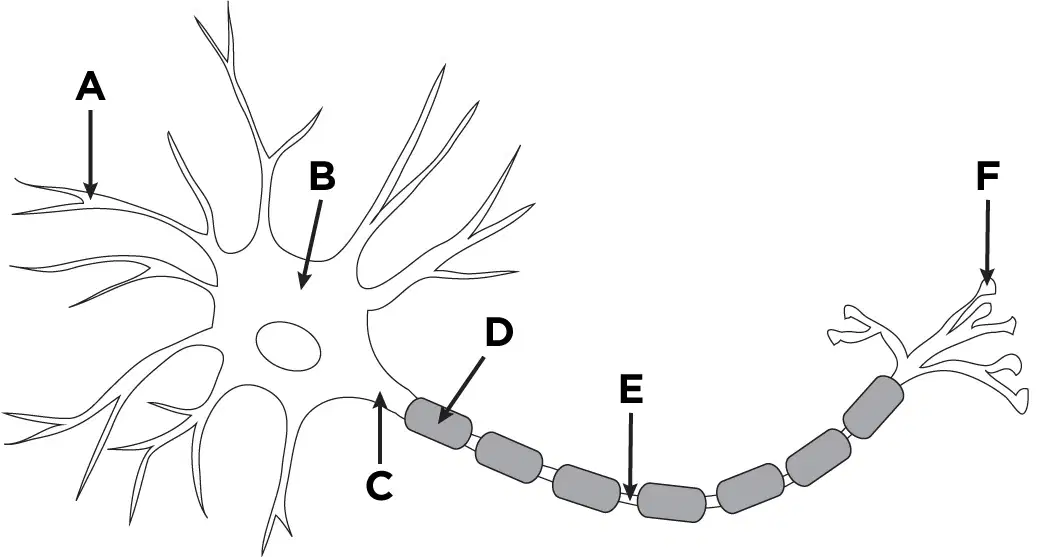
B.
Soma/Body
Schwann's Cell
Myelin
Postsynaptic receptor
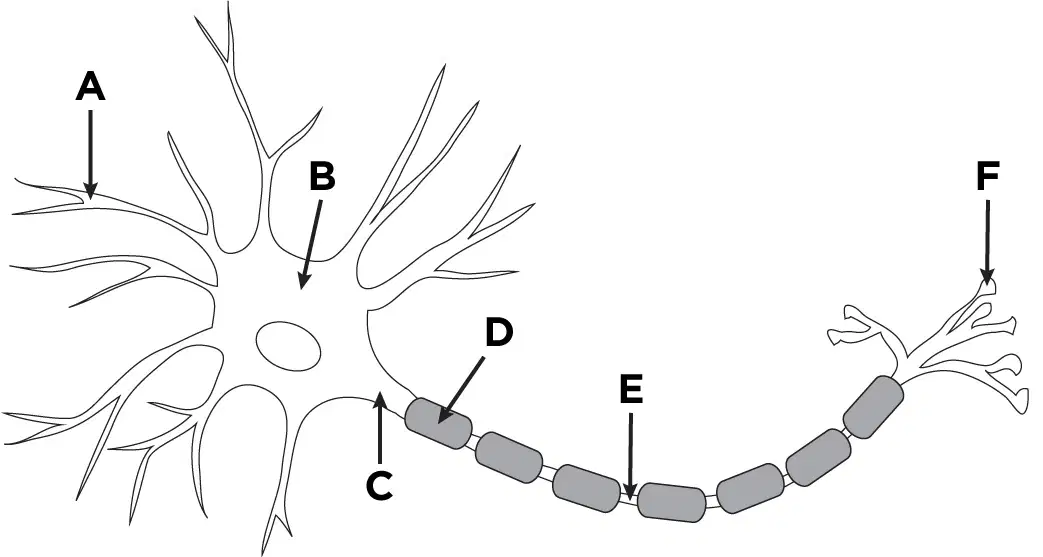
D.
Dendrite
Soma/Body
Axon Terminal
Schwann Cell
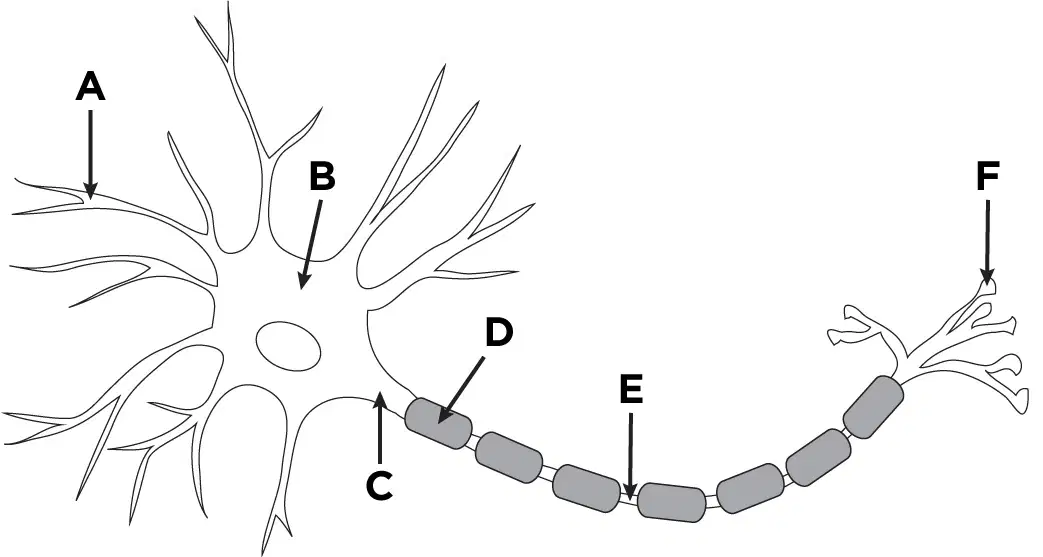
E
Schwann Cell
Axon Terminal
Node of Ranvier
Dendrite
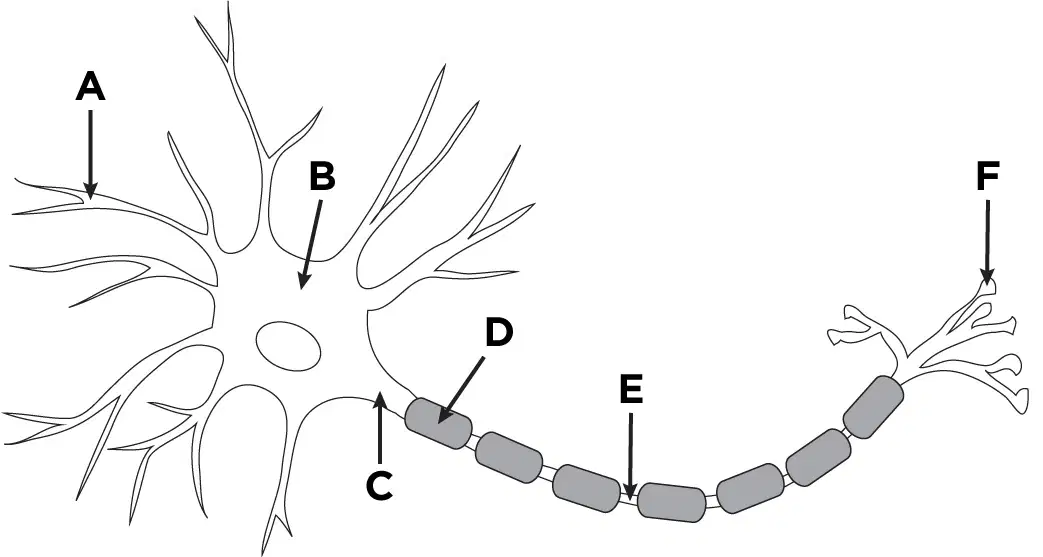
F.
Axon Terminal
Dendrite
Soma/body
Schwann cell

