Wayground logo

Free Printable Worksheets

Font size

S
M
L
XL
Worksheets

Economics Quiz

Total questions: 51

Worksheet time: 59mins

Name
Class
Date
1.

What is an economic good?

a)

A good that can only be exchanged for other goods but not for money

b)

A service that is given for free and has no value

c)

A good or service that has value and can be exchanged for money or other goods and services

d)

A good that has no value and cannot be exchanged

2.

What are factors of production?

a)

Types of consumer goods

b)

Categories of marketing strategies

c)

Resources used to produce goods and services

d)

Methods of distribution

3.

What is scarcity?

a)

Equal distribution of resources

b)

Unlimited availability of resources

c)

Limited availability of resources

d)

Abundance of resources

4.

What is a limited resource?

a)

Abundant and easily replenished

b)

Unlimited and always available

c)

Temporary and constantly renewed

d)

Scarce and cannot be easily replenished

5.

What is a PPF in economics?

a)

Personal Productivity Factor

b)

Profit Potential Forecast

c)

Public Policy Framework

d)

Production Possibility Frontier

6.

What is a free good?

a)

A good that is scarce and has a high opportunity cost

b)

A good that is expensive and has a high opportunity cost

c)

A good that is abundant and has a high opportunity cost

d)

A good that is not scarce and has a zero opportunity cost

7.

What are the two types of goods in economics?

a)

Private goods and public goods

b)

Luxury goods and necessity goods

c)

Free goods and paid goods

d)

Imported goods and exported goods

8.

What are the factors of production in economics?

a)

Water, air, and sunlight

b)

Land, labor, capital, and entrepreneurship

c)

Money, technology, and resources

d)

Education, healthcare, and infrastructure

9.

What is the concept of opportunity cost?

a)

The value of the next best alternative that is given up when a decision is made.

b)

The cost of an opportunity to make a decision

c)

The price of the next best alternative

d)

The value of the chosen alternative

10.

What is the law of increasing opportunity cost?

a)

The law of increasing opportunity cost states that the production of one good decreases the opportunity cost of producing an additional unit of that good.

b)

The law of increasing opportunity cost only applies to services, not goods.

c)

The law of increasing opportunity cost is not a real economic principle.

d)

As the production of one good increases, the opportunity cost of producing an additional unit of that good also increases.

11.

What is the concept of utility in economics?

a)

The satisfaction or benefit derived from consuming a good or service

b)

The cost of producing a good or service

c)

The price of a good or service

d)

The value of the next best alternative

12.

What is the difference between microeconomics and macroeconomics?

a)

Microeconomics focuses on individual consumers and firms, while macroeconomics focuses on the overall economy

b)

Microeconomics focuses on the overall economy, while macroeconomics focuses on individual consumers and firms

c)

There is no difference between microeconomics and macroeconomics

d)

Microeconomics and macroeconomics are the same thing

13.

What is the law of demand in economics?

a)

The law of demand states that as the price of a good or service increases, the quantity demanded decreases

b)

The law of demand states that as the price of a good or service decreases, the quantity demanded decreases

c)

The law of demand states that as the price of a good or service increases, the quantity demanded increases

d)

The law of demand states that as the price of a good or service decreases, the quantity demanded increases

14.

What is the difference between a normal good and an inferior good?

a)

A normal good is a luxury item, while an inferior good is a necessity

b)

A normal good is in high demand, while an inferior good is in low demand

c)

A normal good's demand increases with income, while an inferior good's demand decreases with income

d)

A normal good's demand decreases with income, while an inferior good's demand increases with income

15.
True or False: Everything that is scarce requires a choice, and these choices always involve a tradeoff.
a)
True
b)
False
16.
If the production of good X increases by 3 units and production of good Y decreases by one unit, then the opportunity cost of one unit of X is ____ unit(s) of Y.
a)
3
b)
1
c)
1/3
d)
4
17.

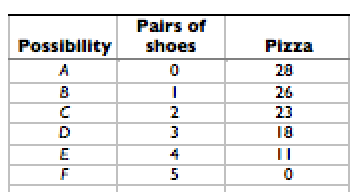
The table shows the production possibilities for a country. Based on the table, which of the following production combinations is a possibility?

a)

28 pizzas and 5 pairs of shoes

b)

3 pairs of shoes and 23 pizzas

c)

2 pairs of shoes and 20 pizzas

d)

4 pairs of shoes and 15 pizzas

18.
Based on the table, if the country is currently producing at point B and decides to produce at point C, the opportunity cost for the additional pair of shoes is ____ pizzas.   
a)
26
b)
23
c)
3
d)
2
19.
What is the production possibilities curve?
a)
a graph that shows how much an economy can produce between 2 goods
b)
how much money something is
c)
the opportunity one has to give up in order to gain something else
d)
land, labor, capital, entrepreneurs
20.
What is opportunity cost?
a)
a graph that shows how much an economy can produce between 2 goods
b)
how much money something is
c)
the opportunity one has to give up in order to gain something else
d)
land, labor, capital, entrepreneurs
21.
How do you satisfy your unlimited wants in a world of limited resources?
a)
by making more money
b)
by making choices
c)
by stealing
d)
by setting a budget
22.
What is the fundamental problem of every society?
a)
labor costs
b)
scarcity
c)
economic interdependence
d)
market fluctuation
23.
Land, Labor, Capital, and Entrepreneurship 
a)
Diversification
b)
Deductions
c)
Portfolio
d)
Factors of Production 
24.
The opportunity cost of increasing production from 4 to 7 boats is
a)
1 boat
b)
2 boats
c)
2 trucks
d)
3 trucks
25.
Movement down the PPF curve indicates that the opportunity cost of more capital goods is producing more consumer goods
a)
True
b)
False
26.
Efficiency is producing the maximum possible output from available resources
a)
True
b)
False
27.
If many workers decide to retire at an early age, the PPF would shift inward.
a)
True
b)
False
28.
What do points inside the PPF indicate?
a)
The combination of goods that employ goods efficiently
b)
The combination of goods that employ resources fully
c)
The combination of goods that do not employ resources fully
29.
What do points inside the PPF indicate?
a)
The combination of goods that employ goods efficiently
b)
The combination of goods that employ resources fully
c)
The combination of goods that do not employ resources fully
30.
Which of the following might cause an inward shift of the PPF?
a)
A computer network shuts down due to a virus
b)
More people earn bachelor degrees
c)
A new maching that produces bread faster is invented
d)
OPEC announces a new source of oil
31.
An increase in the labor force would cause the PPF to 
a)
Shift inward
b)
Shift outward
c)
Do nothing
d)
Turn into a straight line
32.
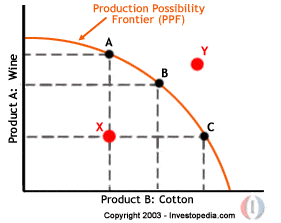
What does point Y represent on the PPC?
a)
Efficiency
b)
Unattainable / impossible
c)
Inefficency
d)
Nothing
33.
What does point B represent?
a)
Production at greater than the country's minimum potential
b)
Production is less than the country's minimum potential
c)
Productive inefficiency
d)
Productive efficiency
34.
Which point represents "resources are not being used efficiently, or resources are being wasted or idle"?
a)
Point A
b)
Point Y
c)
Point X
d)
All of the above
35.
A garbage truck driver is an example of which Factor of Production?
a)
labor
b)
land
c)
entrepreneurship
d)
capital
36.
Iron, minerals, coal and plants are examples of which productive resource?
a)
land
b)
labor
c)
entrepreneurship
d)
capital
37.
factory worker
a)
Natural
b)
Labor
c)
Capital
d)
????????
38.
a farmer
a)
Natural
b)
Labor
c)
Capital
d)
????????
39.
Which factor of production would you consider a lawn mower?
a)
Land
b)
Labor
c)
Capital
d)
Entrepreneur
40.
Which factor of production would you consider a cow?
a)
Land
b)
Labor
c)
Capital
d)
Entrepreneur
41.
fish
a)
Natural
b)
Labor
c)
Capital
d)
????????
42.
gold
a)
Natural
b)
Labor
c)
Capital
d)
????????
43.
The people who decide to buy.
a)
Producers
b)
Consumers
c)
Economist
d)
Entreprenuers
44.
What part of the picture is the natural resource?
a)
rope
b)
rock mountain
c)
rock climber
45.
Name the natural resource(s).
a)
wheat
b)
combine
c)
truck
d)
combine and truck
46.
What kind of resource is this?
a)
natural and capital resource
b)
natural resource
c)
capital resource
d)
human resource
47.
What is this resource?
a)
human resource
b)
capital resource
c)
natural resource
d)
human and capital resource
48.
What is an entrepreneur?
a)
A person who starts a new business.
b)
A leader of a country.
c)
A worker in a factory.
d)
A student in college.
49.

When we produce a good by exploiting natural resources, it is an activity of the:

a)

(a) Secondary sector

b)

(b) Tertiary sector

c)

(c) Primary sector

d)

(d) Organised sector

50.

Which of the following is included in tertiary sector?

a)

(a) ATM booths

b)

(b) Call centres

c)

(c) Internet cafe

d)

(d) All of them

51.

Government owns most of the assets and provides all the services:

a)

(a) Private Sector

b)

(b) Public Sector

c)

(c) Organised Sector

d)

(d) Tertiary Sector