
 Worksheets
Nervous, Endocrine, Reproduction
Total questions: 42
Worksheet time: 22mins
Where is insulin produced?
Pancreas
kidneys
thyroid
What is the primary sex hormone of males?
Testicle
Prostate Gland
Testosterone
Prostate gland
What part of the female's body releases the egg?
Testes
Bladder
ovaries
fallopian tube
Which body system has a function to allow all organisms to keep their species going?
Respiratory
Reproductive
Endocrine
Skeletal


collection of organs that allows humans to produce babies.
Skeletal system
Reproductive system
Capillaries
Urinary system
What is the main reproductive organ in females that produces the egg?
Testes
Ovaries

Which organ is represented by letter A?
Brain
Spinal Cord
Nerves
Which organ is represented by letter B?
Brain
Spinal Cord
Nerves
Which organ is represented by letter C?
Brain
Spinal Cord
Nerves
The Nervous System is divided into two parts called
The Central Nervous System & The Peripheral Nervous System
The Central Nervous System & The Paradigm Nervous System
The Corollary Nervous System & The Peripheral Nervous System
What type of product is secreted by endocrine glands?
Sweat
Hormones
Saliva
Tears
Endocrine glands secrete _
Hormones
Neurotransmitters
A wide range of chemical substances
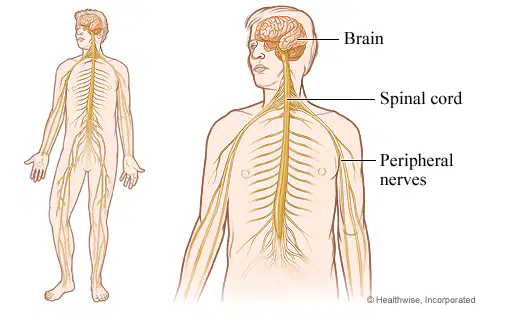
What is the function of the nervous system?
Provide nutrients for the body.
Send and receive messages
Circulate oxygen to cells
Remove carbon dioxide from blood
What is the main function of the endocrine system?
It creates chemicals, or hormones, that are sent around the body to maintain homeostasis.
It creates electrical messages that are sent around the body to maintain homeostasis.
It maintains the correct level of oxygen in the body to maintain homeostasis.
It releases waste from the body to maintain homeostasis.
Which of the following organs produce sperm?
haploids
ovaries
testes
zygotes
What is the process called where a sperm and egg make a zygote?
Fertilization
Budding
Fragmentation

Made up of the nerves branching off of the spinal cord.
Nervous System
Central Nervous System
Peripheral Nervous System

A collection of glands that control the body fluid balance, growth and sexual development.
Circulatory System
Endocrine System
Digestive System
Nervous System

Produce hormones involved with female reproductive development
Testes
Uterus
Ovaries
Pancreas

Regulates blood sugar levels by producing insulin
Pancreas
Parathyroid
Liver
Neurons

Secretes hormones that affect other glands and organs. Also affects growth.
Pancreas
Parathyroid
Pituitary Gland
Thymus

Affects the rate at which you use energy
Parathyroid
Thymus
Pituitary Gland
Thyroid
Too much human growth hormone in children causes ______________________.
dwarfism
goiter
gigantism
tall syndrome
What organ makes insulin to regulate blood sugar?
thyroid
pancreas
glands
pineal
The endocrine system works to maintain stable internal conditions (balance).
Hormones
Homeostasis
Hypothyroidism
Hidrosis
The nervous system is composed of the ___, ___, and ___.
heart, brain, kidneys
lungs, liver, stomach
brain, spinal cord, nerves
eyes, pancreas, veins

What part of the integumentary system sends and receives messages?
Glands
Hair
Nails
Nerves

Check ALL facts that are true about the integumentary system
Vitamin D is produced in the skin
Blood volume is regulated in the integumentary system
Skin is mostly dead
Integumentary systems works with the nervous system
Integumentary system works with the excretory system

What is known as the "brain" of the cell due to its ability to control the cell's actions?
Mitochondria
Nucleus
Cell Membrane
Vacuole
What causes puberty to occur
No one knows
Hormones
Nerve impulses
Enzymes
What type of product is secreted by endocrine glands?
Sweat
Hormones
Saliva
Tears
What happens to the heart rate during the fight-or-flight response?
Increases
Remains the same
Decreases
Adrenaline is also known as "fight or flight" hormone.
True
False
How does the “fight or flight” reaction work in the body?
The 'fight or flight" reaction causes a person to develop a phobia.
The "fight or flight" reaction creates memories.
When faced with a threat, hormones are released, allowing the body to address the threat faced; which causes a person to either stay and fight or run away seeking safety.
The "fight or flight" reaction can cause confusion in a person.

Located above the kidneys. Help the body respond to stress and danger.
Ovaries
Pituitary Gland
Thymus
Adrenal Gland
Produce hormones involved with female reproductive development
Testes
Uterus
Ovaries
Pancreas

A collection of organs that gather and interpret information about the body's internal and external environment
Endocrine System
Muscular System
Nervous System
Digestive System

Produce hormones involved with male reproductive development
Thymus
Testes
Thyroid
Parathyroid
The _________________ gland(s) sit on top of the kidneys, protect us from stress and produce cortisol (adrenaline).
thyroid
pituitary
parathyroid
adrenal

