
 Worksheets
SB2 abc Mega Review
Total questions: 87
Worksheet time: 1hrs 19mins
ATG TGA CAG
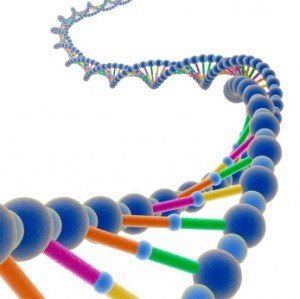

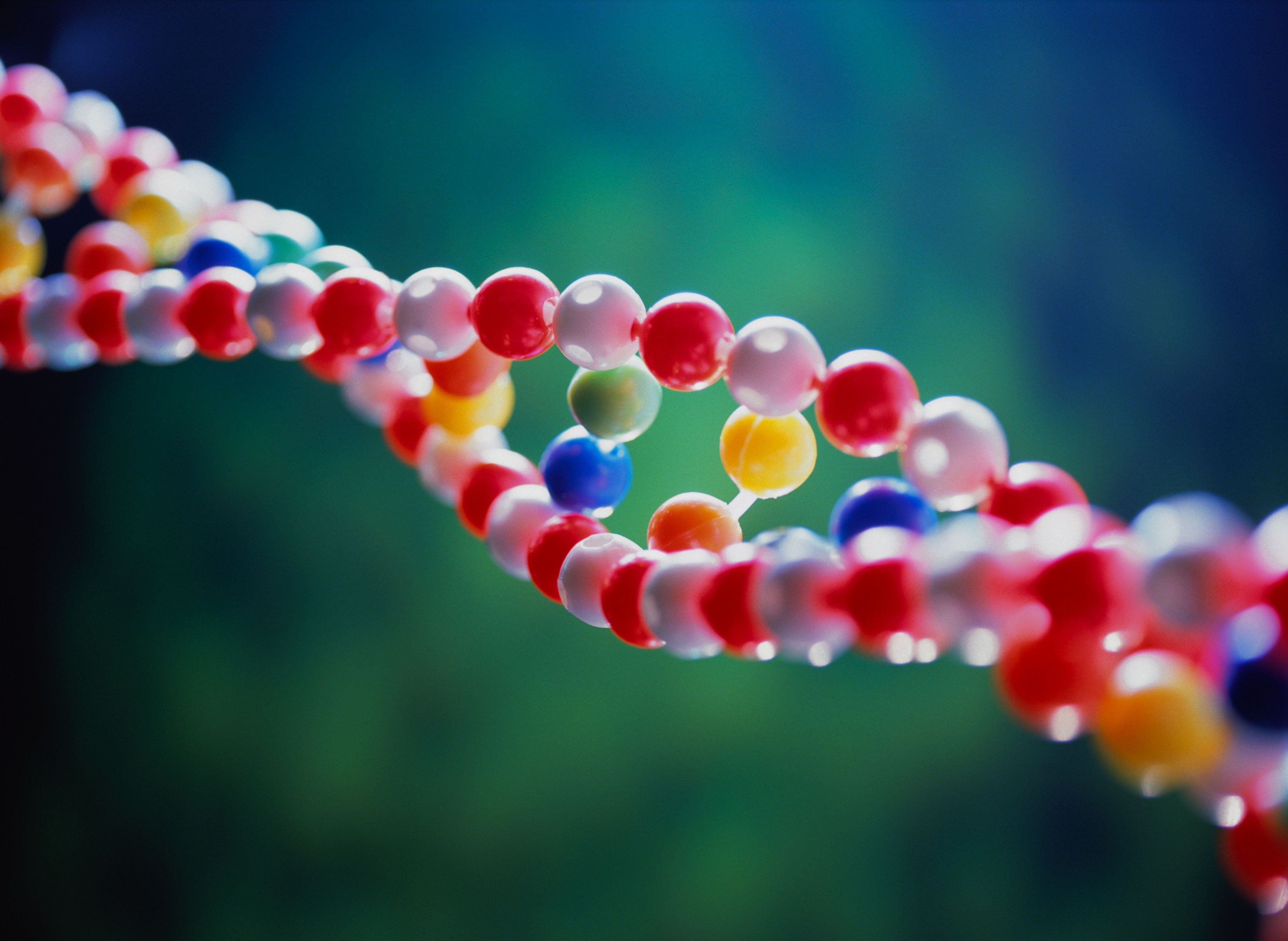
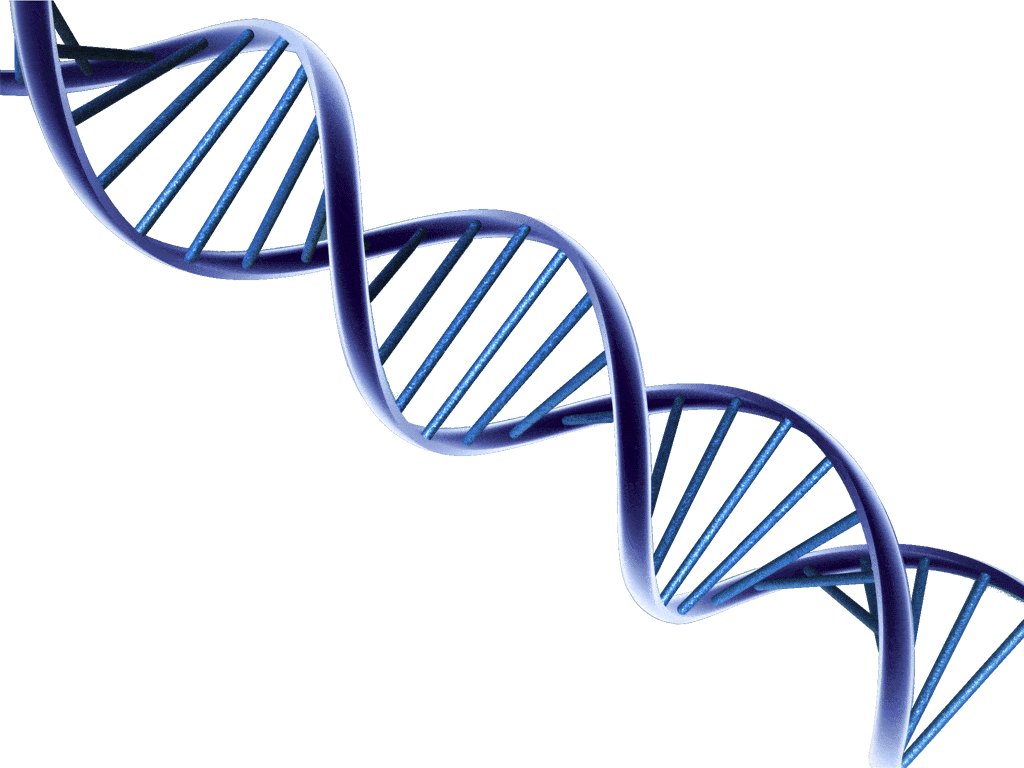
What is the name of the place where the double helix is unwound?
Replication Fork
The Y zone
Open Sesame
Replication Spoon
The two strands of DNA are
Parallel
Antiparallel
Perpendicular
At Right Angles

Which enzyme is responsible for building nucleotides?
Helicase


Name this structure
double helix
nucleotide
amino acid
protein
The nucleus contains DNA. Which statement BEST describes how DNA controls the working of the cell?
It codes for proteins.
It inhibits division of cells.
It helps in energy transformation.
It regulates traffic in and out of the cell.
DNA molecules contain the genetic information that determines the characteristics of a living organism. How do DNA molecules express the genetic information they contain?
by breaking down proteins within the cell
by directing the process of protein synthesis
by regulating the storage of cellular proteins
by controlling the movement of protein molecules
Rungs/steps of DNA ladder
phosphate and sugar
phosphate and nitrogen base
nitrogen base pair
sugar and nitrogen base
Backbone/sides of DNA
phospate and sugar
phosphate and nitrogen base
nitrogen base pair
sugar and nitrogen base
DNA making a copy of itself
transcription
replication
translation
protein synthesis
Process of making mRNA
replication
translation
extraction
transcription
Where does transcription take place in a cell?
ribosome
cytoplasm
nucleus
ER
A triplet on mRNA is called
codon
anticodon
Where does translation take place in the cell?
nucleus
ribsome
nucleolus
ER
GCU will base pair to which of the following in DNA?
AGA
CGA
CGT
ACU
Where is DNA made into RNA?
Cytoplasm
Nucleus
Ribosome
Cell Membrane
Where is RNA made into protein?
Cytoplasm
Nucleus
Ribosome
Cell Membrane
Is this a strand of DNA or RNA?
TACGGACTA
DNA
RNA
Impossible to tell
MET is know as the __________ codon.
stop
main
start
most common

Select the RNA sequence or sequences for Glutamine.
CGU
CAG
CUA
CAA
DNA is used as a guide to rewrite the genetic code into RNA. RNA can then leave the nucleus.
This is Transcription.
This is Translation.
RNA goes to the ribosome where it is used as a guide to attach amino acids together. Amino acids in a chain is a protein
This is Transcription.
This is Translation.

Find the amino acid that this segment of DNA codes for: GAC
Leucine
Serine
Aspartic Acid
Histine
In DNA, C pairs with G , and A pairs with
U
A
C
T
Select the DNA sequence or sequences for Lysine.
TTC
AAC
TTT
TAT
Which of the following is an example of biotech in which researchers sequenced and mapped ALL genes in the human species?
Stem Cells
Human Genome Project
Cloning
Gene Therapy
Which of the following is an example of Biotech in which genetically identical copies of an individual is produced?
Stem Cells
Human Genome Project
Cloning
Gene Therapy
Which of these processes entail removing DNA from a cell and separating it from the rest of the cell parts?
DNA Extraction
GMO
CRISPR
DNA Fingerprint
Which of the following is unspecialized cells that have the potential to become any other cell in the body?
Stem Cells
Human Genome Project
Cloning
Gene Therapy
Which of these processes utilizes electricity to pass through a gel that contains DNA samples to create a pattern unique to each sample.
DNA Extraction
GMO
CRISPR
DNA Fingerprint
Which of the following uses genes to treat or prevent illness?
Stem Cells
Human Genome Project
Cloning
Gene Therapy

Which one is not an application for Gene Therapy
Replace a disease-causing gene
Inactivating a disease-causing gene
Crime scene investigation.
Introducing a new gene to help treat a disease
Which of these entails inserting the gene of one organism into the genome of another organism?
DNA Extraction
GMO
CRISPR
DNA Fingerprint
Which of these is used for Genome Editing - changing the SEQUENCE of bases in the DNA
DNA Extraction
GMO
CRISPR
DNA Fingerprint

A map of all the genes in an organism is called:
CRISPR
Genome
Nucleotide
DNA Fingerprint
Which of the following are examples of GMOs?
Crops that have genes inserted to help produce better harvest
Bacteria that have been used to create insulin for humans
DNA polymerase attaching nucleotides
Glow in the dark pets
Which of the following is true about CRISPR?
It stands for Clustered Regularly Interspaced Short Palindromic Repeats.
Was studied between October 1, 1990 - April 23, 2003.
It can be used to correct genetic defects.
It can alter the sequence of bases in a genome.
True or False: Comparing Embryonic and Adult Stem Cells, Adult Stem Cells are the more versatile type of stem cell.
True
False
Which of the following is the result of cloning?
a genetically different individual
two similar offspring
a genetically identical offspring
genetically indifferent offspring
The pattern for DNA fingerprinting is created because the smaller fragments will move ___________ than the larger fragments and travel ___________.
Slower , nearer
Faster, nearer
Slower , further
Faster , further
How are GMOs created using bioengineering?
A desirable gene is removed from one organism and inserted into another organisms genome
Two different organisms with desired genes are mated
Bacteria with good genes are inserted into other organisms
An undesirable gene is found, removed, and replaced with the desirable form of the gene

What phase is shown here? Hint: you are starting to see the nuclear membrane again!
Metaphase II
Telophase I
Telophase II
Metaphase I

What phase is this?
Hint: membrane is disappearing
Interphase II
Prophase I
Metaphase I
Anaphase II


CROSSING OVER INCREASES
LIFE SPAN
GENETIC VARIATION
THE NUMBER OF OFF-SPRING
ALL ARE TRUE


What phase of Meiosis is this?
Telophase I
Anaphase I
Anaphase II
Telophase II
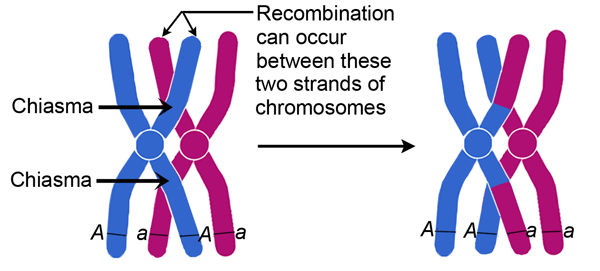

Crossing over in organisms is responsible for...?
Dominance of genes
Recombination of genes
Linkage
Segregation of alleles

The image is an example of
(a)
What is genetic recombination?
The combination of genes produced by crossing over and independent assortment.
When genes located close to each other on the same chromosome tend to travel together during meiosis.
A map that shows the sequence of genes on a chromosome.
The occurrence of one or more extra sets of chromosomes.

Crossing over occurs during prophase I of meiosis. Which statement about crossing over is true?
RNA translation occurs in the smooth endoplasmic reticulum
Crossing over takes place in backterial cells
Crossing over produces genetically identical daughter cells
Crossing over provides genetic diversity in eukaryotic cells
What mutation has occurred here?
T-G-A-C-C-A
T-G-A-G-C-A
Substitution
Deletion
Insertion
Frameshift
DNA molecule segment is : TTACGCAAG
The mutated DNA segment is TTCGCAAG. This is an example of ___ mutation.
Substitution
Deletion
Insertion
Inversion
A mutation is defined as:
A change in the cell's structure
Anything that changes in an embryo
Any change in the physical features of a human
A change in the DNA sequence
ATTTGAGCC- Original
ATTGAGCC - Mutated
The example above is an example of a
Insertion- Frameshift
Deletion- Substitution
Deletion -Frameshift
All of the above
Which of the following is an example of a harmful mutation?
Attached vs detached earlobes
Huntington's
Change in eye color
All of the above
Which of the following is an example of a helpful mutation?
Attached vs detached earlobes
Malaria resistance
Huntington's
All of the above
What are the two main goals of all species?
Eat and sleep
Become the top species and eliminate the weak
Survive and reproduce
Play Fortnite and eat pizza
Why are advantageous traits more likely to be passed onto offspring?
Because they are more likely to survive and reproduce.
Because they come from dominant alleles.
Because they come from recessive alleles.
Because the organism knew it needed that trait, survives, and passes it on.

