
 Worksheets
Energy, photosynthesis and cell respiration
Total questions: 213
Worksheet time: 5hrs 4mins
Which type of reaction releases energy?
catabolic
anabolic
What type of reaction needs energy in order to take place?
catabolic
anabolic
Which type of reaction occurs when monomers are put together to form a polymer?
catabolic
anabolic
How many phosphate molecules are in one ATP molecule?
1
2
3
4
How many phosphate molecules are in one ADP molecule?
1
2
3
4
When you remove a phosphate from ATP, what type of reaction is this?
catabolic
anabolic
When you add a phosphate to ADP, what type of reaction is this?
catabolic
anabolic

What is the full name of the molecule ATP?
Adenine Diphosphate
Adenosine Diphosphate
Adenine Triphosphate
Adenosine Triphosphate

What is ATP used for?
It is recharged to be used later.
As a backbone for DNA.
Special cell actions that require large amounts of energy.
Any cellular process requiring energy.

Which bond of the ATP molecule is broken in order to release energy?
A
B
C
D

Label A in the diagram is identified as...
reactants
products
activation energy
photosynthesis
Label D in the diagram is identified as...
reactants
products
activation energy
photosynthesis
This energy diagram shows a _____ reaction.
endothermic
exothermic
activation energy
photosynthesis
Metabolic reactions are controlled by _____ that bind to reactants.
enzymes
nucleic acids
lipids
carbohydrates

#1 in the diagram can be identified as...
active site
substrate
product
enzyme
#2 in the diagram can be identified as...
active site
substrate
product
enzyme
#3 in the diagram can be identified as...
active site
substrate
product
enzyme
#4 in the diagram can be identified as...
active site
substrate
product
enzyme
Which of the following factors can change the rate of a chemical reaction?
temperature
pH
substrate concentration
catalysts
competitive inhibitors
All of the chemical reactions within each cell of an organism...
metabolism
reactants
denaturation
endothermic
The breaking and forming of bonds between different substances during chemical changes...
chemical reactions
endothermic
exothermic
denaturation
The amount of energy needed to make a chemical reaction start...
activation energy
catabolic
anabolic
metabolism
Substances that are changed during a chemical reaction...
Reactants
Products
Metabolism
Catalyst
Substances that are made by a chemical reaction...
products
reactants
catalysts
enzymes
A type of reaction that absorbs energy...
endothermic
exothermic
active site
denaturation
A type of reaction that releases energy...
exothermic
endothermic
metabolism
denaturation
Proteins that speed up biochemical reactions by lowering activation energy...
enzymes
metabolism
active site
chemical reactions
Substances that speed up chemical reactions without being permanently altered...
catalysts
products
reactants
active sites
A region on an enzyme that fits only one substrate...
active site
activation energy
reactant
enzyme
A process in which an enzyme's active site gets deformed and loses its specific shape...
Denaturation
Metabolism
Catalyst
Catabolic
A process in which an enzyme's active site gets deformed and loses its specific shape...
Denaturation
Metabolism
Catalyst
Catabolic
A process in which an enzyme's active site gets deformed and loses its specific shape...
Denaturation
Metabolism
Catalyst
Catabolic
A reaction that builds larger molecules from smaller ones...
anabolic
catabolic
enzyme
denaturation
A reaction that breaks down larger molecules into simpler molecules
catabolic
anabolic
denaturation
enzyme
Which of the following factors can increase the rate of a chemical reaction?
increasing temperature
higher substrate concentration
catalysts
competitive inhibitors
How does energy change during a chemical reaction?
Breaking bonds requires energy absorption while building bonds releases energy
Breaking bonds releases energy while building bonds requires energy absorption
It doesn't change
Photosynthesis is
Anabolic
Catabolic
Fermentation
Cellular respiration occurs in
Ribosomes
Endoplasmic reticulum
Mitochondria
Chloroplasts
Fermentation can produce
Oxygen
Lactic acid
Glucose
Carbon
In photosynthesis, sunlight energy is transferred to
Oxygen
Carbon dioxide
Glucose
The light reaction split this molecule and grabs its electrons
Glucose
Oxygen
Water
This process occurs during the Calvin cycle
Carbon fixation
Splitting of water
Production of oxygen gas
When microbes decompose dead organisms, they produce
Oxygen gas
Carbon dioxide gas
Glucose
The conversion of ATP back to ADP is
Anabolic
Catabolic
Disastrous
Enzymes are proteins that_____ chemical reactions
Slow down
Speed up
Disrupt
Reactants of photosynthesis
Oxygen and water
Carbon dioxide and water
Glucose and carbon dioxide
Cellular respiration is the breakdown of
Water
Glucose
Carbon dioxide
oxygen
When oxygen is absent, cells will use this process for ATP
Cellular respiration
Photosynthesis
Fermentation
Food is the energy source for
Photosynthesis
Cellular respiration
Both
Energy carriers like ATP, NAHD, and NADPH are used in
Photosynthesis
Cellular respiration
Both
When a phosphate is added to ADP it is
Anabolic
Catabolic
Ridiculous
The light reactions occur in the
Mitochondria
Ribosomes
Thylakoid membranes

Is the mushroom a producer, consumer or decomposer?
producer
consumer
decomposer

Is the corn a producer, consumer or decomposer?
producer
consumer
decomposer

Is the catfish a producer, consumer or decomposer?
producer
consumer
decomposer

Why are decomposers important in an ecosystem?
They break down dead organic matter and recycle nutrients
They hunt for food
They make their own food

Is the green algae a producer, consumer or decomposer?
producer
consumer
decomposer


What is an animal that eats meat?
Carnivore
Herbivore
Omnivore

What type of animal eats plants and fruit?
Carninore
Herbivore
Omnivore

What type of animal eats both meat and plants?
Carnivore
Herbivore
Omnivore
What organelle does photosynthesis take place in?
chloroplasts
nucleus
mitochondria

In this figure, between which parts of the molecule must the bonds be broken to form an ADP molecule?
A and B
B and C
C and D
Plants gather the sun's energy with light-absorbing molecules called
pigments
thylakoids
stroma
The stroma is the space that surrounds
thylakoids
chloroplasts
plant cells
Where do light dependent reactions take place?
in the stroma
outside the chloroplasts
in the thylakoid membranes
The Calvin cycle is another name for
light independent reactions
light dependent reactions
photosynthesis
What is the product of the calvin cycle
oxygen gas
ATP
high energy sugars
Where are photosystems or light collecting units of photosynthesis found?
thylakoid membranes
stroma
granum

Photosystems I and II are found in the structure labeled ____ in this figure
A
B
neither
the oxygen released in photosynthesis comes from...
splitting water
splitting glucose
splitting chlorophyll
splitting carbon dioxide
which product of light reactions is not used by the calvin cycle?
NADPH
oxygen, O2
ATP
carbon dioxide, CO2
which of the following sequences correctly represents the flow of electrons during all of photosynthesis?
NADPH --> O2 ---> CO2
H2O---> photosystem l ----> photosystem ll
H20 ---> NADPH----> calvin cycle
NADPH -----> electron transport chain -----> O2
the final electron acceptor in the light reaction is
PGA
PEP
FAD+
NADP+
chlorophyll reflects (does not absorb) which color of light
blue
green
red
purple
the photosynthetic electron transport chain causes the accumulation of hydrogen ions in which part of the chloroplast?
stroma
matrix
outermembrane
thylakoid space
which of the following is nt associated with he thlakoid membrane
electron transport chain
ATP synthase
photosystmes l and ll
the calvin cycle
which of the following does not occur during the calvin cycle
reduction
carbon fixation
regenartion of RuBP
splitting of water
when light excites chlorophyll,the chlorophyll molecule
become onized
changes to carotene
becomes radioactive
absords he energy and moves electrons to a hugher energy level
which molecule must eneter the calvin cycle continually for the light independent reactions to take place?
rubisco
3- PGA
CO2
RUBP
which of the following sequences correctly represents the flow of electrons during all of photosynthesis?
NADPH --> O2 ---> CO2
H2O---> photosystem l ----> photosystem ll
H20 ---> NADPH----> calvin cycle
NADPH -----> electron transport chain -----> O2
In this chemcial equation, the highlight red is called the ______.
In this chemcial equation, the highlight red is called the ______.
Most of the ATP made during Cellular Respiration is made during which stage?
Glycolysis
Krebs
Electron Transport Chain
None of these
Which type of organisms can perform Cellular Respiration?
bacteria
plants
animals
both plants and animals
In the absence of oxygen, cells will do this process after performing Glycolysis to release energy
Photosynthesis
Electron Transport Chain
Kreb Cycle
Fermentation
What are the 3 stages of cellular respiration in the correct order?
Krebs, Glycolysis, Electron Transport Chain
Glycolysis, Krebs, Electron Transport Chain
Electron Transport Chain, Krebs, Glycolysis
What is the correct equation of cellular respiration?
oxygen + glucose -> carbon dioxide + water + ATP
oxygen + water -> carbon dioxide + glucose + ATP
carbon dioxide + water -> oxygen + glucose + ATP

What organelle converts glucose into ATP?
Ribosomes
Vesicles
Cytoskeleton
Mitochondria

What are the products of cellular respiration?
NADH and ATP
oxygen and heat
FADH2 and NADH
CO2 and H2O

Anaerobic means without ________?
Nitrogen
Carbon Dioxide
Oxygen
Phosphorus
Aerobic means with oxygen
True
False
Match the Number with the part of the Mitochondria.
Mitochondrial Matrix
dna
outer membrane
inner membrane
cristae


What happens in ETC?
Electrons flow through ATP Synthase, which makes ATP
Pyruvate are stuck together, pulled apart, repeat
Water breaks sugar
Nothing
What are reactants for ETC?
Pyruvate, Oxygen
Oxygen, NADH, FADH2
Sugar, Water
ATP
What are reactants for Krebs Cycle?
Pyruvate, Oxygen
Oxygen, NADH, FADH2
Sugar, Water
ATP
What happens in Krebs cycle (aka Citric Acid Cycle)?
Electrons flow through ATP Synthase, which makes ATP
Pyruvates are stuck together, pulled apart, repeat
Water breaks sugar
Nothing
What happens in glycolysis?
Electrons flow through ATP Synthase, which makes ATP
Pyruvates are stuck together, pulled apart; this repeats again and again
Water breaks sugar
Nothing
What is the first step?
Stimulus
ETC
Krebs Cycle
Glycolysis
Where does cellular respiration happen?
Glucose
Mitochondria
Cytoplasm
Homeostasis
What is NOT a part of the mitochondria
The Matrix
Inner membrane
Cristae
Thylakoid
saclike photosynthetic membranes stacked inside a chloroplast
pigments
thylakoids
chlorophyll
photosynthesis
the first set of reactions in photosynthesis
adenosine triphosphate
light-dependent reaction
photosystem
respiration
ATP one of the most important compounds that cells use to store and release energy
photosynthesis
light-dependent reaction
adenosine triphosphate
pigments
the light-absorbing molecules plants use to gather the sun’s energy
photosystems
adenosine triphosphate
glucose
pigments
organisms that make their own food
autotrophs
heterotrophs
pigments
adenosine triphosphate
the fluid portion in a chloroplast that surround the thylakoid
stroma
chlorphyll
photosystem
pigment
clusters of chlorophyll and proteins in the thylakoid membrane
light-dependent reaction
pigments
photosystems
chloroplasts
the plants’ principal pigment
thylakoid
photosystem
heterotroph
chlorophyll

A research scientist designs an experiment to measure the inputs and outputs of photosynthesis, by mass, for a representative plant over a certain time. The scientist’s predictions for the results are shown in the table.
The table that the scientist constructed does not include light. Describe the role of light in the scientist’s experiment. Then propose an explanation for why light was not included in the table.
Light provides the energy for the chemical reactions that take place during photosynthesis, and the table includes only matter, not energy.
Light provides the matter for the chemical reactions that take place during photosynthesis, and the table includes only energy, not matter.
Light is a product of the chemical reactions that take place during photosynthesis, and the table includes only reactants, not products.
Light plays no role in the scientist’s experiment and therefore was not included in the table.
A research scientist designs an experiment to measure the inputs and outputs of photosynthesis, by mass, for a representative plant over a certain time. The scientist’s predictions for the results are shown in the table.
What is the main role of carbon dioxide during the process of photosynthesis?
Carbon dioxide is a waste product that is released into the atmosphere.
Carbon dioxide is used to assemble sugars, the main product of photosynthesis.
Carbon dioxide is used to accept electrons and transfer them between photosystems.
Carbon dioxide is used to transfer energy from the light-dependent reactions to the light-independent reactions.
A research scientist designs an experiment to measure the inputs and outputs of photosynthesis, by mass, for a representative plant over a certain time. The scientist’s predictions for the results are shown in the table.
If the scientist’s predictions are shown to be accurate, then which conclusion about photosynthesis do they support? (HINT: Apply scientific principles such as the Law of Conservation of Mass.)
All of the matter in water is converted into oxygen gas.
All of the matter in carbon dioxide is converted into oxygen gas.
All of the matter in carbon dioxide is converted into sugars.
Some but not all of the matter in carbon dioxide is converted into sugars.

In both photosystem I and photosystem II, light energy is used to excite electrons. The two photosystems were named in the order of their discovery, and not the order of their work in the light-dependent reactions. Photosystem II comes first in the sequence of events that moves electrons from water molecules to their destination, NADP+. Hydrogen ions travel with the electrons, and they combine with NADP+ to form NADPH. The process is summarized in this diagram.
The concentration of hydrogen ions is greater inside the thylakoid than outside. Which reaction releases hydrogen ions inside the thylakoid?
the break-up of NADPH
the formation of NADPH
the break-up of water molecules
the formation of water molecules
In both photosystem I and photosystem II, light energy is used to excite electrons. The two photosystems were named in the order of their discovery, and not the order of their work in the light-dependent reactions. Photosystem II comes first in the sequence of events that moves electrons from water molecules to their destination, NADP+. Hydrogen ions travel with the electrons, and they combine with NADP+ to form NADPH. The process is summarized in this diagram.
In the diagram, an arrow leads from the splitting of water, to the two photosystems, and then to NADP+. What process is represented by this arrow?
the formation of high-energy sugars
the cycling of light energy within the photosystems
the movement of electrons along the electron transport chain
the conversion of electrons into sunlight

The model includes a wavy arrow to show light striking the thylakoids. Which label for the wavy arrow would be MOST USEFUL for communicating the role of light in photosynthesis?
Light is radiated from the chloroplast during the light-independent reactions.
Light energy is cycled within the thylakoid.
The chloroplast reflects the green wavelengths of light.
Light is the energy source for converting ADP to ATP, and NADP+ to NADPH.
To revise the model, Chandler wants to use color to identify the reactants of photosynthesis. Which labels should he color?
H2O and O2
O2 and CO2
H2O and CO2
H2O, O2, and CO2

Jerry is developing the model shown to illustrate the process of photosynthesis. He plans to use the model to explain how photosynthesis transforms both energy and matter. In a key or legend for the model, how should Jerry describe the roles of NADPH and ATP in the light-independent reactions?
providing the oxygen for sugar molecules
providing the carbon for sugar molecules
absorbing the energy of light and transferring it to electrons
supplying the energy necessary to assemble sugar molecules
Fred is developing a model of the light-independent reactions of photosynthesis, also known as the Calvin cycle. How should the model show how carbon compounds enter and exit the cycle?
enter as glucose, exit as carbon dioxide
enter as glucose, exit as 3-carbon molecules
enter as carbon dioxide, exit as 3-carbon molecules
enter as elemental carbon, exit as 6-carbon molecules
During the light-dependent reactions of photosynthesis, which event must occur for ATP synthase to function properly?
Hydrogen ions must pass through a channel within ATP synthase.
Molecular oxygen must combine with ATP synthase.
A molecule of ATP must release a phosphate group to become ADP.
Photosystem I and photosystem II must be deactivated.
Which is the role of the electron transport chain in the process of photosynthesis?
adding energy to the electrons that enter photosystem I
carrying electrons from photosystem II, to photosystem I, to NADP+
removing electrons from the chloroplast
cycling electrons between photosystem I and photosystem II
What best describes the roles of photosystem I and photosystem II in the process of photosynthesis?
They transfer electrons from a series of intermediates to form NADPH.
They absorb sunlight and transfer the energy to electrons.
They form ATP as hydrogen ions cross the thylakoid membrane.
They absorb sunlight and distribute the energy as heat.

During photosynthesis, what best describes the role of the compound with the chemical formula C6H12O6?
a product that is not useful because of its low-energy chemical bonds
a product that is useful because of its high-energy chemical bonds
a reactant that is useful because of its high-energy chemical bonds
either a product or a reactant, depending on whether the cell needs to store energy or release energy
By analyzing this equation, which property of photosynthesis can be identified?
the chemical changes that occur during the light-independent reactions
the chemical changes that occur during the light-dependent reactions
the source of carbon atoms in the carbohydrate product
the identities and roles of electron carriers
What best describes the role of light in the overall process of photosynthesis?
Light accepts the energy that is released by small molecules.
Light accepts the energy that is released by sugars.
Light provides the energy for breaking apart sugars into small molecules.
Light provides the energy for assembling small molecules into sugars.
Joy is describing the role of electron carriers, such as NADP+, in photosynthesis. Which property of NADP+ should Joy cite?
the chemical bonds formed by electrons in its molecular structure
its ability to accept and release high-energy electrons and a hydrogen ion
its reactivity with oxygen, water, and carbon dioxide
its ability to emit a stream of electrons in a nuclear reaction
Jane is asked to describe the structural organization of chloroplasts. She writes the following sentence: “A chloroplast contains thylakoid stacks, called stroma, that are surrounded by fluid-filled grana.” Which change to the sentence is necessary to make the sentence accurate?
Replace “grana” with “chlorophyll.”
Replace “stroma” with “chlorophyll.”
Exchange the positions of “stroma” and “grana.”
Exchange the positions of “thylakoid” and “stroma.”
Carl is explaining why chlorophyll is classified as a plant pigment and how it is useful in photosynthesis. Which property of chlorophyll would be most appropriate for him to cite?
chlorophyll’s ability to absorb light
chlorophyll’s green color
chlorophyll’s presence in chloroplasts
chlorophyll’s reactivity with oxygen


Label the structures in light-dependent reactions.
Thylakoid Space
Photosystem I
Photosystem II
ATP Synthase
Stroma
Label the diagram for photosynthesis.
Carbon DIoxide
NADPH
ATP
Sugars
Oxygen
Water
NADP+
ADP
Thylakoid Membrane
Stroma
During which phase of photosynthesis is glucose actually made?
1st phase - the light reactions
2nd phase - the Calvin Cycle
both the 1st and 2nd phases
For chemiosmosis to work there needs to be a H+ concentration gradient. How is this gradient made? (Check all that apply.)
H+ come from the ATP molecule.
The Calvin Cycle regenerates the H+.
H+ come from the splitting of water.
The H+ get pumped against the gradient using energy from the electrons in the electron transport chain during the light reactions.
Why is light needed for photosynthesis?
Light causes glucose to be synthesized directly inside the chlorophyll molecules of the photosystems.
Light splits water molecules and causes electrons to get excited (gain energy) and travel down the electron transport chain in the thylakoid membrane.
Light causes the conversion of water into carbon dioxide, oxygen, and electrons and energizes chemiosmosis.
Light directly causes carbon dioxide to attach to RuBP during the carbon fixation stage of the Calvin Cycle.
Where in the chloroplast does the Calvin Cycle take place?
thylakoids
matrix
stroma
nucleus
Chemiosmosis makes
NADPH for the Calvin Cycle.
ATP for the Calvin Cycle.
Both NADPH and ATP for the Calvin Cycle.
ATP for the electron transport chain.
What part of the plant cell performs photosynthesis?
The Mitochondrion
The Nucleus
The Chloroplast
The Cell Wall
An enzyme that has a channel through which the H+ flows back out of the thylakoids.
ATP synthase
ADP catalazye
thylakoidase
photosystems
Which of the following is NOT a reactant of the light independent reactions?
NADPH
ATP
Oxygen
Carbon dioxide

What happens to the remaining (5) G3P molecules in the last step of the Calvin Cycle?
They are used to make glucose.
They are reshuffled to make CO2 by adding ATP.
They exit the cycle.
They are reshuffled to make RuBP by adding ATP.
What happens to NADPH and ATP after they are used in the Calvin Cycle?
they recycle back to the light reactions
they are used to make G3P
They become denatured
They are then digested by the lysosomes
What does carbon dioxide combine with to start the Calvin Cycle?
NADPH
ATP
RuBP
G3P
Which of the following would have an affect on the rate of photosynthesis?
amount of water
carbon dioxide concentration
temperature
all of these
Temperatures that are too high can slow photosynthesis because
stomata stay open
enzymes are ruined
there is not enough CO2
there is too much water

The following are parts of the chloroplast:
stomata -- tiny pores that allow for gas exchange
granum -- stacks of thylakoids
stroma -- colorless fluid surrounding the thylakoid
chlorophyll -- light absorbing pigment
What is the first stage of the Calvin Cycle?
Carbon fixation
Reduction
Regeneration of RUBP
Primary
What is the second stage of the Calvin Cycle?
Carbon fixation
Reduction
Regeneration of RUBP
Secondary

The Calvin Cycle occurs in the
Thylakoid
Grana
Inner membrane of chloroplast
Stroma
Main products of the Calvin Cycle
Oxygen, NADP+, ADP
Glucose, CO2, ADP
ADP, NADP+, Glucose
ATP, NADPH, Oxygen
5 carbon sugar that combines with CO2 in the Calvin Cycle
3-PGA
G3P
RuBP
Glucose
CAM plants keep stomata closed in daytime, thus reducing loss of water. They can do this because they
fix CO2 into organic acids during the night.
fix CO2 into sugars in the bundle-sheath cells.
fix CO2 into pyruvate in the mesophyll cells.
use photosystem I and photosystem II at night.
Why are C4 plants able to photosynthesize with no apparent photorespiration?
They do not participate in the Calvin cycle.
They use PEP carboxylase to initially fix CO2.
They conserve water more efficiently.
They exclude oxygen from their tissues.
What would be the expected effect on plants if the atmospheric CO2 concentration was doubled?
All plants will experience increased rates of photosynthesis.
C3 plants will have faster growth; C4 plants will be minimally affected.
C4 plants will have faster growth; C3 plants will be minimally affected.
C3 plants will have faster growth; C4 plants will have slower growth.
The pH of the inner thylakoid space has been measured, as have the pH of the stroma and of the cytosol of a particular plant cell. Which, if any, relationship would you expect to find?
The pH within the thylakoid is less than that of the stroma.
The pH of the stroma is lower than that of the other two measurements.
The pH of the stroma is higher than that of the thylakoid space but lower than that of the cytosol.
The pH of the thylakoid space is higher than that anywhere else in the cell.
A flask containing photosynthetic green algae and a control flask containing water with no algae are both placed under a bank of lights, which are set to cycle between 12 hours of light and 12 hours of dark. The dissolved oxygen concentrations in both flasks are monitored. Predict what the relative dissolved oxygen concentrations will be in the flask with algae compared to the control flask.
The dissolved oxygen in the flask with algae will be higher in the light, but the same in the dark.
The dissolved oxygen in the flask with algae will be higher in the light, but lower in the dark.
The dissolved oxygen in the flask with algae will always be higher.
The dissolved oxygen in the flask with algae will always be lower.
Label the 3 stages of cellular respiration occue
Glycolysis
Kreb Cycle
Electron Transport Chain
ATP is made in the second light reaction calledchemiosmosis by
adding H+ and electrons to NADP+.
adding H+ and electrons to ADP.
adding a phosphate to ADP.
adding a phosphate to NADP+.
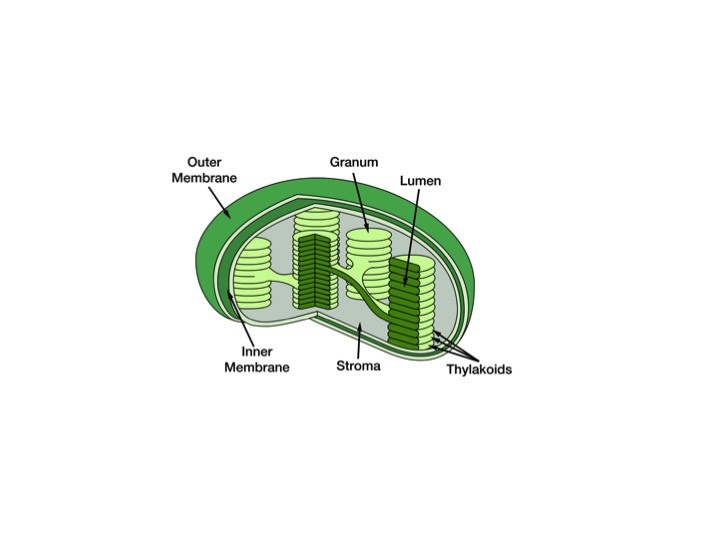
Chloroplasts are...
Organelles in animal cells to produce ATP.
Organelles where lipids are made in animals.
Organelles in plants where food is made.
Waste organelle in plants.
Where in the chloroplast does the Calvin Cycle take place?
thylakoids
matrix
stroma
nucleus
Which are the correct names for the steps of the Calvin Cycle?
Step 1: carbon reduction
Step 2: carbon fixation
Step 3: regeneration of carbon
Step 1: regeneration of RuBP
Step 2: carbon reduction
Step 3: carbon fixation
Step 1: carbon fixation
Step 2: carbon reduction
Step 3: regeneration of RuBP
Why is light needed for photosynthesis?
Light causes glucose to be synthesized directly inside the chlorophyll molecules of the photosystems.
Light splits water molecules and causes electrons to get excited (gain energy) and travel down the electron transport chain in the thylakoid membrane.
Light causes the conversion of water into carbon dioxide, oxygen, and electrons and energizes chemiosmosis.
Light directly causes carbon dioxide to attach to RuBP during the carbon fixation stage of the Calvin Cycle.

In the picture of the chloroplast, structure #2 is
stroma - the fluid part of the chloroplast
thylakoids - the saclike structures in the chloroplast
outer membrane of the chloroplast

In this picture of the chloroplast, the structure labeled 1 is:
stroma - the fluid part of the chloroplast
a thylakoid - a saclike structures in the chloroplast
grana - stacks of thylakoids
The Calvin Cycle is the __________ phase of photosynthesis.
light independent
light dependent

