wayground logo

Free Printable Worksheets

NEW

Font size

S
M
L
XL
Worksheets

Science Benchmark Review

Total questions: 62

Worksheet time: 51mins

Name
Class
Date
1.

Which of the following substances can dissove in water?

a)

salt

b)

rocks

c)

pebbles

d)

grass

2.

What will happen if you pour salt into water and stir it?

a)

It will dissolve.

b)

It will stay separate.

3.

If something has more density than water, what will happen to that substance?

a)

It will sink.

b)

It will float.

4.

If something has less density than water, what will happen to that substance?

a)

It will sink.

b)

It will float to the top.

5.
If you replace the paper clip with a plastic spoon, what is the plastic spoon acting as?
a)
A conductor
b)
A diode
c)
An insulator
d)
A switch
6.
If you replace the paper clip with a plastic spoon, what happens?
a)
The bulb doesn't light
b)
The bulb is dimmer
c)
The wires get hot
d)
There is no change
7.
Which of these objects is an insulator?
a)
Copper Wire
b)
Paper Clip
c)
Steel Pole
d)
Rubber Gloves
8.
An object through which electrons can easily flow is called a(n) ___________.
a)
Conductor
b)
Insulator
9.
Which statement is true?
a)
The light bulb will light up because the  circuit is complete.
b)
The light bulb will light up because the  circuit is broken.
c)
The light bulb will not light up because the  circuit is complete.
d)
The light bulb will not light up because the  circuit is broken.
10.
Which one is a conductor? 
a)
wood 
b)
iron 
c)
plastic spoon 
d)
paper 
11.
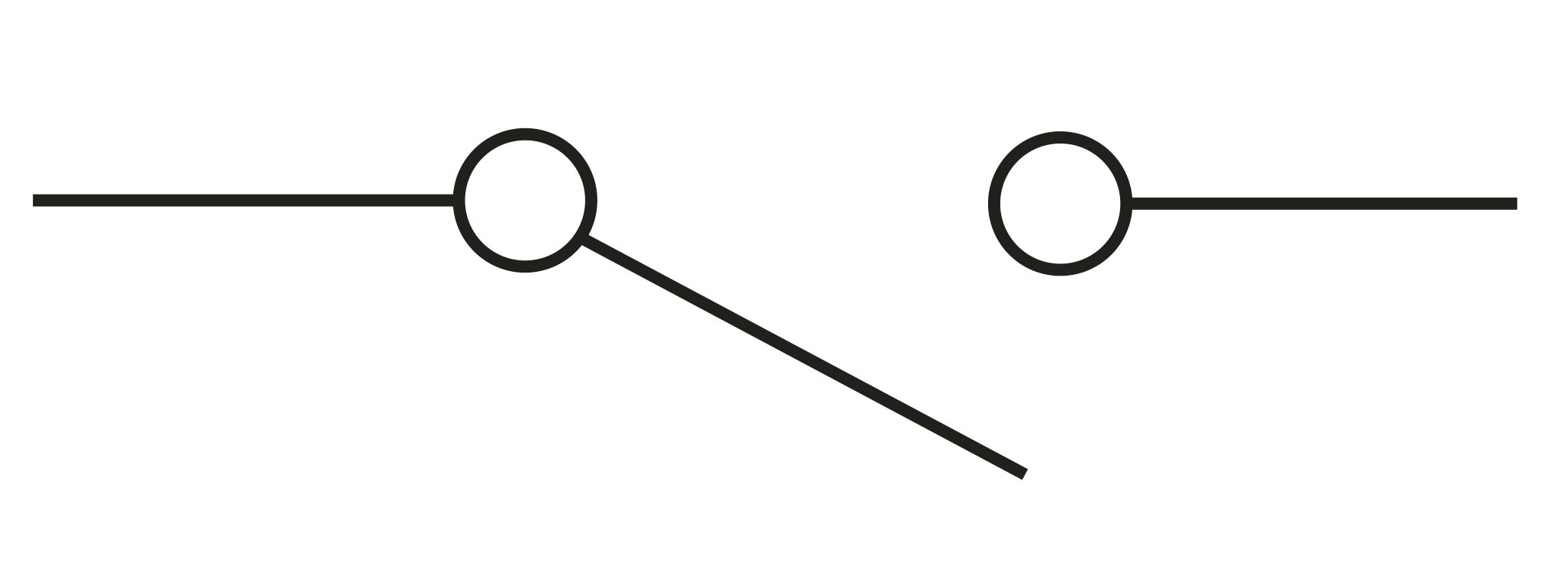
this is the symbol for a _____?
a)
switch
b)
light 
c)
battery
d)
wires
12.

If a circuit is OPEN...

a)

the circuit is complete and the light will work.

b)

the circuit is broken and the light will NOT work

c)

the circuit is a series circuit

13.

A series circuit...

a)

has a single path for energy to flow

b)

has multiple paths for energy to flow

c)

has a single load

14.

A complete, unbroken path that allows electricity to flow is called a ___________ circuit.

a)

open

b)

closed

c)

parallel

15.

The buildup or electrical charges is called ________. It is what makes clothes stick together.

a)

static electricity

b)

charged particles

16.

What type of circuit is this?

a)

parallel circuit

b)

series circuit

c)

open circuit

d)

closed circuit

17.

Will the light bulb light in this circuit?

a)

Yes

b)

No

18.

Is a plastic fork an insulator or conductor?

a)

insulator

b)

conductor

19.

Is a paperclip an insulator or a conductor?

a)

insulator

b)

conductor

20.

Which of the following is an insulator?

a)

nail

b)

screw

c)

cardboard

d)

copper sheet

21.

When ___________ and __________ charges are not balanced they can cause object to attract to one another.

a)

positive, positive

b)

positive, negative

c)

negative, negative

22.
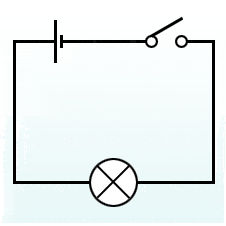
this circuit is .....?
a)
open
b)
parallel
c)
closed
d)
The cutest little circuit evah!
23.
When all parts of the circuit are connected it is a ______ circuit. 
a)
open
b)
closed
24.

What are the 3 States of Matter

a)

Solid, Iron, Gas

b)

Solid, Liquid, Gas

c)

Iron Liquid Gas

d)

Metals, nonmetals, metalloids

25.

Why does a penny Sink in water

a)

Pennies are less dense than water

b)

Pennies are more dense than water

26.

What does ice float in water?

a)

Ice cubes are less dense than water

b)

Ice cubes are more dense than water

27.
Which liquid has the least density?
a)
Water
b)
Glycerine
c)
Corn Oil
d)
Corn Syurp
28.
Volume is __________.
a)
how many atoms
b)
how much matter is in an object
c)
how  much something weighs
d)
how much space an object takes up
29.
Which liquid is the most dense?
a)
corn syurp
b)
water
c)
glycerine
d)
corn oil
30.
An object that floats in water is __________.
a)
more dense than water
b)
same density as water
c)
less dense than water
d)
must be in the shape of a cube
31.
What causes an object to float in a water?
a)
if the object's density is less than the water's density.
b)
if the object's density is the same as the water's density
c)
if the object's density is greater than the water's density
d)
if the object's density is zero
32.
What causes an object to sink in a water?
a)
if the object's density is less than the water's density.
b)
if the object's density is the same as water's density.
c)
if the object's density is greater than water's density.
d)
if the object's density is zero
33.
What property do these tools measure?
a)
volume
b)
mass
c)
length
d)
temperature
34.
What is volume of the water? 
a)
10 mL
b)
15 mL
c)
20 mL
d)
25 mL
35.
What is the volume of the rock?
a)
30cm3
b)
10cm3
c)
40cm3
d)
20cm3
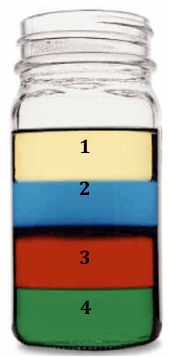
36.
Put the liquids in order from most dense to least dense?
a)
4, 3, 2, 1
b)
1, 2, 3, 4
c)
3, 4, 2, 1, 
d)
4, 3, 1, 2
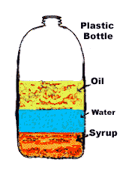
37.
Which liquid is the least dense?
a)
oil
b)
water
c)
syrup 
d)
plastic bottle
38.
What is this tool to get volume?
a)
triple beam balance
b)
ruler
c)
thermometer
d)
graduate cylinder
39.
Look at this image.  Which object has the LOWEST density in water? How
a)
The Ping Pong Ball because it floats to the top 
b)
The bolt because it has sunk to the bottom
c)
The soda cap because it is not just full of air like the Ping Pong ball
40.
Why do the liquids form different layers?
a)
They have different densities.  
b)
They have different masses.  
c)
They have different volumes.  
d)
They are different temperatures.  
41.
A brick sinks in water while a wooden block of the same size floats.  This is because the brick has a
a)
lower volume than the wooden block
b)
lower density than the wooden block
c)
higher volume than the wooden block
d)
higher density than the wooden block
42.
If you poured 3 liquids that do not mix how could you tell which one is the most dense?
a)
The liquid on top
b)
The liquid in the middle
c)
The liquid at the bottom
43.
An object should float in a liquid if it is 
a)
Denser than the liquid 
b)
Less dense than the liquid
c)
Lighter than metal
d)
 Shaped like a ball 
44.

What is Solubility?

a)

If something dissolves in water

b)

If something sinks in water

c)

If something floats in water

d)

None of the above

45.

Salt has Solubility because it dissolves in water.

a)

True

b)

False

46.

Which answer does NOT have solubility?

a)

sugar

b)

salt

c)

oil

47.

What does dissolve mean?

a)

The particles spread out and become part of the water

b)

It sinks to the bottom of the water

c)

It floats on top of the water

d)

None of the above

48.

Is pepper soluble?

a)

Yes, it dissolves in water

b)

No, it sinks in water

c)

No, it floats in water

d)

Yes, it doesn't dissolve in water

49.

When something dissolves in water then it has Solubility.

a)

True

b)

False

50.

Which answer is Soluble in water?

a)

rocks

b)

honey

c)

pepper

d)

marbles

51.

Koolaid is soluble in water.

a)

True

b)

False

52.
Electric charges that are alike _______ each other.
a)
Attract
b)
Repel
53.
Ms Jo Jo rubbed two balloons with a piece of wool. What will happen when the balloons are brought near each other?
a)
The balloons will repel each other.
b)
The balloons will attract each other.
c)
The balloons will become positively (+) charged.
d)
The balloons will pop.
54.
This form of energy is created using heat.
a)
thermal
b)
light
c)
heat
d)
sound
55.

This microwave uses what type of energy to heat up food?

a)

mechanical energy

b)

sound energy

c)

electrical energy

d)

light energy

56.

Which form of energy is produced when a lamp is switched on?

a)

Sound energy

b)

Electrical energy

c)

Chemical energy

d)

Light energy

57.
What kind of energy does this device use?
a)
Chemical
b)
Electrical
c)
Thermal
d)
Chemical
58.

What kind of energy is represented in this picture?

a)

Thermal and light energy

b)

Sound

c)

Electrical

d)

Mechanical

59.
 Ryan rubs two sticks together quickly. When he stops rubbing the sticks, he notices that they are warm to touch where he rubbed them. Which type of energy has been produced?
a)
sound energy
b)
electrical energy
c)
light energy
d)
heat energy
60.

If metal is exposed to the sun for a long period of time, it will get very hot because ______.

a)

It is a conductor.

b)

It is an insulator.

61.

What part of a pencil is a conductor of electricity?

a)

the eraser

b)

the silver part near the eraser

c)

the wood

62.

If a circuit is complete, __________.

a)

energy will flow through it

b)

energy will NOT be able to pass