
Font size
 Worksheets
Semester 1 - 6th Grade
Total questions: 76
Worksheet time: 2hrs 48mins
Biotic factors are...
living things
non-living things
undead things
Abiotic factors are...
living things
non-living things
undead things

Which organism is a primary consumer?
Hawk
Grass
Frog
Mouse
A __________ includes all living and non-living things in an environment.
population
ecosystem
community
A producer in an ecosystem gets its energy by:
consuming, or eating, other organisms
breaking down dead organisms
drinking water
using the sun to make its own energy
There are not enough rabbits to feed a fox population in a forest. What is the limiting factor in this situation?
Food
Space
Shelter
New Organism
If a deer does not have enough water to drink in an ecosystem, how will the population change?
It will increase
It will decrease
The population of predators in an ecosystem increases. Which of the following would be the best explanation for why this happened?
There is a large population of prey.
There is a small population of prey.
There was a drought.
The season changed.
If the amount of food resources increases, the population of an animal would
increase
decrease
stay the same
go extinct
If a disease that destroyed oak trees came through an ecosystem, what would happen to the acorn eating squirrel population?
nothing - it would stay the same
the squirrel population would increase
the squirrel population would decrease
none of the above
All living things need ________ to survive.
water
space
food
all of the above
A mouse is eaten by an eagle; the mouse is prey.
True
False
Both plants and animals will benefit from adaptations to improve their chances to survive.
True
False
Why do plants use camouflage?
to look more beautiful
to aid in pollination
to help predators approach them
What adaption helps an animal survive in cold weather?
smell
thick fur
food
shelter
A feature that allows an organism to survive its environment is called what?
Evolution
Adaptation
Trait
Survivability factor
What is an adaptation?
A characteristic that helps a plant or animal survive
The way a plant or animal lives
A TV drama based on a book
How an animal feels
What structure on a rabbit helps it survive in a cold climate?
thick fur
brown eyes
long tail
strong claws
Which adaptations most likely help a plant survive in a dry environment?
deep roots
large leaves
red flowers
sour fruit
Which result is likely to happen to a species that cannot adapt to changes in its environment?
Grow and reproduce
Decrease in numbers or become extinct
Only hunt at night
Only eat one type of food.
A behavioral adaptation is what an animal DOES in order to survive.
True
False
A physical adaptation is something an animal _________________..
Has
Does
Likes
Mimicry is ________________.
When an animal looks like another animal
when an animal is not seen at all
when an animal blends in to the tree
when an animal is poisonous
An example of camouflage is ______________.
an arctic fox's white fur
a frog's bright colors
an elephant's big ears
a giraffe's long neck
Adaptations can be either ______________ or _______________.
Physical, Behavioral
Physical, Useful
Behavioral, Useful
Physical, Adaptive
A ______________ is something an animal does – how it acts - usually in response to some type of external stimuli.
Body adaptation
Structural adaptation
Instinctual adaptation
Behavioral adaptation
What is homeostasis?
the ability to go into chaos rather than balance
the state of change in an organism
the tendency to resist change in order to maintain a stable, relatively constant internal environment
A snake relies on the sun to keep its body temperature at a safe range. This snake is a(n) _____________.
Endotherm
Ectotherm
Herbivore
Omnivore
_____________ is an animal that uses energy from their body to keep their body at a steady temperature.
Ectotherm
Cellular Respiration
Endotherm
Herbivore
Endotherms are called cold-blooded.
True
False

Which of the following geologic events would most likely occur where two continental plates converge?
tsunami
earthquake
mountain formation
Movement between the Pacific plate and the North American plate create the San Andreas Fault in California. What type of motion is occurring?
convergent
divergent
transform
The mantle is the ______ layer of the earth
thinnest
thickest
coldest
hottest
The lithosphere consists of the-
upper mantle and crust.
lower mantle and outer core.
inner and outer core.
crust and the entire mantle.
According to scientific data, which layer of Earth is the thickest?
Crust
Inner Core
Mantle
Outer Core
Oceans and other bodies of water are found on which layer of the Earth?
Outer Core
Mantle
Inner Core
Crust
What is the coolest layer?
Crust
Mantle
Outer Core
Inner Core
What is the hottest layer?
Crust
Mantle
Outer Core
Inner Core
What are convection currents?
the cycle of heated rock or metal rising, and cooling rock or metal falling.
the cycle of cooling rock or metal rising, and heated rock or metal falling.
an electric current found in the mantle.
and electric current found in the outer core.
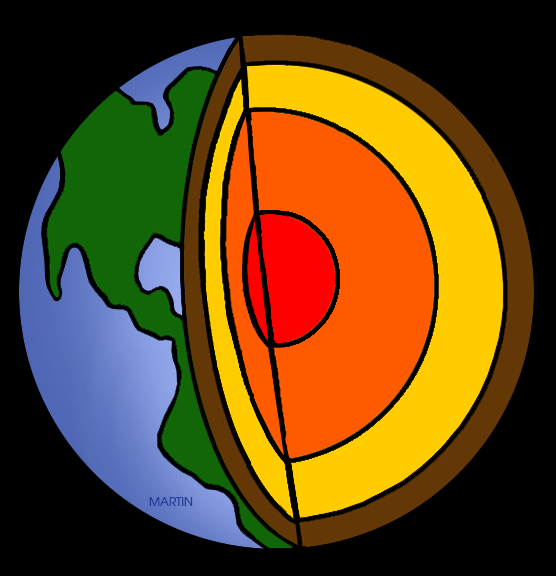
Which layer is shown in red?
crust
mantle
outer core
inner core
What layer of the Earth do we live on?
mantle
inner core
crust
outer core

What layer of the Earth is labeled A?
inner core
outer core
mantle
crust


______________ is the breaking down of rock material by physical and chemical processes.
Weathering
Erosion
Deposition
Sedimentary Exchange
This type of weathering occurs when rock is physically broken down into smaller pieces of rock.
physical weathering
chemical weathering
erosion weathering
deposition
What is the Theory of Continental Drift?
Earth's continents do not move.
Earth's continents moved in the past and continue moving today.
Earth's continents will eventually fall off the planet.

What is the name for the large landmass of all the continents that formed 175 million years ago?
Pangaea
Laurasia
United Continents
What piece of evidence for Continental Drift states that the same plant and animal fossils are found on continents separated by oceans.
Continent Shape
Fossil/Climate Evidence
Landform/Rock Evidence
Glacial Evidence
What piece of evidence for Continental Drift states that similar types and ages of rocks are found on different continents?
Continent Shape
Fossil/Climate Evidence
Landform/Rock Evidence
Glacial Evidence
What piece of evidence for Continental Drift states that glacial deposits and glacial scarring are found on continents with warm climates today.
Continent Shape
Fossil/Climate Evidence
Landform/Rock Evidence
Glacial Evidence
What is the process of magma pushing up through a mid-ocean ridge, forming new crust, and pushing continents apart called?
seafloor spreading
seafloor growing
volcanic volleyball
What is the process of magma in the mantle rising and cooling and sinking and warming that causes the continents to move?
a tiny mouse running on a wheel
magma wheel
convection currents
In what layer of Earth do convection currents happen?
crust
mantle
outer core
inner core

