wayground logo

Free Printable Worksheets

Font size

S
M
L
XL
Worksheets

Semester 1 - 7th Grade

Total questions: 76

Worksheet time: 2hrs 55mins

Name
Class
Date
1.

The area around a magnet is called?

a)

magnetic field

b)

magnetism

c)

magnetic poles

d)

friction

2.
Where is the force of attraction the strongest on a magnet?
a)
at the poles
b)
in the middle
c)
above the magnet
d)
below the magnet
3.

Every magnet has a:

a)

East and West pole

b)

North and South pole

c)

East and South pole

d)

North and West pole

e)

Chicago and Saint pole

4.
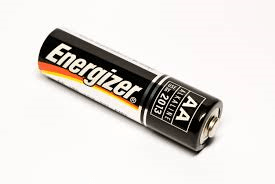
The picture is an example of an:
a)
Electric circuit
b)
Electromagnet
c)
Electric nail
d)
Electric power cell
5.

Which metal can be attracted to magnets?

a)

Copper

b)

Aluminum

c)

Iron

d)

Gold

6.
What will happen when these magnets are brought close together?
a)
They will attract each other.
b)
They will repel each other.
c)
Both magnets will turn to the left
d)
Both magnets will turn to the right
7.

To make this electromagnet stronger you could:

a)

use less wire

b)

have fewer wire coils around the nail

c)

have more wire coils around the nail

d)

use a plastic core

8.
What is an electromagnet?
a)
a magnet that creates an electric current
b)
a magnet created by an electric current
c)
a magnet that has an electric charge
d)
an electric charge that is magnetic
9.

When two magnets are brought together, the north pole and a south pole ______________ each other.

a)

repel

b)

attract

10.

An electromagnet is a magnet that

a)

has only one pole

b)

can be turned on and off

c)

always pushes objects

d)

produces electricity

11.

Which of the following is true of all magnets?

a)

all magnets can be turned on and off

b)

all magnets have a strong magnetic force

c)

all magnets always pull instead of push

d)

all magnets have a north pole and a south pole

12.
What charge does a proton have?
a)
negative (-)
b)
positive (+)
c)
neutral or no charge (0)
13.
What charge does an electron have?
a)
negative (-)
b)
positive (+)
c)
neutral or no charge (0)
14.
What types of charges attract?
a)
Positive and Positive
b)
Positive and Neutral
c)
Negative and Neutral
d)
Positive and Negative
15.
If a substance has a higher number of electrons than protons on its surface, what type of charge does it have?
a)
A positive charge.
b)
A negative charge.
c)
A neutral charge
d)
No charge at all
16.
What types of charges repel?
a)
Positive and Positive
b)
Positive and Neutral
c)
Negative and Neutral
d)
Neutral and Neutral
17.
A disturbance that travels through a medium as a longitudinal wave
a)
sound
b)
wavelength
c)
pitch
d)
frequency
18.
travels through solids fastest because the molecules are closer together
a)
speed of sound
b)
wavelength
c)
frequency
d)
amplitude
19.
The number of wavelengths that pass a point each second
a)
frequency
b)
wavelength
c)
pitch
d)
amplitude
20.
Material (matter) through which a wave travels
a)
medium
b)
Doppler Effect
c)
sound
d)
pitch
21.
How high or low a sound is; depends on the frequency (greater frequency= higher pitch)
a)
pitch
b)
frequency
c)
sound
d)
medium
22.
When the sound source moves, the frequency changes
ex. police car siren sounding lower pitch after the car passes
a)
pitch
b)
frequency
c)
Doppler Effect
d)
medium
23.
The part of a longitudinal wave where the particles of the medium are close together.
a)
rarefaction
b)
compression
c)
crest
d)
trough
24.
A part in a longitudinal wave where the particles are spread apart
a)
compression
b)
rarefaction
c)
crest
d)
trough
25.
The number of wavelengths that pass a point each second
a)
crest
b)
amplitude
c)
frequency
d)
pitch
26.
Highest point of a wave
a)
crest
b)
trough
c)
wavelength
d)
frequency
27.

What is the part of a wave where the particles are packed tightly and there is a lot of pressure?

a)

wavelength

b)

frequency

c)

compression

d)

rarefaction

28.

The "taller" a wave (the further the wave is pushed), the ________ the sound.

a)

higher

b)

lower

c)

quieter

d)

louder

29.

The "shorter" a wave (the less the wave is pushed), the ______ the sound.

a)

quieter

b)

louder

c)

higher

d)

lower

30.

This image shows a change in what characteristic of sound? Click ALL that apply

a)

volume

b)

wavelength

c)

frequency

d)

amplitude

e)

pitch

31.

This image shows a change in what characteristic(s) of sound? Click ALL that apply.

a)

pitch

b)

volume

c)

frequency

d)

amplitude

e)

wavelength

32.
What is the distance between two points on a wave?
a)
Frequency
b)
Wavelength
33.

Sound waves travel as ________ waves.

a)

Transverse

b)

Longitudinal

c)

Surface

34.

Sound waves CANNOT travel through which of these:

a)

Paper

b)

Milk

c)

Outer space

35.

Loudness of waves is measured in

a)

Hertz

b)

Decibels

c)

Watts

36.

High frequency sounds have _______ pitch

a)

HIgh

b)

Low

37.
High Amplitude =__________________
a)
Louder sounds
b)
Quieter Sounds
38.
Low Amplitude = ______________
a)
Quieter Sounds
b)
Louder sounds
39.
Sound is produced when something ______________
a)
Vibrates
b)
Moves through empty space
40.
In General Sound waves travel the fastest in __________
a)
solid
b)
liquid
c)
Gas
d)
plasma
41.
In General Sound waves travel the slowest in __________
a)
solid
b)
liquid
c)
Gas
d)
Plasma
42.

Which wave produced the loudest sound?

a)

high Amplitude

b)

low Amplitude

43.
Define REFLECTION
a)
When light bounces off something smooth at the same angle it hits the object
b)
When light bends as it passes through an object
c)
When light bounces off a rough surface at the same angle it hits the object
d)
When light bends
44.
Define REFRACTION
a)
When light bounces off something smooth at the same angle it hits the object
b)
When light bends as it passes through an object
c)
When light bounces off a rough surface at the same angle it hits the object
d)
When light looks green but is actually white.
45.
Smooth surfaces _______ a lot of light.
a)
reflect
b)
bend
c)
absorb
d)
twist
46.
Another name for light bending is ....
a)
Reflaction
b)
Absorbing
c)
Refraction
d)
mirror
47.
The Law of Reflection:
The angle of incidence is _________ the angle of reflection
a)
bigger than
b)
the same as
c)
smaller than
48.
Which section of the spectrum is the ONLY one we can see?
a)
X-rays
b)
Visible Light
c)
Gamma Rays
d)
Ultraviolet Rays
49.
High frequency waves have _________ wavelengths.
a)
varying
b)
long
c)
the same
d)
short
50.
What is the correct order of the colors of the rainbow?
a)
Red, Yellow, Orange, Blue, Indigo, Violet
b)
Red, Orange, Yellow, Green, Blue, Indigo, Violet
c)
Yellow, Orange, Red, Green, Blue, Violet, Indigo
51.
When a pencil is put into a glass of water, it appears to be broken? Why does the pencil look broken?
a)
because the shiny glass reflects light
b)
because the water separates light into many colors
c)
because the part of the pencil outside the water casts a shadow
d)
because light rays are bent when they pass from air into water
52.
Energy due to motion is ____________ energy. 
a)
Potential 
b)
Energy
c)
Kinetic
d)
Friction
53.

Kinetic energy depends on

a)

mass and height

b)

height and speed

c)

mass and speed

d)

mass and force

54.
The faster an object moves, the ________ kinetic energy it has. 
a)
more
b)
less
c)
none of the above
d)
all of the above 
55.
__________ is stored energy. 
a)
Potential
b)
Kinetic
c)
None of the above 
d)
All of the above 
56.

Potential energy depends on

a)

mass and height

b)

height and speed

c)

mass and speed

d)

height and force

57.
What kind of energy is in a rock at the edge of a cliff?
a)
Potential
b)
Kinetic
58.
What kind of energy is in a stretched rubber band?
a)
Potential
b)
Kinetic
59.
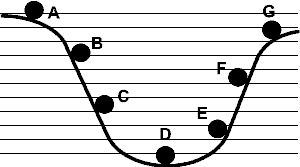
Which point has the most potential energy?
a)
G
b)
f
c)
b
d)
a
60.
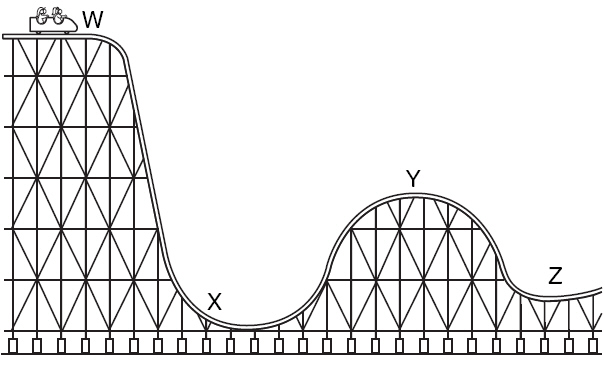
At which point is potential energy greatest?
a)
W
b)
X
c)
Y
d)
Z
61.
At which point is kinetic energy greatest?
a)
W
b)
X
c)
Y
d)
Z
62.

When a roller coaster is at the bottom of a hill it has

a)

high potential energy

b)

high kinetic energy

c)

low kinetic energy

d)

equal amounts of kinetic and potential energy

63.

You throw a ball into the air as shown in the diagram. At what point does the ball have the most potential energy?

a)

W

b)

X

c)

Y

d)

Z

64.
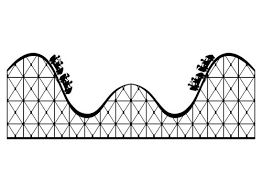
On a roller coaster, where is maximum kinetic energy?
a)
At the bottom of a big hill
b)
When going around a corner
c)
When going upside down
d)
At the top of a big hill
65.
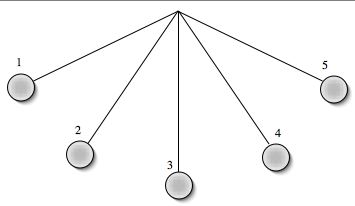
When a pendulum swings, at which point is kinetic energy highest?
a)
1
b)
2
c)
3
d)
4
66.

When a person strikes and lights a match, potential energy in the match is transformed into which types of energy?

a)

radiant and nuclear

b)

nuclear and kinetic

c)

thermal and radiant

d)

electrical and thermal

67.

A flashlight uses the chemical energy stored in a battery. This chemical energy is eventually converted into which two forms of energy?

a)

nuclear and electrical

b)

thermal and mechanical

c)

radiant and thermal

d)

mechanical and nuclear

68.

Coal contains __________ energy.

a)

chemical

b)

mechanical

c)

kinetic

d)

light

69.

__________ energy is a form of energy caused by vibrations in a solid, liquid, or gas.

a)

Light

b)

Sound

c)

Radiant

d)

Chemical

70.
what type of energy is stored in a battery?
a)
electrical
b)
chemical
c)
thermal
d)
mechanical
71.

bending of light that happens when light travels through different mediums (substances)

a)

reflection

b)

refraction

c)

diffusion

72.
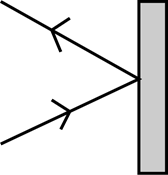
The illustration shows a light ray striking an object.
In the illustration, the light ray striking the object is-
a)
absorbed
b)
stopped
c)
reflected
d)
refracted
73.
A student placed a pencil in a cup of water.  The pencil appears broken because light-
a)
always travels in a straight line
b)
bends when it passes through water
c)
makes the water in the glass evaporate
d)
reflects the pencil on the water's surface
74.
Light is a form of 
a)
energy
b)
radiation
c)
reflection
75.

What is transferred during the movement of a wave?

a)

matter

b)

speed

c)

mass

d)

energy

76.

A seagull dives into the ocean to catch a fish. What is the energy transformation that occurs when the seagull dives to catch the fish?

a)

Potential energy to kinetic energy

b)

Kinetic energy to potential energy

c)

Thermal energy to radiant energy

d)

Chemical energy to kinetic energy