wayground logo

Free Printable Worksheets

Font size

S
M
L
XL
Worksheets

Tectonic Plate Boundaries Homework

Total questions: 46

Worksheet time: 38mins
Name
Class
Date
1.
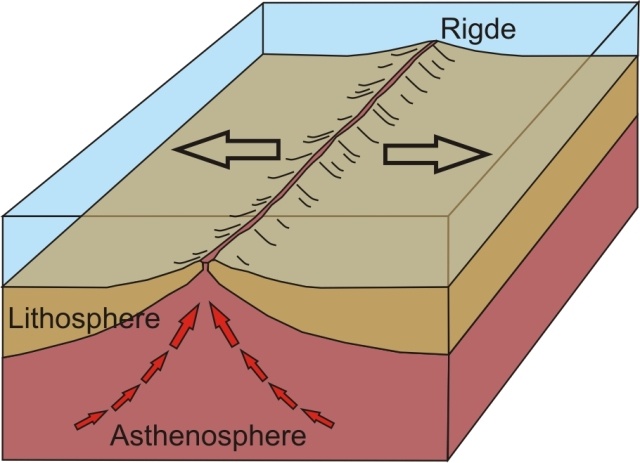
What kind of plate boundary is shown here?
a)
divergent
b)
convergent
c)
transform
d)
subducting
2.
What kind of plate boundary is shown here?
a)
divergent
b)
convergent
c)
transform
d)
submergent
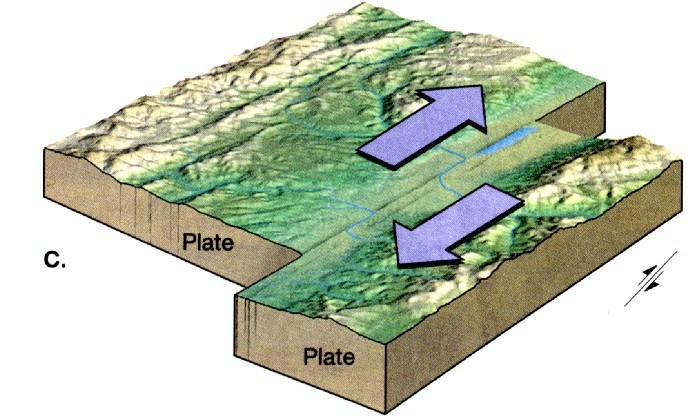
3.
What kind of plate boundary is shown here?
a)
divergent
b)
convergent
c)
transform
d)
strike slip
4.
What geologic feature/event you be most likely to find at a transform boundary?
a)
Earthquakes
b)
Volcanoes
c)
Mountains
d)
Rift Valleys
5.
What geologic feature/event would you most likely to find at a divergent boundary between two pieces of oceanic crust?
a)
Rift Valley
b)
Mid-Ocean Ridge
c)
Island Arc
d)
Flat land
6.
What geologic feature/event would you most likely to find at a divergent boundary between two pieces of continental crust?
a)
Mid-Ocean Ridge
b)
Mountain
c)
Rift Valley
d)
Island Arc
7.
What geologic feature/event would you most likely to find at a convergent boundary between two pieces of continental crust?
a)
Volcano
b)
Mountain
c)
Rift
d)
Island Arc
8.
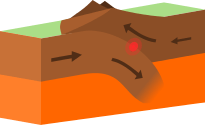
A subduction zone is formed...
a)
when one tectonic plate sinks below another
b)
at every type of convergent plate boundary
c)
at every type of divergent plate boundary
d)
at transform boundaries
9.
Name the boundary
a)
convergent boundary
b)
divergent boundary
c)
transform boundary
d)
sergent boundary
10.
Name the boundary
a)
convergent boundary
b)
divergent boundary
c)
transform boundary
d)
sergent boundary
11.
In which type of boundary do the plates move away from each other?
a)
convergent
b)
normal
c)
divergent
d)
transform
12.
The area where two or more plates meet is called a __________________.
a)
fault
b)
plate boundary
c)
plate edge
d)
ring of fire
13.
Plates slide past one another at ____________ boundaries.
a)
divergent
b)
convergent
c)
transform
d)
submergent
14.
Plates move towards one another at ______________ boundaries.
a)
divergent
b)
convergent
c)
transform
d)
detergent
15.

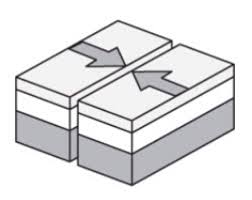
Which model is depicting a convergent boundary between two plates?

a)

top

b)

middle

c)

bottom

16.

Which model is depicting a transform boundary between two plates?

a)

top

b)

middle

c)

bottom

17.

Which model is depicting a divergent boundary between two plates?

a)

top

b)

middle

c)

bottom

18.

What type of landform occurs at a divergent boundary between two continental plates?

a)

seafloor spreading

b)

rift valley

c)

earthquake

d)

mountain range

19.

What occurs between two oceanic plates at a divergent boundary?

a)

rift valley

b)

sea floor spreading

c)

volcanic mountain range

20.
When a continental plate is pulled away from another continental plate, the area of crust that is thinned and pulled apart is called. 
a)
a trench
b)
a rift zone or rift valley
c)
ocean spreading ridge
d)
Continental crust
21.

The Great Rift Valley in Africa and the Mid-Ocean Ridge were all created by this boundary

a)

Divergent

b)

Convergent

c)

Reform

d)

Transform

22.

What is this image...

a)

Revolving boundary

b)

San Andreas (Transform)

c)

Convergent

23.

This landform can occur at a divergent plate boundary.

a)

ocean trench

b)

mid-ocean ridge

c)

tall mountains

d)

transform fault

24.
What type of plate boundary is this?
a)
Plate
b)
Divergent
c)
Convergent
d)
Transform
25.
What type of event will occur at this boundary?
a)
Earthquake
b)
Volcano Eruption
c)
Tornado
d)
Mountain Building
26.
What type of plate boundary is this?
a)
Transform
b)
Convergent
c)
Divergent
d)
Plate
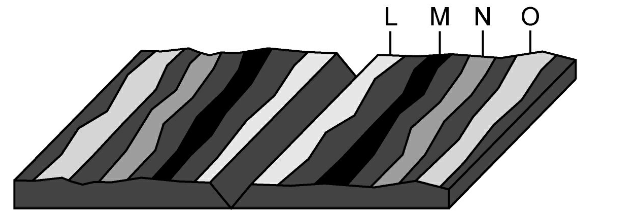
27.
Where would the oldest rock be found?
a)
L
b)
M
c)
N
d)
O
28.
Where does the heat come from that drives this convection current in the mantle? 
a)
The sun
b)
The crust
c)
the mantle
d)
the core
29.

Which two plates are causing the San Andreas Fault?

a)

African Plate

b)

Pacific Plate

c)

Eurasian Plate

d)

North American Plate

e)

Antartic Plate

30.

What force makes the plates move?

a)

Water

b)

Magma

c)

Convection Currents

d)

A machine

31.

How is a mid-ocean ridge created?

a)

When water moves the plates

b)

By sea floor spreading, when oceanic/oceanic plates move apart from each other

c)

By continental/continental plates spreading apart at a divergent boundary

d)

By rift valleys

32.

What happens to the magma that comes up at divergent boundaries?

a)

It turns green

b)

Nothing happens to the magma

c)

The magma melts

d)

The magma cools and hardens into new crust

33.

What formations happen at ocean to ocean subduction zones?

a)

Deep oceanic trenches

b)

Mountain Ranges

c)

Coastal Volcanic Mountains

d)

Both mountains and volcanoes

34.

At which boundary is crust DESTROYED (when melting in the mantle!)?

a)

Continent- continent Convergent

b)

Transform boundaries

c)

Subduction zones

d)

All convergent boundaries

35.
What are valleys between the mountain ridges?
a)
rift zones
b)
trenches
c)
abyssal plains
d)
continental slope
36.
The East African Rift Valley lies at what type of boundary?
a)
Transform
b)
Convergent
c)
Divergent
37.
The convergence of two continental plates would produce ___________.
a)
island arcs
b)
rift valleys
c)
folded mountains
d)
trenches
38.
What is the largest tectonic plate?
a)
North American
b)
Pacific
c)
Antarctic
d)
Eurasian
39.
New ocean crust is formed at ______.
a)
convergent boundaries
b)
divergent boundaries
c)
transform fault
40.
The formation of the Hawaiian Islands is associated with ____.
a)
a transform boundary
b)
hot spots
c)
convergent boundaries
d)
divergent boundaries
41.
Continental volcanic arcs are associated with what type of plate boundary?
a)
oceanic-continental convergent
b)
oceanic-oceanic convergent
c)
continental-continental convergent
d)
transform
42.
The Himalayas in South Asia are an example of what type of plate boundary?
a)
continental-oceanic convergent
b)
continental-continental convergent
c)
oceanic-oceanic convergent
d)
continental-continental divergent
43.
A divergent boundary at two oceanic plates can result in a ____.
a)
volcanic island arc
b)
continental volcanic arc
c)
earthquake
d)
ocean ridges (seafloor spreading)
44.

Which of the descriptions below is for an island arc?

a)

a curved chain of volcanic islands usually formed along converging plates where subduction takes place near a deep ocean trench.

b)

a major volcanic belt formed by the many volcanoes that rim the Pacific Ocean.

c)

Geographical regions with very high levels of volcanic activity, formed along the boundaries of Earth's plates

d)

an area where material from within the mantle rises and then melts, forming magma.

45.

Occurs when a less dense plate slides under a more dense plate

a)

tectonic plates

b)

subduction

c)

continental drift

d)

landmass

46.

What is/are formed when two oceanic plates collide? (Multiple answer)

a)

Trench

b)

Tsunami

c)

Volcanic Island Arc

d)

Mountain Ranges