
 Worksheets
Unit 1 Test Review
Total questions: 48
Worksheet time: 33mins
What does heat do when convection currents are moving?
Sinks
Rises
Stays in place

Which picture shows material that is more dense?
The picture of the left
The picture on the right
When do particles move faster?
In hot water
In cold water
Convection currents occur in...
fluids
solids
______________is created by unequal heating of the Earth's surface.
conduction
radiation
wind
river movement
Convection currents in the Earth's mantle are caused by:
Less dense hot magma moving downward
Less dense hot magma moving upward
Tectonic plate movement
More dense cooler magma moving upward
When air is heated it becomes...
More dense
Less dense
Heavier
Moist
When air moves into the upper atmosphere it becomes...
Cool and heavy
Cool and light
Warm and heavy
Warm and light
Wind is created when..
Warm air moves in to replace cool air
Dry air moves in to replace moist air
Cool air moves in to replace warm air
Both air masses are the same temperature
Air sinking down toward the Earth's surface causes a...
High Pressure area
Low Pressure area
Air rising up above the Earth's surface causes a...
High pressure area
Low pressure area
Winds flow from...
High pressure to low pressure
Low pressure to high pressure

Is this image a Land breeze or a Sea breeze?
Land breeze
Sea breeze

Which letter represents High pressure?
A
B

What does the blue line represent in the Thermohaline circulation?
Warm salty water
Warm water
Cold water
Cold salty water
Which pictures shows the correct "Global Conveyor Belt"?


________ and _______ affect the ocean's density and cause the Global Conveyor Belt to travel
gravity and the Coriolis Effect
temperature and salinity
wind and climate
temperature and the Coriolis Effect
Most of the water vapor in the atmosphere comes from evaporation of water from oceans. Most of this evaporation occurs where there is the greatest solar radiation, which is -
along the coast of Europe.
around islands in the Pacific.
near the Equator.
at both of the poles.

The circulation of warm and cold matter is called...
Convection
Wind
Evaporates
Rises
Which of the following factors contributes most to formation of hurricanes?
gravitational pull of the moon and sun
toxic chemicals in the atmosphere by industry
Glaciers melting in polar regions
solar radiation heating the oceans by equator
Where does the Storm Start?
Over Cold Water
Over Antarctica
Over Warm Water
Overseas
Hurricanes are the result of heat energy and water evaporated from which of the following.
natural springs in Texas
reservoirs heated by industry
oceans in tropics
large lake in Africa
Why does a hurricane slow down when it hits land?
The wind stops it
It stops raining
It loses its energy source
The air is different

Which air mass is normally associated with the formation of hurricanes?
maritime tropical
maritime polar
continental tropical
continental polar

A cold front is approaching Minneapolis. What will happen to the air temperature?
stay the same
increase
decrease





Near which two cities are the low pressure systems located?
Seattle & San Francisco
Chicago & Seattle
Dallas & Houston
Chicago & Nashville

Near which city is the high pressure system located?
Seattle
Minneapolis
Dallas
Chicago

Which two cities are most likely to experience clear, dry weather?
Seattle & San Francisco
Chicago & Minneapolis
Chicago & Nashville
Dallas & Houston
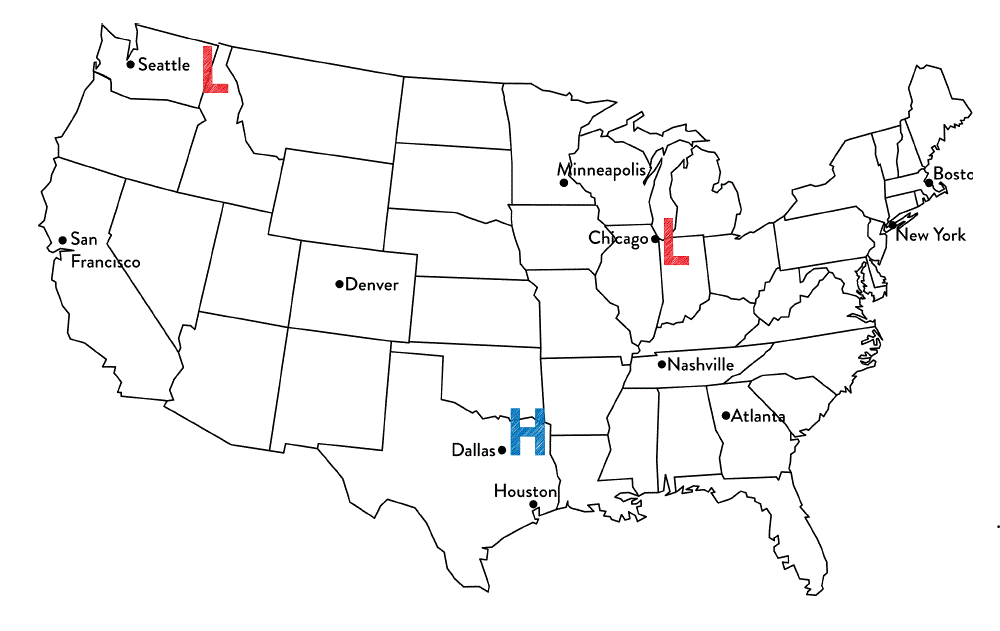
Tim said that Chicago is most likely to experience rainy weather. Jennifer thinks that Dallas is most likely to experience rainy weather.
Which student is correct?
Tim because Chicago is the closest to a low pressure system and they produce precipitation.
Jennifer because high pressure systems produce precipitation
Both students are correct because all systems produce precipitation
Neither of the students are correct because the cities are not close enough to the system.

What type of weather is Minneapolis most likely experiencing?
light/drizzly rain
severe thunderstorms
sunny skies
cloudy skies, light precipitation

What type of weather is Denver most likely experiencing? Notice the type of front that has just passed through.
High humidity, cooler temperatures
Low humidity, cooler temperatures
Rainy, cold weather
Rainy, humid weather

Which location is most likely experiencing warmer temperatures and higher humidity?
Location A
Location B
Location C
Location D

Why does city "B" have clear skies?
It is in North America
There is not a front moving through city "B"
Clouds do not form in the West
It is located near a high pressure system


In which direction is the cold front moving?
South
North
West
East

Should the "?" be replaced with an "H" or an "L"?
"L" because the fronts near this location do not create precipitation and low pressure systems bring precipitation.
"L" because the fronts near the location produce precipitation and low pressure systems bring precipitation
"H" because the fronts near this location create precipitation and high pressure systems bring precipitation.
"H" because the fronts near this location create precipitation and high pressure systems do not bring precipitation.

What is the temperature like in Dallas?
60-70 Degrees
70-80 Degrees
80-90 Degrees
90+ Degrees

What weather conditions are present in Dallas, Texas?
storms, precipitation, cooler temperatures
high humidity, rising temperatures
Clear skies, fair weather

